

Active time: ~45 minutes | Total time: ~1 hour 5 minutes | Serves: 6 (about 12 blintzes) | Difficulty: Moderate
Quick Overview

- A 50/50 blend of whole wheat and all-purpose flour replaces white flour in the batter — more fiber, same crepe texture
- The filling uses 2% low-fat cottage cheese instead of full-fat farmer’s cheese — protein stays high, saturated fat drops sharply
- Sugar is cut significantly in both the batter and the filling, with vanilla carrying more of the sweetness
- The blintzes are baked instead of pan-fried in butter — most of the added fat disappears
- Greek yogurt and fresh fruit replace sour cream and sugary preserves at the table
What This Version Changes — and What It Keeps
Traditional blintzes are already a fairly modest dish by dessert standards: nothing is deep-fried, and the cheese filling carries real protein. The technique stays exactly the same here — thin crepes cooked one at a time, filled, and folded into a tight parcel. Anyone who has made the traditional version already knows how to make this one.
What adds up quietly in the traditional recipe is where the fat and sugar concentrate: full-fat cheese in the filling, butter in both the batter and the frying pan, and sugar added twice. This version addresses each point individually rather than making one dramatic change — a lower-fat cheese, less sugar, oil in place of butter, and baking instead of frying. None of these swaps touch the folding technique or the basic proportions of the dish.
Why These Swaps Work
Half the flour in the batter is whole wheat instead of all-purpose. Milling strips away the bran and germ, which carry most of the wheat kernel’s fiber, B vitamins, and vitamin E; Harvard T.H. Chan School of Public Health puts the loss at more than half the B vitamins, 90 percent of the vitamin E, and virtually all the fiber.1 The blend stays at 50/50 rather than going fully whole wheat because all-whole-wheat crepes turn noticeably denser and tear more easily when rolled.
The filling swaps full-fat farmer’s cheese for 2% low-fat cottage cheese. Cleveland Clinic’s nutrition team steers people toward low-fat or full-fat cottage cheese and away from nonfat, since nonfat “contains less protein and won’t be as satisfying” — full-fat carries about 1.5 grams more saturated fat than 2% per serving.2 A 100-gram serving of 2% provides 84 calories, 2.3 grams of fat, and 11 grams of protein, keeping the filling’s protein close to the traditional version while cutting a meaningful share of saturated fat.2
Sugar drops by about half in the filling and by more in the batter, where it played a smaller role to begin with. Harvard’s Nutrition Source gives specific guidance for baking — cut added sugar by a quarter to a third cup per recipe, or replace half of it with mashed fruit — and vanilla picks up more of the sweetness once less sugar is competing for attention.3 Topping the finished blintzes with fresh fruit instead of a sugary preserve keeps the dish’s added sugar modest overall.
Butter disappears from two places: the batter, where a small amount of canola oil takes its place, and the pan, since the blintzes are baked rather than fried. Butter is about 60 percent saturated fat by weight versus 7 percent for canola oil, and Harvard’s Nutrition Source lists butter and other dairy fats among the leading sources of saturated fat in the American diet — a nutrient the Dietary Guidelines for Americans caps at 10 percent of daily calories, and the American Heart Association caps even lower, at 7 percent.4
Sour cream is replaced with plain Greek yogurt at the table. Cleveland Clinic recommends exactly this swap for cutting saturated fat, noting that Greek yogurt “has about twice as much protein as traditional yogurt” and works well in place of sour cream.5 Full-fat or 2% holds up best in texture; nonfat versions taste noticeably thinner alongside a warm blintz.
Healthy Blintzes Recipe
Recipe developed independently by Heritage Healthy Kitchen, drawing on traditional Ashkenazi Jewish techniques. Sources for further reading are listed at the end of this article.
Ingredients
For the crepes (makes about 12)
- ½ cup (60g) whole wheat pastry flour
- ½ cup (65g) all-purpose flour
- 2 large eggs
- 1¼ cups (300ml) low-fat (1%) milk
- 1 tablespoon canola or sunflower oil, plus more for the pan
- 1 teaspoon granulated sugar
- ¼ teaspoon fine salt

For the filling
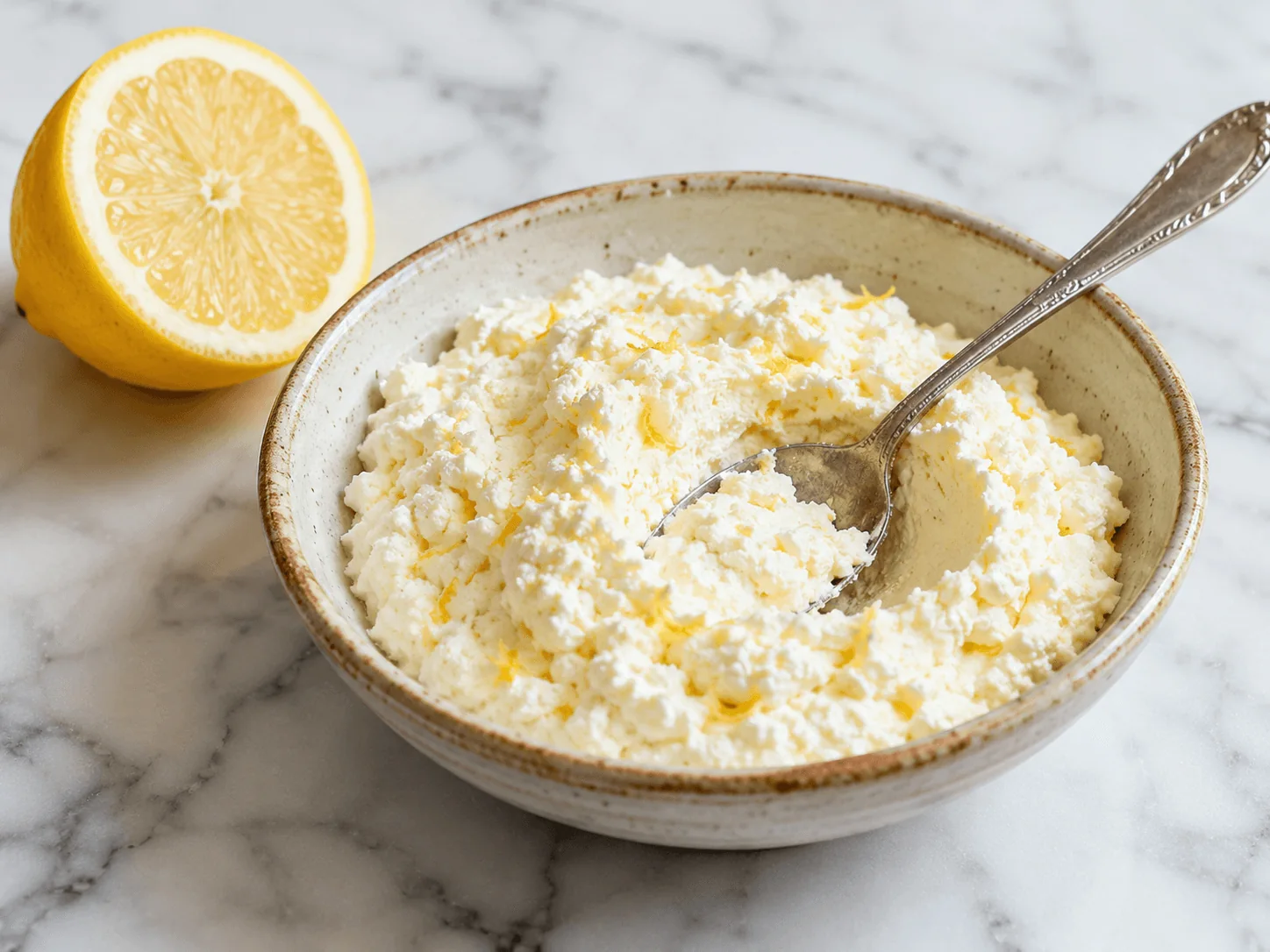
- 2 cups (450g) low-fat (2%) cottage cheese, well-drained
- 1 large egg yolk
- 1½ tablespoons granulated sugar
- 1 teaspoon vanilla extract
- ¼ teaspoon fine salt
- Zest of ½ lemon (optional)
For baking and serving
- Canola or sunflower oil spray, or 1 tablespoon oil for brushing
- Plain Greek yogurt (2% or full-fat), for serving
- Fresh berries or other fresh fruit, for serving
Instructions

- Make the batter. Whisk both flours, eggs, milk, oil, sugar, and salt together until smooth. Let the batter rest for 15–20 minutes; whole wheat flour needs slightly longer than all-purpose alone to fully hydrate.
- Cook the crepes. Heat a lightly oiled 8-inch nonstick skillet over medium heat. Pour in a thin layer of batter, swirling to coat the pan, and cook for 45–60 seconds until the surface looks matte and the edges lift. Flip and cook the second side for about 15 seconds, then stack the finished crepes between sheets of parchment paper.
- Make the filling. Stir together the cottage cheese, egg yolk, sugar, vanilla, salt, and lemon zest until evenly combined. If the mixture looks watery, drain it through a fine sieve for a few minutes first.
- Fill and fold. Lay each crepe browned-side up. Place about 2–3 tablespoons of filling near one edge, fold the sides in over the filling, then roll into a tight rectangular parcel.
- Bake. Preheat the oven to 400°F (200°C). Arrange the filled blintzes seam-side down on a lightly oiled baking sheet, brush or spray the tops lightly with oil, and bake for 15–18 minutes, until golden and heated through.
- Serve. Serve warm, topped with Greek yogurt and fresh berries.
Kitchen Tips
Whole wheat flour absorbs more liquid than all-purpose. If the batter looks thick after resting, thin it with a tablespoon of milk at a time until it coats the pan in a smooth, even layer.
Draining the 2% cottage cheese matters more here than it would with a firmer, drier cheese. Even a light press through a sieve for a few minutes keeps the filling from turning the crepe soggy once baked.
A parchment-lined, lightly oiled baking sheet gives the bottoms of the blintzes some color without needing a heavy hand with the oil brush on top.
Nutritional Comparison
Per serving (2 blintzes, one of 6 servings)

| Nutrient | Traditional Blintzes | This Version |
|---|---|---|
| Calories | ~310–350 kcal | ~230–270 kcal |
| Protein | ~14–16g | ~14–16g |
| Total fat | ~17–19g | ~9–11g |
| Saturated fat | ~8–11g | ~1.5–2.5g |
| Carbohydrates | ~27–31g | ~23–27g |
| Dietary fiber | <1g | ~1–2g |
| Sodium | ~470–560mg | ~440–520mg |
All values are estimates based on standard ingredient databases and will vary depending on specific products, brands, and portion sizes. Choosing a low-sodium cottage cheese lowers the sodium figure further in either version.
Storage and Reheating
Keeps in the refrigerator for up to 3 days in a sealed container. Reheat in a 350°F (175°C) oven for about 10 minutes, or in a lightly oiled skillet until warmed through. A microwave works in a pinch but leaves the crepe soft rather than lightly crisp.
The filled, unbaked blintzes freeze well for up to 2 months. Freeze in a single layer on a baking sheet before transferring to a bag, then bake directly from frozen, adding about 8–10 minutes to the baking time.
Healthy Blintzes

Ingredients
For the crepes (makes about 12)
- ½ cup (60g) whole wheat pastry flour
- ½ cup (65g) all-purpose flour
- 2 large eggs
- 1¼ cups (300ml) low-fat (1%) milk
- 1 tablespoon canola or sunflower oil, plus more for the pan
- 1 teaspoon granulated sugar
- ¼ teaspoon fine salt
For the filling
- 2 cups (450g) low-fat (2%) cottage cheese, well-drained
- 1 large egg yolk
- 1½ tablespoons granulated sugar
- 1 teaspoon vanilla extract
- ¼ teaspoon fine salt
- Zest of ½ lemon (optional)
For baking and serving
- Canola or sunflower oil spray, or 1 tablespoon oil for brushing
- Plain Greek yogurt (2% or full-fat), for serving
- Fresh berries or other fresh fruit, for serving
Instructions
- Make the batter. Whisk both flours, eggs, milk, oil, sugar, and salt together until smooth. Let the batter rest for 15–20 minutes; whole wheat flour needs slightly longer than all-purpose alone to fully hydrate.
- Cook the crepes. Heat a lightly oiled 8-inch nonstick skillet over medium heat. Pour in a thin layer of batter, swirling to coat the pan, and cook for 45–60 seconds until the surface looks matte and the edges lift. Flip and cook the second side for about 15 seconds, then stack the finished crepes between sheets of parchment paper.
- Make the filling. Stir together the cottage cheese, egg yolk, sugar, vanilla, salt, and lemon zest until evenly combined. If the mixture looks watery, drain it through a fine sieve for a few minutes first.
- Fill and fold. Lay each crepe browned-side up. Place about 2–3 tablespoons of filling near one edge, fold the sides in over the filling, then roll into a tight rectangular parcel.
- Bake. Preheat the oven to 400°F (200°C). Arrange the filled blintzes seam-side down on a lightly oiled baking sheet, brush or spray the tops lightly with oil, and bake for 15–18 minutes, until golden and heated through.
- Serve. Serve warm, topped with Greek yogurt and fresh berries.
Frequently Asked Questions
Does 2% cottage cheese work as well as farmer’s cheese in this filling?
Reasonably well, once it’s well-drained. Cleveland Clinic notes that 2% cottage cheese provides 11 grams of protein per 100-gram serving alongside just 2.3 grams of fat, which keeps the filling satisfying without the saturated fat load of full-fat farmer’s cheese.2 The texture is slightly looser than farmer’s cheese, so draining matters more here.
Can I use 100% whole wheat flour instead of the 50/50 blend?
It’s possible, but expect a denser crepe that tears more easily when rolled, since whole wheat lacks the gluten structure all-purpose flour provides. If trying it, let the batter rest longer than 20 minutes and handle the crepes gently — the extra resting time helps the flour hydrate fully and makes the crepes a little less fragile.
Why bake instead of pan-fry?
Baking removes most of the added fat that pan-frying in butter contributes, and it also means not having to babysit several batches in a skillet. The tradeoff is texture: baking browns the blintzes evenly but doesn’t produce quite the same deep, crisp edge that a few minutes in butter does. A light brushing of oil before baking closes most of that gap.
Is this version noticeably less sweet?
A little, though vanilla and the natural tang of the cottage cheese carry more of the flavor once less sugar is added. Topping with fresh fruit instead of a sugary preserve makes up more of the difference than most people expect.
Will Greek yogurt curdle on a hot blintz?
It can, if it sits directly on food that’s still very hot. Adding it just before serving, rather than while the blintzes are still steaming, avoids this. Full-fat or 2% Greek yogurt holds up better than nonfat, which separates more easily.
Does this version lower the sodium significantly?
Not by much. In both versions, most of the sodium comes from the cottage or farmer’s cheese itself rather than from added salt.2 Choosing a low-sodium cottage cheese, which most supermarkets carry, is the more effective way to bring the sodium figure down in either version.
Is this version suitable for someone managing blood sugar or heart health?
The combination of more fiber, less added sugar, and a large cut to saturated fat moves the dish in a more favorable direction on paper.1,3,4 Individual needs vary by health status, medications, and overall diet, so anyone managing diabetes, prediabetes, or heart disease should check with a doctor or registered dietitian rather than relying on recipe changes alone.
The Traditional Version
For the full traditional recipe — white flour crepes, full-fat farmer’s cheese, butter throughout, and the dish’s Ashkenazi Jewish history and Shavuot traditions — the Traditional Blintzes article on this site covers the method and cultural background in detail.
Further Reading & Sources
The following sources were consulted for the nutritional information and health context in this article. Heritage Healthy Kitchen’s recipe was developed independently; these links are provided for readers who want to explore further.
- “Whole Grains.” The Nutrition Source, Harvard T.H. Chan School of Public Health. nutritionsource.hsph.harvard.edu/what-should-you-eat/whole-grains — nutrients lost when wheat is refined into white flour; fiber’s role in the diet.
- “7 Reasons Why Cottage Cheese Is Good for You.” Cleveland Clinic Health Essentials. health.clevelandclinic.org/cottage-cheese-benefits — nutritional profile of 2% cottage cheese; dietitian guidance on choosing 2% or full-fat over nonfat; sodium content and guidance on choosing low-sodium varieties.
- “Added Sugar.” The Nutrition Source, Harvard T.H. Chan School of Public Health. nutritionsource.hsph.harvard.edu/carbohydrates/added-sugar-in-the-diet — guidance on reducing added sugar in baking; daily added-sugar limits from the Dietary Guidelines for Americans and the American Heart Association.
- “Types of Fat.” The Nutrition Source, Harvard T.H. Chan School of Public Health. nutritionsource.hsph.harvard.edu/what-should-you-eat/fats-and-cholesterol/types-of-fat — saturated fat content of butter versus canola oil; recommended daily saturated fat limits; leading sources of saturated fat in the U.S. diet.
- “Is Yogurt Good for You?” Cleveland Clinic Health Essentials. health.clevelandclinic.org/is-yogurt-good-for-you — Greek yogurt’s protein content relative to regular yogurt; recommendation to use it in place of sour cream.
Disclaimer
The information in this article is provided for educational and informational purposes only. Heritage Healthy Kitchen makes no representations or warranties regarding the accuracy or completeness of any content on this site. Nutritional values are estimates only and will vary depending on the specific ingredients, brands, and measurements used. This content is not intended as dietary, medical, or professional nutritional advice. Always consult a qualified healthcare provider regarding any dietary needs or health conditions. Heritage Healthy Kitchen is not responsible for any outcomes resulting from the use of recipes or information published on this site.
You Might Also Like
More heritage recipes from our kitchen



Leave a Reply