
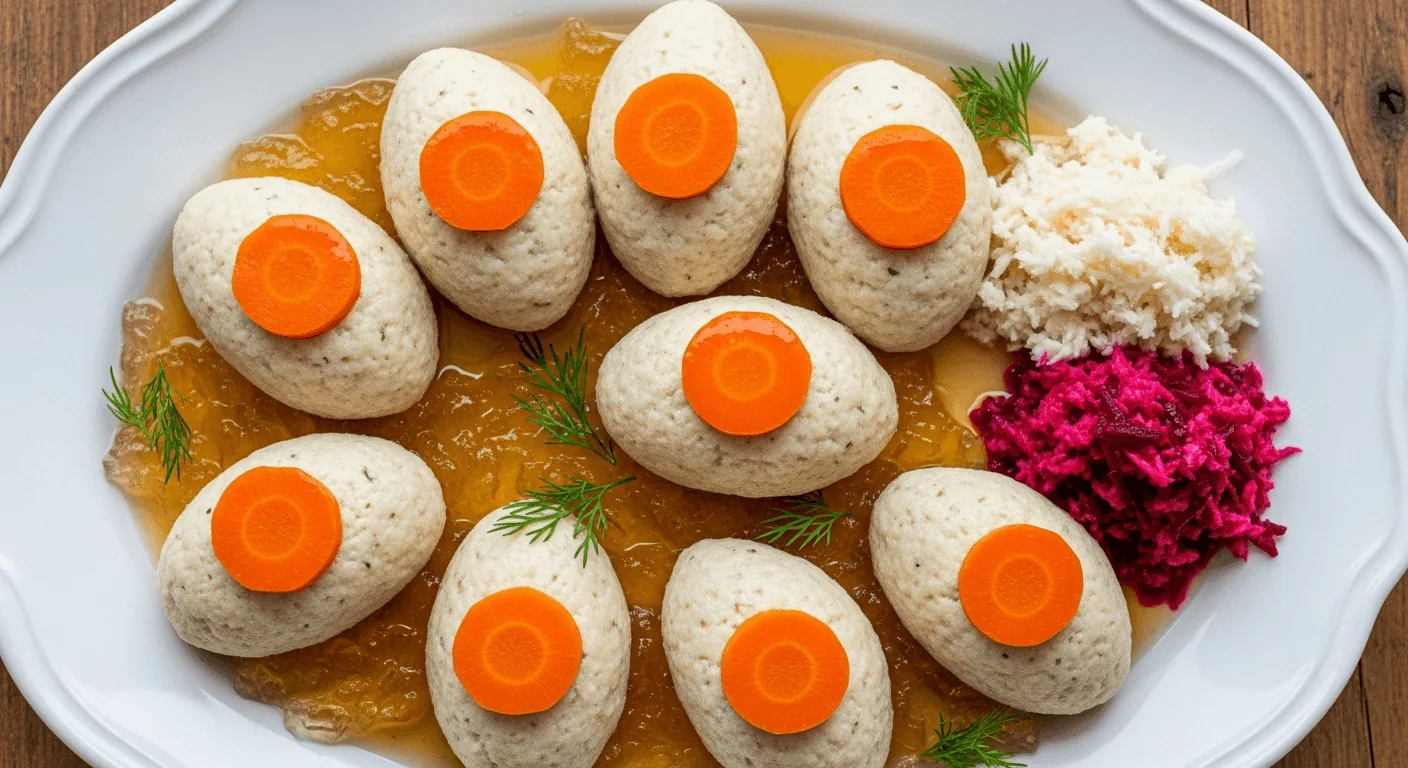
Active time: ~1 hour | Total time: ~4 hours (including chilling) | Serves: 8 | Difficulty: Moderate
Quick Overview
- Simmer fish bones, heads, onion, and carrot into a light broth
- Grind whitefish and pike fillets, then mix with egg, matzo meal, onion, and seasoning
- Chill the fish mixture until firm enough to shape
- Form the mixture into ovals and poach them gently in the broth
- Chill the finished fish in its own broth until the liquid sets into a light gel
- Serve cold with a slice of the poached carrot and horseradish (chrain)
What Gefilte Fish Is
Gefilte fish is ground freshwater fish, usually carp, pike, and whitefish, bound with egg and matzo meal and formed into ovals, then poached in a light fish broth.1 It is served cold, garnished with a slice of cooked carrot, and eaten alongside horseradish known as chrain.1 The name comes from Yiddish, where gefilte means “stuffed.”1
Recipes use these three fish alone or in combination, and which version a family made often came down to means. Carp, cheap and easy to raise in freshwater ponds, was historically the most common choice and became closely tied to poorer households, who often used it alone.9,10 Blending in pike or whitefish, as this recipe does, gives a milder result.
That name is a holdover from an older method: removing the flesh from a whole fish, grinding it with seasonings, and stuffing the mixture back into the fish’s own skin before cooking.1 By the 16th century, patties and oval quenelles had become the more common form for everyday cooking, but the stuffed-skin method never fully disappeared. Oral history interviews document the stuffed-skin method still in use in Eastern Europe well into the 20th century, and some home cooks still prepare it this way.1,11
It is one of the most recognizable dishes in Ashkenazi Jewish cooking, served on Shabbat and holidays including Passover and Rosh Hashanah.1,3 In Poland, the same preparation is known outside Jewish kitchens too, as karp po żydowsku, “carp Jewish-style.”1
Where Gefilte Fish Came From
Gefilte fish did not start out as a Jewish dish. The earliest known reference to a stuffed-fish preparation, gefuelten hechden, or stuffed pike, appears in Daz Buoch von Guoter Spise, a Middle High German cookbook dated to roughly 1350 CE, where poached and mashed pike was flavored with herbs, packed into its skin, and roasted.1 It was popular among German Catholics during Lent, when meat was forbidden. By the Middle Ages it had migrated into German and Eastern European Jewish kitchens, and as those communities spread into Poland, Ukraine, Lithuania, and Russia, it took on regional identities, with different communities favoring whatever fish their local rivers and lakes offered.1,7
The Gefilte Fish Line
Ancestry decides the seasoning. Sweet gefilte fish traces to Poland and Galicia (roughly southeastern Poland and western Ukraine), while Litvak communities in Lithuania and Belarus kept theirs savory and peppered.1,3
The divide traces to an industrial shift: the first sugar beet factory in the region opened at the turn of the 19th century in southern Poland, and the sugar industry that followed, with heavy Jewish involvement, spread into dishes that had been savory, gefilte fish among them.1,3 Litvak communities further north, without the same access to cheap sugar, kept to salt and pepper.
In the mid-1960s, Yiddish linguist Marvin Herzog was mapping the boundary between two major Yiddish dialects, central Polish/Galician versus northern Lithuanian, when he noticed his dialect map lined up almost exactly with the sweet-versus-savory divide.1,3,8 The line matched no political or geographic border. It was, and still is, called the Gefilte Fish Line.3
Sweet gefilte fish has grown rarer in many communities over the past century, while a peppery style became standard specifically in American Jewish cooking.3 Families with roots in Poland and Galicia, wherever they settled, often still keep the sweeter version alive at home.
Fish, Shabbat, and the Question of Bones
Fish has held a place at the Jewish Sabbath table since the Talmudic period, well before gefilte fish existed.4 Ancient sages associated fish with fertility, and by some traditions the Hebrew word for fish, dag, corresponds numerically to seven, the day of the Sabbath.4
Gefilte fish’s popularity is usually explained as a solution to poverty and Jewish law at once. Grinding and stretching a modest amount of fish let a family feed more people,4 and a boneless patty sidestepped a Shabbat restriction against separating bones from flesh, forbidden “sorting” work known as borer.1,2 Because Shabbat also forbids cooking, a dish made ahead and served cold was doubly convenient.1
That explanation is widely repeated, but not every scholar accepts it. Historian Haym Soloveitchik notes that gefilte fish is a relatively recent invention, while Jews had already eaten fish on Shabbat for roughly fifteen centuries beforehand without recorded controversy, and calls the borer explanation a popular after-the-fact story rather than a documented cause.2 Heritage Healthy Kitchen presents both views, since neither is fully settled.
From the Shtetl to the Jar: One Community’s Path
Ashkenazi communities that emigrated carried their recipes with them, and each version kept evolving on its own terms. In the United Kingdom, gefilte fish is commonly fried rather than poached.1 One well-documented path: fresh carp bought early in the week and kept alive until preparation time, a ritual around Shabbat and Passover in some United States immigrant communities, including on New York’s Lower East Side.7
The mid-20th century brought a bigger shift: a purpose-built American kosher food industry. Advertising figures Joseph Jacobs and Joshua C. Epstein persuaded manufacturers including H.J. Heinz and Maxwell House that kosher certification and Yiddish-language advertising could reach a real market, and kosher products grew roughly tenfold between 1945 and the late 1950s.4 Gefilte fish became one of that industry’s signature products.4
Sidney Leibner, son of a fish store owner, launched one of the first ready-made brands, Mother’s, shortly before the Second World War; Manischewitz, Mrs. Adler’s, and Rokeach followed.1 A 1963 patent held by Monroe Nash and Erich G. Freudenstein for a stable jellied broth made mass-market glass-jar distribution possible.1
By the 1950s, gefilte fish was enough of a fixture in American Jewish life to be served at a 1954 New York celebration marking 300 years of Jewish settlement in America, with President Dwight Eisenhower among the guests.4 It has stayed a cultural touchstone since: jarred gefilte fish today runs about 220 to 290 milligrams of sodium per serving, and low-sodium, sugar-free versions are sold specifically to address that.1
On the Holiday Table
Gefilte means stuffed in Yiddish, which is also how the dish ends up on the Sukkot table. Filled foods are eaten right through that festival, stuffed cabbage and kreplach among them, as a nod to a full harvest.¹²
Traditional Recipe
This recipe was developed independently by Heritage Healthy Kitchen; the sources cited throughout are for further reading on the dish’s history and background, not the basis of the recipe itself.
Ingredients
For the broth:
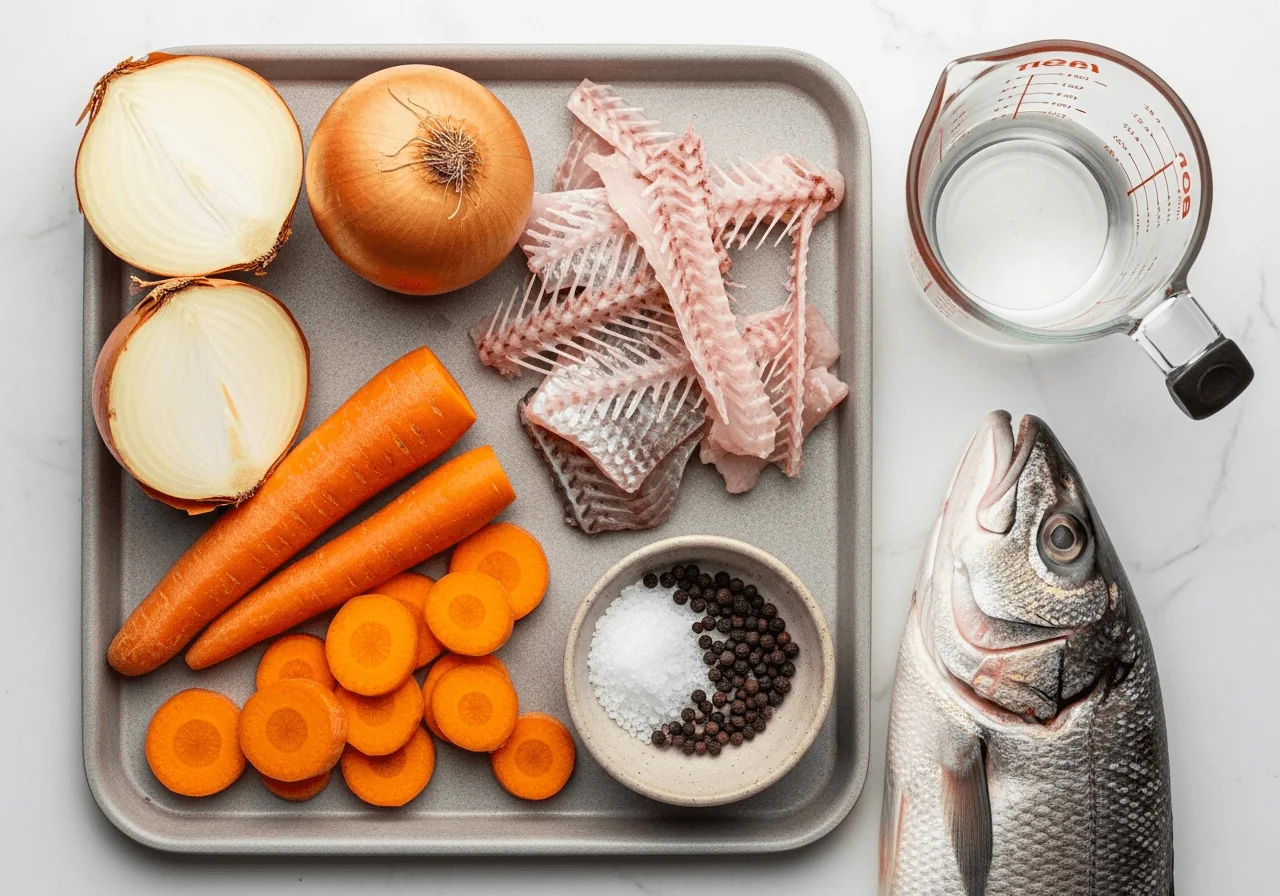
- Bones, skin, and heads from the fish below (ask your fishmonger to reserve these when filleting)
- 2 medium onions, quartered
- 3 medium carrots, peeled and cut into thick rounds
- 8 cups water
- 1 1/2 teaspoons salt, plus more to taste
- 1/2 teaspoon whole black peppercorns
For the fish:
- 1 1/2 lbs skinless whitefish fillets
- 1/2 lb skinless pike fillets (carp may be substituted for either)
- 1 medium onion, very finely minced or grated
- 2 large eggs
- 1/3 cup matzo meal
- 1/4 cup cold water
- 1 1/2 teaspoons salt
- 1/2 teaspoon ground white or black pepper
- 1 to 2 tablespoons sugar (for a Galitzianer-style sweeter version), or an additional 1/2 teaspoon black pepper (for a Litvak-style peppery version)
Instructions

Step 1: Start the broth
Combine the reserved fish bones, skin, and heads with the onions, carrots, water, salt, and peppercorns in a large pot. Bring to a gentle simmer over medium heat, then reduce to low.
Step 2: Grind the fish
While the broth simmers, grind the whitefish and pike fillets in a food processor or meat grinder until finely textured but not pureed to a paste. Transfer to a large bowl.
Step 3: Mix the fish mixture
Add the minced onion, eggs, matzo meal, cold water, salt, pepper, and either the sugar or the extra pepper to the ground fish. Mix by hand until fully combined and slightly sticky.
Step 4: Chill and shape
Cover the mixture and refrigerate for at least 30 minutes, which makes it far easier to shape. With wet hands, form the chilled mixture into about 16 oval patties, each roughly the size of a small egg.
Step 5: Poach
Remove the carrot rounds from the broth and set aside. Gently lower the fish ovals into the simmering broth, cover, and poach at a bare simmer for 1 to 1 1/2 hours, without letting the liquid boil hard.
Step 6: Cool and chill
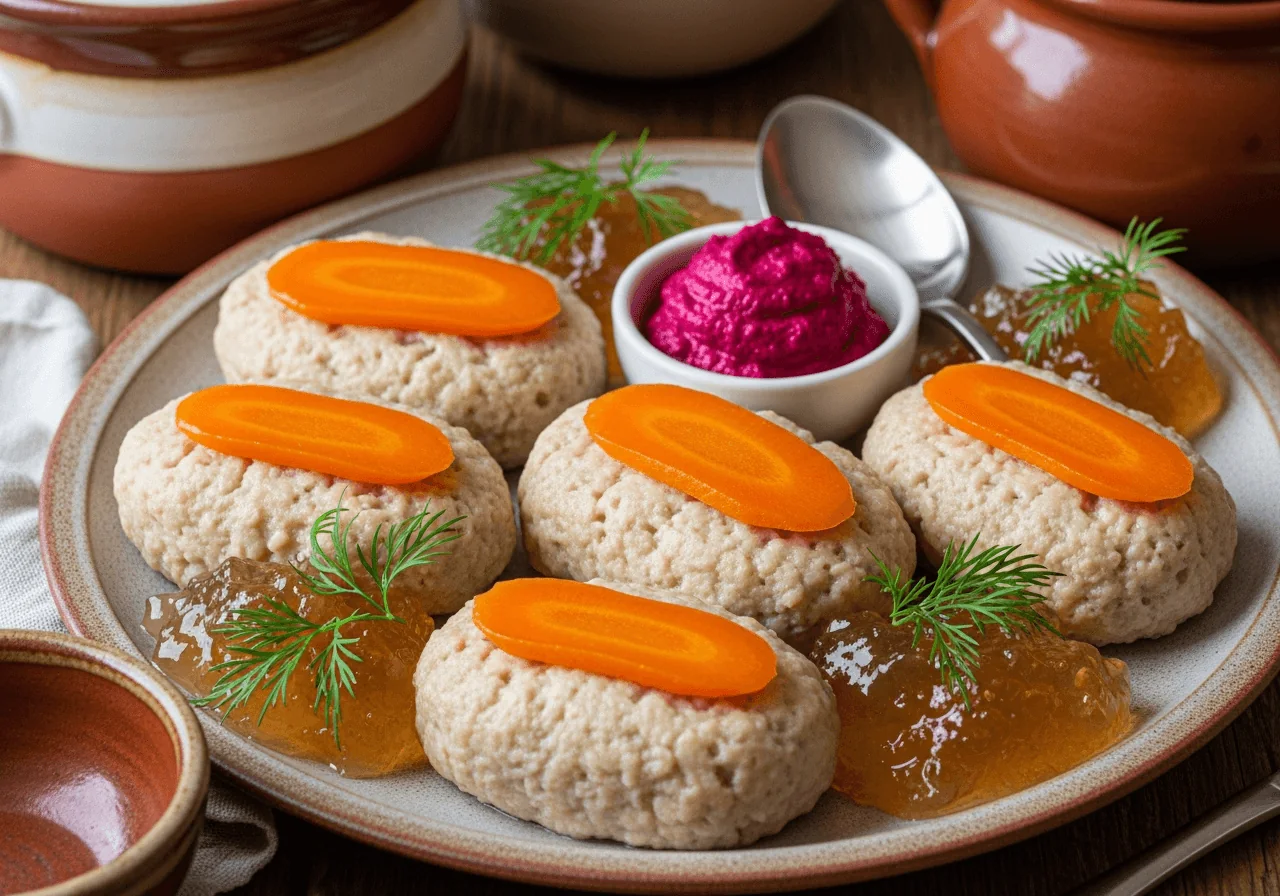
Carefully transfer the cooked fish to a shallow dish, then strain the broth over it. Top each piece with a reserved carrot round, cover, and refrigerate for at least 3 hours, or until the broth sets into a light gel.
Step 7: Serve
Serve the gefilte fish cold, straight from the refrigerator, 2 ovals per person, with a spoonful of the jellied broth and a generous amount of chrain on the side.
Kitchen Tips
Using carp alone works fine if the budget allows only one fish; expect a firmer, more assertive result than the blend below.
Ask the fishmonger to fillet and grind the fish, and to set aside the bones, skin, and head. Those trimmings give the poaching broth its body and characteristic light gel.
Keep the broth at a bare simmer once the fish ovals go in. A hard boil can break the ovals apart and cloud the broth.
Chilling the fish mixture before shaping isn’t optional if a clean oval is the goal. A cold, rested mixture is far less sticky than one straight from grinding.
Don’t skip the chrain. The sharp bite of prepared horseradish, plain or with beets, is the traditional counterpoint to gefilte fish’s mild flavor.
Nutritional Information
The figures below cover a homemade, moderately salted savory batch, not a saltier commercial jarred version.
Per serving (2 fish ovals with a small spoonful of jellied broth, 1 of 8 servings)
- Calories: approximately 160–190 kcal
- Protein: ~20–24g
- Total fat: ~5–7g
- Carbohydrates: ~4–6g (higher for the sweetened Galitzianer-style version)
- Sodium: ~450–600mg (varies considerably with added salt and how much broth is served)
Fish is a source of lean protein and, depending on species, omega-3 fatty acids, linked by Harvard T.H. Chan School of Public Health to lower rates of death from heart disease when eaten regularly.5 Whitefish and pike are leaner than the fattier ocean species that research focuses on, so the omega-3 contribution here is modest.
For a lighter version with about a third less sodium and a real boost of omega-3s, see the Lighter Version recipe card below: it cuts the salt in the broth and fish mixture, swaps half the whitefish for salmon, adds extra onion, black pepper, and lemon to the broth to make up the flavor difference, and reduces or omits the added sugar. The cut in sodium helps toward the American Heart Association’s daily target of 2,300 milligrams, ideally 1,500.6 The omega-3 boost from salmon builds on the benefits discussed above.5
Nutritional values are estimates based on standard ingredient databases. They will vary depending on the specific fish used, the amount of added salt and sugar, and portion size.
Storage and Reheating
Store gefilte fish in an airtight container, covered in its own broth, in the refrigerator for up to 3 to 4 days; staying submerged keeps it from drying out.
It also freezes well for up to 2 to 3 months, ideally packed in some broth. Thaw overnight in the refrigerator before serving; since it’s eaten cold, reheating isn’t necessary.
Traditional Gefilte Fish

Ingredients
For the broth
- Bones, skin, and heads from the fish below (ask your fishmonger to reserve these when filleting)
- 2 medium onions, quartered
- 3 medium carrots, peeled and cut into thick rounds
- 8 cups water
- 1 1/2 teaspoons salt, plus more to taste
- 1/2 teaspoon whole black peppercorns
For the fish
- 1 1/2 lbs skinless whitefish fillets
- 1/2 lb skinless pike fillets (carp may be substituted for either)
- 1 medium onion, very finely minced or grated
- 2 large eggs
- 1/3 cup matzo meal
- 1/4 cup cold water
- 1 1/2 teaspoons salt
- 1/2 teaspoon ground white or black pepper
- 1 to 2 tablespoons sugar (for a Galitzianer-style sweeter version), or an additional 1/2 teaspoon black pepper (for a Litvak-style peppery version)
Instructions
- Simmer fish bones, heads, onion, and carrot into a light broth
- Grind whitefish and pike fillets, then mix with egg, matzo meal, onion, and seasoning
- Chill the fish mixture until firm enough to shape
- Form the mixture into ovals and poach them gently in the broth
- Chill the finished fish in its own broth until the liquid sets into a light gel
- Serve cold with a slice of the poached carrot and horseradish (chrain)
Lighter Version
This dish is already poached, not fried, and modest in fat as written, so a separate healthy-adaptation article wasn’t warranted. The card below makes the specific swaps discussed in the Nutritional Information section above: less salt in the broth and fish mixture, a partial swap toward salmon for more omega-3s, extra onion, black pepper, and lemon in the broth to keep the flavor balanced, and less or no added sugar. The technique is identical to the traditional recipe — only the ingredient balance changes.
Lighter Gefilte Fish
Ingredients
For the broth
- Bones, skin, and heads from the fish below (ask your fishmonger to reserve these when filleting)
- 3 medium onions, quartered
- 3 medium carrots, peeled and cut into thick rounds
- 8 cups water
- 1 teaspoon salt, plus more to taste
- 3/4 teaspoon whole black peppercorns
- 2 tablespoons fresh lemon juice, or a few thin lemon slices
For the fish
- 3/4 lb skinless whitefish fillets
- 3/4 lb skinless salmon fillets, skin and pin bones removed
- 1/2 lb skinless pike fillets (carp may be substituted for either)
- 1 medium onion, very finely minced or grated
- 2 large eggs
- 1/3 cup matzo meal
- 1/4 cup cold water
- 1 teaspoon salt
- 1/2 teaspoon ground white or black pepper
- 1/2 to 1 tablespoon sugar (for a lighter Galitzianer-style version), or omit entirely (for a peppery Litvak-style version)
Instructions
- Combine the reserved fish bones, skin, and heads with the onions, carrots, water, salt, peppercorns, and lemon juice or slices in a large pot. Bring to a gentle simmer over medium heat, then reduce to low.
- While the broth simmers, grind the whitefish, salmon, and pike fillets in a food processor or meat grinder until finely textured but not pureed to a paste. Transfer to a large bowl.
- Add the minced onion, eggs, matzo meal, cold water, salt, pepper, and sugar if using to the ground fish. Mix by hand until fully combined and slightly sticky.
- Cover the mixture and refrigerate for at least 30 minutes, which makes it far easier to shape. With wet hands, form the chilled mixture into about 16 oval patties, each roughly the size of a small egg.
- Remove the carrot rounds from the broth and set aside. Gently lower the fish ovals into the simmering broth, cover, and poach at a bare simmer for 1 to 1 1/2 hours, without letting the liquid boil hard.
- Carefully transfer the cooked fish to a shallow dish, then strain the broth over it. Top each piece with a reserved carrot round, cover, and refrigerate for at least 3 hours, or until the broth sets into a light gel.
- Serve the gefilte fish cold, straight from the refrigerator, 2 ovals per person, with a spoonful of the jellied broth and a generous amount of chrain on the side.
Estimated nutrition per serving (2 fish ovals with a small spoonful of jellied broth, 1 of 8 servings): approximately 165–195 kcal, protein ~20–24g, total fat ~6–8g (higher, from the added salmon), carbohydrates ~2–5g (lower, from the reduced sugar), sodium ~300–400mg (about a third less than the traditional version). Nutritional values are estimates and will vary with the specific fish used and how much broth is served.
Frequently Asked Questions
What does gefilte fish actually taste like?
Mild and slightly sweet or peppery, with a soft, dense texture closer to a fish dumpling than a fillet.
Why is some gefilte fish sweet and other versions savory?
It comes down to ancestry: Polish and Galician communities gained easy access to sugar once the regional sugar beet industry took off in the early 1800s, while Lithuanian and Belarusian communities stayed peppery.1,3
Why is gefilte fish traditionally served cold?
Jewish law forbids cooking on Shabbat, so dishes served that day are prepared in advance. Gefilte fish holds up well chilled.1
Is the “avoiding fish bones” explanation for gefilte fish definitely true?
It’s the most common explanation, but not every historian accepts it. Jews ate fish on Shabbat for centuries before gefilte fish existed without it being a problem.2
Can other fish be used instead of carp, pike, or whitefish?
Yes. Many modern versions use salmon for a pale pink color, or milder fish like cod. The key is a kosher, mild-tasting fish that grinds well.
Why isn’t catfish used in gefilte fish?
Catfish lacks the fins and scales Jewish dietary law requires for a kosher fish.1
Is store-bought gefilte fish very different from homemade?
Texturally and in sodium content, yes. Commercial versions run firmer and saltier than a fresh batch, though low-sodium, sugar-free options exist.1
Can gefilte fish be made ahead of a holiday?
It’s meant to be. Making it 3 to 4 days ahead and refrigerating it in its broth is standard.
Is there a lighter or “healthy” version of this recipe on the site?
Not as a separate article, but yes within this one. Gefilte fish is already poached rather than fried and low in fat as written, so instead of a full second article, the Lighter Version recipe card below folds in the main swaps: less salt in the broth and fish mixture, a partial swap toward salmon for more omega-3s, and less or no added sugar.
Further Reading & Sources
The following sources were consulted in researching the history, technique, and cultural background of traditional gefilte fish. Heritage Healthy Kitchen’s recipe was developed independently; these links are provided for readers who want to explore further.
- “Gefilte Fish.” Wikipedia. en.wikipedia.org/wiki/Gefilte_fish — etymology, origins in medieval German cooking, the shift from stuffed fish to patties, kosher fish requirements, and the 1963 commercial jellied-broth patent.
- “Gefilte Fish: Why, Oy Why?” National Geographic. nationalgeographic.com — the borer explanation for gefilte fish’s Shabbat popularity, and historian Haym Soloveitchik’s scholarly skepticism toward that account.
- “The Gefilte Fish Line: A Sweet And Salty History Of Jewish Identity.” NPR, The Salt. npr.org — the sugar beet industry’s role in the sweet-savory divide, and linguist Marvin Herzog’s 1960s dialect research.
- “Gefilte Fish in America.” Tweel, Tamara Mann. My Jewish Learning. myjewishlearning.com — fish and Shabbat symbolism, the mid-century kosher food industry, and the 1954 Eisenhower tercentenary dinner.
- “Fish: Friend or Foe?” The Nutrition Source, Harvard T.H. Chan School of Public Health. nutritionsource.hsph.harvard.edu/fish — omega-3 fatty acids in fish and their association with reduced heart disease mortality.
- “How Much Sodium Should I Eat Per Day?” American Heart Association. heart.org — recommended daily sodium limits for most adults.
- “The History of Gefilte Fish.” The Nosher, My Jewish Learning. myjewishlearning.com/the-nosher — the Lower East Side tradition of keeping live carp before Shabbat and Passover.
- Johnson, George. “Scholars Debate Roots of Yiddish, Migration of Jews.” The New York Times, October 29, 1996. sites.santafe.edu/~johnson/articles.yiddish.html — the Columbia University Language and Culture Atlas of Ashkenazic Jewry, led by Marvin Herzog after Uriel Weinreich’s 1967 death, and its documentation of the sweet-versus-savory boundary.
- Wasserman, Tina. “The Iconic Jewish Fish Dish.” ReformJudaism.org, Union for Reform Judaism. reformjudaism.org — carp’s low cost and pond-raising, and its historical association with poorer Jewish households.
- “Is Carp Kosher?” Chabad.org. chabad.org — corroborating note that inexpensive carp was for many years the most common fish on Jewish Shabbat tables.
- Vaisman Schulman, Asya. “Well Said: Beser gefilte fish eyder gefilte tsores.” Pakn Treger, Yiddish Book Center, Summer 2014. yiddishbookcenter.org — the skin-stuffing method’s persistence into the 20th century, documented in oral history interviews with Ashkenazi cooks.
- “8 Foods and Traditions to Celebrate Sukkot.” Tasting Table. tastingtable.com — stuffed foods as a Sukkot custom tied to the harvest, including stuffed cabbage and kreplach.
Disclaimer
The information in this article is provided for educational and informational purposes only. Heritage Healthy Kitchen makes no representations or warranties regarding the accuracy or completeness of any content on this site. Nutritional values are estimates only and will vary depending on the specific ingredients, brands, and measurements used. This content is not intended as dietary, medical, or professional nutritional advice. Always consult a qualified healthcare provider regarding any dietary needs or health conditions. Heritage Healthy Kitchen is not responsible for any outcomes resulting from the use of recipes or information published on this site.
Cook by Occasion
This recipe is part of our Rosh Hashanah menu and our Shabbat table.
You Might Also Like
More heritage recipes from our kitchen

Leave a Reply