

Active time: ~25 minutes | Total time: ~1 hour 30 minutes | Serves: 10 | Difficulty: Easy
Quick Overview
- Boil wide egg noodles until just tender
- Whisk eggs, cottage cheese, sour cream, cream cheese, and sugar into a custard
- Fold the noodles and raisins into the custard
- Pour into a buttered dish and add a cinnamon-cornflake topping
- Bake until golden and set, then rest before slicing
- Serve warm, at room temperature, or cold
What Noodle Kugel Is
Noodle kugel, also called lokshen kugel, is a baked casserole of wide egg noodles bound together in a custard of eggs, sugar, and dairy, most often cottage cheese, sour cream, or cream cheese.1 It can be made sweet, with cinnamon and raisins, or savory, with black pepper and fried onion, though the sweet dairy version is by far the more common one today.1,3
The dish is a staple of the Ashkenazi Jewish table, served alongside dishes like challah on Shabbat and at Jewish holidays throughout the year.2 Its Yiddish name, kugel, means sphere or ball in Middle High German, a name that traces back to a much older, much simpler dish than the golden casserole most people know today.2
From Shabbat Stew to Standalone Dish
Kugel’s earliest form wasn’t a side dish at all. It began as balls of dough dropped into the communal pot of cholent, the long-simmering Shabbat stew, left to cook alongside the meat and absorb its flavor before being served the next day.1 Those round dumplings are the likely source of the name itself, though some accounts instead trace “kugel” to the round, puffed shape of the finished dish, styled after the German Gugelhupf cake.2 Either way, the earliest kugels were made from bread and flour and were savory, not sweet.2
The dumpling-in-the-pot method wasn’t just tradition; it was practical. Jewish law forbids cooking on Shabbat once the day begins, but dry food that’s already been fully cooked can generally be reheated without technically violating that prohibition, a rule that applies more clearly to dry dishes than to liquids, where Jewish legal authorities have long disagreed.6 A baked, dry casserole like kugel could be finished entirely before Friday sundown and served warm the next day without any conflict, which helps explain why it became such a practical, make-ahead dish for Shabbat.6
Noodles Take Over
Kugel eventually broke away from the stew pot and became its own baked dish, and sometime around the 1500s, Jewish cooks began swapping the old bread-and-flour base for lokshen, thin egg noodles.3 That makes noodle kugel the older of the two major branches of the dish; potato kugel wouldn’t appear for roughly another 300 years, once the potato reached Jewish kitchens in Eastern Europe.3,4
The noodles themselves reached Ashkenazi kitchens by two separate routes. Jewish traders carried pasta from Italy into the Franco-German lands in the fourteenth century, while Tatar traders brought noodles from Central Asia into the Slavic lands roughly two centuries later.3 That double arrival left a mark on the language: the Western Yiddish word for noodles, frimsel, shares a root with the Italian vermicelli, while the Eastern Yiddish lokshen descends from the Persian lakhsha, meaning slippery.3
Sugar Draws the Line Between Sweet and Savory
For a long stretch of its history, kugel stayed firmly savory — noodles or bread bound with egg and fat, sometimes seasoned with little more than pepper and fried onion.2,3 That began to shift once sugar became affordable. In the early 1800s, Polish Jews entered the sugar beet refining industry, and the cheaper sugar that resulted found its way into noodle kugel alongside cinnamon, nutmeg, raisins, and berries.3
The sweet-versus-savory split settled along regional lines. In the 1960s, Yiddish linguist Marvin Herzog mapped what he called the Gefilte Line, a dialect boundary that also predicted whether a family’s gefilte fish, and by extension its kugel, leaned peppery or sweet.3 Litvaks, Jews from Lithuania, are generally credited as the progenitors of the salt-and-pepper style, while Galitzianers, from southeastern Poland, are credited with the sweet version built around raisins, nuts, and cinnamon.1,5
A dairy version followed once cottage or farmer’s cheese was folded into the sweet kugel, giving observant families a dish suited to occasions other than the typically meaty Sabbath meal, including Shavuot, the holiday when dairy foods are customary.3
Kugel Crosses the Atlantic
The first published kugel recipe to appear in an American Jewish cookbook shows up in Esther Levy’s 1871 cookbook, a sweet noodle version made with homemade noodles, raisins, eggs, and sugar.4 Immigration patterns tipped the dish further toward sweet over the following decades. Far more Polish Jews than Lithuanian Jews settled in North America from the nineteenth century onward, and the Galitzianer preference for sweet kugel came with them, eventually becoming the dominant style in American Jewish cooking.1
Twentieth-century American kitchens kept adapting the dish. Raisins gave ground to canned pineapple, maraschino cherries, and fruit cocktail, and a crushed cornflake topping, mixed with sugar, cinnamon, and melted butter, became a standard American finish over the course of the twentieth century.1,3 Some cooks in the American South top their kugel with pecan pralines instead.1 A related but distinct variation, Jerusalem kugel, took shape in the opposite direction: caramelized sugar paired with a heavy dose of black pepper, said to have arrived in Jerusalem in the eighteenth century with followers of the Vilna Gaon.2,4
The dish’s staying power shows in its continued reinvention. Bon Appétit magazine hosted a noodle kugel cook-off in 2015, proof that a centuries-old Shabbat dish still has room to surprise a modern kitchen.4 As the German poet Heinrich Heine put it in an 1825 letter after a Shabbat dinner, “I had Shabbos dinner with Cohn. He served kugel,” before going on to credit the dish, only half-joking, with preserving Jewish identity better than any scholarly journal could.4
On the Holiday Table
A sweet noodle kugel sits on most Ashkenazi Rosh Hashanah tables, listed on the standard New Year menu next to brisket, round challah and honey cake.⁸
Traditional Noodle Kugel Recipe
Recipe developed independently by Heritage Healthy Kitchen, drawing on traditional Ashkenazi Jewish techniques, part of our collection of heritage recipes. Sources for further reading are listed at the end of this article.
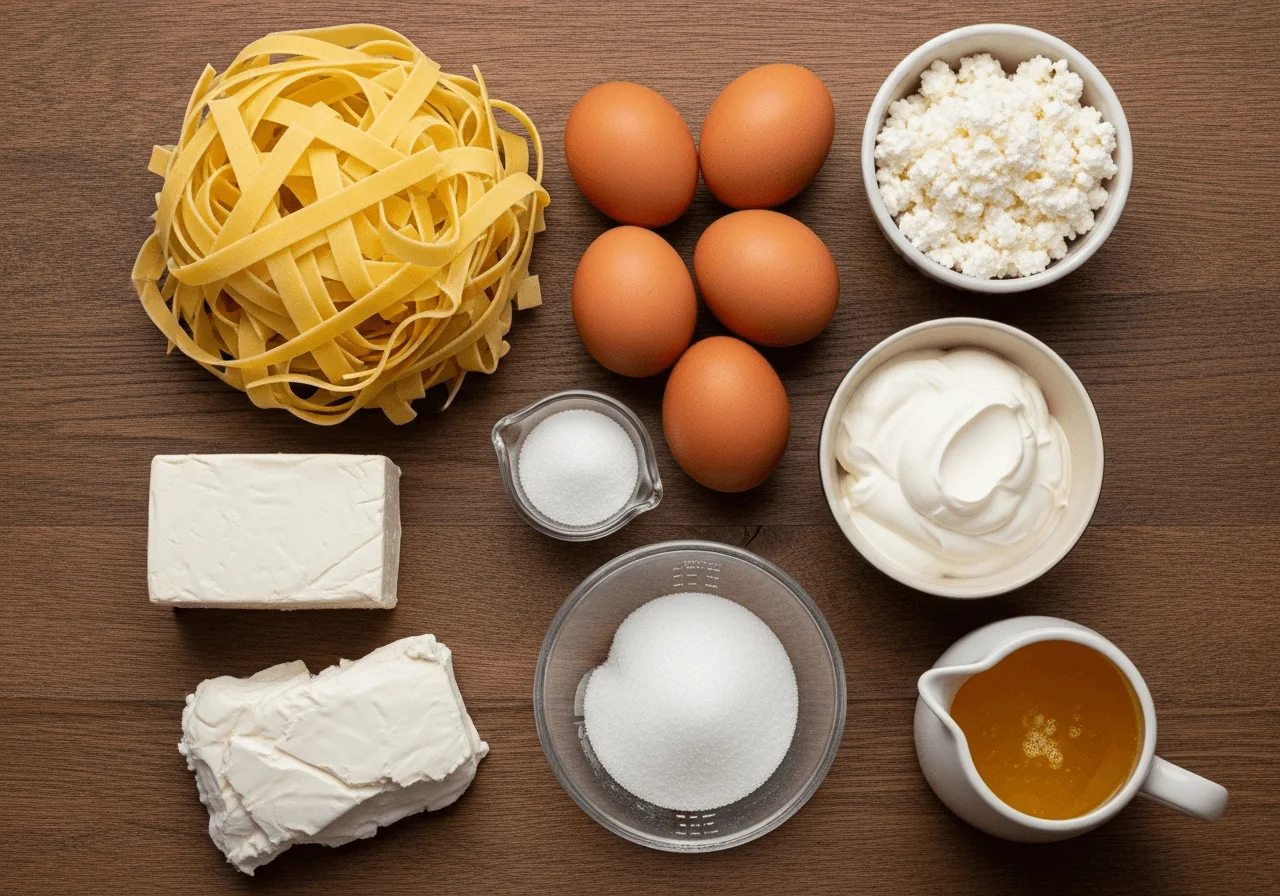
Ingredients
For the kugel
- 1 lb (450g) wide egg noodles
- 6 large eggs
- 1 cup (225g) cottage cheese
- 1 cup (240g) sour cream
- 8 oz (225g) cream cheese, softened
- ¾ cup (150g) granulated sugar
- ½ cup (115g) unsalted butter, melted, divided
- 1 teaspoon vanilla extract
- 1 teaspoon ground cinnamon
- ½ teaspoon fine salt
- ¾ cup (110g) raisins (optional)
For the topping
- 2 cups cornflakes, crushed
- 3 tablespoons granulated sugar
- 1 teaspoon ground cinnamon
- 3 tablespoons unsalted butter, melted

Method
- Boil the noodles. Cook the egg noodles in salted boiling water until just tender, about 7–8 minutes. Drain well and set aside.
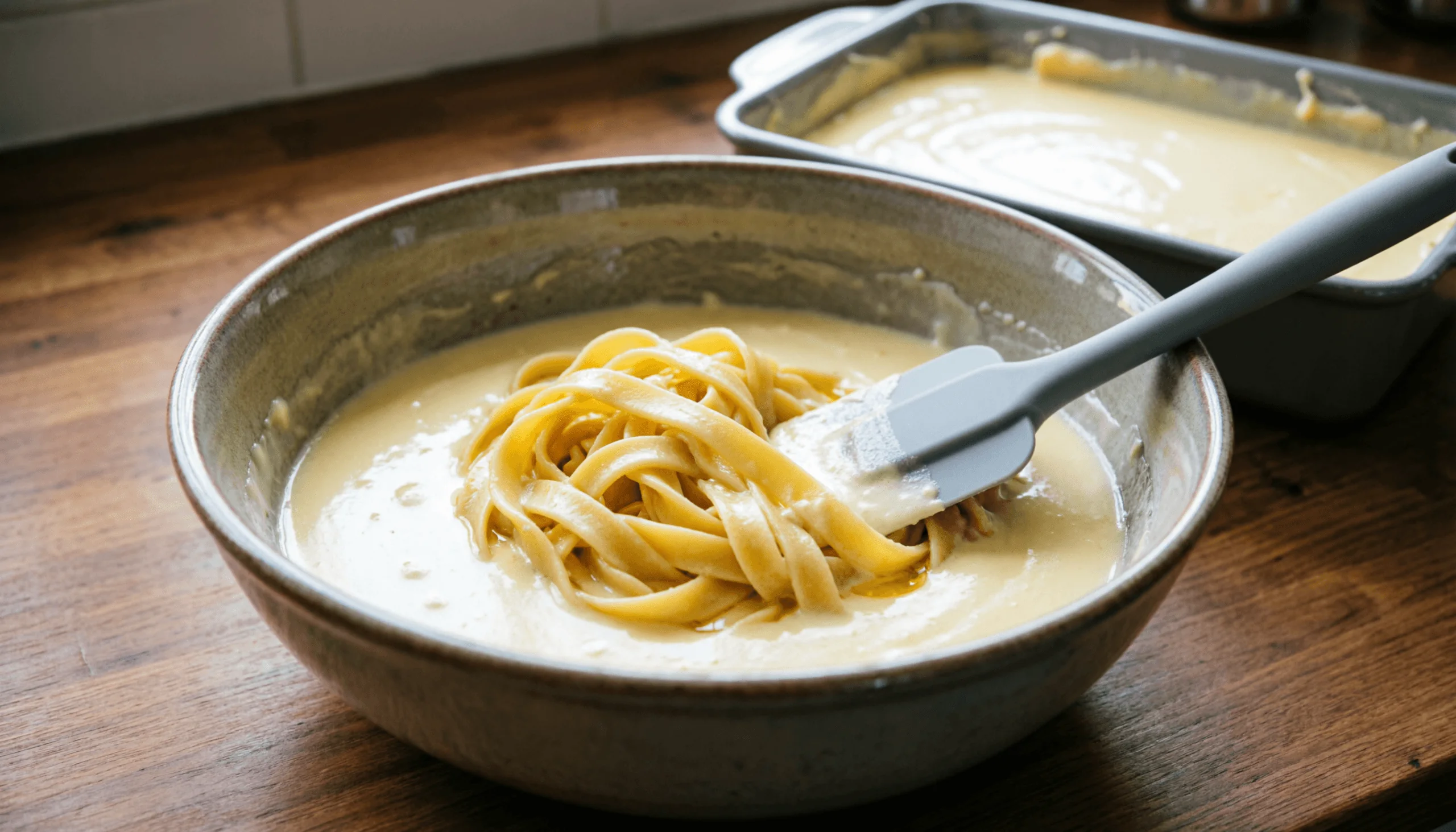
- Make the custard. In a large bowl, beat the eggs, then whisk in the cottage cheese, sour cream, softened cream cheese, sugar, half the melted butter, vanilla, cinnamon, and salt until fairly smooth.
- Combine. Fold the drained noodles and raisins into the custard until evenly coated.
- Assemble. Pour the mixture into a buttered 9×13-inch baking dish and drizzle the remaining melted butter over the top.
- Top. Mix the crushed cornflakes with sugar, cinnamon, and melted butter, and scatter evenly over the kugel.
- Bake. Bake at 350°F (175°C) for 50–55 minutes, until the top is golden and the center is set.
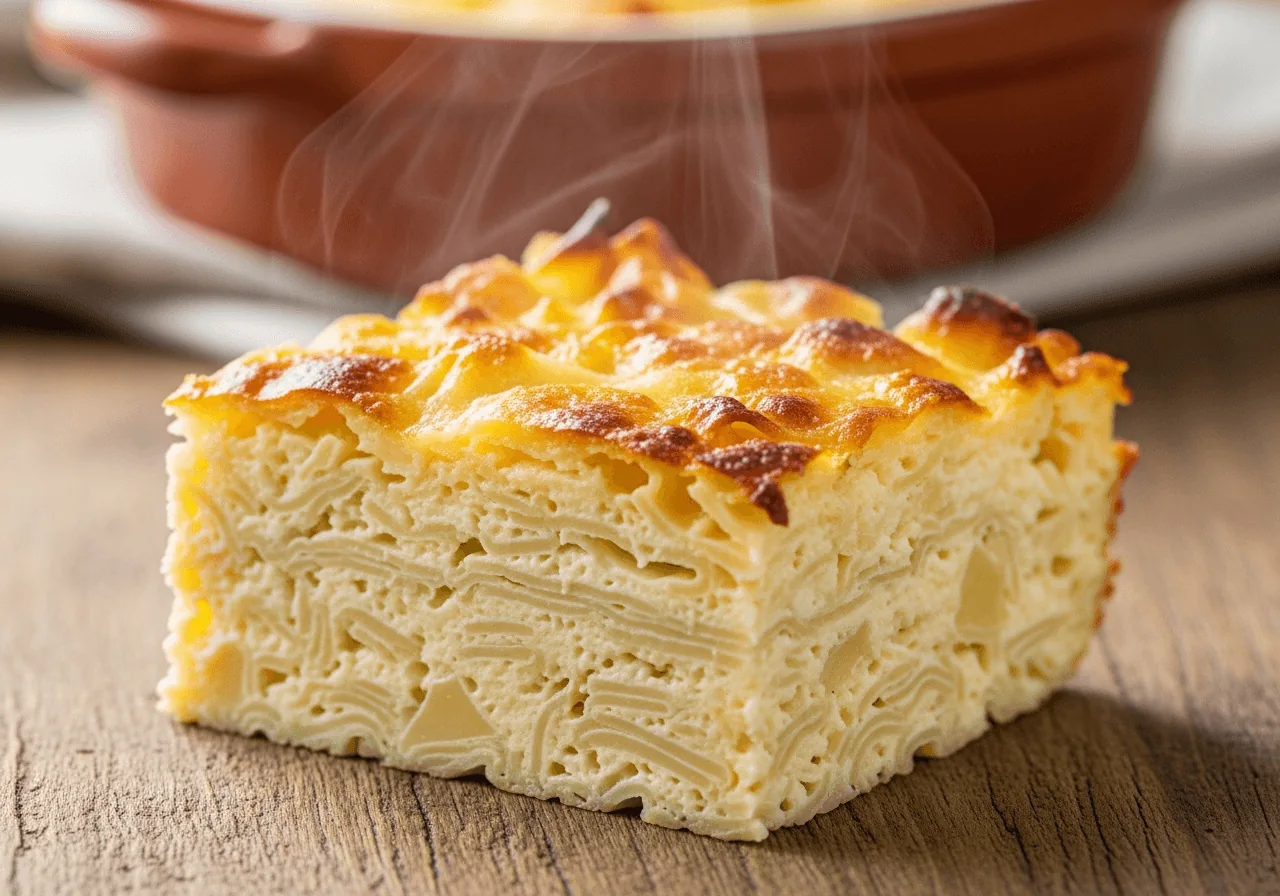
- Rest and serve. Let the kugel rest for 10–15 minutes before slicing. Serve warm, at room temperature, or cold.
Kitchen Tips
On the Noodles
Slightly undercook the noodles before baking, since they’ll continue cooking in the oven. Noodles boiled to full tenderness on the stovetop tend to turn mushy by the time the kugel is done.
On the Dairy
Bring the cream cheese to room temperature before mixing. Cold cream cheese blends unevenly into the custard, and a lumpy filling is the most common kugel complaint.
On the Topping
For a sharper, more distinct crunch, add the cornflake topping only for the final 20 minutes of baking rather than from the start. Adding it earlier gives a softer, more integrated crust.
Nutritional Information
Per serving (based on 10 servings)
- Calories: approximately 520–580 kcal
- Protein: ~12–14g
- Total fat: ~28–33g
- Carbohydrates: ~54–62g
- Sodium: ~340–400mg
Nutritional values are estimates calculated from raw ingredient quantities using standard nutrient databases; actual values will vary with the specific dairy products and noodles used. Eggs are the main source of this dish’s cholesterol; research from Harvard’s Nutrition Source, drawing on two large cohort studies covering nearly 40,000 men and over 80,000 women, found that up to one egg a day is not associated with increased heart disease risk in healthy adults.7 The sugar, butter, and full-fat dairy in a traditional kugel weigh more heavily on its overall nutrition profile than the eggs do.
Storage and Reheating
Store leftover kugel covered in the refrigerator for up to 4 days.
Reheat individual portions in a 325°F (165°C) oven for about 15 minutes, until warmed through, or use a microwave for a softer result with less crisping on top.
Baked kugel freezes well for up to 2 months if tightly wrapped. Thaw it overnight in the refrigerator before reheating.
Traditional Noodle Kugel

Ingredients
For the kugel
- 1 lb (450g) wide egg noodles
- 6 large eggs
- 1 cup (225g) cottage cheese
- 1 cup (240g) sour cream
- 8 oz (225g) cream cheese, softened
- ¾ cup (150g) granulated sugar
- ½ cup (115g) unsalted butter, melted, divided
- 1 teaspoon vanilla extract
- 1 teaspoon ground cinnamon
- ½ teaspoon fine salt
- ¾ cup (110g) raisins (optional)
For the topping
- 2 cups cornflakes, crushed
- 3 tablespoons granulated sugar
- 1 teaspoon ground cinnamon
- 3 tablespoons unsalted butter, melted
Instructions
- Boil the noodles. Cook the egg noodles in salted boiling water until just tender, about 7–8 minutes. Drain well and set aside.
- Make the custard. In a large bowl, beat the eggs, then whisk in the cottage cheese, sour cream, softened cream cheese, sugar, half the melted butter, vanilla, cinnamon, and salt until fairly smooth.
- Combine. Fold the drained noodles and raisins into the custard until evenly coated.
- Assemble. Pour the mixture into a buttered 9×13-inch baking dish and drizzle the remaining melted butter over the top.
- Top. Mix the crushed cornflakes with sugar, cinnamon, and melted butter, and scatter evenly over the kugel.
- Bake. Bake at 350°F (175°C) for 50–55 minutes, until the top is golden and the center is set.
- Rest and serve. Let the kugel rest for 10–15 minutes before slicing. Serve warm, at room temperature, or cold.
Frequently Asked Questions
What’s the difference between noodle kugel and potato kugel?
Noodle kugel is built on egg noodles and is the older of the two, dating to around the 1500s, while potato kugel is made from grated potato and came about roughly 300 years later. Potato kugel tends to stay savory, while noodle kugel can go either sweet or savory.2,3
Is kugel a side dish or a dessert?
It depends on the version. Sweet noodle kugel is traditionally served as a side dish alongside a savory main course, though it’s sweet enough that many families also treat it as dessert.1
What is Jerusalem kugel?
Also called kugel yerushalmi, it’s a distinctive variation built on caramelized sugar and a generous amount of black pepper, said to have arrived in Jerusalem in the eighteenth century with followers of the Vilna Gaon.2,4
Why do some noodle kugels have a cornflake topping?
The cornflake crumb topping is an American addition, first popularized in the early twentieth century as sweet dairy kugel met the pantry staples of its new country.1
Can noodle kugel be made without dairy?
Yes. A pareve version made with cooking oil or margarine in place of butter and dairy exists and follows largely the same method, though the dairy version remains the more common one.1
Why is kugel associated with Shabbat specifically?
Mainly because of its origins as a dumpling cooked inside the Shabbat stew pot, and because its dry, baked form fits neatly around Jewish law’s rules on reheating food once Shabbat has begun.1,6
Where does the word “kugel” come from?
From the Middle High German word for sphere or ball, likely a reference either to the round dumplings that were kugel’s earliest form or to the round, puffed shape of the finished dish itself.1,2
Can noodle kugel be made ahead?
Yes, and it usually is. A baked kugel holds its texture well for a day or two in the refrigerator, and many cooks bake it the day before a holiday meal to free up oven space and time on the day itself.
Looking for a Lighter Version?
Traditional noodle kugel leans on butter, full-fat dairy, and sugar for its richness, and there’s real room to adjust each of those without losing what makes kugel taste like kugel. A separate Healthy Noodle Kugel article on this site works through those swaps in detail.
Further Reading & Sources
The following sources were consulted in researching the history, cultural context, and technique of traditional noodle kugel. Heritage Healthy Kitchen’s recipe was developed independently; these links are provided for readers who want to explore further.
- “Noodle kugel.” Wikipedia. en.wikipedia.org/wiki/Noodle_kugel — definition, the cholent-dumpling origin of the name, regional sweet/savory divide, the effect of immigration patterns, and topping traditions.
- “Kugel.” Wikipedia. en.wikipedia.org/wiki/Kugel — Middle High German etymology, the shift from bread to noodles, and the origins of Jerusalem kugel.
- Haber, Joel. “The Tangled History of Noodle Kugel.” My Jewish Learning (The Nosher). myjewishlearning.com/the-nosher/the-tangled-history-of-noodle-kugel — noodle kugel’s origins around the 1500s, the two routes noodles took into Ashkenazi kitchens, sugar beet refining and the sweet/savory split, the Gefilte Line, and American-era changes to the dish.
- Alt Miller, Yvette. “Kugel!” Aish. aish.com/kugel — the 1825 Heinrich Heine letter, Esther Levy’s 1871 cookbook, the origins of Jerusalem kugel, and the 2015 Bon Appétit kugel cook-off.
- Levi, Yonah. “A Brief History of Kugel.” Aish. aish.com/a-brief-history-of-kugel — the traditional savory character of early kugel and the association between lokshen kugel and sweet ingredients like raisins, nuts, and cinnamon.
- “Sabbath food preparation.” Wikipedia. en.wikipedia.org/wiki/Sabbath_food_preparation — the Jewish legal distinction between reheating dry versus liquid food on Shabbat.
- “Eggs.” The Nutrition Source, Harvard T.H. Chan School of Public Health. nutritionsource.hsph.harvard.edu/food-features/eggs — research on moderate egg consumption and heart disease risk.
- “Rosh Hashanah.” Academy of Nutrition and Dietetics. eatright.org — sweet kugel on the standard Ashkenazi Rosh Hashanah menu.
Disclaimer
The information in this article is provided for educational and informational purposes only. Heritage Healthy Kitchen makes no representations or warranties regarding the accuracy or completeness of any content on this site. Nutritional values are estimates only and will vary depending on the specific ingredients, brands, and measurements used. This content is not intended as dietary, medical, or professional nutritional advice. Always consult a qualified healthcare provider regarding any dietary needs or health conditions. Heritage Healthy Kitchen is not responsible for any outcomes resulting from the use of recipes or information published on this site.
Cook by Occasion
This recipe is part of our Rosh Hashanah menu and our Shabbat table.
You Might Also Like
More heritage recipes from our kitchen
Leave a Reply