
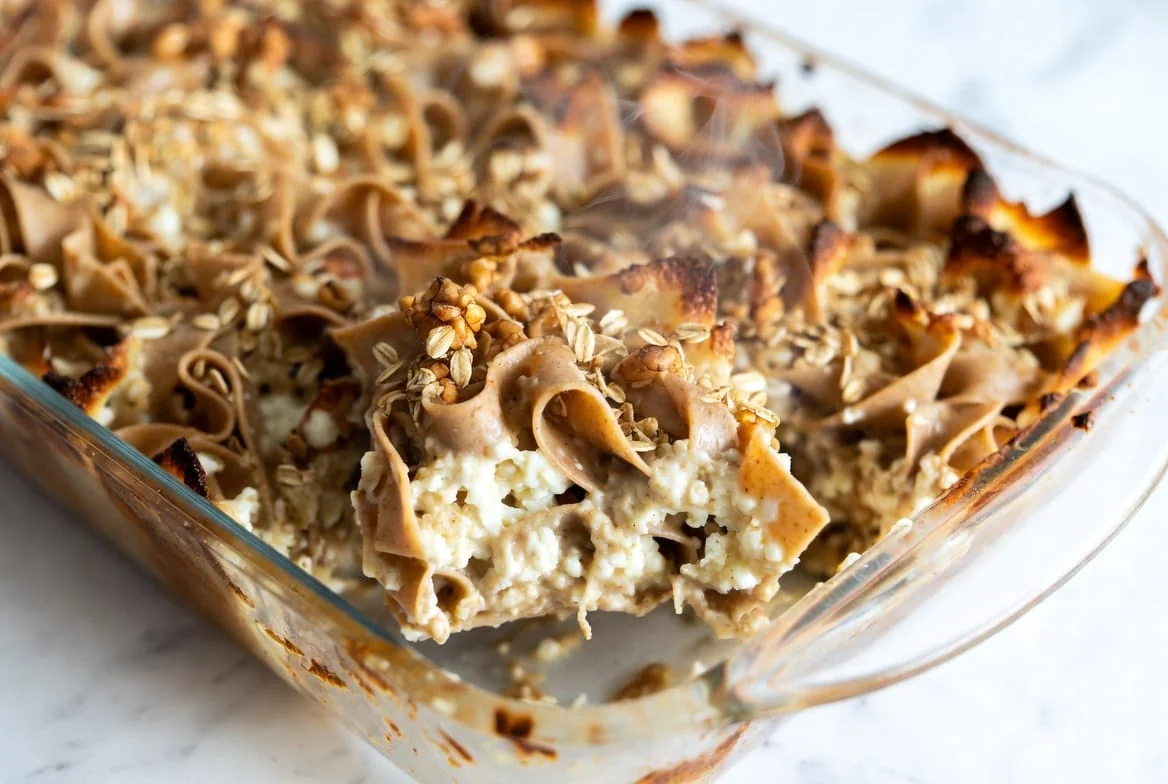
Active time: ~25 minutes | Total time: ~1 hour 30 minutes | Serves: 10 | Difficulty: Easy
Quick Overview
- Whole wheat egg noodles replace regular egg noodles — more fiber, same familiar bite
- Three whole eggs plus six egg whites replace six whole eggs — less cholesterol and saturated fat, protein holds steady
- Low-fat cottage cheese and plain Greek yogurt replace cream cheese and sour cream
- Added sugar drops by more than half, with raisins and cinnamon carrying more of the sweetness
- Butter is cut sharply in both the custard and the topping
- A rolled oat and walnut topping replaces the cornflake-butter-sugar crumble
What This Version Changes — and What It Keeps
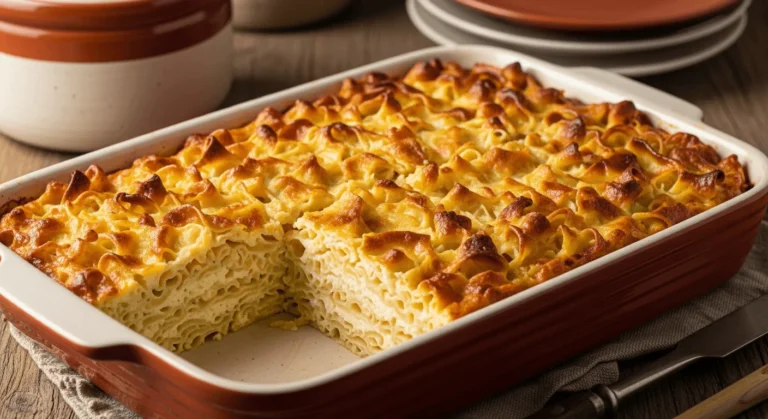
The technique stays exactly the same as the traditional recipe: boil the noodles, mix the custard, fold everything together, bake until golden and set. Nothing about the method changes, and the result still looks, slices, and eats like noodle kugel. The raisins, cinnamon, and vanilla that give the dish its character all stay in place.
What changes is where the calories, saturated fat, and added sugar were concentrated in the original: a full cup each of cream cheese and sour cream, six whole eggs, three-quarters of a cup of sugar plus more in the topping, and a stick of butter split between the custard and a buttery cornflake crumble. This version addresses each of those points individually — lower-fat dairy in place of the richest ingredients, fewer whole eggs, meaningfully less sugar, and a topping built from whole grains and nuts instead of butter and cereal.
Why These Swaps Work
Regular wide egg noodles are replaced with whole wheat egg noodles. Milling wheat into white flour strips away the bran and germ, and with them more than half the grain’s B vitamins, 90 percent of its vitamin E, and virtually all of its fiber, according to Harvard’s Nutrition Source.1 Keeping the noodle format the same preserves the dish’s familiar texture while adding real fiber where the traditional version had almost none.
Three of the six whole eggs are replaced with six egg whites. Cleveland Clinic dietitian Anna Taylor, RD, notes that egg whites are “almost pure protein and don’t contain any saturated fat,” while whole eggs bring more calories and saturated fat along with their protein.2 Keeping half the yolks preserves enough richness and color for the custard to still taste and look like kugel.
Cream cheese disappears from the recipe entirely, and low-fat cottage cheese takes over its role, blended smooth, alongside plain Greek yogurt in place of sour cream. Cleveland Clinic’s cottage cheese guide, developed with registered dietitian Julia Zumpano, lists it as a substitute for sour cream; a 100-gram serving of 2% cottage cheese provides 84 calories and 2.3 grams of fat alongside 11 grams of protein.3 Taylor separately recommends Greek yogurt in place of sour cream for the same reason: a real protein boost for a fraction of the fat.2
Added sugar drops from three-quarters of a cup plus three tablespoons in the traditional recipe to about a third of a cup in the custard plus one tablespoon in the topping. Harvard’s Nutrition Source recommends cutting added sugar in baking by a quarter to a third of a cup per recipe, and this version leans on that guidance, then leans further on the raisins’ natural sweetness and a full teaspoon of cinnamon to make up the difference.4
Butter drops from half a cup plus three tablespoons to three tablespoons in the custard and one tablespoon in the topping. Butter is about 60 percent saturated fat by weight, and Harvard’s Nutrition Source lists butter and other dairy fats among the leading sources of saturated fat in the American diet — a nutrient the Dietary Guidelines for Americans cap at 10 percent of daily calories, and the American Heart Association caps lower still, at 7 percent.5
The cornflake-butter-sugar topping is replaced with rolled oats, chopped walnuts, a little cinnamon, and a small amount of butter. Oats are a whole grain in their own right,1 and walnuts carry the kind of unsaturated fat that Harvard’s Nutrition Source associates with a 30 to 50 percent lower risk of cardiovascular disease among people who eat nuts several times a week, largely because those fats help lower LDL cholesterol and raise HDL.6 The topping still turns golden and adds crunch, just from ingredients that pull their own nutritional weight.
Healthy Noodle Kugel Recipe
Recipe developed independently by Heritage Healthy Kitchen, drawing on traditional Ashkenazi Jewish techniques. Sources for further reading are listed at the end of this article.
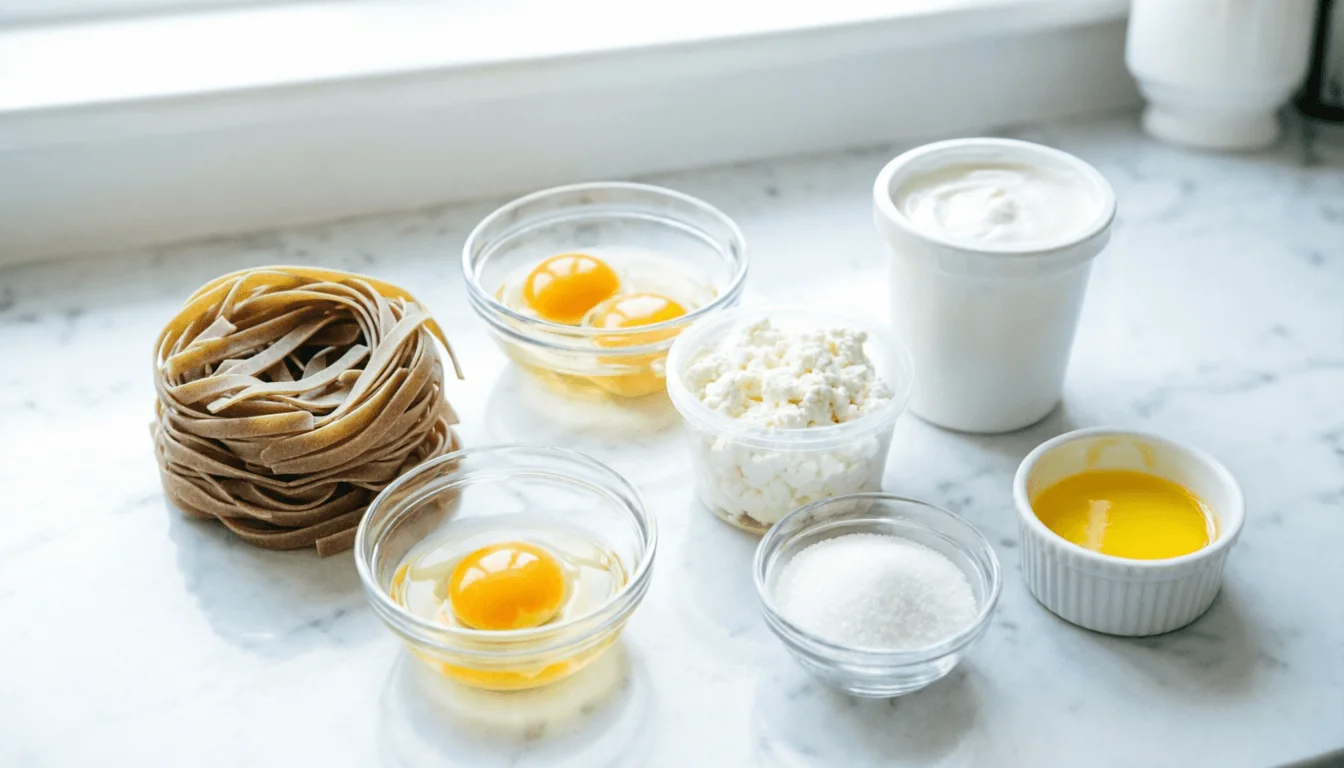
Ingredients
For the kugel
- 1 lb (450g) whole wheat egg noodles
- 3 large eggs
- 6 large egg whites (or ¾ cup egg whites from a carton)
- 2 cups (450g) low-fat (2%) cottage cheese
- 1 cup (225g) plain Greek yogurt (2%)
- ⅓ cup (67g) granulated sugar
- 3 tablespoons (42g) unsalted butter, melted
- 1 teaspoon vanilla extract
- 1 teaspoon ground cinnamon
- ¼ teaspoon fine salt
- ¾ cup (110g) raisins
For the topping
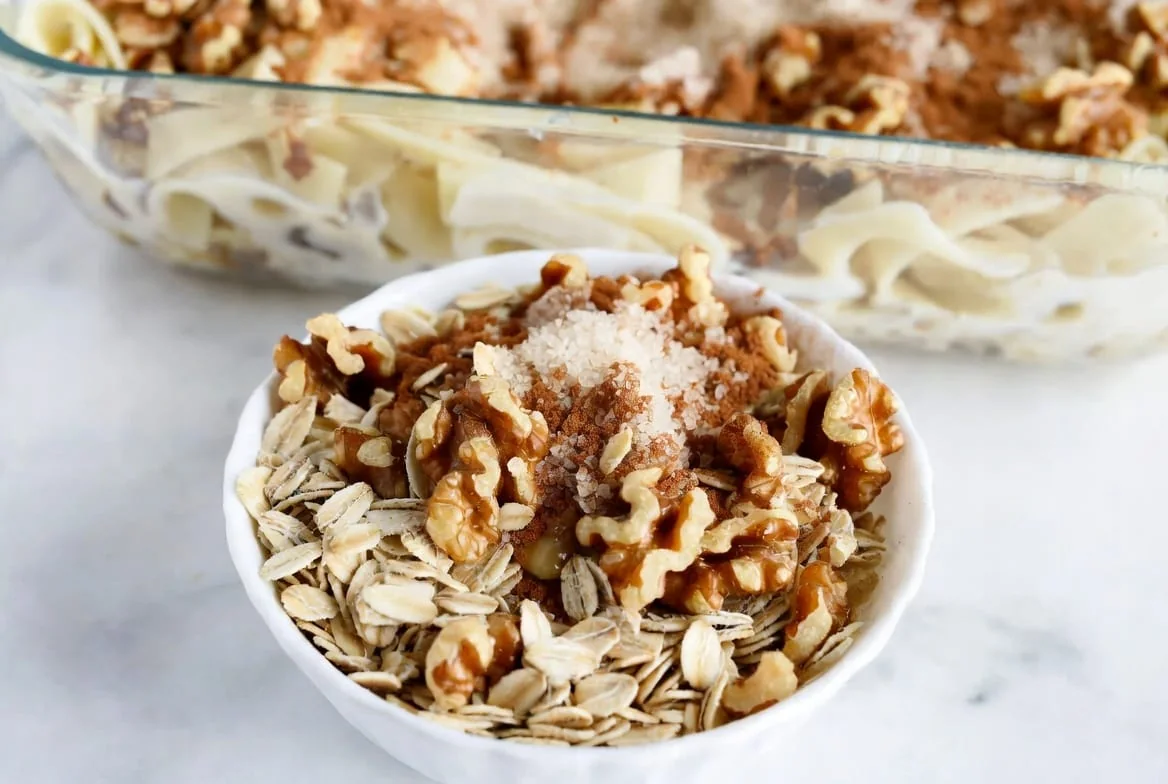
- 1 cup (90g) old-fashioned rolled oats
- ⅓ cup (40g) walnuts, chopped
- 1 tablespoon (12.5g) granulated sugar
- 1 teaspoon ground cinnamon
- 1 tablespoon (14g) unsalted butter, melted
Instructions

- Boil the noodles. Cook the whole wheat egg noodles in salted boiling water until just tender, about 8–9 minutes. Drain well and set aside.
- Blend the base. Blend or process about half the cottage cheese until smooth, then stir it back in with the remaining cottage cheese and the Greek yogurt. This keeps some texture while smoothing out the rest.
- Make the custard. In a large bowl, beat the whole eggs and egg whites together, then whisk in the cottage cheese mixture, sugar, melted butter, vanilla, cinnamon, and salt until fairly smooth.
- Combine. Fold the drained noodles and raisins into the custard until evenly coated.
- Assemble. Pour the mixture into a lightly buttered or oiled 9×13-inch baking dish.
- Top. Mix the oats, walnuts, sugar, cinnamon, and melted butter, and scatter evenly over the kugel.
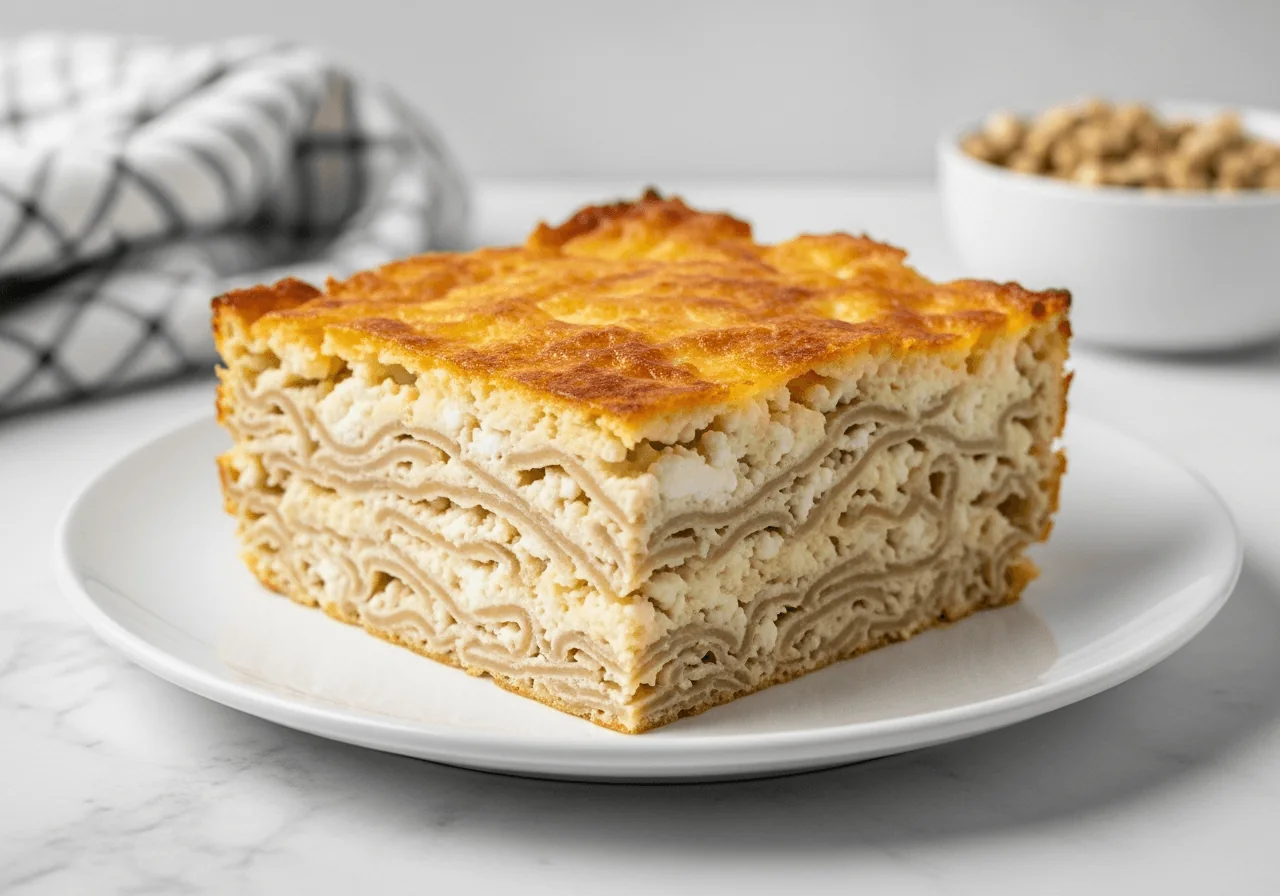
- Bake. Bake at 350°F (175°C) for 45–50 minutes, until the top is golden and the center is set.
- Rest and serve. Let the kugel rest for 10–15 minutes before slicing. Serve warm, at room temperature, or cold.
Kitchen Tips
Blending only half the cottage cheese, rather than all of it, keeps a little of the traditional dish’s soft curd texture while still smoothing out most of the mixture. Blend all of it for a completely smooth, custard-like result instead.
Whole wheat noodles can take slightly longer to reach the same tenderness as regular egg noodles. Taste a strand a minute or two before the package’s suggested cook time and pull them while still a little firm, since they finish cooking in the oven.
Toast the walnuts in a dry skillet for a few minutes before mixing the topping if a deeper, more roasted flavor is wanted; it’s not necessary, but it does add another layer of flavor for very little extra effort.
Nutritional Comparison
Per serving (one of 10 servings)
| Nutrient | Traditional Noodle Kugel | This Version |
|---|---|---|
| Calories | ~520–580 kcal | ~350–400 kcal |
| Protein | ~12–14g | ~17–20g |
| Total fat | ~28–33g | ~11–14g |
| Saturated fat | ~15–19g | ~3.5–5g |
| Carbohydrates | ~54–62g | ~44–52g |
| Dietary fiber | <1g | ~5–7g |
| Sodium | ~340–400mg | ~250–300mg |
All values are estimates calculated from this recipe’s specific ingredient quantities using standard nutrient databases and will vary depending on specific products, brands, and portion sizes. The sodium drop is a side effect of removing cream cheese and the cornflake topping and cutting the added salt, not a specific target of this recipe; choosing a low-sodium cottage cheese lowers the sodium figure further in either version.
Storage and Reheating
Store leftover kugel covered in the refrigerator for up to 4 days.
Reheat individual portions in a 325°F (165°C) oven for about 15 minutes, until warmed through, or use a microwave for a softer result with less crisping on top.
Baked kugel freezes well for up to 2 months if tightly wrapped. Thaw it overnight in the refrigerator before reheating.
Healthy Noodle Kugel

Ingredients
For the kugel
- 1 lb (450g) whole wheat egg noodles
- 3 large eggs
- 6 large egg whites (or ¾ cup egg whites from a carton)
- 2 cups (450g) low-fat (2%) cottage cheese
- 1 cup (225g) plain Greek yogurt (2%)
- ⅓ cup (67g) granulated sugar
- 3 tablespoons (42g) unsalted butter, melted
- 1 teaspoon vanilla extract
- 1 teaspoon ground cinnamon
- ¼ teaspoon fine salt
- ¾ cup (110g) raisins
For the topping
- 1 cup (90g) old-fashioned rolled oats
- ⅓ cup (40g) walnuts, chopped
- 1 tablespoon (12.5g) granulated sugar
- 1 teaspoon ground cinnamon
- 1 tablespoon (14g) unsalted butter, melted
Instructions
- Boil the noodles. Cook the whole wheat egg noodles in salted boiling water until just tender, about 8–9 minutes. Drain well and set aside.
- Blend the base. Blend or process about half the cottage cheese until smooth, then stir it back in with the remaining cottage cheese and the Greek yogurt. This keeps some texture while smoothing out the rest.
- Make the custard. In a large bowl, beat the whole eggs and egg whites together, then whisk in the cottage cheese mixture, sugar, melted butter, vanilla, cinnamon, and salt until fairly smooth.
- Combine. Fold the drained noodles and raisins into the custard until evenly coated.
- Assemble. Pour the mixture into a lightly buttered or oiled 9×13-inch baking dish.
- Top. Mix the oats, walnuts, sugar, cinnamon, and melted butter, and scatter evenly over the kugel.
- Bake. Bake at 350°F (175°C) for 45–50 minutes, until the top is golden and the center is set.
- Rest and serve. Let the kugel rest for 10–15 minutes before slicing. Serve warm, at room temperature, or cold.
Frequently Asked Questions
Will the texture be noticeably different with less fat and sugar?
A little firmer and less sweet, but still recognizably kugel. Blending part of the cottage cheese smooth does most of the work of restoring the creamy texture that cream cheese and sour cream provided in the traditional version.
Can I use all whole eggs instead of part egg whites?
Yes, though it brings back some of the saturated fat this version is designed to cut. Six whole eggs will work in place of the three eggs plus six whites without changing the method.
Why blend only part of the cottage cheese instead of all of it?
It’s a texture choice. Blending everything gives a smoother, more custard-like kugel closer to what the cream cheese version produced; leaving half unblended keeps some of the soft curd texture that’s part of a classic cottage cheese kugel.
Does using whole wheat noodles change the cook time?
Slightly. Whole wheat noodles can take a minute or two longer than regular egg noodles to reach the same tenderness, so it’s worth tasting a strand near the end of the package’s suggested time rather than going by the clock alone.
Can this version be made dairy-free?
Not easily without changing its character. Cottage cheese and Greek yogurt are doing real nutritional work here — protein, calcium, and the creamy texture — that a dairy-free swap would need to replace some other way, and that’s a bigger change than this recipe is built around.
Is this version suitable for someone managing blood sugar or heart health?
The combination of more fiber, meaningfully less added sugar, and a large cut to saturated fat moves the dish in a more favorable direction on paper.1,4,5 Individual needs vary by health status, medications, and overall diet, so anyone managing diabetes, prediabetes, or heart disease should check with a doctor or registered dietitian rather than relying on recipe changes alone.
Why did the sodium go down if that wasn’t the goal?
Cream cheese and the cornflake topping were both meaningful sodium sources in the traditional recipe, and cutting the added salt by half on top of removing them brought the total down even though the cottage cheese quantity doubled. It’s a side benefit of the other swaps rather than something specifically engineered.
The Traditional Version
For the full traditional recipe — cream cheese, sour cream, a full stick of butter, and the dish’s Ashkenazi Jewish history from medieval Germany to today’s Shabbat table — the Traditional Noodle Kugel article on this site covers the method and cultural background in detail.
Further Reading & Sources
The following sources were consulted for the nutritional information and health context in this article. Heritage Healthy Kitchen’s recipe was developed independently; these links are provided for readers who want to explore further.
- “Whole Grains.” The Nutrition Source, Harvard T.H. Chan School of Public Health. nutritionsource.hsph.harvard.edu/what-should-you-eat/whole-grains — nutrients lost when wheat is refined into white flour; oats as a whole grain.
- “Try These 21 High-Protein Foods.” Cleveland Clinic Health Essentials. health.clevelandclinic.org/high-protein-foods — dietitian guidance on egg whites versus whole eggs for saturated fat, and Greek yogurt as a sour cream substitute.
- “7 Reasons Why Cottage Cheese Is Good for You.” Cleveland Clinic Health Essentials. health.clevelandclinic.org/cottage-cheese-benefits — nutritional profile of 2% cottage cheese and dietitian guidance on using it as a sour cream substitute.
- “Added Sugar.” The Nutrition Source, Harvard T.H. Chan School of Public Health. nutritionsource.hsph.harvard.edu/carbohydrates/added-sugar-in-the-diet — specific guidance on reducing added sugar in baking recipes.
- “Types of Fat.” The Nutrition Source, Harvard T.H. Chan School of Public Health. nutritionsource.hsph.harvard.edu/what-should-you-eat/fats-and-cholesterol/types-of-fat — saturated fat content of butter; recommended daily saturated fat limits; leading dietary sources of saturated fat.
- “Nuts for the Heart.” The Nutrition Source, Harvard T.H. Chan School of Public Health. nutritionsource.hsph.harvard.edu/nuts-for-the-heart — cardiovascular benefits associated with regular nut consumption, including walnuts.
Disclaimer
The information in this article is provided for educational and informational purposes only. Heritage Healthy Kitchen makes no representations or warranties regarding the accuracy or completeness of any content on this site. Nutritional values are estimates only and will vary depending on the specific ingredients, brands, and measurements used. This content is not intended as dietary, medical, or professional nutritional advice. Always consult a qualified healthcare provider regarding any dietary needs or health conditions. Heritage Healthy Kitchen is not responsible for any outcomes resulting from the use of recipes or information published on this site.
Cook by Occasion
This recipe is part of our Rosh Hashanah menu and our Shabbat table.
You Might Also Like
More heritage recipes from our kitchen

Leave a Reply