
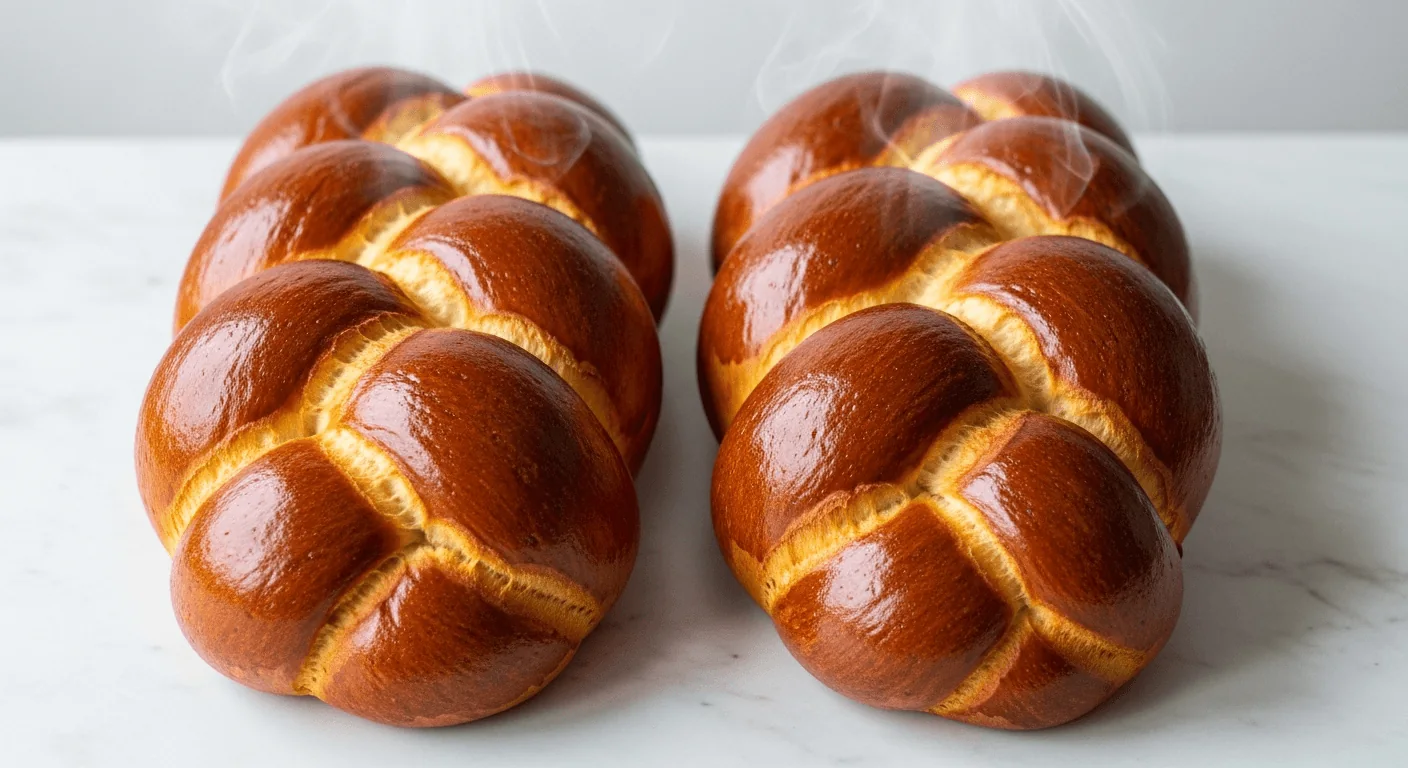
Active time: ~30 minutes | Total time: ~4 hours (including rising) | Serves: 16–20 (2 loaves) | Difficulty: Moderate
Quick Overview
- Replace half the all-purpose flour with white whole wheat flour for more fiber
- Cut the granulated sugar by about a quarter, leaning on the honey already in the dough
- Swap part of the oil for unsweetened applesauce — mainly a calorie trim, not a fat-quality fix
- Use a mix of whole eggs and egg whites to lower cholesterol and saturated fat per slice
- Braid, bake, and slice into slightly smaller portions than a traditional loaf
What This Version Changes — and What It Keeps
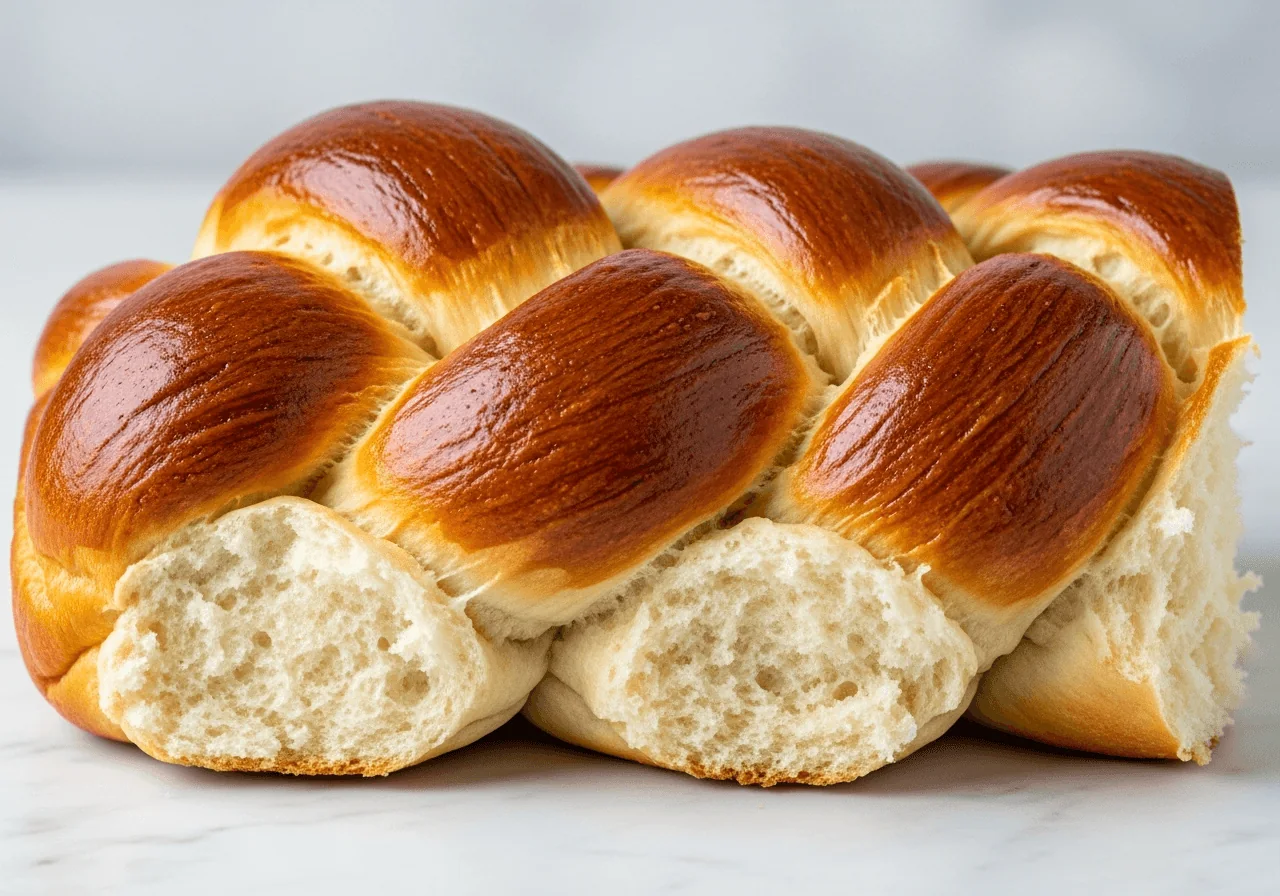
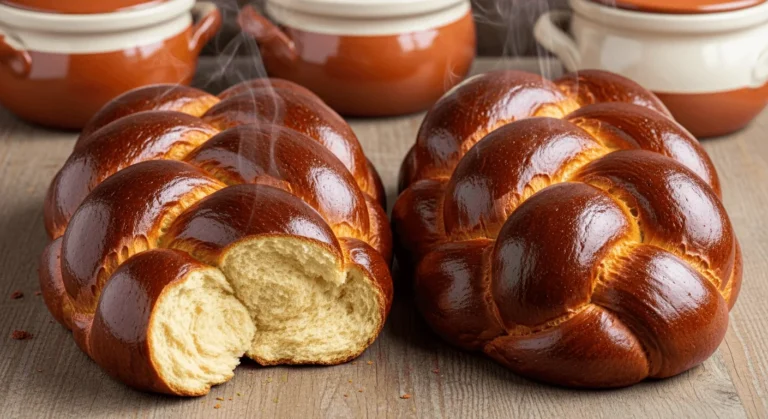
This version keeps the parts of challah that make it challah: the braid, the egg wash, the soft and slightly sweet crumb, and the two-loaf tradition at the table. Nothing here turns the bread into something unrecognizable, and it’s still built to rise, braid, and bake exactly the way the traditional version does — same shaping technique, same golden crust, same texture at the table.
What changes is the flour, the sugar, the fat, and part of the egg content. Half the all-purpose flour becomes whole wheat, the sugar is trimmed back, half the oil is replaced with unsweetened applesauce, and some of the whole eggs are swapped for egg whites. None of these changes are dramatic on their own, which is exactly the point — small, tested swaps that add up without changing what challah is supposed to taste and feel like. Anyone who wants to push the swaps further can do so gradually, adjusting one variable at a time to see what still feels like the challah they know.
Why These Swaps Work
Swapping in whole wheat flour for part of the all-purpose flour adds back the fiber-rich bran and nutrient-dense germ that milling strips out of refined flour, along with B vitamins, iron, and other nutrients that are otherwise mostly lost — refining wheat strips away more than half its B vitamins, about 90% of its vitamin E, and nearly all of its fiber.1 Whole grains as a category are linked in large long-term studies to lower rates of heart disease and type 2 diabetes, though that research is about overall dietary patterns rather than any single loaf of bread.1 Cleveland Clinic dietitian Elyse Homan notes that whole wheat flour delivers meaningfully more fiber and protein than all-purpose flour and can generally be substituted in equal amounts, though the result bakes a little denser — which is why this recipe only replaces half the flour rather than all of it.4
Cutting back on added sugar follows a similar logic. The Dietary Guidelines for Americans recommend keeping added sugar under 10% of daily calories, and the American Heart Association suggests an even tighter limit for most adults, since regular high sugar intake is a growing concern for type 2 diabetes, heart disease, and other chronic conditions.2 The Academy of Nutrition and Dietetics notes that most baked goods can lose about a quarter of their sugar with no noticeable difference in taste, sometimes needing a small increase in liquid to compensate.5 This recipe applies roughly that reduction, trimming the granulated sugar while keeping the honey that’s part of challah’s traditional flavor.
The oil swap deserves a more honest explanation than the others, because it isn’t fixing an unhealthy ingredient. Harvard’s Healthy Eating Plate lists olive, canola, sunflower, soy, corn, and peanut oil together as recommended healthy oils, with no calorie cap on how much of a person’s fat intake can come from them — “low-fat” is not the same thing as “healthy” by that same guidance.6 This recipe calls for canola or sunflower specifically for a culinary reason, not a nutritional one: olive oil has a distinctive, fairly strong flavor that most bakers reserve for savory breads, while a neutral oil keeps challah’s sweet, delicate crumb from tasting like something else. The real reason to trim the oil at all is simply that it’s extremely calorie-dense, so cutting back lowers the total calories and total fat grams in a slice — which matters mainly for someone managing overall calorie intake, not someone trying to avoid a bad fat. This recipe keeps half the oil rather than removing it, both because the flavor and texture of oil are part of what makes challah what it is, and because a full swap can leave an enriched dough noticeably denser.5
Eggs remain a normal part of a healthy diet in moderation — Harvard’s Nutrition Source notes that up to about one egg a day isn’t linked to higher heart disease risk in most healthy adults, since the fat in an egg is mostly unsaturated and eggs also supply protein, choline, and several vitamins, even though a single yolk does carry a meaningful amount of dietary cholesterol.3 Using a mix of whole eggs and egg whites in this recipe keeps that same protein contribution while trimming some of the cholesterol and saturated fat that comes with every added yolk, which matters most for anyone already watching those numbers closely.
Healthy Challah Recipe
Recipe developed independently by Heritage Healthy Kitchen, part of our collection of Ashkenazi Jewish recipes. Sources for the health claims behind each swap are listed at the end of this article.
Ingredients
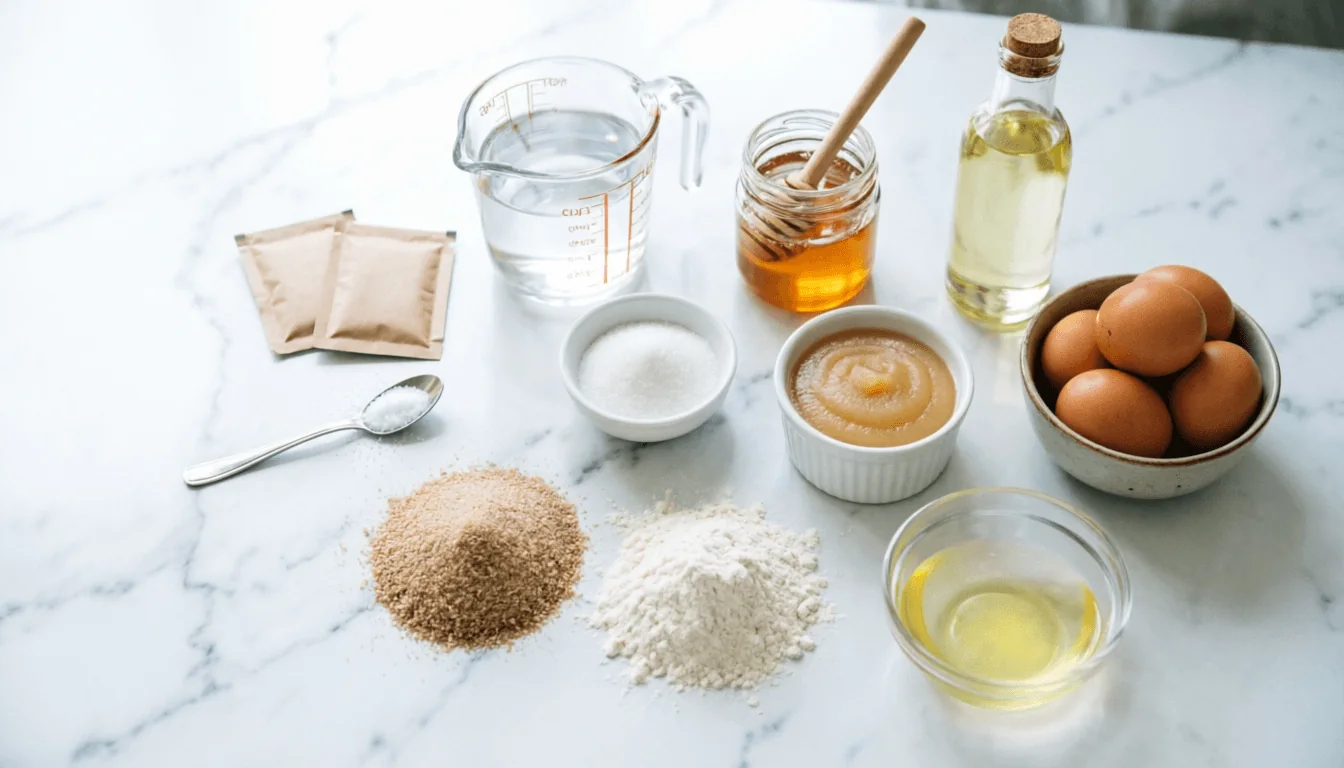
For the dough (makes 2 loaves)
- 2 packets (about 4½ teaspoons) active dry yeast
- 1½ cups warm water (about 110°F)
- 3 tablespoons granulated sugar, divided (reduced from ½ cup)
- 2 large eggs plus 4 large egg whites, plus 1 extra egg for egg wash
- ¼ cup neutral vegetable oil (canola or sunflower), plus extra for the bowl
- ¼ cup unsweetened applesauce
- 2 tablespoons honey
- 2½ teaspoons fine salt
- 3½–4 cups white whole wheat flour
- 3½–4 cups all-purpose flour, plus more for kneading
For topping
- 1 egg white, beaten, for egg wash
- Sesame seeds or poppy seeds (optional)
Instructions
Step 1: Bloom the yeast
In a large bowl or stand mixer, sprinkle the yeast over the warm water. Add 1 tablespoon of the sugar and stir gently. Let it sit for 5–10 minutes, until foamy. If it doesn’t foam, the yeast is inactive — start again with a fresh packet.
Step 2: Mix the wet ingredients
Whisk in the remaining sugar, the whole eggs and egg whites, oil, applesauce, honey, and salt until well combined.
Step 3: Add the flour
Add the whole wheat flour first, mixing well, then add the all-purpose flour one cup at a time until a soft dough forms that pulls away from the sides of the bowl but still feels slightly tacky.
Step 4: Knead
Knead by hand on a floured surface, or with a stand mixer’s dough hook, for about 8–10 minutes. Whole wheat flour absorbs more liquid than all-purpose, so the dough may feel slightly firmer than a traditional challah dough — that’s expected.
Step 5: First rise
Place the dough in a lightly oiled bowl, turning once to coat. Cover and let rise in a warm spot for 1–1.5 hours, until roughly doubled. Whole wheat dough can rise a little more slowly than an all-white-flour dough, so give it the extra time if needed.
Step 6: Divide and braid
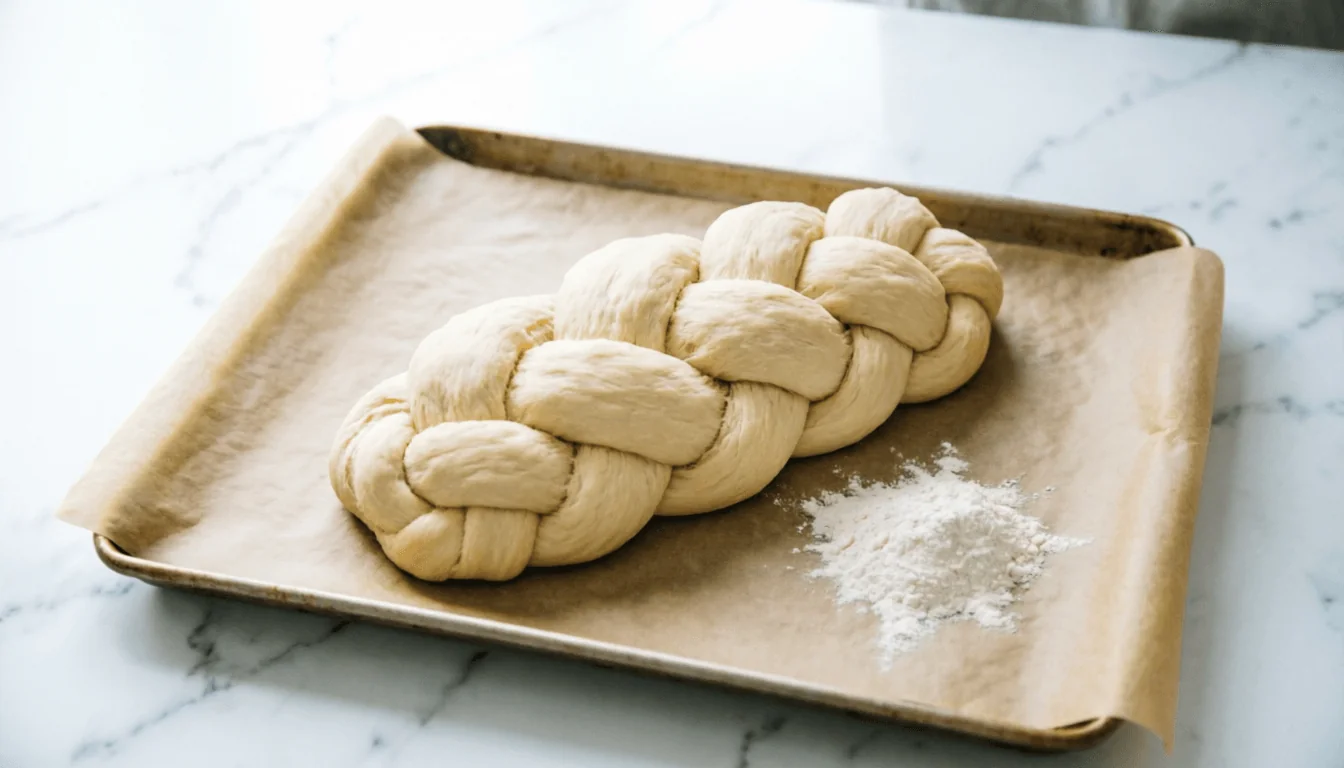
Punch down the dough and divide it in half for two loaves. Divide each half into 3 or 6 equal pieces, roll into ropes, and braid, tucking the ends underneath.
Step 7: Second rise
Place the braided loaves on a parchment-lined baking sheet, spaced apart. Cover loosely and let rise for 45 minutes to 1 hour, until visibly puffy.
Step 8: Egg wash and bake
Preheat the oven to 375°F. Brush the loaves with beaten egg white, sprinkle with seeds if using, and bake for 30–38 minutes — whole wheat loaves often need a few extra minutes — until deeply golden and the bottom sounds hollow when tapped.
Step 9: Cool and slice
Cool on a wire rack for at least 20 minutes. For portion control, slice into 20 pieces per pair of loaves rather than 16, in line with general guidance to keep baked-goods portions modest.5
Kitchen Tips
White whole wheat flour, milled from a lighter wheat variety, gives a milder flavor and lighter color than regular whole wheat flour, which makes it an easier substitution for anyone braiding challah for the first time with a whole-grain flour.
If the dough feels stiff after adding all the flour, add water a tablespoon at a time rather than more flour — whole wheat flour continues absorbing liquid as the dough rests, so a dough that seems slightly wet at first often firms up during the rise.
Store-bought unsweetened applesauce varies in thickness between brands; if it’s very watery, drain it briefly in a fine-mesh sieve before measuring so the dough doesn’t end up too loose.
Because this dough is a little firmer than an all-white-flour version, let the ropes rest for a minute or two after rolling and before braiding — this relaxes the gluten and makes the strands easier to shape without springing back.
Nutritional Comparison
Per serving (1 slice)

| Traditional | This Version | |
|---|---|---|
| Calories | 170–210 kcal | 140–170 kcal |
| Protein | 4–6g | 5–7g |
| Total fat | 4–6g | 2–4g |
| Carbohydrates | 27–31g | 24–28g |
| Fiber | ~1g | ~2–3g |
| Sodium | 190–260mg | 180–240mg |
Nutritional values are estimates based on standard ingredient databases and will vary depending on exact brands, flour ratios, and slice size. Individual dietary needs vary — anyone managing a specific health condition should check with a healthcare provider or registered dietitian before making significant changes to their regular diet.
Storage and Reheating
Store cooled challah at room temperature, wrapped well or in an airtight container, for up to 3 days — slightly shorter than the traditional version, since whole wheat flour and less oil mean less shelf-stable fat to keep the crumb soft. Slicing the loaf before storing, rather than leaving it whole, can also speed up staling slightly, so keep it in one piece until shortly before serving if possible.
This version freezes well for up to 3 months. Wrap tightly in plastic wrap, then foil, and thaw at room temperature before serving. Freezing individual slices, separated by parchment, makes it easy to pull out a single portion at a time rather than defrosting a whole loaf. Refresh a slightly stale loaf by wrapping it in foil and warming it in a 300°F oven for 10–15 minutes.
Healthy Challah Variations

Ingredients
For the dough (makes 2 loaves)
- 2 packets (about 4½ teaspoons) active dry yeast
- 1½ cups warm water (about 110°F)
- 3 tablespoons granulated sugar, divided (reduced from ½ cup)
- 2 large eggs plus 4 large egg whites, plus 1 extra egg for egg wash
- ¼ cup neutral vegetable oil (canola or sunflower), plus extra for the bowl
- ¼ cup unsweetened applesauce
- 2 tablespoons honey
- 2½ teaspoons fine salt
- 3½–4 cups white whole wheat flour
- 3½–4 cups all-purpose flour, plus more for kneading
For topping
- 1 egg white, beaten, for egg wash
- Sesame seeds or poppy seeds (optional)
Instructions
- Replace half the all-purpose flour with white whole wheat flour for more fiber
- Cut the granulated sugar by about a quarter, leaning on the honey already in the dough
- Swap part of the oil for unsweetened applesauce — mainly a calorie trim, not a fat-quality fix
- Use a mix of whole eggs and egg whites to lower cholesterol and saturated fat per slice
- Braid, bake, and slice into slightly smaller portions than a traditional loaf
Frequently Asked Questions
Will the whole wheat flour make the challah taste noticeably different?
It adds a slightly nuttier flavor and a denser, heartier crumb, but at a 50/50 ratio with all-purpose flour, most people still recognize it clearly as challah rather than a different bread entirely.4
Can the flour ratio be adjusted further toward whole wheat?
Yes, though replacing all the flour with whole wheat will produce a noticeably denser, heavier loaf; a 50/50 split is a reasonable middle ground for a first attempt.1,4
Isn’t vegetable oil already a healthy fat? Why reduce it, and why canola or sunflower instead of olive oil?
Yes to the first part — see “Why These Swaps Work” above for the full explanation. In short: canola, sunflower, and olive oil are all recognized as healthy fats, so trimming oil here is purely about calories, not fat quality, and it’s a swap that’s easy to skip. Canola or sunflower rather than olive oil is a flavor choice, not a health one — olive oil would work just as well nutritionally.6
Why use applesauce instead of just using less oil outright?
Cutting oil without replacing its moisture tends to dry out an enriched dough. Applesauce adds back the moisture without the calories that the missing oil would have added, which is why a partial swap — rather than removing the oil entirely — keeps the texture soft.5
Is it necessary to use egg whites, or can whole eggs be used throughout?
Whole eggs work fine if preferred; the mix of whole eggs and whites here is simply a way to keep the same protein contribution while trimming some cholesterol and saturated fat, not a food-safety requirement.3
Does reducing the sugar affect how the dough rises?
Not meaningfully at this level of reduction — yeast needs only a small amount of sugar to activate, and the honey in the recipe still contributes some fermentable sugars.
Can mashed banana be used instead of applesauce?
Yes, in the same amount — both are commonly used fruit purees for replacing part of the fat in baked goods, though banana will add its own distinct flavor, while applesauce stays closer to neutral.5
Is this version suitable for people with diabetes or those watching blood sugar?
It’s likely a modest improvement over the traditional version thanks to the added fiber and reduced sugar, but bread made with enriched flour and sugar remains a carbohydrate-dense food regardless of these swaps. Anyone managing diabetes should discuss portion sizes and overall meal planning with a healthcare provider or registered dietitian.2
Can this dough be made nut-free or dairy-free?
Yes — as written, the recipe already contains no nuts and no dairy, since challah is traditionally made with oil rather than butter or milk.
How much lighter is this loaf, really?
Based on the combined effect of less sugar, less oil, and part egg whites, expect somewhat fewer calories and less total fat per slice than the traditional version, along with more fiber from the whole wheat flour — a moderate rather than dramatic difference, which fits the goal of a recipe that still tastes and behaves like challah.
Looking for the Full Story?
This article focuses on the swaps and the reasoning behind them, not on retelling challah’s background. For the history, symbolism, and full traditional recipe this version is based on, see the Traditional Challah article on this site — the two are meant to be read together, one for the story and one for the kitchen.
Further Reading & Sources
The following sources support the health claims behind each swap in this article. Heritage Healthy Kitchen’s recipe was developed independently; these links are provided for readers who want to explore further.
- Harvard T.H. Chan School of Public Health. “Whole Grains.” The Nutrition Source. nutritionsource.hsph.harvard.edu/what-should-you-eat/whole-grains — nutrient loss from milling refined flour, and the health associations of whole grain intake.
- Harvard T.H. Chan School of Public Health. “Added Sugar.” The Nutrition Source. nutritionsource.hsph.harvard.edu/carbohydrates/added-sugar-in-the-diet — Dietary Guidelines limits on added sugar, and applesauce/fruit-based sugar substitution in baking.
- Harvard T.H. Chan School of Public Health. “Eggs.” The Nutrition Source. nutritionsource.hsph.harvard.edu/food-features/eggs — moderate egg consumption and heart disease risk, and the nutritional profile of eggs.
- Cleveland Clinic. “Are Some Flours Healthier Than Others? Here Are 8 Worth Trying.” health.clevelandclinic.org/how-to-use-healthy-flour-substitutes — registered dietitian Elyse Homan on whole wheat flour’s nutritional profile and substitution ratio.
- Academy of Nutrition and Dietetics. “Healthy Baking Alternatives.” EatRight.org. eatright.org/food/food-preparation/cooking-tips/healthy-baking-alternatives — whole-grain flour substitution ratios, reducing added sugar by about 25%, using fruit purees to replace part of the fat in baking, and portion control.
- Harvard T.H. Chan School of Public Health. “Healthy Eating Plate.” The Nutrition Source. nutritionsource.hsph.harvard.edu/healthy-eating-plate — olive, canola, and other vegetable oils as recommended healthy fats, and guidance that healthy fat sources aren’t subject to a calorie cap.
Disclaimer
The information in this article is provided for educational and informational purposes only. Heritage Healthy Kitchen makes no representations or warranties regarding the accuracy or completeness of any content on this site. Nutritional values are estimates only and will vary depending on the specific ingredients, brands, and measurements used. This content is not intended as dietary, medical, or professional nutritional advice. Individual dietary needs and suitability vary, particularly for anyone managing diabetes, celiac disease, or other health conditions. Always consult a qualified healthcare provider or registered dietitian regarding any dietary needs or health conditions. Heritage Healthy Kitchen is not responsible for any outcomes resulting from the use of recipes or information published on this site.
Cook by Occasion
This recipe is part of our Rosh Hashanah menu and Hanukkah menu.
You Might Also Like
More heritage recipes from our kitchen
Leave a Reply