

Active time: ~30 minutes | Total time: ~4 hours (including rising) | Serves: 12–16 (2 loaves) | Difficulty: Moderate
Quick Overview
- Bloom yeast in warm water with a little sugar, then mix in eggs, oil, honey, and salt
- Knead in the flour gradually until the dough is smooth, soft, and slightly tacky
- Let the dough rise until doubled, then divide it into strands and braid two loaves
- Brush the shaped loaves with egg wash and let them rise again until puffy
- Bake until deeply golden, with a hollow sound when the bottom is tapped
What Challah Is
Challah is the braided, egg-enriched bread that appears on Jewish tables every Friday night for Shabbat, as well as on certain major holidays.1 It’s made with flour, eggs, oil, yeast, sugar, and salt — never butter or milk, since it’s meant to be pareve, free of both dairy and meat, so it can accompany any meal.2 The word is biblical in origin and simply means “loaf,” though it now carries a level of ritual meaning that few other everyday breads can claim.2
Two loaves, rather than one, traditionally sit on the table at the start of a Shabbat or holiday meal.1 They stay covered until the blessing over wine is recited, and only afterward are they uncovered, blessed, and torn or sliced so everyone at the table can share a piece.1,2
From Manna to the Sabbath Table
The word challah first appears in the Torah, in a passage in the Book of Numbers instructing the Israelites to set aside a portion of their bread dough once they settled in the Land of Israel.3 That original challah wasn’t a finished loaf at all — it was the small piece of dough itself, separated and, in Temple times, handed over to the priests who served there.5 The Temple was destroyed in 70 CE, and once that happened, the offering to the priests stopped; bakers began burning the separated piece instead, a substitution that quietly preserves a commandment that no longer has anywhere else to go.6
The two loaves placed on the table each week point to a separate biblical episode. During the Israelites’ forty years in the desert after the Exodus, manna fell from the sky each morning to feed them — except on the Sabbath, when none fell at all, so a double portion arrived the day before to last through the day of rest.2 The paired loaves on a modern Shabbat table are a weekly echo of that arrangement, and the cloth that covers them is said to recall the dew that settled over the manna each morning.4
How the Braid Was Born
For much of Jewish history, “challah” didn’t necessarily mean a braided loaf at all — it simply meant whatever bread was set aside as Shabbat bread, and that bread took very different forms depending on where a community lived.5 Some Sephardic communities still bake round loaves scented with spices, and Yemenite Jews have traditionally served a flat pan-fried bread instead of anything braided.5
The braided, egg-rich version most people picture today has a more specific and more recent origin. Food historian Gil Marks traces it to Jewish bakers in southern Germany, who began adopting a local braided bread in the 1400s — the same festive loaf their non-Jewish neighbors already baked for Sunday.6 Other sources place the same development a little more broadly, across southern Germany and neighboring Austria in that same 15th-century window, with Jewish bakers picking up the technique from their non-Jewish neighbors and carrying it over to Shabbat.2,5 Before that adoption, the Ashkenazi Sabbath bread went by the older name berches, a term some communities still use today.3,4
From southern Germany and Austria, the custom spread eastward as Jewish communities migrated into Poland, the rest of Eastern Europe, and Russia.4 Along the way it picked up regional names — chałka in Poland, kitke in South Africa, and a whole family of related terms across Yiddish-speaking Europe.2 The name “challah” is simply the one that stuck in many of these communities, even as the same bread went by different names elsewhere.
Why Braided Strands Carry Meaning
Braiding turned an ordinary loaf into something recognizably festive, and Jewish tradition has layered plenty of symbolism onto the shape since. Braided loaves, with their strands crossing like intertwined arms, are widely read as a symbol of love; a three-strand braid is often tied specifically to truth, peace, and justice.4 In some Ashkenazi customs, each loaf is woven from six strands, so the pair on the table adds up to twelve strands total — a nod to the twelve showbread loaves once displayed in the Temple, representing the twelve tribes of Israel.2,4
Shape can change with the calendar as well. The most widely known example is Rosh Hashanah, the Jewish New Year, when the loaf is often coiled into a circle rather than braided into a strip, as a symbol of continuity.2,4 Beyond that, different communities and occasions have their own traditional variations on the basic shape.4
One custom in particular has drawn attention well beyond observant circles: shlissel challah, or “key challah,” baked on the first Shabbat after Passover, sometimes with an actual key pressed into the dough or the dough itself shaped like one.5 It’s tied to hopes for livelihood in the coming year, and its earliest written record traces back to a text by Rabbi Avraham Yehoshua Heshel (1748–1825), published in 1863.2
Taking Challah: A Small Ritual Before Baking
Separating a piece of dough before baking — the practice that gives the bread its name — remains a living custom for many home bakers and commercial bakeries alike, even though the priestly offering it originally represented ended along with the Temple.4,5 The exact threshold is a matter of halachic detail that sources state somewhat differently, but the general shape of the practice is consistent: a large enough batch of dough calls for the full ritual, with a blessing recited before a portion about the size of an egg is pulled off and burned; a smaller batch may still be separated without the blessing; and a small home-sized batch isn’t separated at all.5,6
Some bakers treat the moment as an opportunity to pray, reciting Psalms or speaking in their own words, since separating challah has long been treated as one of the mitzvahs closely associated with Jewish women.5 The ritual has stayed remarkably consistent for centuries, tying a modern kitchen counter to a form of observance that predates the destruction of the Second Temple.5
On the Holiday Table
Round challot stay on the table for the whole High Holiday stretch, not only for Rosh Hashanah. On Hoshana Rabbah, the seventh day of Sukkot, the loaf goes into honey again instead of salt.⁸
Traditional Challah Recipe
Recipe developed independently by Heritage Healthy Kitchen, drawing on traditional Ashkenazi Jewish baking methods. Sources for further reading are listed at the end of this article.
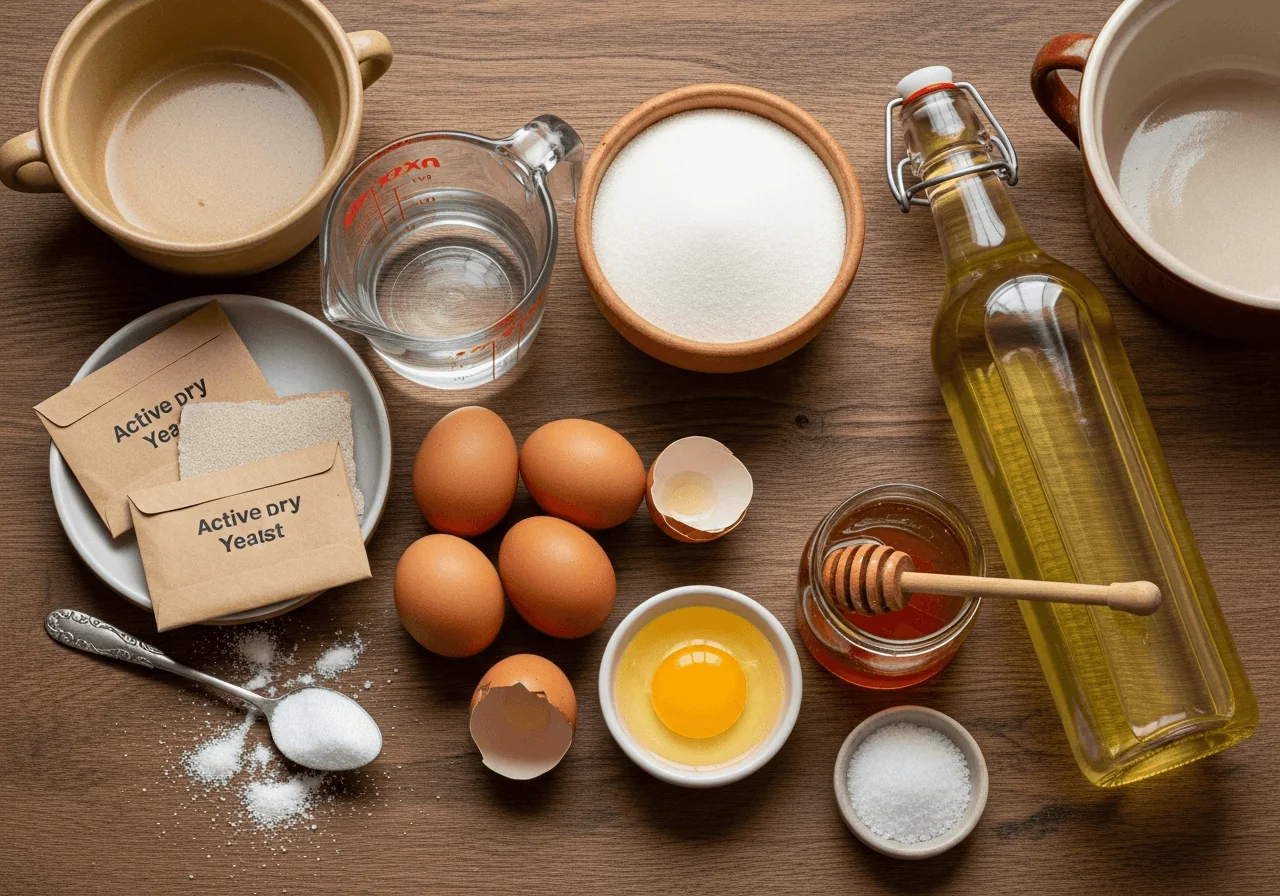
Ingredients
For the dough (makes 2 loaves)
- 2 packets (about 4½ teaspoons) active dry yeast
- 1½ cups warm water (about 110°F)
- ½ cup granulated sugar, divided
- 4 large eggs, plus 1 extra for egg wash
- ½ cup neutral vegetable oil (canola or sunflower), plus extra for the bowl
- 2 tablespoons honey
- 2½ teaspoons fine salt
- 7–8 cups all-purpose flour, plus more for kneading
For topping
- 1 egg, beaten, for egg wash
- Sesame seeds or poppy seeds (optional)
Instructions
Step 1: Bloom the yeast
In a large bowl or stand mixer, sprinkle the yeast over the warm water. Add a tablespoon of the sugar and stir gently. Let it sit for 5–10 minutes, until foamy on top. If it doesn’t foam, the yeast is inactive — start again with a fresh packet.
Step 2: Mix the wet ingredients
Whisk in the remaining sugar, the 4 eggs, oil, honey, and salt until well combined.
Step 3: Add the flour
Add the flour one cup at a time, mixing after each addition, until a soft dough forms that pulls away from the sides of the bowl but still feels slightly tacky to the touch.
Step 4: Knead
Knead the dough by hand on a floured surface, or with a stand mixer’s dough hook, for about 8–10 minutes, until it becomes smooth and elastic.
Step 5: First rise
Place the dough in a lightly oiled bowl, turning it once to coat. Cover with a damp towel or plastic wrap and let it rise in a warm spot for 1–1.5 hours, until roughly doubled in size.
Step 6: Divide and braid
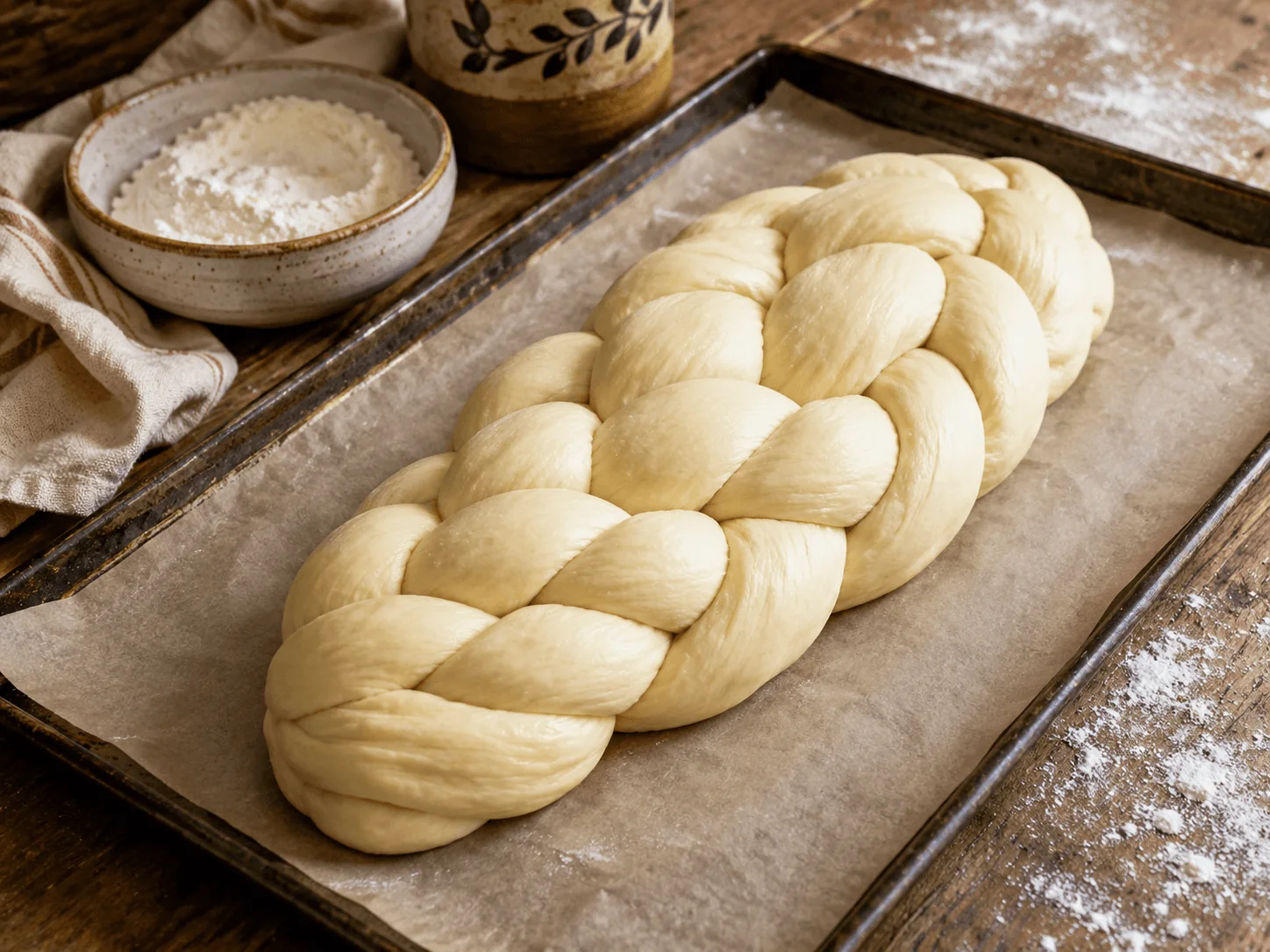
Punch down the dough and divide it in half for two loaves. Divide each half into 3 or 6 equal pieces, roll each into a long rope, and braid them together, pinching and tucking the ends underneath.
Step 7: Second rise
Place the braided loaves on a parchment-lined baking sheet, spaced well apart. Cover loosely and let rise for another 45 minutes to 1 hour, until visibly puffy.
Step 8: Egg wash and bake
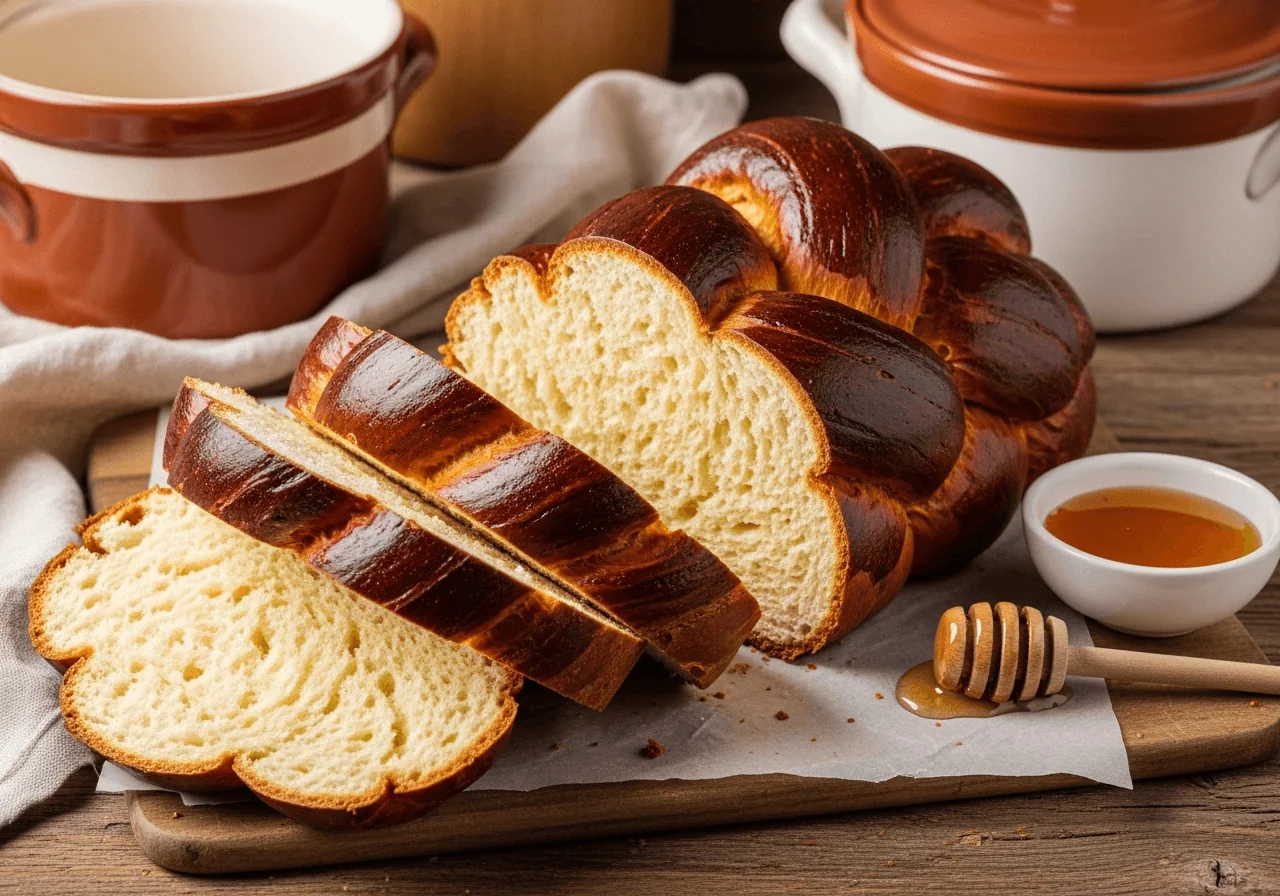
Preheat the oven to 375°F. Brush the loaves generously with beaten egg, sprinkle with seeds if using, and bake for 30–35 minutes, until deeply golden and the bottom sounds hollow when tapped.
Step 9: Cool
Transfer the loaves to a wire rack and let them cool for at least 20 minutes before slicing or tearing.
Kitchen Tips
A dough that stays slightly tacky, rather than fully dry and smooth, tends to bake into a softer, more tender crumb — resist the urge to add flour until the dough is completely clean of the bowl.
For a deeper golden color, apply a second light coat of egg wash about 10 minutes into baking. Rotating the pan halfway through baking also helps the loaves brown evenly, especially in ovens with uneven heat.
Six-strand braiding takes practice but isn’t difficult: lay the strands side by side, pinch the tops together, and work the outer strands over the center in a steady, repeating pattern until reaching the bottom.
Nutritional Information
Per serving (1 of 16 slices)
- Calories: approximately 170–210 kcal
- Protein: ~4–6g
- Total fat: ~4–6g
- Carbohydrates: ~27–31g
- Sodium: ~190–260mg
Nutritional values are estimates based on standard ingredient databases. They will vary depending on the exact flour, oil, and sweetener used, as well as slice thickness. Eggs contribute the bulk of the fat in the dough, along with a moderate amount of high-quality protein, choline, and several vitamins.7
Storage and Reheating
Store cooled challah at room temperature, wrapped well or in an airtight container, for up to 3–4 days. Because the dough is enriched with eggs and oil, it stays soft noticeably longer than a lean bread would.
For longer storage, challah freezes well for up to 3 months. Wrap a cooled loaf tightly in plastic wrap, then foil, and thaw it at room temperature before serving. To refresh a slightly stale loaf, wrap it in foil and warm it in a 300°F oven for 10–15 minutes.
Traditional Challah

Ingredients
For the dough (makes 2 loaves)
- 2 packets (about 4½ teaspoons) active dry yeast
- 1½ cups warm water (about 110°F)
- ½ cup granulated sugar, divided
- 4 large eggs, plus 1 extra for egg wash
- ½ cup neutral vegetable oil (canola or sunflower), plus extra for the bowl
- 2 tablespoons honey
- 2½ teaspoons fine salt
- 7–8 cups all-purpose flour, plus more for kneading
For topping
- 1 egg, beaten, for egg wash
- Sesame seeds or poppy seeds (optional)
Instructions
- Bloom yeast in warm water with a little sugar, then mix in eggs, oil, honey, and salt
- Knead in the flour gradually until the dough is smooth, soft, and slightly tacky
- Let the dough rise until doubled, then divide it into strands and braid two loaves
- Brush the shaped loaves with egg wash and let them rise again until puffy
- Bake until deeply golden, with a hollow sound when the bottom is tapped
Frequently Asked Questions
Why are there always two loaves of challah on the table?
The pair represents the double portion of manna that fell before Shabbat during the Israelites’ time in the desert, since none fell on the day of rest itself.2
Why doesn’t challah contain butter or milk?
Challah is kept pareve — free of both dairy and meat — so it can be served at any meal, including one built around meat, without violating the Jewish dietary laws that separate the two.2
Why is challah round on Rosh Hashanah instead of braided into a strip?
The circular shape is read as a symbol of the year’s continuity, with no clear beginning or end, fitting for the start of the Jewish New Year.2,4
What does “taking challah” actually involve?
It’s the practice of separating a small piece of dough, about the size of an egg, from a large enough batch, saying a blessing over it, and burning that piece rather than baking or eating it — a practice rooted in a Temple-era offering to the priests.5
Is challah the same as brioche?
The two breads are close cousins — both are egg-enriched and can look similar once braided — but classic brioche is made with butter and is not pareve, while challah is traditionally made with oil for exactly that reason.2
Where does the braided shape actually come from?
It isn’t biblical. Jewish bakers in southern Germany and Austria adopted a locally popular braided Sunday bread sometime in the 1400s, and the style eventually became the standard for Ashkenazi Shabbat bread.2,6
Can challah be made without eggs?
Yes — “water challah,” made without eggs or added sweetener, has long existed alongside the richer egg version and has a denser texture closer to a plain white loaf.2
Why is the challah covered with a cloth before the meal begins?
Covering the loaves lets the blessing over wine come first without appearing to slight the bread, and the cloth is also said to recall the dew that covered the manna each morning in the desert.1,4
Looking for a Lighter Version?
Traditional challah is an enriched, sweetened bread by design, and there’s genuine room to adjust it — a partial swap to whole wheat flour, a lighter hand with sugar, or a reduced-egg version that still braids and bakes beautifully. A separate Healthy Challah article on this site walks through those adjustments in detail.
Further Reading & Sources
The following sources were consulted in researching the history, symbolism, and technique of traditional challah. Heritage Healthy Kitchen’s recipe was developed independently; these links are provided for readers who want to explore further.
- “Challah.” Encyclopaedia Britannica. britannica.com/topic/challah — the double-loaf custom and the blessing sequence at the Shabbat table.
- “Challah.” Wikipedia. en.wikipedia.org/wiki/Challah — etymology, pareve status and ingredients, regional names, the manna account, the Rosh Hashanah round loaf, shlissel challah’s documented history, and comparison to brioche.
- Aish. “A Brief History of Challah.” aish.com/a_brief_history_of_challah — the biblical source of the word in Numbers 15, and the older name berches.
- My Jewish Learning. “What Is Challah?” myjewishlearning.com/article/challah — symbolism of braids and shapes by holiday, the challah cover and dew symbolism, the post-Temple burning practice, and the bread’s spread through Germany, Austria, Bohemia, and Eastern Europe.
- Chabad.org. “11 Challah Facts Every Jewish Woman Should Know.” chabad.org/theJewishWoman/11-Challah-Facts — the Temple-era dough offering, the mechanics of taking challah, flatbread traditions in Sephardic and Yemenite communities, and shlissel challah.
- Aish. “What Is Challah?: Six Facts.” aish.com/six-facts-about-challah — food historian Gil Marks’s account of the braided loaf’s origin in 1400s southern Germany, the 70 CE Temple destruction and the shift to burning the separated dough, and details on the flour-quantity thresholds for taking challah.
- Harvard T.H. Chan School of Public Health. “Eggs.” The Nutrition Source. nutritionsource.hsph.harvard.edu/food-features/eggs — nutritional composition of eggs, a key ingredient in traditional challah dough.
- “Hoshana Raba.” National Jewish Outreach Program. njop.org — the whole round challah dipped in honey on Hoshana Rabbah, the seventh day of Sukkot.
Disclaimer
The information in this article is provided for educational and informational purposes only. Heritage Healthy Kitchen makes no representations or warranties regarding the accuracy or completeness of any content on this site. Nutritional values are estimates only and will vary depending on the specific ingredients, brands, and measurements used. This content is not intended as dietary, medical, or professional nutritional advice. Always consult a qualified healthcare provider regarding any dietary needs or health conditions. Heritage Healthy Kitchen is not responsible for any outcomes resulting from the use of recipes or information published on this site.
Cook by Occasion
This recipe is part of our Rosh Hashanah menu and our Shabbat table.
You Might Also Like
More heritage recipes from our kitchen

Leave a Reply