
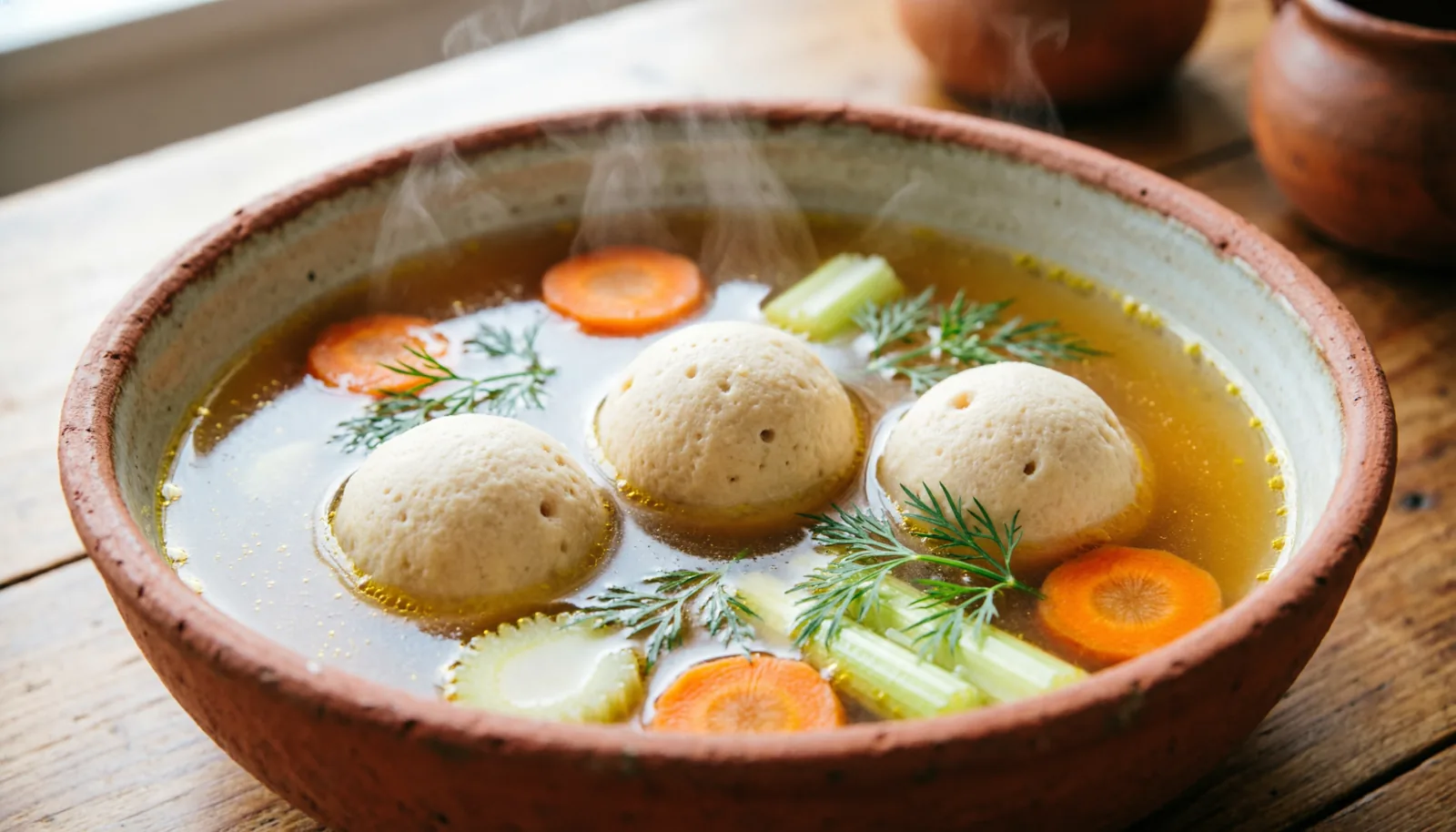
Active time: ~45 minutes | Total time: ~4 hours, plus chilling the broth overnight | Serves: 8 | Difficulty: Medium
Quick Overview
- Simmer a whole chicken with carrots, celery, onions and herbs for about two hours
- Strain the broth and chill it overnight
- Lift off the fat that sets on top and keep a little for the matzo balls
- Mix matzo meal, eggs, schmaltz and broth, then chill the mixture
- Roll loose balls with wet hands and cook them covered in salted water
- Serve in the hot broth with carrots, celery and dill
What Matzo Ball Soup Is
Matzo ball soup is clear chicken broth served with kneidlach, soft dumplings made from matzo meal, eggs and fat.1 It comes from Ashkenazi Jewish cooking, the cooking of the Jews of Central and Eastern Europe, and it’s traditionally eaten on Passover, though it’s common throughout the year.1 Matzo is unleavened bread made only from flour and water and baked, by Jewish tradition, within 18 minutes of mixing, before the dough can rise.18 Matzo meal is just matzo ground fine; it was once made from crumbs and is now produced by pulverizing whole matzos.2 Cooks disagree about texture. Some want light “floaters,” others swear by dense “sinkers.”3
History and Cultural Roots
How old the matzo ball is depends on whom you ask. Tablet’s list of the 100 most Jewish foods traces it to the German Knödel, a bready dumpling, and says that Jewish cooks in the Middle Ages first adapted such dumplings to Sabbath soups.3 An article on Chabad.org considers it a relatively new invention, probably from the 19th century, and points out that its exact origins aren’t clear.2
One of the earliest printed recipes in English is in The Jewish Manual, published in London in 1846. Its “Matso Soup” is made with beef, not chicken: the stock simmers for about eight hours and is skimmed of fat, and the matzo balls, bound with eggs and suet and seasoned with ginger and nutmeg, go in ten minutes before serving.4 The English name “matzo ball” first appeared in print in 1902.3
Regional habits varied. In Lithuania, kneidlach for the Sabbath were sometimes filled with cinnamon or meat,3 and a version with a little schmaltz inside was known as “matzah balls with souls.”1
On the Holiday Table
Matzo ball soup is at home on the Passover table, but not every community serves it during the holiday. Some, by custom, avoid matzo that has been soaked in liquid for most of Passover, while others eat matzo balls throughout the festival.1,2
The soup belongs to the Jewish New Year as well. The Academy of Nutrition and Dietetics lists matzo ball soup among the common Ashkenazi dishes for Rosh Hashanah, along with vegetable soup with short ribs and beef brisket.5 The recipe below is part of our Rosh Hashanah menu.
Traditional Matzo Ball Soup Recipe
This recipe was compiled by Heritage Healthy Kitchen from a comparison of published recipes; the sources are listed at the end of this article. Figures that are Heritage Healthy Kitchen’s own estimates rather than taken from a published source are marked as such.
Published recipes simmer a whole chicken of about 2kg (4–5 lb) in 4.7–5.7 liters (5–6 quarts) of water with carrots, celery and onion, some adding parsnip, turnip or parsley root, for anywhere from one to nearly four hours. Several chill the broth overnight and lift off the fat that sets on top.6,7,8,9 For the matzo balls, the proportions per cup of matzo meal run from 2 to about 4½ eggs, about 3½ to 5 tablespoons of fat and 3½ to 8 tablespoons of liquid, with 20 minutes to an hour of chilling and 30 to 40 minutes of cooking. None of these recipes uses baking powder.6,7,8,10 The amounts below sit inside those ranges. The weight of a cup of matzo meal, the number of matzo balls (16 to 24, depending on size), the amount of finished broth and the number of servings are Heritage Healthy Kitchen’s estimates.
Ingredients (serves 8)

For the broth:
- 1 whole chicken, about 2kg (4–4½ lb), left whole or cut into quarters
- 4.7 liters (5 quarts) cold water
- 4 carrots (about 400g), peeled and cut into large pieces
- 4 celery stalks with leaves, cut into large pieces
- 2 onions, peeled and halved
- 1 parsnip, peeled (optional)
- A handful of flat-leaf parsley sprigs
- 6 sprigs fresh dill, plus chopped dill for serving
- 2 bay leaves
- 1 tablespoon whole black peppercorns
- Salt, to taste
For the matzo balls (16–24):
- 4 large eggs
- 60ml (¼ cup) schmaltz (rendered chicken fat), melted and cooled, or vegetable oil
- 60ml (¼ cup) broth or cold seltzer
- 1 cup (about 115g) matzo meal
- 1 teaspoon salt
- Freshly ground black pepper
- 1 tablespoon chopped fresh dill (optional)
For serving:
- 2 carrots, peeled and sliced
- 2 celery stalks, sliced
Instructions
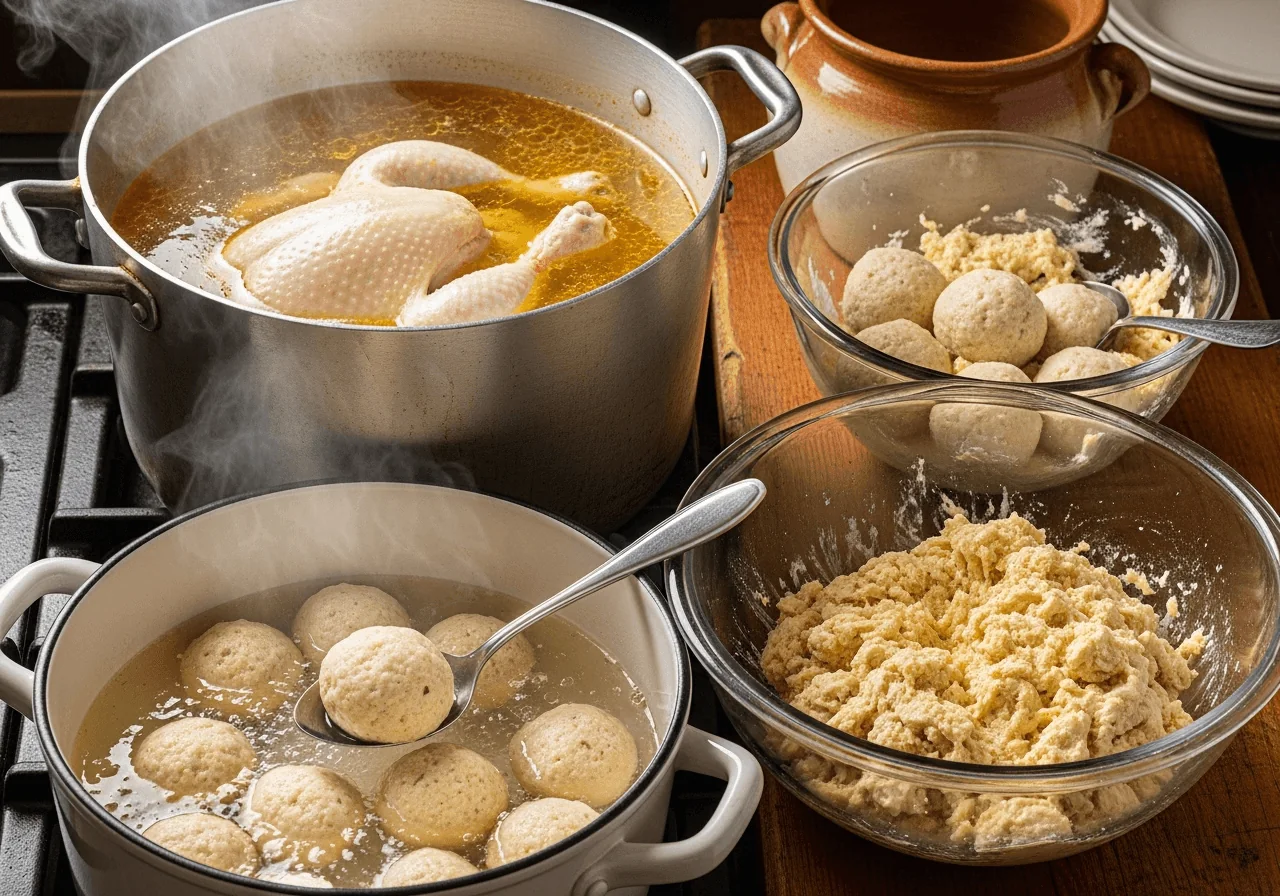
- Start the broth. Put the chicken in a large pot, cover with the cold water and bring to a boil over high heat, skimming off the foam as it rises.6,9
- Add the vegetables. Add the carrots, celery, onions, parsnip if using, parsley, bay leaves and peppercorns. Lower the heat and simmer gently with the lid ajar for about 2 hours, adding the dill sprigs for the last 45 minutes.6
- Strain and chill. Lift out the chicken and strain the broth, discarding the vegetables. Let it cool, then refrigerate overnight. The chicken meat can be pulled from the bones for the soup or kept for another dish.6,7,9
- Lift off the fat. The next day, remove the fat that has set on the surface. This is schmaltz; keep 60ml (¼ cup) of it for the matzo balls. Season the broth with salt to taste.6,7,9
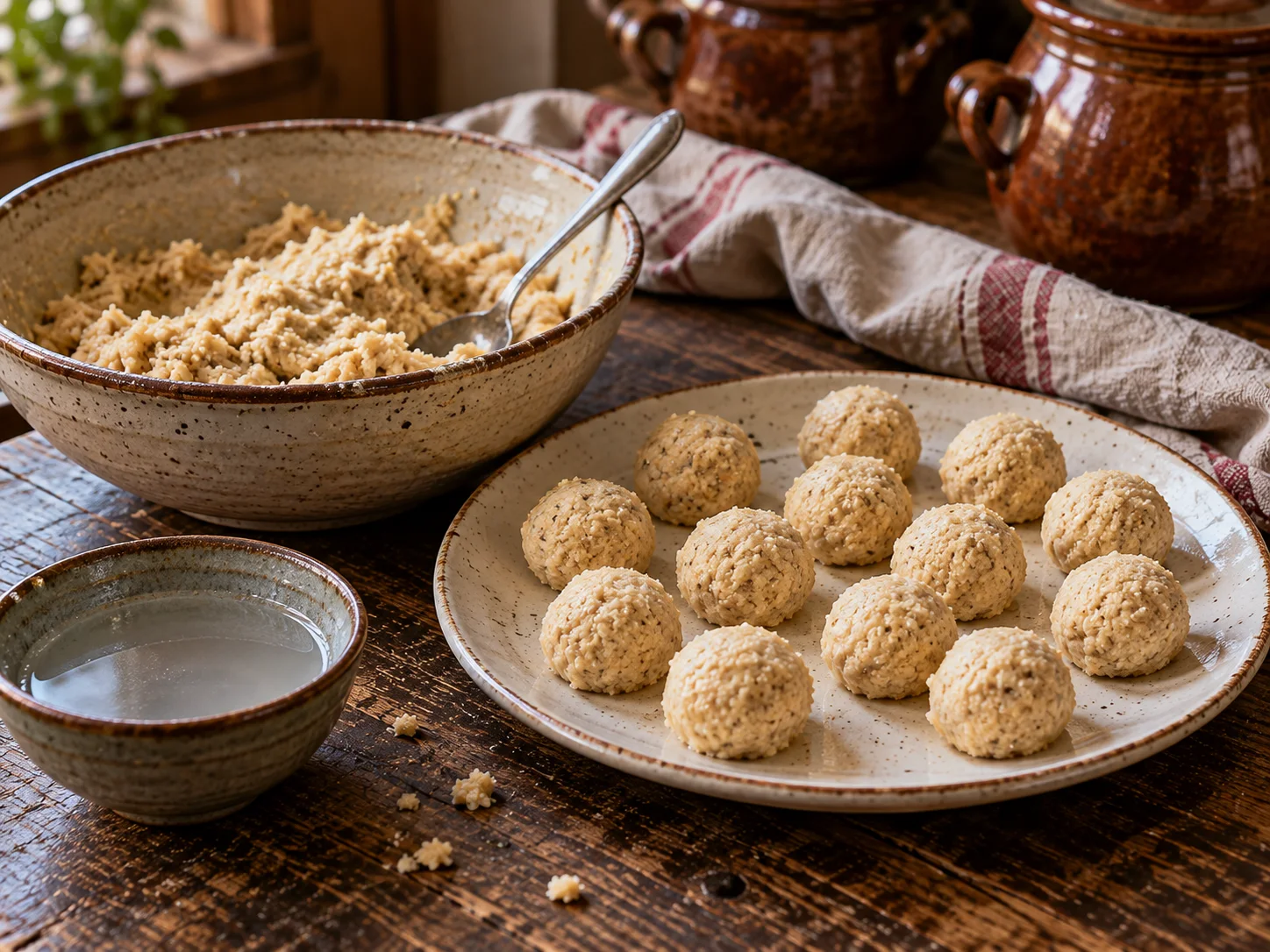
- Mix the matzo balls. Beat the eggs with the schmaltz and the broth or seltzer, then stir in the matzo meal, salt, pepper and dill until just combined. Cover and refrigerate for 30 minutes to 1 hour.6,8,10
- Shape them. Bring a large pot of well-salted water to a boil. With wet hands, roll heaping tablespoons of the mixture into balls without pressing them tight.6,8,9
- Cook. Drop the balls into the boiling water, let it return to a boil, then cover and simmer for 30–40 minutes. They roughly double in size.6,9
- Serve. Meanwhile, bring the broth to a simmer, add the sliced carrots and celery and cook for 20–30 minutes, until tender. Lift the matzo balls into the soup with a slotted spoon and serve two or three per bowl, with chopped dill.6,9
Kitchen Tips
Mix the matzo ball batter with a fork only until it comes together; overmixing makes the balls heavy.8
Keep a bowl of cold water with a few ice cubes next to you and dip your hands before each ball. The mixture won’t stick, and you can roll the balls gently between your palms instead of squeezing them.8
The fat lifted from the chilled broth is the schmaltz for the matzo balls, so there’s no need to render it separately.7
The matzo balls swell to about twice their size as they cook, so use a large pot and give them room.6
A Lighter Way to Make It
The traditional method already takes care of the broth: chilling it overnight and lifting off the fat that sets on top keeps that fat out of the bowl.6,7 The matzo balls are where the rest of the fat is. Olive oil or another liquid vegetable oil can replace the schmaltz. By weight, chicken fat has about twice the saturated fat of olive oil,11 and the American Heart Association recommends nontropical liquid oils in place of solid fats.12 One published recipe already uses olive oil.10
Two of the four eggs can be swapped for three egg whites. A large egg yolk has about 200 mg of cholesterol, and Harvard’s Nutrition Source suggests that people who have trouble controlling their cholesterol choose foods made with egg whites.13 Whole-wheat matzo meal keeps the bran and germ that milling removes,14 and whole-wheat matzo has about four times the fiber of plain matzo.11 How much egg white to use is Heritage Healthy Kitchen’s estimate, and the matzo balls may come out slightly different in texture.
Then there’s salt. Season the broth at the end, to taste, rather than adding a fixed amount at the start; the American Heart Association advises no more than 2,300 mg of sodium a day, with 1,500 mg as the ideal for most adults.15 Extra carrots in the bowl add fiber, since a cup of cooked carrots has about 4.8g.16 Made with olive oil, two eggs plus three whites, whole-wheat matzo meal and half the salt in the matzo balls, a bowl comes to roughly 245–300 kcal, with about 2.5g of saturated fat instead of 4g, about half the cholesterol and about twice the fiber (Heritage Healthy Kitchen’s estimate).
Nutritional Information
Per serving (one-eighth of the recipe: about 350ml of broth with one-eighth of the matzo balls and vegetables, without the chicken meat):
- Calories: approximately 260–320 kcal
- Protein: 12–15g
- Total fat: 12–15g, of which saturated 3.5–4.5g
- Carbohydrates: 24–30g
- Fiber: about 1g
- Cholesterol: 100–120mg
- Sodium: 770–945mg
Nutritional values are estimates based on standard ingredient databases (USDA FoodData Central). Sodium depends heavily on how much salt goes into the broth.
Storage and Reheating
Store the broth and the matzo balls in separate containers, so the matzo balls don’t sit in the liquid.9 Refrigerate within 2 hours of cooking, in shallow covered containers; both keep for 3 to 4 days in the refrigerator or 3 to 4 months in the freezer.17
Reheat the broth on the stove until it reaches 74°C (165°F) and warm the matzo balls in it for the last few minutes.17
Traditional Matzo Ball Soup

Ingredients
For the broth
- 1 whole chicken, about 2kg (4–4½ lb), left whole or cut into quarters
- 4.7 liters (5 quarts) cold water
- 4 carrots (about 400g), peeled and cut into large pieces
- 4 celery stalks with leaves, cut into large pieces
- 2 onions, peeled and halved
- 1 parsnip, peeled (optional)
- A handful of flat-leaf parsley sprigs
- 6 sprigs fresh dill, plus chopped dill for serving
- 2 bay leaves
- 1 tablespoon whole black peppercorns
- Salt, to taste
For the matzo balls (16–24)
- 4 large eggs
- 60ml (¼ cup) schmaltz (rendered chicken fat), melted and cooled, or vegetable oil
- 60ml (¼ cup) broth or cold seltzer
- 1 cup (about 115g) matzo meal
- 1 teaspoon salt
- Freshly ground black pepper
- 1 tablespoon chopped fresh dill (optional)
For serving
- 2 carrots, peeled and sliced
- 2 celery stalks, sliced
Instructions
- Broth: Chicken in cold water, boil and skim; add vegetables, simmer ~2 hours lid ajar, dill for the last 45 minutes.
- Chill: Strain, cool and refrigerate overnight; lift off the set fat and keep ¼ cup of it.
- Mix: Eggs, schmaltz, broth or seltzer, matzo meal, salt, pepper; chill 30–60 minutes.
- Shape: Wet hands, heaping tablespoons, rolled loosely.
- Cook: Covered in salted boiling water, 30–40 minutes.
- Serve: Simmer sliced carrots and celery in the broth 20–30 minutes; two or three matzo balls per bowl, with dill.
Frequently Asked Questions
Why do some matzo balls float and others sink?
It depends on the mixture and on how firmly the balls are rolled. Light “floaters” are often made with soda water or a little baking powder, while dense “sinkers” have their own loyal fans.3 Rolling the balls loosely, without compacting them, also keeps them lighter.9
Can I make matzo balls ahead of time?
Yes. Cook them, let them cool and store them separately from the broth, then warm them through in the simmering soup before serving.9 Refrigerated, they keep for 3 to 4 days.17
What is the difference between matzo and matzo meal?
Matzo meal is matzo ground fine. It was once made from matzo crumbs; today it is produced by pulverizing whole matzos.2
Is matzo ball soup only eaten at Passover?
No. The dumplings are traditionally eaten on Passover, but they are common throughout the year.1
Do I have to use schmaltz?
No. Some published recipes use schmaltz,6,7 others vegetable or olive oil.8,10 Made with oil, the matzo balls are pareve.10
Can I cook the matzo balls directly in the soup?
Yes. Some recipes cook them in the simmering broth instead of a separate pot of salted water.7,10 Cooking them separately and adding them at the end lets you keep the broth and the matzo balls apart for storage.9
Further Reading & Sources
The recipe is a compilation based on the published recipes listed here; these links are provided for readers who want to explore further.
- My Jewish Learning (no author named). Ask the Expert: Matzah Balls vs. Kreplach. Kneidlach as matzah balls; eaten on Passover and throughout the year; the Lithuanian “matzah balls with souls.”
- Yehuda Shurpin. How Traditional Are Matzo Balls? The Unusual History of the Kneidel. Chabad.org (no date given). Matzo meal from pulverized matzos; the matzo ball as a probably 19th-century invention; the custom of some communities to avoid wetted matzo during Passover.
- Joan Nathan. Matzo Balls. The 100 Most Jewish Foods, Tablet. The German Knödel and medieval Sabbath soups; filled Sabbath kneidlach in Lithuania; “matzo ball” in English from 1902; floaters and sinkers.
- The Jewish Manual; Practical Information in Jewish and Modern Cookery. “Edited by a Lady.” London, 1846. Project Gutenberg edition. The 1846 recipe “Matso Soup” with beef stock and matzo balls seasoned with ginger and nutmeg.
- Melissa Altman-Traub, MS, RDN. (1 March 2023). Rosh Hashanah. Academy of Nutrition and Dietetics, eatright.org. Common Ashkenazi Rosh Hashanah menu items include vegetable soup with short ribs or matzo ball soup, and beef brisket.
- Mitchell Davis. (20 March 2020, updated 12 August 2024). Classic Matzo Ball Soup. Jewish Food Society. Published recipe: broth proportions, simmering times, chilling and skimming; matzo balls with schmaltz, chilling, shaping and cooking time.
- Petra Kay. (9 April 2020). Matzo Ball Soup. PBS Food. Published recipe: broth chilled overnight and the schmaltz lifted off; matzo balls with schmaltz, cooked in the soup.
- Shannon Sarna. (29 March 2017). How to Make Chicken Soup with Matzah Balls. The Nosher, My Jewish Learning. Published recipe: broth vegetables and times; matzah balls with oil and seltzer, mixing, chilling and rolling with wet hands.
- Jennifer Segal. (27 September 2022, updated 2026). Matzo Ball Soup. Once Upon a Chef. Used for method only: chilling and skimming the broth, shaping, carrots simmered in the finished soup, separate storage.
- Hadassah Sabo Milner. (30 December 2011, updated 20 August 2019). Matzah Balls – Kneidlach. JamieGeller.com. Published pareve recipe with olive oil and seltzer; chilling and cooking times; cooking directly in the soup.
- U.S. Department of Agriculture. FoodData Central, SR Legacy: chicken fat (FDC 173564), olive oil (FDC 171413), plain matzo (FDC 172740), whole-wheat matzo (FDC 172742). Per 100g: chicken fat 29.8g saturated fat, olive oil 13.8g; plain matzo 3g fiber, whole-wheat matzo 11.8g.
- American Heart Association. (last reviewed 24 October 2023). Healthy Cooking Oils. heart.org. Nontropical vegetable oils are healthier choices than solid fats; solid fats and tropical oils have more saturated fat than nontropical liquid fats; use oils in place of butter, stick margarine or solid fats.
- The Nutrition Source. Eggs. Harvard T.H. Chan School of Public Health (last reviewed August 2020). One large egg yolk has about 200 mg of cholesterol; people who have trouble controlling their cholesterol may want to be cautious about egg yolks and choose foods made with egg whites instead.
- Howard LeWine, M.D. (1 January 2021). How important are whole grains in my diet? Harvard Health Publishing. Whole grains keep the bran, which holds most of the fiber, and the germ; milling refined grains removes both.
- American Heart Association. (last reviewed 15 July 2025). How much sodium should I eat per day? heart.org. No more than 2,300 mg of sodium a day, with an ideal limit of no more than 1,500 mg for most adults.
- Lisa Catanese. (4 March 2024). Foods high in fiber: Boost your health with fiber-rich foods. Harvard Health Publishing. Cooked carrots: 4.8 grams of fiber per cup.
- USDA Food Safety and Inspection Service. Leftovers and Food Safety. Refrigerate within 2 hours in shallow covered containers; leftovers keep 3 to 4 days in the refrigerator or 3 to 4 months in the freezer; reheat to 165°F (74°C).
- Rabbi Yissachar Dov Krakowski. (25 February 2026). Understanding the Not-So-Simple Matzah. OU Kosher. Matzah as bread that has not risen, made from flour and water alone and fully baked within 18 minutes of mixing.
Disclaimer
The information in this article is provided for educational and informational purposes only. Heritage Healthy Kitchen makes no representations or warranties regarding the accuracy or completeness of any content on this site. Nutritional values are estimates only and will vary depending on the specific ingredients, brands, and measurements used. This content is not intended as dietary, medical, or professional nutritional advice. Always consult a qualified healthcare provider regarding any dietary needs or health conditions. Heritage Healthy Kitchen is not responsible for any outcomes resulting from the use of recipes or information published on this site.
Cook by Occasion
This recipe is part of our Passover menu, our Rosh Hashanah menu and our Shabbat table.
You Might Also Like
More heritage recipes from our kitchen


Leave a Reply