

Part of our Heritage Kitchen Glossary – short guides to the ingredients and techniques behind Eastern European cooking.
The short answer
Schmaltz is rendered poultry fat – almost always chicken, historically goose – that served as the primary cooking fat of Ashkenazi Jewish kitchens for centuries. Where French cooking reaches for butter and Mediterranean cooking for olive oil, the Jewish kitchens of Poland, Ukraine and Lithuania reached for schmaltz.
Why schmaltz existed in the first place
The answer is kosher law. Dairy and meat cannot be combined in the same meal, which ruled out butter for cooking anything with chicken or beef. Olive oil did not grow in Eastern Europe, and vegetable oils were a twentieth-century industrial product. What every household did have was the fat trimmed from a chicken. Rendered slowly with onion, it became a cooking fat with a deep, savory flavor that no oil can imitate.
How it is made
Chicken fat and skin are cut small and heated gently with sliced onion until the fat melts and the skin turns into crisp golden nuggets. The liquid fat is strained and kept; the crisp bits – gribenes – are the cook’s reward, eaten warm with salt or scattered over kasha. A jar of schmaltz keeps for weeks in the refrigerator.
Where you will meet it on this site
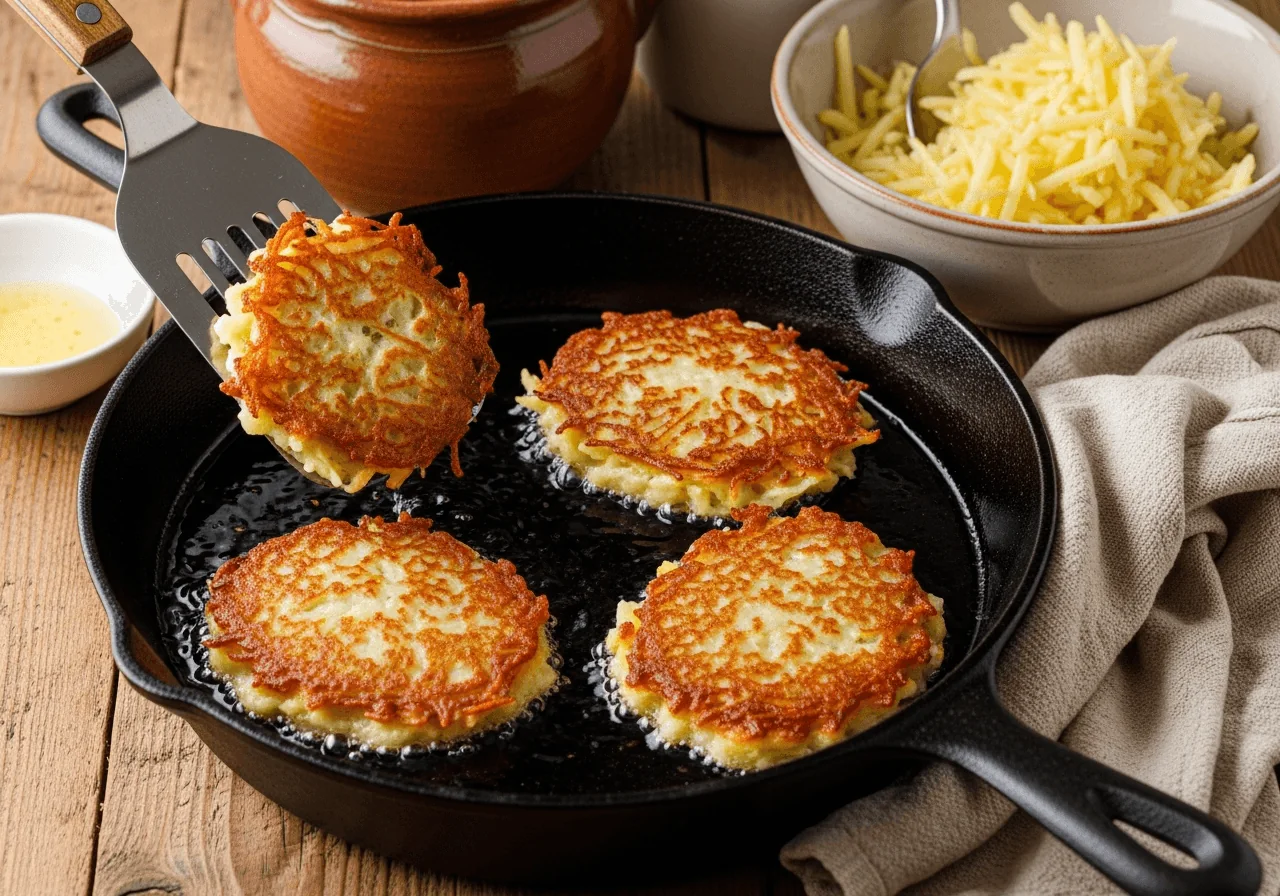
Schmaltz is the traditional fat in our Traditional Matzo Ball Soup, where it binds the kneidlach and carries the flavor of the broth, and it is the frying fat many families still swear by for Traditional Latkes. You will also find its spirit – fat rendered with onion as a flavor base – across the whole region, from Polish bigos to Ukrainian banosh with its salo shkvarky.
Substitutes and the lighter view
Neutral oil with a pinch of onion powder is the standard modern substitute; olive oil works where its flavor fits. Our healthy adaptations usually swap schmaltz for olive oil – see Healthy Matzo Ball Soup for how the swap changes the nutrition numbers without losing the soul of the dish. Nutritionally, schmaltz is comparable to other animal fats: mostly monounsaturated and saturated fat, best treated as a flavoring rather than a base when cooking lighter.
Further Reading & Sources
This entry draws on the sources below and on the recipes it links to elsewhere on this site. They are listed for readers who want to go further.
- “Schmaltz.” Wikipedia. en.wikipedia.org/wiki/Schmaltz — etymology of the Yiddish word and the shift from goose fat to chicken fat.
- “Schmaltzy History: A Nostalgic Look at Fats for Frying Latkes.” Jewish Telegraphic Agency. jta.org — why rendered poultry fat, rather than butter or oil, became the everyday cooking fat of the Ashkenazi kitchen.
- “Ashkenazic Cuisine.” My Jewish Learning. myjewishlearning.com — the wider kitchen schmaltz belongs to, and the kosher separation of meat and dairy that shaped it.
Leave a Reply