
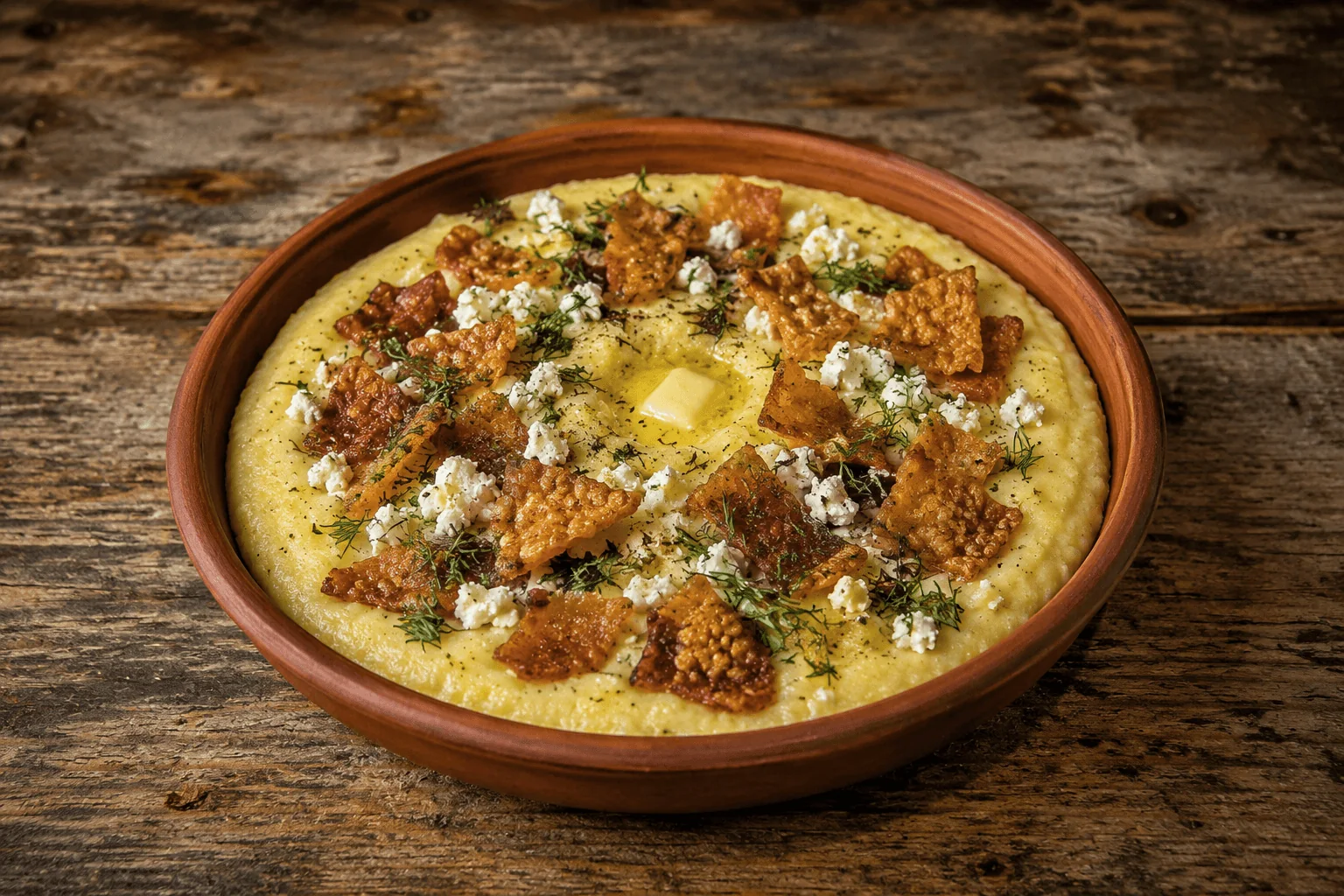
Active time: ~20 minutes | Total time: ~35 minutes | Serves: 4 | Difficulty: Easy
Quick Overview
- Warm cream and sour cream together in a heavy pot until nearly simmering, then whisk in cornmeal in a steady stream
- Stir constantly with a wooden spoon over low heat for 15–20 minutes until the porridge turns thick, smooth, and glossy
- Meanwhile, fry diced pork belly or bacon in a separate pan until crisp
- Spoon the hot porridge into bowls and make a small well in the center for a pat of butter
- Finish with crumbled bryndza cheese, the fried pork cracklings, and a scatter of fresh herbs
What Banosh Is
Banosh, also spelled banush, is a thick cornmeal porridge simmered in cream or sour cream (smetana) until velvety, then topped with bryndza sheep’s cheese and pork cracklings or sautéed mushrooms.3 It belongs to Hutsul cuisine, the food of the pastoral highlanders of Ukraine’s Carpathian Mountains,2,3 and it is especially associated with the Zakarpattia region.5
In the Hutsul dialect, the dish also goes by the name tokan, a word more often used for a slightly thicker preparation eaten with a spoon or, once set, sliced with a length of thread the way bread might be cut.7 Cognates of the dish turn up across the wider Carpathian world: bălmuș in Romania and banusz in Poland both describe closely related corn-and-dairy porridges.3
What separates banosh from an everyday side of cornmeal is the dairy. Where Italian polenta is typically built on water, banosh is cooked almost entirely in cream and sour cream, which gives it a much richer, silkier texture.7
The Hutsuls: Guardians of the Carpathians
Hutsuls are an ethnographic group of Ukrainian highlanders who have lived in the Carpathian Mountains for centuries, herding sheep and cattle across high alpine pastures called polonynas.1,2 Their exact origins are debated among scholars: some trace the name to an old word for nomad describing people who fled the Mongol invasion into these mountains, others to a Romanian term, still others to a Slavic tribe that resettled here long before. Whatever the truth of it, their distinct identity, dialect, and folkways have persisted regardless of which empire happened to rule the valleys below.2
By the mid-19th century there were already over a hundred Hutsul villages scattered through the region, populated in part by peasants who had fled serfdom in the lowlands for the relative freedom of the mountains.2 That isolation bred a fierce independence: bands of mountain outlaws called opryshoks spent centuries avenging the wrongs done to common people by landowners, and Hutsuls are still remembered across Ukraine for that streak of defiance.2
Food in this world grew directly out of the polonyna. Recent ethnobotanical fieldwork among Hutsul communities documents both banosh and the related dish kulesh as foods still prepared for holidays in the region today, the latter made in part with cheese from sheep grazed on the high pastures.1 The same research found that gathering wild mushrooms, berries, and herbs from the surrounding forests remains a living practice passed down through generations, not a historical curiosity.1
A Dish Cooked by Men, Over an Open Fire
Banosh carries a gendered history unusual among Eastern European comfort foods. Because sheep husbandry and cheesemaking were traditionally considered men’s work among the Hutsuls, it was men, not women, who cooked banosh and tended the bryndza.5,7 Shepherds prepared it themselves on the mountain slopes, over the same fires where they watched their flocks.4
The classic method calls for a large cast-iron pot set directly over an open campfire, stirred continuously with a wooden spoon, traditionally always in the same direction, so the porridge takes on a faint smokiness from the fire itself.4,7 Some households still keep a dedicated spot in the yard set aside for exactly this purpose.7
One folk explanation for the dish’s origin leans into scarcity rather than abundance. One version holds that banosh is a product of hard times, when meat was scarce but sheep’s milk and a little cornmeal were still on hand.4 A related telling puts it more simply: a cow gave milk, the pantry held some cornmeal, and someone worked out that the two together made a meal substantial enough to get by on.7
The Legend of a Man Named Banosh
Ask a Hutsul cook where the name comes from and there’s a good chance the answer involves a story, not an etymology. One widely repeated version tells of a devoted wife who kept calling her husband in from the fields with the words “eat, Banosh, eat, Banosh,” and the porridge she was calling him to simply took his name.4,7
A separate, only half-joking bit of local wisdom holds that a really good banosh can only be made by someone born into a Hutsul family, well versed in dairy, mushrooms, and salo, and, above all, in love.4,7 Falling for a Hutsul girl, as the saying goes, is what really guarantees the porridge turns out right.
Whether or not the romance is required, the practical wisdom behind these stories is real. Banosh does depend on getting a feel for the cornmeal, the heat, and the dairy all at once, the kind of knowledge that in this region has always been passed down hand to hand rather than written in a book.
Banosh Today: From Mountain Fire to National Table
Banosh has traveled a long way from a shepherd’s fire. What was once a regional dish, saved for special occasions because its cream and cheese were relatively costly, is now served in restaurants across Ukraine and sold ready-made in supermarkets.3,6 The town of Rakhiv, deep in the Carpathians, hosts an annual banosh festival that draws visitors specifically to sample the dish cooked the old way.4,7
There is no single correct recipe. Because banosh has only ever really required cornmeal and a dairy base, individual cooks have always taken liberties with toppings: cracklings, sautéed wild mushrooms, fried onion, smoked sausage, even stewed prunes for a meat-free version, while the porridge itself stays essentially the same.4
The dish can also be made thick enough to hold its shape, cut into slices the way bread is cut, or looser and spoonable, depending on the household and the occasion.4,7 Either way, the two ingredients that never change are cornmeal and cream.
Traditional Banosh Recipe
Recipe developed independently by Heritage Healthy Kitchen, drawing on traditional Hutsul culinary methods. Sources for further reading are listed at the end of this article.
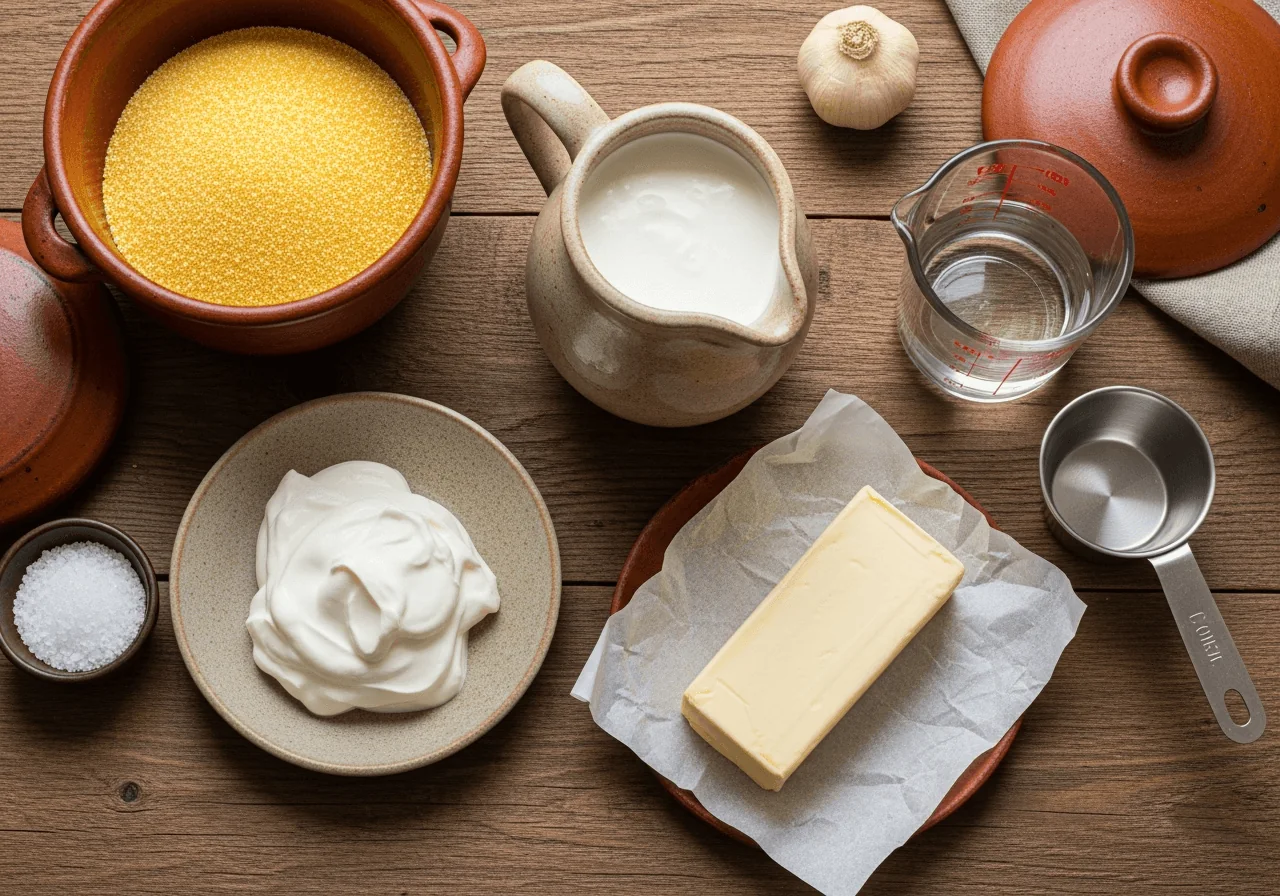
Ingredients
For the porridge (serves 4)
- 1 cup (about 150g) medium or coarse cornmeal (polenta-style, not fine)
- 1 cup heavy cream or whipping cream
- 1/2 cup full-fat sour cream
- 1–1 1/2 cups water, plus more as needed
- 1/2 teaspoon salt, or to taste
- 2 tablespoons unsalted butter
For the toppings
- 200g pork belly or thick-cut bacon, diced
- 150–200g bryndza cheese, crumbled (sheep’s milk feta is the closest widely available substitute)
- Freshly ground black pepper
- Fresh dill or parsley, chopped
- Optional: sautéed wild mushrooms or fried onion, in place of or alongside the pork
Instructions

Step 1: Fry the pork
Dice the pork belly or bacon into small pieces. Fry it in a dry skillet over medium heat until deeply golden and crisp, then set it aside, leaving the rendered fat in the pan.
Step 2: Warm the cream
In a heavy-bottomed pot, combine the cream, sour cream, and 1 cup of water. Warm over medium heat, stirring, until the mixture is hot but not boiling.
Step 3: Add the cornmeal gradually
Add the cornmeal in a slow, steady stream while whisking constantly, a little at a time rather than all at once, to keep it from clumping. Stir in the salt.
Step 4: Cook low and slow
Reduce the heat to low and switch to a wooden spoon, stirring frequently for 15–20 minutes as the porridge thickens. If it becomes too stiff before it turns silky, add a splash more water or cream rather than forcing it along on high heat.
Step 5: Finish and serve
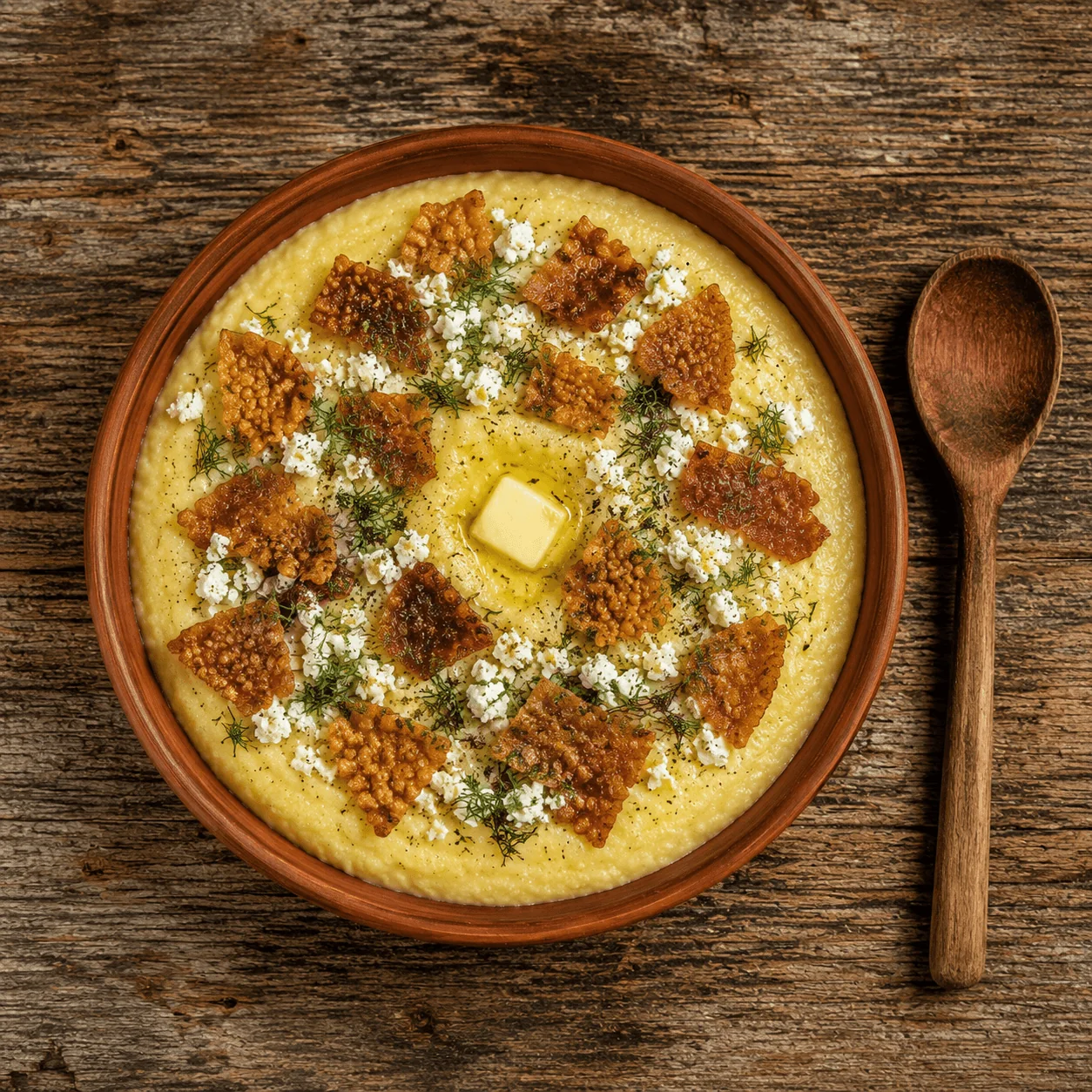
Once the porridge is thick, smooth, and glossy, spoon it into bowls. Press a small well into the center of each portion and tuck in a pat of butter so it melts into the surface just before serving.
Step 6: Top and serve hot
Scatter the crisp pork over the top, crumble the bryndza generously over that, and finish with black pepper and chopped herbs. Serve immediately, while the porridge is still hot enough to keep the butter glossy.
Kitchen Tips
Use medium or coarse cornmeal rather than a fine-ground variety. Fine cornmeal cooks up gummy and dense, while a coarser grind gives banosh its characteristic soft, slightly toothy texture.6
Add the cornmeal slowly and keep whisking as it goes in. Dumping it into the pot all at once is the single most common cause of lumpy porridge, since the outer layer of each grain sets before the liquid can fully penetrate it.6
As a rough ratio, plan on about four parts liquid to one part cornmeal by volume, adjusting as needed depending on how thick a finished porridge you prefer.6 A thinner banosh loosens easily with a splash of warm cream; a thicker one is easier to serve sliced.
Go easy on salt in the porridge itself. Both bryndza and pork cracklings are naturally salty, and it is easy to end up with an over-seasoned dish if the base is heavily salted as well.5
Nutritional Information
Per serving (porridge with pork and cheese toppings, 1 of 4 servings)
- Calories: approximately 500–600 kcal
- Protein: ~14–18g
- Total fat: ~40–48g
- Carbohydrates: ~28–32g
- Sodium: ~450–650mg (varies considerably with the saltiness of the cheese and cracklings used)
Nutritional values are estimates based on standard ingredient databases. They will vary depending on the fat content of the cream and cheese used, the amount of pork topping, and how much salt is added.
Storage and Reheating
Banosh is best enjoyed freshly made, while the porridge is still hot and the toppings are still crisp.6 If storing leftovers, keep the plain porridge separate from the pork and cheese toppings, in an airtight container in the refrigerator for up to 2–3 days.6
To reheat, warm the porridge gently in a small saucepan with a splash of milk or cream, stirring often until it loosens back into a smooth, glossy consistency. Add fresh toppings after reheating rather than storing them mixed in, since refried cracklings hold their crunch far better than ones reheated a second time.6
Traditional Banosh

Ingredients
For the porridge (serves 4)
- 1 cup (about 150g) medium or coarse cornmeal (polenta-style, not fine)
- 1 cup heavy cream or whipping cream
- 1/2 cup full-fat sour cream
- 1–1 1/2 cups water, plus more as needed
- 1/2 teaspoon salt, or to taste
- 2 tablespoons unsalted butter
For the toppings
- 200g pork belly or thick-cut bacon, diced
- 150–200g bryndza cheese, crumbled (sheep’s milk feta is the closest widely available substitute)
- Freshly ground black pepper
- Fresh dill or parsley, chopped
- Optional: sautéed wild mushrooms or fried onion, in place of or alongside the pork
Instructions
- Warm cream and sour cream together in a heavy pot until nearly simmering, then whisk in cornmeal in a steady stream
- Stir constantly with a wooden spoon over low heat for 15–20 minutes until the porridge turns thick, smooth, and glossy
- Meanwhile, fry diced pork belly or bacon in a separate pan until crisp
- Spoon the hot porridge into bowls and make a small well in the center for a pat of butter
- Finish with crumbled bryndza cheese, the fried pork cracklings, and a scatter of fresh herbs
Frequently Asked Questions
What is bryndza, and can I substitute something else?
Bryndza is a salty, tangy brined cheese made from sheep’s, goat’s, or cow’s milk, traditional to the Carpathian region.5,7 Sheep’s milk feta is the closest widely available substitute; regular cow’s milk feta also works, though it is milder.
Why is my banosh lumpy?
Lumps almost always come from adding the cornmeal too quickly or without enough stirring. Whisk constantly and add it in a slow, steady stream rather than all at once.6
What kind of cornmeal should I use?
Medium or coarse cornmeal, similar to what’s sold for Italian polenta, gives the right texture. Very finely ground cornmeal produces a denser, gummier result.6
Is banosh the same as polenta?
They’re close cousins, both built on cornmeal, but not identical. Polenta is traditionally cooked in water, while banosh is cooked almost entirely in cream and sour cream, which gives it a noticeably richer texture.7
Can banosh be made vegetarian?
Yes. Fried mushrooms and onion are a common modern substitution for the pork.6 One older version uses stewed prunes as a meat-free topping instead.4
Why is banosh traditionally cooked by men?
Among the Hutsuls, sheep husbandry and cheesemaking were historically considered men’s work, and since bryndza and the dish built around it were tied to that work, the cooking fell to men as well.5,7
Where does the name “banosh” come from?
Local legend traces it to a man named Banosh, whose devoted wife would repeatedly call him in from the fields to come eat.4,7 It’s also known as tokan in the Hutsul dialect.7
Looking for a Lighter Version?
Traditional banosh leans heavily on cream, sour cream, and salty toppings, which makes it a rich, occasional dish rather than an everyday one. There’s real room to lighten it: swapping in kefir or low-fat yogurt for some of the cream, leaning on mushrooms over cracklings, without losing what makes it recognizably banosh. A separate Healthy Banosh article on this site walks through those adjustments in detail.
Further Reading & Sources
The following sources were consulted in researching the history, technique, and cultural background of traditional banosh. Heritage Healthy Kitchen’s recipe was developed independently; these links are provided for readers who want to explore further.
- Fontana, N.M., Pasailiuk, M.V., and Pohribnyi, O. “Traditional ecological knowledge to traditional foods: The path to maintaining food sovereignty in Hutsulshchyna.” Frontiers in Sustainable Food Systems, vol. 6, 2022. frontiersin.org/journals/sustainable-food-systems/articles/10.3389/fsufs.2022.720757 — peer-reviewed ethnobotanical fieldwork documenting banosh and kulesh as living holiday foods tied to polonyna sheep grazing and bryndza production.
- “Hutsuls.” Internet Encyclopedia of Ukraine, Canadian Institute of Ukrainian Studies, University of Toronto/University of Alberta. encyclopediaofukraine.com — Hutsuls — scholarly overview of Hutsul origins, history, settlement, and folk culture.
- “Banosh.” Wikipedia. en.wikipedia.org/wiki/Banosh — basic definition, ingredients, and the Polish (banusz) and Romanian (bălmuș) cognate names.
- Slava. “Banosh – A Velvety Cornmeal Porridge.” Kitchen Epiphanies. kitchenepiphanies.com/banosh-velvety-cornmeal-porridge — history, the mid-18th-century corn cultivation timeline, name legend, and the Rakhiv banosh festival.
- Stsepeleva, Yuliia. “Banosh (Hutsul Corn Porridge).” Recipes From Europe. recipesfromeurope.com/banosh — recipe method, ingredient substitutions, and the tradition of banosh being cooked by men.
- Savchenko, Nataliia. “Banosh (Ukrainian Cornmeal Porridge with Pork Belly and Cheese).” Savas Kitchen. savaskitchen.com/banosh-ukrainian-cornmeal-porridge-with-pork-belly-and-cheese — cornmeal-to-liquid ratio, cooking technique, and storage guidance.
- “Ukrainian banosh – Why do you need to fall in love to cook this national dish?” Ukrainian Recipes. ukrainian-recipes.com — Ukrainian banosh — the tokan name, wooden-spoon and open-fire tradition, and the name-origin legend.
Disclaimer
The information in this article is provided for educational and informational purposes only. Heritage Healthy Kitchen makes no representations or warranties regarding the accuracy or completeness of any content on this site. Nutritional values are estimates only and will vary depending on the specific ingredients, brands, and measurements used. This content is not intended as dietary, medical, or professional nutritional advice. Always consult a qualified healthcare provider regarding any dietary needs or health conditions. Heritage Healthy Kitchen is not responsible for any outcomes resulting from the use of recipes or information published on this site.
You Might Also Like
More heritage recipes from our kitchen

Leave a Reply