
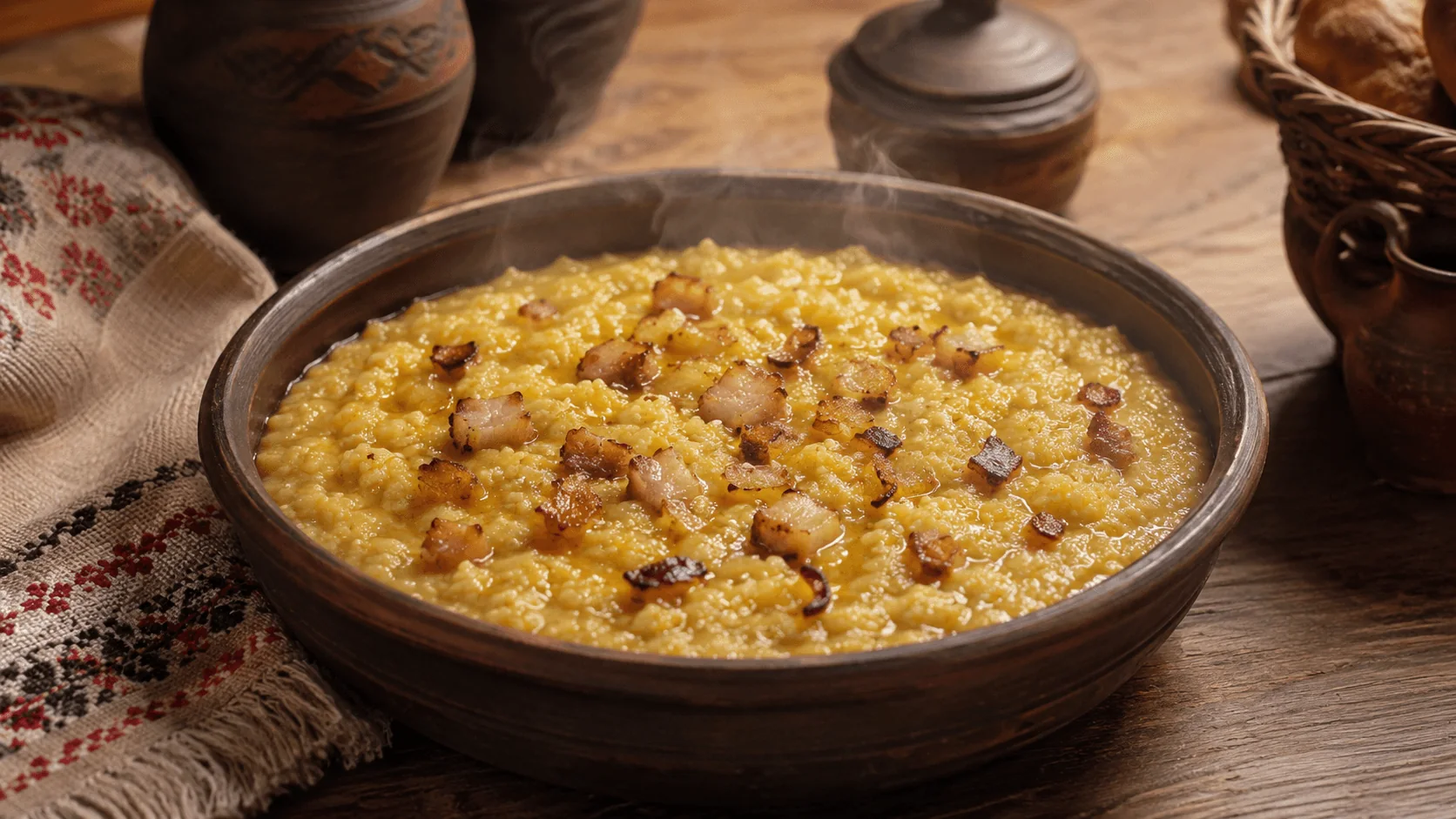
Active time: ~15 minutes | Total time: ~40 minutes | Serves: 4 | Difficulty: Easy
Quick Overview
- Rinse millet several times until the water runs clear, which removes the bitterness that gives poorly made kulish a harsh edge
- Render lard or bacon fat in a heavy pot, then fry chopped onion in the fat until golden
- Add the rinsed millet, coat it in the fat, then pour in water or broth
- Simmer uncovered, stirring occasionally, until the millet is tender and the mixture thickens into a spoonable, glossy porridge
- Serve hot in deep bowls with dark rye bread, ideally straight from the pot
What Kulish Is
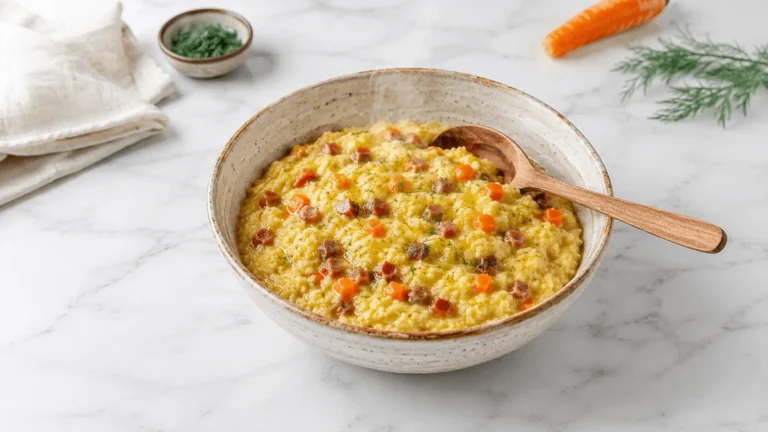
Kulish is a millet porridge cooked in a single pot with rendered lard and onion, thickened until it sits somewhere between a stew and a porridge.5 It is the defining field dish of the Zaporozhian Cossacks, the horsemen and river-raiders who controlled the lower Dnipro steppe from the sixteenth through the eighteenth centuries.1,3
The dish has no fixed recipe. At its simplest it is millet boiled in water with salt.4 With meat, bacon, or fish added when available, it becomes a heartier main course, and a very thick version was traditionally given its own name, kuleba.4 That flexibility was the entire point: kulish was built to be cooked by men on the move, from whatever was in the saddlebag that week.
It is sometimes called “field porridge” for that reason, since it was the meal Cossack detachments cooked over open fires during military campaigns on the steppe, in cauldrons large enough to feed an entire company from a single pot.3,4,5
It sits alongside other one-pot heritage dishes of the region, such as Traditional Ukrainian Borscht and Traditional Banosh, both built on the same principle of turning a handful of humble ingredients into a full meal in a single pot.
The Zaporozhian Cossacks and the Steppe They Cooked In
The word “Cossack” comes from a Turkic root meaning a free man, someone who answered to no lord and lived by his own resources.1 By the sixteenth century it had come to describe Ukrainians who had fled serfdom and Polish rule for the sparsely settled steppe south of the Dnipro Rapids, where they built a fortified base known as the Zaporozhian Sich.1
Life there was organized around near-constant defense against Tatar raids, river campaigns, and long stretches spent far from any town or supply line.1 Cossack rations from military records of the period show why a dish like kulish mattered: a single Cossack artillery serviceman in the Pereyaslav regiment received close to 200 kilograms of rye, 50 kilograms each of wheat, buckwheat flour, and millet, plus 15 kilograms of salo (cured pork fat) and 55 grams of salt, as an annual allotment.2 Millet and cheap rendered fat were not incidental ingredients. They were quite literally what the army was paid in.
Cooking under these conditions had to be fast and required no equipment beyond a cauldron and a fire. Kulish, along with kasha and a handful of other grain dishes, filled that role for the ordinary Cossack rank and file, while the officer class ate considerably better when campaigning further afield.2
The dish wasn’t unique to the Zaporozhian Cossacks either. Don Cossacks, settled further east along the Don River, prepared their own soups and stews built around fish, among them a version of the same porridge they called kulesh.2 The core idea, a single pot, one starchy grain, whatever fat or protein was on hand, kept showing up wherever Cossack communities settled along the rivers of the steppe.
Millet, a Grain Older Than the Cossacks
Millet was not a Cossack invention. Archaeological research suggests it had been cultivated on the territory of modern Ukraine since roughly 5000 BCE, long before the Zaporozhian Sich existed.4 What the Cossacks did was turn an ancient, unglamorous grain into a dish specific enough to carry their own name.
The word “kulish” itself likely traces back to Turkic roots, a linguistic fingerprint of the centuries of contact, conflict, and exchange between Cossack, Tatar, and other steppe peoples.3 It entered Ukrainian as shorthand for this kind of one-pot campfire porridge, and it stayed there long after the Sich itself was gone.
Kulish in Literature and Everyday Speech
The clearest historical fingerprint kulish left behind is literary rather than culinary. Ivan Kotliarevsky’s 1798 mock-heroic poem Eneida, which reimagines the heroes of the Aeneid as Zaporozhian Cossacks, lists kulish among the dishes its characters eat, placing it in the same breath as other Cossack staples like lemishka.4 Eneida is widely regarded as a landmark of Ukrainian vernacular literature, which suggests kulish was already recognizable enough by the late eighteenth century to work as a piece of everyday cultural shorthand.
The dish’s reach went further than literature. It became common enough that it gave rise to a Ukrainian surname, Kulish, carried by, among others, the nineteenth-century writer Panteleimon Kulish (1819–1897) and the twentieth-century playwright Mykola Kulish (1892–1937).6 Few dishes leave that kind of linguistic trace; it is a measure of how deeply kulish sat in ordinary Cossack and peasant life, not just in campaign rations.
Kulish After the Cossacks
The Zaporozhian Sich itself was destroyed by the Russian Empire in 1775, but kulish outlived the institution that made it famous.1 It moved from military rations into ordinary peasant households, where it stayed in rotation as a fast, inexpensive dish that needed no special equipment or planning, one many families cooked simply because there wasn’t time for anything more elaborate.6
Today kulish is cooked mainly as a link to that history rather than as daily fare. It shows up at Cossack heritage festivals, historical reenactments, and communal outdoor gatherings, often prepared exactly as it would have been three centuries ago, in a shared cauldron over an open fire.3,5 Regional variations exist, including versions from western Ukraine that substitute buckwheat for millet, though millet remains the defining grain of the dish.3
Traditional Kulish Recipe
Recipe developed independently by Heritage Healthy Kitchen, drawing on traditional Cossack culinary methods. Sources for further reading are listed at the end of this article.
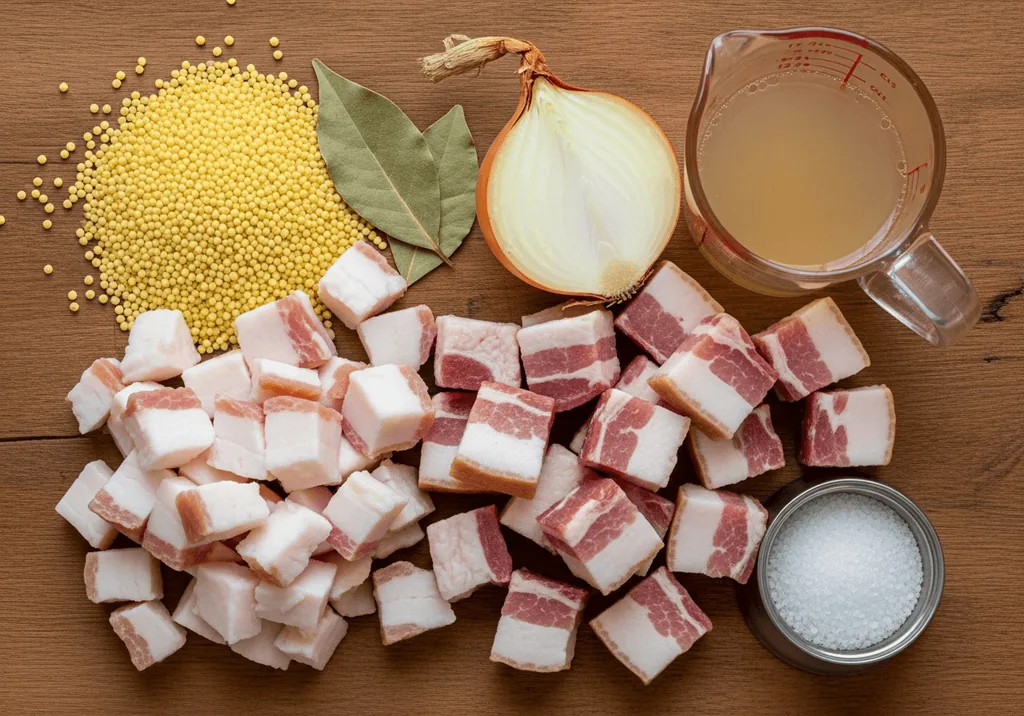
Ingredients
For the porridge (serves 4)
- 1 cup (about 200g) millet
- 3–4 oz (about 100g) salo (cured pork fat) or thick-cut bacon, diced
- 1 medium onion, finely chopped
- 2–3 cups water, light broth, or a mix of both
- Salt, to taste
- 1 bay leaf (optional)
Optional additions
- 6–8 oz stewing meat, cut into small pieces (beef, pork, or a mix)
- 2 cloves garlic, minced
- Fresh dill or parsley, chopped, for serving
Instructions
Step 1: Rinse the millet
Rinse the millet under hot water several times, rubbing the grains gently between your hands, until the water runs clear rather than cloudy. This step is not optional. Skipping it leaves behind a faint bitterness that dulls the whole dish once it’s cooked.
Step 2: Render the fat
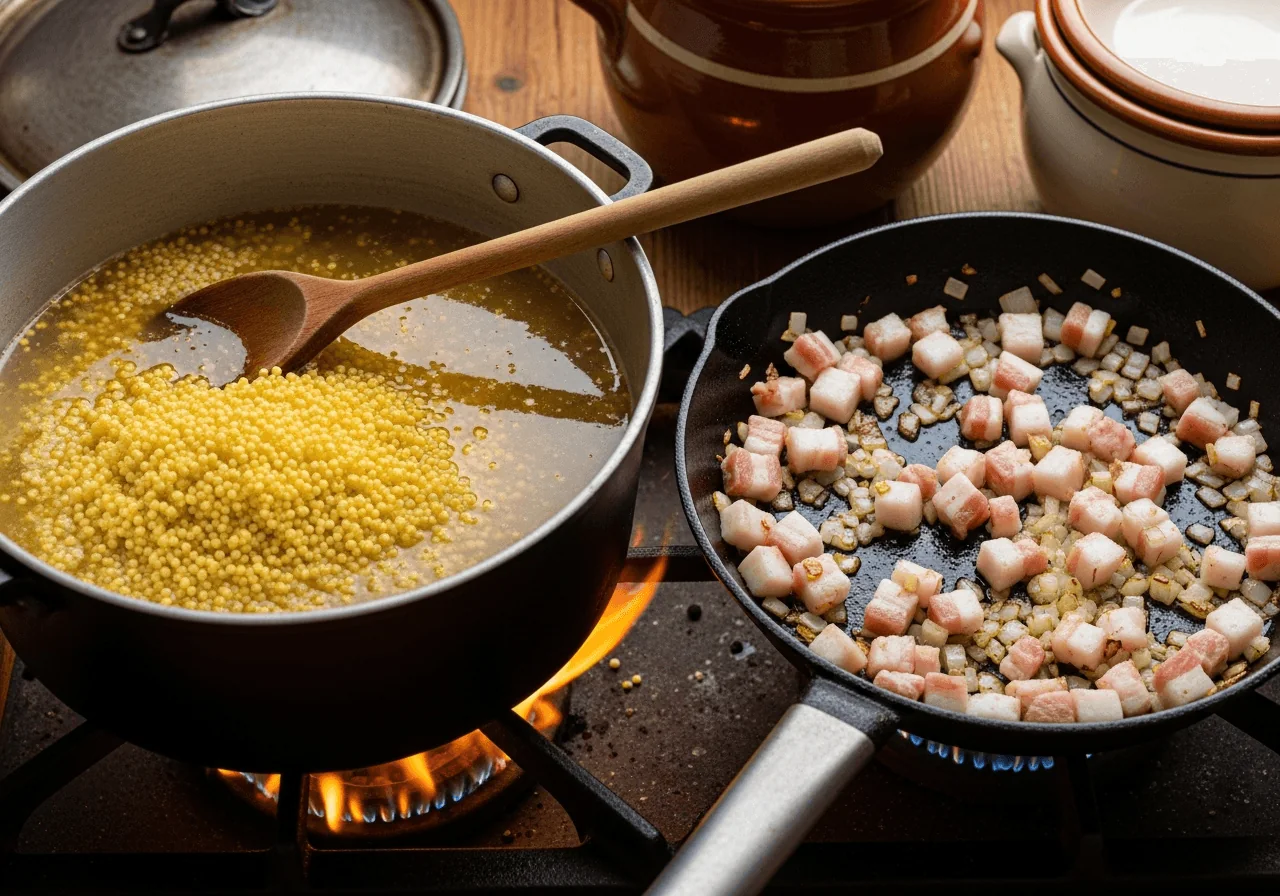
In a heavy pot or cast-iron pan, cook the diced salo or bacon over medium heat until the fat has rendered and the pieces are golden. If using stewing meat, add it now and brown it on all sides in the rendered fat.
Step 3: Build the base
Add the chopped onion to the pot and cook until soft and lightly golden. Stir in the garlic, if using, and cook for about 30 seconds, just until fragrant.
Step 4: Cook the millet
Stir the rinsed millet into the pot, coating it thoroughly in the fat and onion. Pour in the water or broth, add salt and the bay leaf if using, and bring to a gentle simmer.
Step 5: Simmer to a porridge
Cook uncovered over low heat for 20–25 minutes, stirring every few minutes, until the millet is fully tender and the liquid has thickened into a glossy, spoonable porridge. Add a splash of hot water if it thickens too quickly before the millet is done.
Step 6: Serve
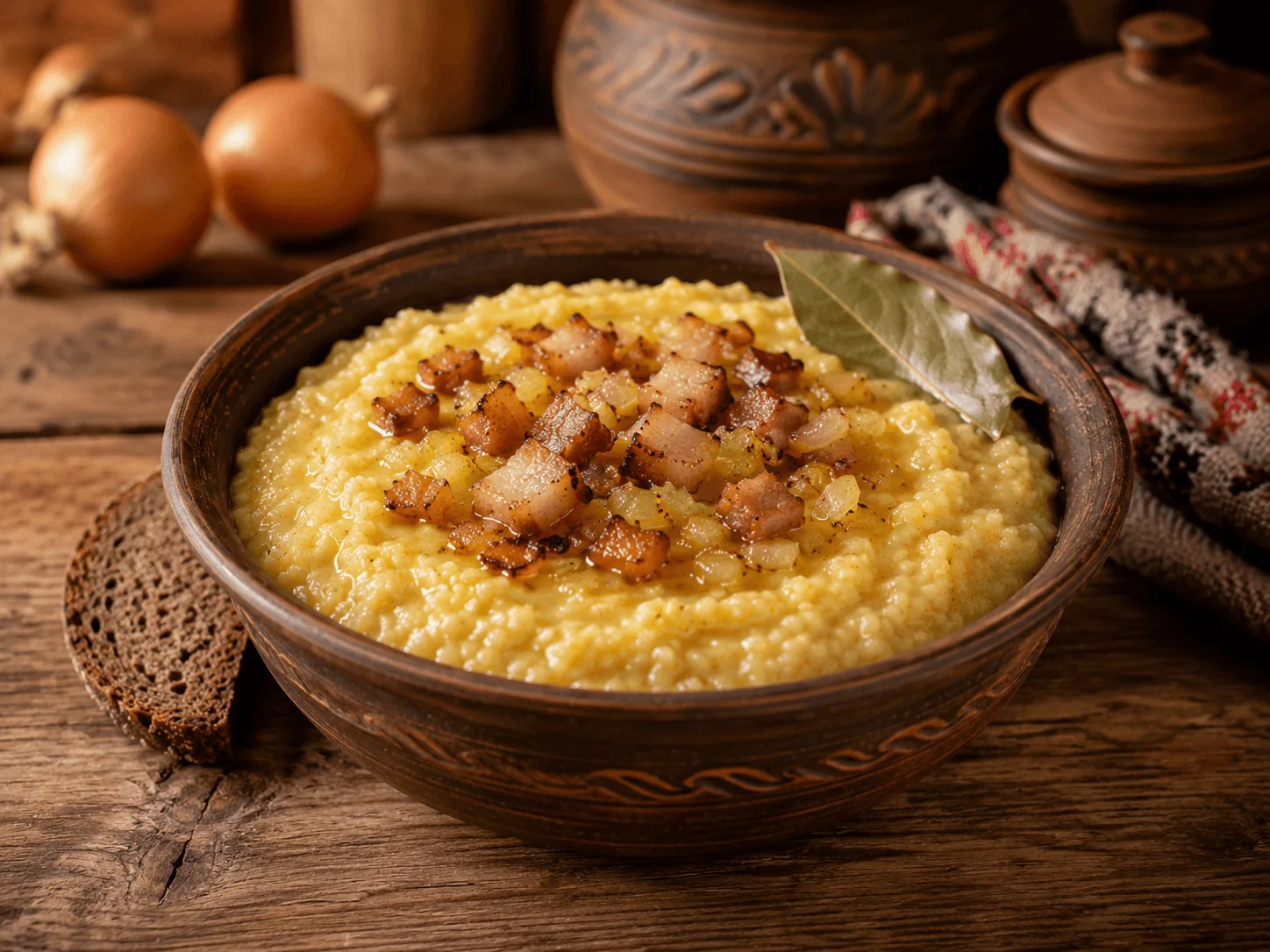
Remove the bay leaf, taste, and adjust the salt. Serve hot, straight from the pot if possible, topped with a little extra rendered fat or fresh herbs, alongside thick slices of dark rye bread.
Kitchen Tips
Rinse the millet more than you think you need to. Historical accounts of the dish specifically mention washing the grain repeatedly, and this is one detail modern cooks tend to skip, at their own cost.5
Kulish should never set up stiff. The texture is meant to sit between a soup and a porridge, thick enough to coat a spoon but still glossy and loose, not dense or dry.5 If it firms up too much on standing, a splash of hot water or broth stirred in gently will bring it back.
Salo is traditional, but a good, thick-cut bacon is a reasonable substitute if salo is not available. What matters is rendering real animal fat slowly enough that it fully coats the grain before the liquid goes in.5
If cooking outdoors over a fire, a cast-iron pot is worth the extra weight. It distributes heat far more evenly than a thin pan and gets you closer to the texture the dish was originally built around.3
Water makes a perfectly authentic pot of kulish, since the plainest historical versions used nothing else.4 That said, a light meat or bone broth deepens the flavor considerably if you have some on hand, and it’s a reasonable middle ground between the austere campaign version and the richer one made for holidays.
Nutritional Information
Per serving (with salo and no added meat, 1 of 4 servings)
- Calories: approximately 320–380 kcal
- Protein: ~7–9g
- Total fat: ~15–20g
- Carbohydrates: ~38–42g
- Sodium: ~350–500mg (varies with the amount of salt and salo used)
Nutritional values are estimates based on standard ingredient databases. They will vary depending on the type and amount of fat used, whether meat is added, and how much salt goes into the pot.
Storage and Reheating
Kulish keeps well in an airtight container in the refrigerator for up to 3 days. Because millet continues to absorb liquid as it sits, expect the porridge to thicken considerably overnight.
To reheat, warm it gently in a saucepan with a splash of water or broth, stirring often until it loosens back to a spoonable consistency. Kulish also freezes reasonably well for up to a month, though the texture softens slightly on thawing.
Traditional Kulish

Ingredients
For the porridge (serves 4)
- 1 cup (about 200g) millet
- 3–4 oz (about 100g) salo (cured pork fat) or thick-cut bacon, diced
- 1 medium onion, finely chopped
- 2–3 cups water, light broth, or a mix of both
- Salt, to taste
- 1 bay leaf (optional)
Instructions
- Rinse millet several times until the water runs clear, which removes the bitterness that gives poorly made kulish a harsh edge
- Render lard or bacon fat in a heavy pot, then fry chopped onion in the fat until golden
- Add the rinsed millet, coat it in the fat, then pour in water or broth
- Simmer uncovered, stirring occasionally, until the millet is tender and the mixture thickens into a spoonable, glossy porridge
- Serve hot in deep bowls with dark rye bread, ideally straight from the pot
Frequently Asked Questions
Is kulish the same thing as kasha?
No. Kasha is a general Ukrainian word for any cooked grain porridge, while kulish refers specifically to millet cooked with rendered fat and onion, traditionally in a single pot over an open fire.5
Where does the name “kulish” come from?
Most sources trace it to a Turkic root. The Cossacks and the Turkic peoples of the steppe were in contact for centuries, and the vocabulary moved with the contactic-speaking peoples of the steppe.3 The word entered Ukrainian as the name for this specific style of campfire porridge and stuck.
Why is kulish associated with the Cossacks specifically?
Because it fit their way of life almost perfectly: cheap, storable ingredients, no equipment beyond a cauldron and fire, and a cooking time short enough to fit between marches or raids.1,3 It was practical rather than ceremonial food, which is why it became so closely tied to Cossack identity.
Can kulish be made without meat or fat?
Yes, and the simplest historical versions were exactly that: millet boiled in water with salt, with nothing else added.4 Meat, bacon, or fish were additions for when they happened to be available, not requirements.
What’s the difference between kulish and kuleba?
Kuleba is simply a much thicker version of kulish, cooked down until very little liquid remains.4 The ingredients and method are otherwise the same.
Do I need a cast-iron pot to make this properly?
No, any heavy-bottomed pot will work fine on a home stove. Cast iron is traditional mainly because it was practical for open-fire cooking and holds heat evenly, which matters more outdoors than in a modern kitchen.3
Is millet gluten-free?
Yes, millet is a naturally gluten-free grain, which makes traditional kulish suitable for gluten-free diets as long as the broth used, if any, is also gluten-free.
Do other Cossack communities have their own version of kulish?
Yes. Don Cossacks, settled further east, prepared a fish-based version they called kulesh, following the same basic one-pot method.2
Looking for a Lighter Version?
Traditional kulish leans on rendered animal fat for most of its flavor, which makes it filling but heavy by modern standards. There’s real room to lighten it without losing the dish’s character: swapping in olive oil for some of the lard, adding vegetables, and leaning on millet’s own naturally high protein and magnesium content. A separate Healthy Kulish article on this site walks through those adjustments in detail.
Further Reading & Sources
The following sources were consulted in researching the history, technique, and cultural background of traditional kulish. Heritage Healthy Kitchen’s recipe was developed independently; these links are provided for readers who want to explore further.
- “Cossacks.” Internet Encyclopedia of Ukraine, Canadian Institute of Ukrainian Studies, University of Toronto/University of Alberta. encyclopediaofukraine.com — Cossacks — scholarly overview of the Zaporozhian Cossacks’ origins, social organization, and history, including the founding and 1775 destruction of the Zaporozhian Sich.
- “Cossack cuisine.” Wikipedia. en.wikipedia.org/wiki/Cossack_cuisine — overview of Cossack food culture, including documented military ration figures from the Pereyaslav regiment (1722–1723).
- “Kulish: The Cossacks’ Hearty Campfire Porridge.” The Taste of Ukraine. thetasteofukraine.com — Kulish — history, etymology, traditional ingredients, and modern variations of kulish.
- Tiazhka, Lilia. “Best Cossack’s Traditional dishes.” Etnocook. etnocook.com — Best Cossack’s Traditional Dishes — kulish history, the Kotliarevsky Eneida reference, and the kuleba variant.
- “Kulish Recipe: Eating Like the Cossacks of the Steppe.” Eats History. eatshistory.com — Kulish Recipe — cooking method, texture guidance, and the dish’s continued role at modern festivals and reenactments.
- Tiazhka, Lilia. “Top 15 Most Famous Ukrainian Dishes.” Etnocook. etnocook.com — Top 15 Most Famous Ukrainian Dishes — the Kulish/Kulesha surname and its association with writers Panteleimon Kulish and Mykola Kulish.
Disclaimer
The information in this article is provided for educational and informational purposes only. Heritage Healthy Kitchen makes no representations or warranties regarding the accuracy or completeness of any content on this site. Nutritional values are estimates only and will vary depending on the specific ingredients, brands, and measurements used. This content is not intended as dietary, medical, or professional nutritional advice. Always consult a qualified healthcare provider regarding any dietary needs or health conditions. Heritage Healthy Kitchen is not responsible for any outcomes resulting from the use of recipes or information published on this site.
You Might Also Like
More heritage recipes from our kitchen
Leave a Reply