

Active time: ~20 minutes | Total time: ~35 minutes | Serves: 4 | Difficulty: Easy
Quick Overview
- Swap most of the heavy cream and sour cream for kefir, with a spoonful of Greek yogurt stirred in off the heat for tang and body
- Use whole-grain, stone-ground cornmeal rather than a finely milled, degerminated one, for more fiber and nutrients
- Cut the pork belly by half and add sautéed mushrooms to fill out the topping — same savory payoff, far less saturated fat
- Use less bryndza than the traditional version, crumbled over the top so its flavor still comes through in every bite
- Season the porridge itself lightly, since the cheese and pork topping already carry plenty of salt
What This Version Changes — and What It Keeps
Traditional banosh gets its richness from three places: heavy cream and sour cream in the porridge, butter stirred in at the end, and a generous topping of pork cracklings and salty cheese. None of that is a flaw exactly, it’s the whole point of the dish, but it does mean a bowl adds up fast in saturated fat and sodium, the same two things nutrition guidance most consistently flags as worth moderating in a rich, dairy-and-pork dish like this one.
This version doesn’t try to turn banosh into something else. The cornmeal is still simmered low and slow until it’s thick and glossy, the topping still lands salty and savory, and bryndza is still very much present. What changes is where the creaminess and the saltiness come from: kefir and yogurt do most of the work cream and sour cream used to do, mushrooms take over part of what the pork used to carry, and the cheese gets used in a smaller, more deliberate amount rather than a heavy layer. The technique, the timing, and the wooden-spoon stirring stay exactly the same.
Why These Swaps Work
Cornmeal itself is a whole grain, corn is listed alongside wheat, oats, and rye among the grains that qualify.1 The problem is that most packaged and precooked polenta-style cornmeal sold in stores is degerminated, meaning the germ has been milled away, so it no longer counts as a whole grain.8 The germ is where most of the fat, B vitamins, and vitamin E are stored, so removing it strips out most of those nutrients along with the fiber, and it’s also why degerminated cornmeal keeps so much longer on a shelf, with less fat left to turn rancid.8 Fiber specifically is what slows the breakdown of starch into glucose rather than causing a sharp spike.1 Choosing a whole-grain, stone-ground cornmeal, labeled “whole corn” rather than left unspecified, keeps that fiber intact without changing how the dish is cooked at all.8
Swapping most of the cream and sour cream for kefir is where the bulk of the fat comes out of this dish. A cup of low-fat kefir runs about 104 calories with 2 to 3 grams of fat and 9 grams of protein.7 Full-fat sour cream, for comparison, carries about 198 calories and 19 grams of fat per 100 grams, with close to 90% of those calories coming from fat.3 Kefir also brings live probiotic cultures, and registered dietitians note it contains more bacterial strains than yogurt along with calcium, B12, and vitamin D.2 A spoonful of full-fat Greek yogurt stirred in at the end, off direct heat, restores some of the tang and body that plain kefir alone doesn’t quite match, since Greek yogurt carries less fat and more protein than sour cream but still has enough richness to round out the texture.3
Cutting the pork belly by half and filling the rest of the topping with sautéed mushrooms addresses both fat and sodium at once. Mushrooms are naturally low in calories, fat, and sodium, one cup of cremini mushrooms runs about 15 calories with 2 grams of protein and nearly a gram of fiber, and their savory, umami depth stands in for meat convincingly rather than tasting like a consolation prize.4 In one cited study, substituting mushrooms for half the meat in a ground beef recipe kept the flavor intact while cutting sodium by 25%, and the same logic applies here.4 Harvard’s Healthy Eating Plate guidance is blunt about the category this topping sits in: limit red meat, and avoid processed meats such as bacon.5 Halving the pork rather than eliminating it keeps that smoky, savory note in the bowl while moving the balance of the topping toward mushrooms.
Bryndza is the harder ingredient to swap out entirely, and this recipe doesn’t try. It’s also one of the saltier components on the plate, and the same Harvard guidance that flags red meat also calls for limiting cheese generally.5 Using a smaller amount, crumbled rather than piled on, keeps the distinctive tang of the dish intact while trimming a real share of the sodium that would otherwise come from a heavier hand with the cheese.
Cutting back on added salt in the porridge itself is the last piece, and it matters because the topping is already doing plenty of seasoning work. The American Heart Association recommends no more than 2,300 milligrams of sodium a day, with an ideal target closer to 1,500 milligrams for most adults, and points out that most people underestimate how much they’re actually eating.6 Since the pork, mushrooms, and bryndza all carry their own salt, adding only a light pinch to the cornmeal itself, then tasting before reaching for more, keeps the dish from stacking salt on salt.
Butter gets a smaller role here too, one tablespoon rather than two. Harvard’s own guidance on healthy fats specifically calls for limiting butter in favor of plant oils where richness is needed elsewhere in a dish.5 Since the kefir and yogurt are already carrying the creaminess this version needs, a smaller pat of butter stirred in at the end still adds that glossy finish without doing much extra work.
Healthy Banosh Recipe
Recipe developed independently by Heritage Healthy Kitchen, drawing on traditional Hutsul culinary methods. Sources for further reading are listed at the end of this article.
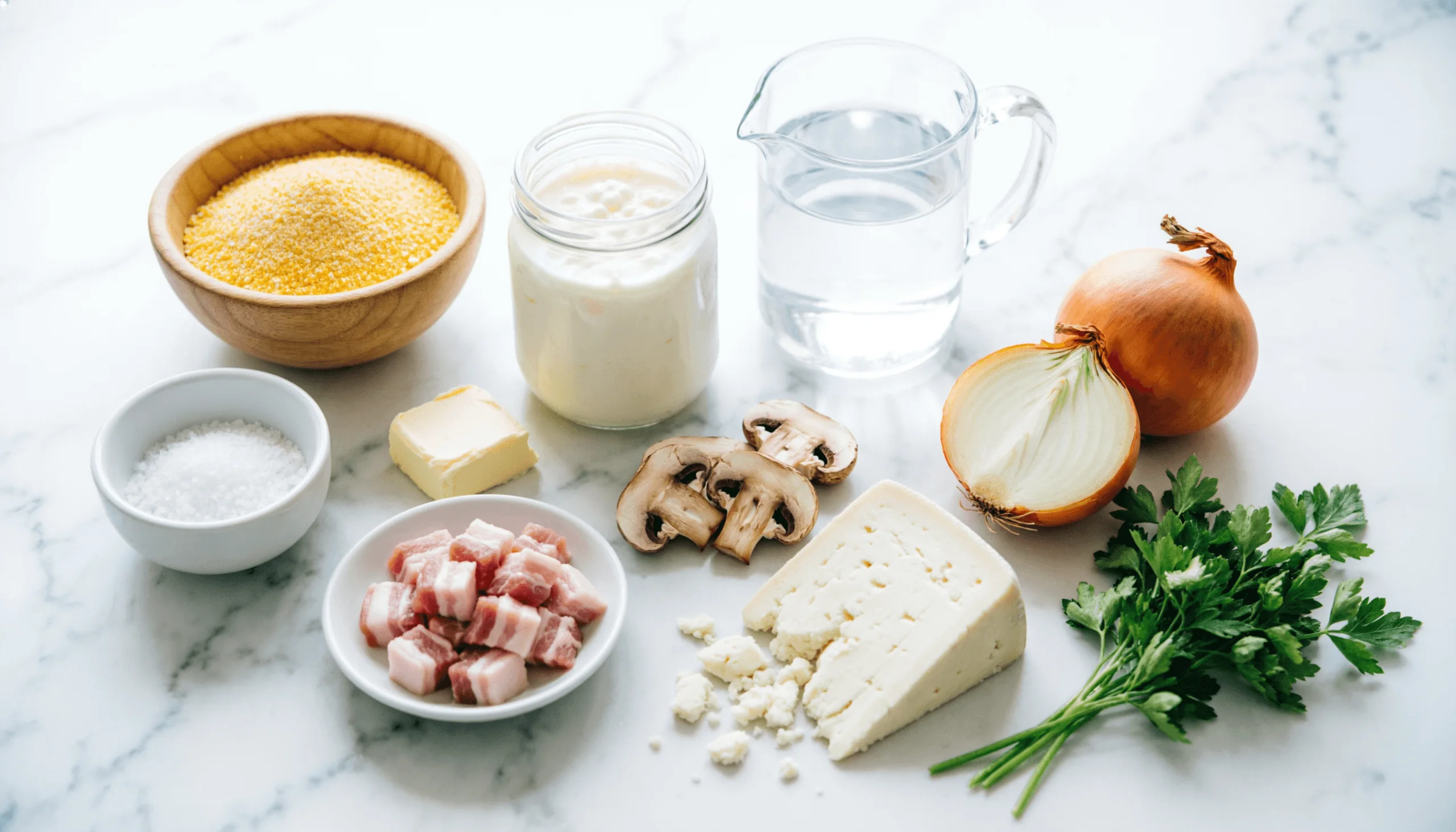
Ingredients
For the porridge (serves 4)
- 1 cup (about 150g) whole-grain, stone-ground cornmeal (not degerminated)
- 1½ cups plain kefir (low-fat or whole, either works)
- ¼ cup full-fat plain Greek yogurt, added off the heat
- 1 cup water, plus more as needed
- ¼ teaspoon salt, or to taste
- 1 tablespoon unsalted butter
For the toppings
- 100g pork belly or thick-cut bacon, diced
- 150g cremini or white mushrooms, sliced
- 1 small onion, finely chopped
- 75–100g bryndza cheese, crumbled (sheep’s milk feta is the closest widely available substitute)
- Freshly ground black pepper
- Fresh dill or parsley, chopped
Instructions

Step 1: Fry the pork
Dice the pork belly or bacon into small pieces. Fry it in a dry skillet over medium heat until golden and crisp, then remove it with a slotted spoon, leaving the rendered fat in the pan.
Step 2: Sauté the mushrooms and onion
In the same pan, add the onion and cook until softened, then add the mushrooms and cook over medium-high heat until they release their liquid and turn golden brown, about 6–8 minutes. Stir the reserved pork back in at the end just to warm through.
Step 3: Warm the kefir
In a heavy-bottomed pot, combine the kefir and 1 cup of water. Warm over medium heat, stirring, until hot but not boiling. Kefir is thinner than cream, so it heats faster and can scorch if left unattended.
Step 4: Add the cornmeal gradually
Add the cornmeal in a slow, steady stream while whisking constantly, a little at a time rather than all at once, to keep it from clumping. Stir in the salt.
Step 5: Cook low and slow
Reduce the heat to low and switch to a wooden spoon, stirring frequently for 15–20 minutes as the porridge thickens. If it stiffens before turning smooth, add a splash more water rather than pushing through on high heat.
Step 6: Finish and serve
Off the heat, stir in the butter and the Greek yogurt until glossy. Spoon into bowls, top with the mushroom-and-pork mixture, crumble the bryndza over the top, and finish with black pepper and fresh herbs.
Kitchen Tips
Kefir separates more easily than cream if it boils, so keep the heat at a bare simmer throughout, not just when the cornmeal goes in.
Add the Greek yogurt only after the pot is off the heat. Stirring it into hot porridge directly on the burner risks curdling, the same reason it’s added at the very end rather than at the start.
Slice the mushrooms a bit thicker than you might for a saute meant to disappear into a sauce; banosh benefits from having some real bite from the mushrooms alongside the smooth porridge.
If bryndza or feta on hand runs especially salty, taste before adding any extra salt to the porridge itself, it’s easy to over-season a bowl that already has cheese and pork in the mix.
Don’t rush the mushrooms. Letting them sit undisturbed for a minute or two once they hit the hot pan, rather than stirring constantly, is what lets them brown properly instead of steaming in their own released liquid.
Nutritional Comparison
Per serving (porridge with mushroom, pork, and cheese toppings, one of 4 servings)

| Nutrient | Traditional banosh | This version |
|---|---|---|
| Calories | ~500–600 kcal | ~300–360 kcal |
| Protein | ~14–18g | ~16–20g |
| Total fat | ~40–48g | ~14–18g |
| Carbohydrates | ~28–32g | ~30–34g |
| Dietary fiber | ~1–2g | ~4–5g |
| Sodium | ~450–650mg | ~260–350mg |
Nutritional values are estimates based on standard ingredient databases. They will vary depending on the fat content of the kefir and yogurt used, the specific cornmeal, the amount of pork and cheese, and how much salt is added.
Storage and Reheating
Store the porridge separately from the toppings in an airtight container in the refrigerator for up to 2–3 days, the same guidance that applies to the traditional version.
To reheat, warm the porridge gently in a small saucepan with a splash of kefir or milk, stirring often until it loosens back into a smooth consistency. Reheat the mushroom-and-pork topping separately in a dry skillet so it re-crisps rather than steams, and add the cheese fresh rather than storing it mixed in.
Healthy Banosh

Ingredients
For the porridge (serves 4)
- 1 cup (about 150g) whole-grain, stone-ground cornmeal (not degerminated)
- 1½ cups plain kefir (low-fat or whole, either works)
- ¼ cup full-fat plain Greek yogurt, added off the heat
- 1 cup water, plus more as needed
- ¼ teaspoon salt, or to taste
- 1 tablespoon unsalted butter
For the toppings
- 100g pork belly or thick-cut bacon, diced
- 150g cremini or white mushrooms, sliced
- 1 small onion, finely chopped
- 75–100g bryndza cheese, crumbled (sheep’s milk feta is the closest widely available substitute)
- Freshly ground black pepper
- Fresh dill or parsley, chopped
Instructions
- Swap most of the heavy cream and sour cream for kefir, with a spoonful of Greek yogurt stirred in off the heat for tang and body
- Use whole-grain, stone-ground cornmeal rather than a finely milled, degerminated one, for more fiber and nutrients
- Cut the pork belly by half and add sautéed mushrooms to fill out the topping — same savory payoff, far less saturated fat
- Use less bryndza than the traditional version, crumbled over the top so its flavor still comes through in every bite
- Season the porridge itself lightly, since the cheese and pork topping already carry plenty of salt
Frequently Asked Questions
Can I use only kefir with no Greek yogurt at all?
Yes, though the texture will be slightly thinner and less rich. The yogurt at the end mostly restores body and a bit of tang; skipping it saves a little more fat but makes the dish taste closer to plain than to banosh.
What if I can’t find whole-grain cornmeal?
A finer, degerminated cornmeal still works for the recipe itself; it will just carry less fiber and fewer nutrients than a stone-ground, whole-grain version.8 Check the ingredient label for the words “whole corn” if a store doesn’t label it directly as whole grain.
Won’t kefir make the porridge taste too sour?
It adds a mild tang, similar in direction to sour cream but less pronounced. If the flavor feels too sharp, use whole-fat kefir rather than low-fat, or increase the Greek yogurt slightly relative to the kefir.
Is this version actually lower in sodium, given the cheese and pork are still there?
Yes, meaningfully. Using about half the bryndza and half the pork of the traditional recipe, with mushrooms filling in the rest of the topping, removes a real share of the sodium those two ingredients would otherwise contribute, on top of using less added salt in the porridge itself.4,5,6
Can I make this vegetarian?
Yes. Skip the pork and use only mushrooms and onion for the topping, and add a bit more olive oil or butter when sautéing to make up for the fat the pork’s rendered drippings would have added.
Is kefir the same thing as buttermilk?
No, though they’re both tangy fermented dairy products. Kefir is fermented with a live culture of bacteria and yeast and has a thinner, drinkable consistency, while buttermilk is a different fermentation process entirely; kefir is the better match here for both flavor and pourability.
Does this version work with a dairy-free kefir?
Coconut- or oat-based kefir can be substituted, though the flavor and nutrition profile shift meaningfully, dairy-free versions don’t carry the same protein or calcium as milk-based kefir.2 Taste and adjust the salt and yogurt quantity accordingly, since non-dairy versions vary widely between brands.
Is this version better for someone watching their blood sugar?
The whole-grain cornmeal swap moves in a favorable direction, since fiber slows the breakdown of starch into glucose compared to a refined, degerminated cornmeal.1 That said, this is still a cornmeal-based dish, and individual needs around carbohydrates vary widely with health status and medication. Anyone managing diabetes or prediabetes should check portion sizes with a doctor or registered dietitian rather than relying on a single recipe swap.
The Traditional Version
If you want the full version with heavy cream, sour cream, a generous layer of pork cracklings, and the history behind the dish, our Traditional Banosh article covers all of that, including the Hutsul cultural background and the legend behind the name.
Further Reading & Sources
The following sources were consulted for the nutritional information and health context in this article. Heritage Healthy Kitchen’s recipe was developed independently; these links are provided for readers who want to explore further.
- “Whole Grains.” The Nutrition Source, Harvard T.H. Chan School of Public Health. nutritionsource.hsph.harvard.edu/what-should-you-eat/whole-grains — corn as a whole grain and fiber’s role in slowing the breakdown of starch into glucose.
- “Is Drinking Kefir Good for You?” Cleveland Clinic Health Essentials. health.clevelandclinic.org/benefits-of-kefir — registered dietitian commentary on kefir’s probiotic strains, protein, and nutrient content.
- “The 7 Best Substitutes for Sour Cream.” Healthline. healthline.com/nutrition/sour-cream-substitutes — calorie, fat, and protein comparison between full-fat Greek yogurt and full-fat sour cream.
- “7 Impressive Reasons To Eat Mushrooms.” Cleveland Clinic Health Essentials. health.clevelandclinic.org/benefits-of-mushrooms — mushroom calorie and fiber content, and the study on substituting mushrooms for meat to reduce sodium.
- “Healthy Eating Plate.” The Nutrition Source, Harvard T.H. Chan School of Public Health. nutritionsource.hsph.harvard.edu/healthy-eating-plate — guidance to limit red meat and cheese and avoid processed meats such as bacon.
- “How Much Sodium Should I Eat Per Day?” American Heart Association. heart.org/en/healthy-living/healthy-eating/eat-smart/sodium — recommended daily sodium limits.
- “9 Evidence-Based Health Benefits of Kefir.” Healthline. healthline.com/nutrition/9-health-benefits-of-kefir — kefir’s calorie, protein, and nutrient content per serving, and its probiotic diversity relative to yogurt.
- “Polenta: Nutrition, Calories, and Benefits.” Healthline. healthline.com/nutrition/polenta-nutrition — degerminated versus whole-grain cornmeal, nutrient loss from removing the germ, and shelf-life differences.
Disclaimer
The information in this article is provided for educational and informational purposes only. Heritage Healthy Kitchen makes no representations or warranties regarding the accuracy or completeness of any content on this site. Nutritional values are estimates only and will vary depending on the specific ingredients, brands, and measurements used. This content is not intended as dietary, medical, or professional nutritional advice. Always consult a qualified healthcare provider regarding any dietary needs or health conditions. Heritage Healthy Kitchen is not responsible for any outcomes resulting from the use of recipes or information published on this site.
You Might Also Like
More heritage recipes from our kitchen



Leave a Reply