

Healthy borscht — Active time: ~40 min | Total time: ~2½ hours | Serves: 8 | Difficulty: Medium
Lenten version for Sviat Vechir — Active time: ~40 min | Total time: ~1½ hours | Serves: 8 | Difficulty: Medium
Quick Overview
- Simmer the broth on a smaller amount of lean beef shank, with a handful of dried mushrooms
- Add white beans for fiber and protein
- Fry the zasmazhka in one tablespoon of sunflower oil instead of two
- Salt lightly, taste at the end, and let garlic, lemon and dill carry the flavor
- Top each bowl with plain yogurt or a smaller spoon of sour cream
- For Sviat Vechir, leave out the beef and build the pot on mushrooms and beans
What This Version Changes — and What It Keeps
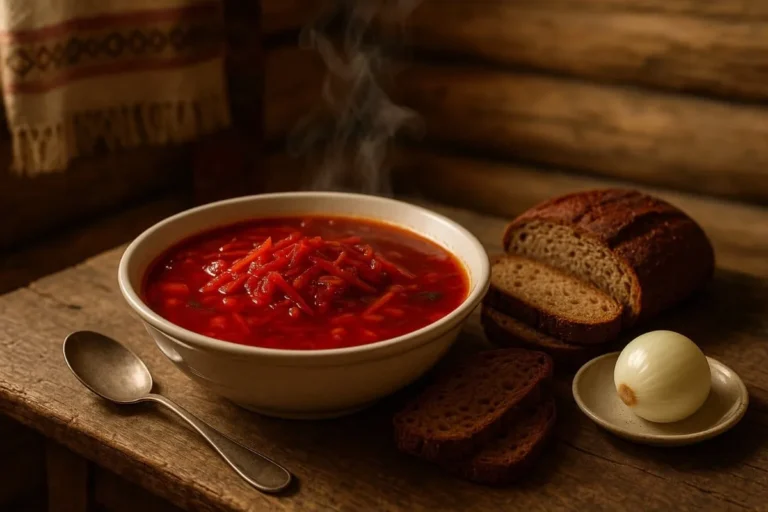
This is the red borscht from our traditional borscht recipe, with a short list of documented changes. Borscht has never been one fixed recipe. UNESCO, which inscribed the culture of Ukrainian borscht cooking on its list of heritage in need of urgent safeguarding in 2022, notes that the recipe, the way it is cooked and the occasion decide which borscht gets made.1 That leaves room for a lighter pot that is still plainly the same soup.
The method stays. The broth is still simmered on meat on the bone and skimmed, the potatoes and cabbage still cook in it, and the zasmazhka of onion, carrot and beet with tomato paste is still fried separately and stirred in near the end.2,3,4 The vegetables go in the same amounts and the same order as in the traditional pot, and the few drops of lemon juice that help the beets keep their color stay too.3
What changes is the meat, the fat and the salt: 300g of trimmed beef shank instead of 500g of pork ribs, a handful of dried mushrooms and a can of white beans in the pot, half the oil in the zasmazhka, half the salt, and plain yogurt or a smaller spoon of sour cream on top. Per bowl, that comes to about 15% fewer calories and about 70% less fat than the traditional recipe, with more fiber. The second recipe, the lenten pot for Sviat Vechir, goes further and leaves the meat out altogether, as the Christmas Eve borscht is made without meat or dairy.5
Why These Swaps Work
Lean beef, and less of it. Fatty cuts of meat are one of the main sources of saturated fat, and the NHS advice for eating less of it is to choose leaner cuts and trim the visible fat before cooking.6 Trimmed beef shank is lean, and its bone still gives the broth body. Using 300g isn’t a stretch either: the published recipes this pot is compiled from use between about 300g and 500g of meat for 2–3 litres of water.2,3 The soup gives up some of the richness of pork ribs, and the mushrooms put much of the savory depth back.
Dried mushrooms in the meat pot. Mushrooms are one of the few plant foods with a strong umami flavor, the savory taste also found in meat and simmering soups. Harvard’s Nutrition Source suggests replacing a quarter to a half of the meat in a recipe with mushrooms, and notes that umami can enhance low-sodium foods and reduce the need for added salt.7 Dried mushrooms in a meat borscht aren’t new: a published family recipe from Ovruch, in Zhytomyr Polissia, cooks them with pork ribs.2
White beans. Beans already belong in borscht: they sometimes go into it, especially the lenten kind,3 and a Lviv family recipe builds the whole pot on them.2 Legumes are a source of protein and fiber, low in saturated fat and sodium in their whole form, and their protein and fiber may increase feelings of fullness.8 The NHS suggests the same move for meat stews in general: make them go further with vegetables and beans.6 Canned beans bring some salt with them, so rinse them, and pick beans canned in water rather than brine where you can.9
Half the oil. The traditional recipe fries the zasmazhka in two tablespoons of sunflower oil; this one uses one. The oil stays the same, only the amount changes, and measuring oil with a spoon instead of pouring it is one of the NHS’s practical tips for eating less fat.6
Less salt, and more of what borscht already has. The traditional nutrition figures assume a teaspoon of salt for the pot; this version starts with half and asks you to taste before adding more. The NHS advises adults to keep to no more than 6g of salt a day, around a level teaspoon, and to flavor food with herbs, garlic, black pepper or lemon juice instead.9 A borscht already has all four: garlic stirred in at the end, black pepper, lemon juice in the beet fry and dill on top.
Yogurt on top. Sour cream is on the NHS list of foods high in saturated fat, and choosing lower-fat dairy is part of the same advice.6 Two tablespoons of plain low-fat yogurt give the hot soup a similar tang for about a third fewer calories than a tablespoon of full-fat sour cream, and roughly a sixth of the fat. If sour cream is what makes it borscht for you, keep it and use a smaller spoonful.
Healthy Borscht Recipe
This recipe was compiled by Heritage Healthy Kitchen from published recipes and the sources for the swaps, all listed at the end of this article. Figures that are Heritage Healthy Kitchen’s own estimates rather than taken from a published source are marked as such.
The base is the traditional recipe on this site, compiled from published recipes:2,3,4 the same vegetables in the same amounts, added in the same order. The changes are explained above, each with its source. The weight of beef shank and its simmering time, the amount of dried mushrooms and their soaking time, the can of beans, the half teaspoon of salt and the amount of yogurt are Heritage Healthy Kitchen’s estimates.
Prep Time: 30 minutes
Cook Time: about 2 hours
Total Time: about 2½ hours
Serves: 8
Difficulty: Medium
Ingredients
For the broth
- 300g (about 10 oz) bone-in beef shank, visible fat trimmed
- 20g (about ¾ oz) dried forest mushrooms, such as porcini
- 3L (about 12½ cups) water
- ½ onion, unpeeled
- 2 bay leaves
- 3 allspice berries
For the borscht
- 2 medium beets (about 350g), peeled and coarsely grated
- 1 large carrot (about 150g), grated or diced
- 1 onion (about 150g), diced
- 4 medium potatoes (about 400g), cubed
- ¼ head white cabbage (about 400g), shredded
- 1 can (400g) white beans, drained and rinsed (about 240g drained)
- 3 tablespoons (45g) tomato paste
- 1 tablespoon sunflower oil
- 3–4 cloves garlic, crushed
- A few drops of lemon juice (about 1 teaspoon)
- ½ teaspoon salt, then more only if needed; black pepper
- ½ teaspoon sugar (optional)
To serve
- Plain low-fat yogurt, about 2 tablespoons per bowl, or 1 tablespoon sour cream
- Fresh dill
- Rye bread
Instructions
- Soak the mushrooms. Cover the dried mushrooms with about 250ml (1 cup) of hot water and leave them for 20–30 minutes (Heritage Healthy Kitchen’s estimate).
- Simmer the beef. Put the beef in a large pot with the water, the half onion, the bay leaves and the allspice, bring to the boil and skim off the foam as it rises.3 Simmer gently for about 1 to 1½ hours, until the meat is tender (Heritage Healthy Kitchen’s estimate for beef shank). Lift out the onion and the beef, take the meat off the bone, chop it and return it to the pot.
- Add the mushrooms and potatoes. Chop the soaked mushrooms and add them with their soaking liquid, leaving the last spoonful, where any grit settles, in the bowl. Add the potatoes and cook for 5–7 minutes, until half done.3,4
- Soften the onion and carrot. Meanwhile, heat the sunflower oil in a large frying pan over medium heat. Cook the onion until soft, then add the carrot and cook for about 5 minutes more.4
- Add the beets and tomato paste. Add the grated beets and cook for about 2 minutes, then stir in the tomato paste, and the sugar if using, and cook everything for 2 minutes more.3,4 Add a few drops of lemon juice to help the beets keep their color.3
- Cook the cabbage. Add the cabbage to the pot and simmer for 10–15 minutes.2,3
- Add the zasmazhka and beans. Stir the zasmazhka and the beans into the pot and simmer for 5–7 minutes more.2,3
- Season. Stir in the crushed garlic.3 Taste, then add the salt and black pepper, a little at a time.9
- Let it stand. Take the pot off the heat and leave it covered for 15–20 minutes before serving.2 Serve with a spoonful of yogurt, fresh dill and rye bread.
For Sviat Vechir: The Lenten Borscht
On Christmas Eve, as during the Lenten fast, borscht is made without meat or dairy. Beans, mushrooms and fish are the usual stand-ins, and some families make a clear borscht served with vushka, small ear-shaped dumplings.5 At Sviat Vechir every dish is cooked with vegetable oil only, and the borscht, simmered with dried mushrooms and often soured with beet kvass, goes to the table without the usual sour cream, typically with mushroom-filled vushka.10 The encyclopedia’s entry on traditional foods describes the meatless Christmas borsch as vegetables cooked in water and soured with beet kvass or another acid,11 and a published Lviv family recipe builds it on beans and serves it at Christmas with mushroom vushka.2

Make the healthy borscht above, with these changes:
- Leave out the beef. Simmer the half onion, bay leaves and allspice in the water for about 30 minutes, the time a published lenten recipe gives its vegetable broth.2
- Double the mushrooms. Use 40g (about 1½ oz) of dried mushrooms and add them with their soaking liquid at the start of the broth. This amount is Heritage Healthy Kitchen’s estimate; one published recipe uses 60g of dried mushrooms in its borscht.2
- Keep the beans. They add protein and body to the meatless pot, and published lenten recipes use them too.2,3
- Use only sunflower oil for the zasmazhka, with no butter or lard.10
- Sour it as you like. Lemon juice works as in the main recipe, or use beet kvass if you have it.11
- Serve it without yogurt or sour cream, with vushka (small ear-shaped dumplings filled with mushrooms) if you are making them.10 The other dishes of the supper are collected in our Sviata Vecheria menu.
The lenten pot takes about 1½ hours in all, since the broth no longer has to wait for the meat.
Kitchen Tips
Color starts with the beets. If a cut beet is pale, has white streaks and gives little bright juice, it won’t color the pot well, so choose a deeply colored one. The few drops of lemon juice in the beet fry help it keep that color.3
If you have time, chill the broth. After cooking, refrigerate it and skim off any fat that has set on top before reheating.12 Trimmed shank leaves little fat to lift off, but the step works for any meat broth.
Salt last. The canned beans and the mushroom soaking liquid both bring some salt, so taste the finished soup before adding more.9
Soft or crisp cabbage. If you like the cabbage soft, add it with the potatoes so it has time to cook through; if you like a little bite, add it when the potatoes are nearly done.3
Nutritional Information
Per serving (one of 8), without yogurt or sour cream:
| Nutrient | Traditional | This version |
|---|---|---|
| Calories | approximately 200–245 kcal | approximately 175–210 kcal |
| Protein | ~10–13g | ~11–13g |
| Fat | ~10–12g | ~3–3.5g |
| Saturated fat | ~3g | ~0.7g |
| Carbohydrates | ~20–24g | ~27–33g |
| Fiber | ~5g | ~6–7g |
| Sodium | ~355–430mg | ~300–365mg |
The traditional column is our traditional recipe made with pork ribs and a teaspoon of salt. The beans add carbohydrate as well as most of the extra fiber, and the canned beans keep the sodium from dropping further; rinsing them helps.
Lenten version for Sviat Vechir, per serving (one of 8): approximately 145–175 kcal; protein ~5–6.5g; fat ~2g; saturated fat ~0.3g; carbohydrates ~29–35g; fiber ~6–7.5g; sodium ~280–345mg. Vushka are not included.
Nutritional values are estimates based on standard ingredient databases (USDA FoodData Central). Two tablespoons of plain low-fat yogurt add about 19 kcal and 0.5g of fat; a tablespoon of full-fat sour cream adds about 30 kcal and 3g of fat.
Storage and Reheating
Keep leftovers in the refrigerator for 3 to 4 days, or freeze them for 3 to 4 months.13 When reheating, bring the soup to a rolling boil,13 and add the dill and yogurt only once it is in the bowl.
Healthy Borscht

Ingredients
Broth
- 300g (about 10 oz) bone-in beef shank, fat trimmed
- 20g (about ¾ oz) dried forest mushrooms
- 3L (about 12½ cups) water
- ½ onion, unpeeled · 2 bay leaves · 3 allspice berries
Borscht
- 2 medium beets (about 350g), grated
- 1 large carrot (about 150g), grated or diced
- 1 onion (about 150g), diced
- 4 medium potatoes (about 400g), cubed
- ¼ head white cabbage (about 400g), shredded
- 1 can (400g) white beans, drained and rinsed
- 3 tbsp (45g) tomato paste
- 1 tbsp sunflower oil
- 3–4 cloves garlic, crushed
- A few drops of lemon juice
- ½ tsp salt, black pepper, ½ tsp sugar (optional)
To serve
- Plain low-fat yogurt or a little sour cream
- Fresh dill · rye bread
Instructions
- Mushrooms: Soak the dried mushrooms in about 250ml hot water for 20–30 min.
- Broth: Simmer the beef in the water with ½ onion, bay leaves and allspice, skimming the foam, about 1–1½ hours. Take the meat off the bone and return it.
- Potatoes: Add the chopped mushrooms with their liquid and the potatoes; cook 5–7 min.
- Zasmazhka: Soften the onion in 1 tbsp oil, add the carrot for 5 min, the beets for 2 min, then the tomato paste (and sugar) for 2 min. Add a few drops of lemon juice.
- Cabbage: Simmer the cabbage in the pot 10–15 min.
- Finish: Add the zasmazhka and beans and simmer 5–7 min. Stir in the garlic, taste, then season. Let stand covered 15–20 min.
- Serve: Top with yogurt or a little sour cream and dill; serve with rye bread.
Lenten Borscht for Sviat Vechir
Ingredients
Broth
- 40g (about 1½ oz) dried forest mushrooms
- 3L (about 12½ cups) water
- ½ onion, unpeeled · 2 bay leaves · 3 allspice berries
Borscht
- 2 medium beets (about 350g), grated
- 1 large carrot (about 150g), grated or diced
- 1 onion (about 150g), diced
- 4 medium potatoes (about 400g), cubed
- ¼ head white cabbage (about 400g), shredded
- 1 can (400g) white beans, drained and rinsed
- 3 tbsp (45g) tomato paste
- 1 tbsp sunflower oil
- 3–4 cloves garlic, crushed
- Lemon juice or beet kvass, to taste
- ½ tsp salt, black pepper, ½ tsp sugar (optional)
To serve
- Fresh dill · vushka (optional)
Instructions
- Mushrooms: Soak the dried mushrooms in about 250ml hot water for 20–30 min.
- Broth: Simmer ½ onion, bay leaves, allspice and the chopped mushrooms with their liquid in the water, about 30 min. Remove the onion.
- Potatoes: Add the potatoes; cook 5–7 min.
- Zasmazhka: Soften the onion in the sunflower oil, add the carrot for 5 min, the beets for 2 min, then the tomato paste (and sugar) for 2 min. Add a little lemon juice.
- Cabbage: Simmer the cabbage in the pot 10–15 min.
- Finish: Add the zasmazhka and beans and simmer 5–7 min. Stir in the garlic, taste, then season and sour to taste. Let stand covered 15–20 min.
- Serve: Serve without sour cream, with dill and vushka (small mushroom dumplings).
Frequently Asked Questions
How is this healthy borscht different from the traditional one?
It uses 300g of trimmed beef shank instead of 500g of pork ribs, adds dried mushrooms and white beans, halves the oil and the salt, and swaps sour cream for plain yogurt or a smaller spoonful. Per bowl that is about 15% fewer calories and about 70% less fat, with more fiber. The vegetables, their amounts and the method stay the same.
Does it still taste like borscht?
The zasmazhka, the beets, the cabbage and the order of cooking are unchanged, so the color and the sweet-and-sour base come from the same place. The broth is lighter, and the dried mushrooms make up much of the difference: mushrooms are one of the few plant foods with a strong umami flavor.7
How do I make borscht for Sviat Vechir?
Leave out the meat and the dairy. Simmer the broth on dried mushrooms, keep the beans, fry the zasmazhka in sunflower oil only, and serve the borscht without sour cream, with vushka, small ear-shaped dumplings filled with mushrooms, if you are making them.5,10
Is the lenten borscht vegan?
The borscht itself is, as written: no meat, dairy, eggs or animal fat, with vegetable oil as the only fat, as is the rule for every dish of the Christmas Eve supper.10
Can I use canned beans?
Yes. Drain and rinse them, and choose beans canned in water rather than brine where you can, since they bring some salt to the pot.9
How long does borscht keep?
Leftovers keep in the refrigerator for 3 to 4 days or in the freezer for 3 to 4 months. Bring the soup to a rolling boil when you reheat it.13
Looking for the Traditional Version?
For the meat borscht on pork ribs and the history of the dish, see the Traditional Borscht Recipe: Red Beet Soup on a Pork-Rib Broth.
Further Reading & Sources
The recipe is a compilation based on the published recipes listed here; these links are provided for readers who want to explore further.
Recipe base
- Olha Sytnik. (6 March 2021). 5 retseptiv ukrainskoho borshchu, yaki vam smakuvatymut [Five Ukrainian borshch recipes you will enjoy]. Ukrainska Pravda. Zhyttia. Published recipes: Zaporizhzhia, Luhansk, Zhytomyr (with dried mushrooms) and the lenten Lviv borscht on beans, served at Christmas with mushroom vushka.
- Yevhen Klopotenko. (1 July 2022, page updated 16 June 2026). Yak pryhotuvaty borshch: 5 naismachnishykh retseptiv [How to cook borshch: five recipes]. klopotenko.com. Published recipes, including two lenten ones, and tips; beans in borscht, especially lenten borscht.
- Olia Hercules. Olia Hercules’ borsch. delicious. magazine (page updated 26 May 2025). Published recipe.
Sources for the swaps
- NHS. (page last reviewed 19 June 2023). How to eat less saturated fat. nhs.uk. Fatty meat and sour cream as sources of saturated fat; leaner cuts, trimming fat, measuring oil, adding beans to stews, lower-fat dairy.
- The Nutrition Source, Harvard T.H. Chan School of Public Health. Mushrooms. Umami flavour; replacing part of the meat with mushrooms; less need for added salt.
- The Nutrition Source, Harvard T.H. Chan School of Public Health. Legumes and Pulses. Protein and fiber; low in saturated fat and sodium; fullness.
- NHS. (page last reviewed 17 April 2023). Salt in your diet. nhs.uk. Daily salt limit; flavouring with herbs, garlic, pepper and lemon; tasting before salting; pulses canned in water.
- American Heart Association. (2024). How Can I Cook Healthfully? Answers by Heart. Refrigerating cooked food and skimming the solid fat before reheating.
- USDA Food Safety and Inspection Service. (last updated 31 July 2020). Leftovers and Food Safety. Storage and reheating.
Borscht, Christmas Eve and fasting
- UNESCO. (2022). Culture of Ukrainian borscht cooking. List of Intangible Cultural Heritage in Need of Urgent Safeguarding, nomination file No. 01852. The many forms of borscht; the recipe, method and occasion decide which is made.
- Mia Billetdeaux. (13 December 2023). Celebrating the Ukrainian way: The 12 dishes of Christmas. The Kyiv Independent. Christmas Eve borsch without meat or dairy; beans, mushrooms and fish as substitutes; clear borsch with vushka.
- Christine Chraibi. (24 December 2025). Sviat Vechir: Ukraine’s ancient Christmas Eve and its twelve sacred dishes. Euromaidan Press. Vegetable oil only; lenten borshch with dried mushrooms, often beet kvass, without sour cream, with vushka.
- S. Stechishin. Traditional foods. Internet Encyclopedia of Ukraine, Canadian Institute of Ukrainian Studies. Meatless Christmas borsch of vegetables cooked in water and soured with beet kvass or another acid.
Disclaimer
This article is for general information and cooking purposes only and is not medical advice. If you have a medical condition, are pregnant or breastfeeding, or are following a diet prescribed by a doctor, talk to a qualified healthcare professional before making significant changes to how you eat.
Cook by Occasion
The lenten borscht is part of our Sviata Vecheria menu, and the healthy borscht of our Rizdvo menu and Malanka feast.
You Might Also Like
More heritage recipes from our kitchen

Leave a Reply