

Part of our Heritage Kitchen Glossary – short guides to the ingredients and techniques behind Eastern European cooking.
A family of sour soups
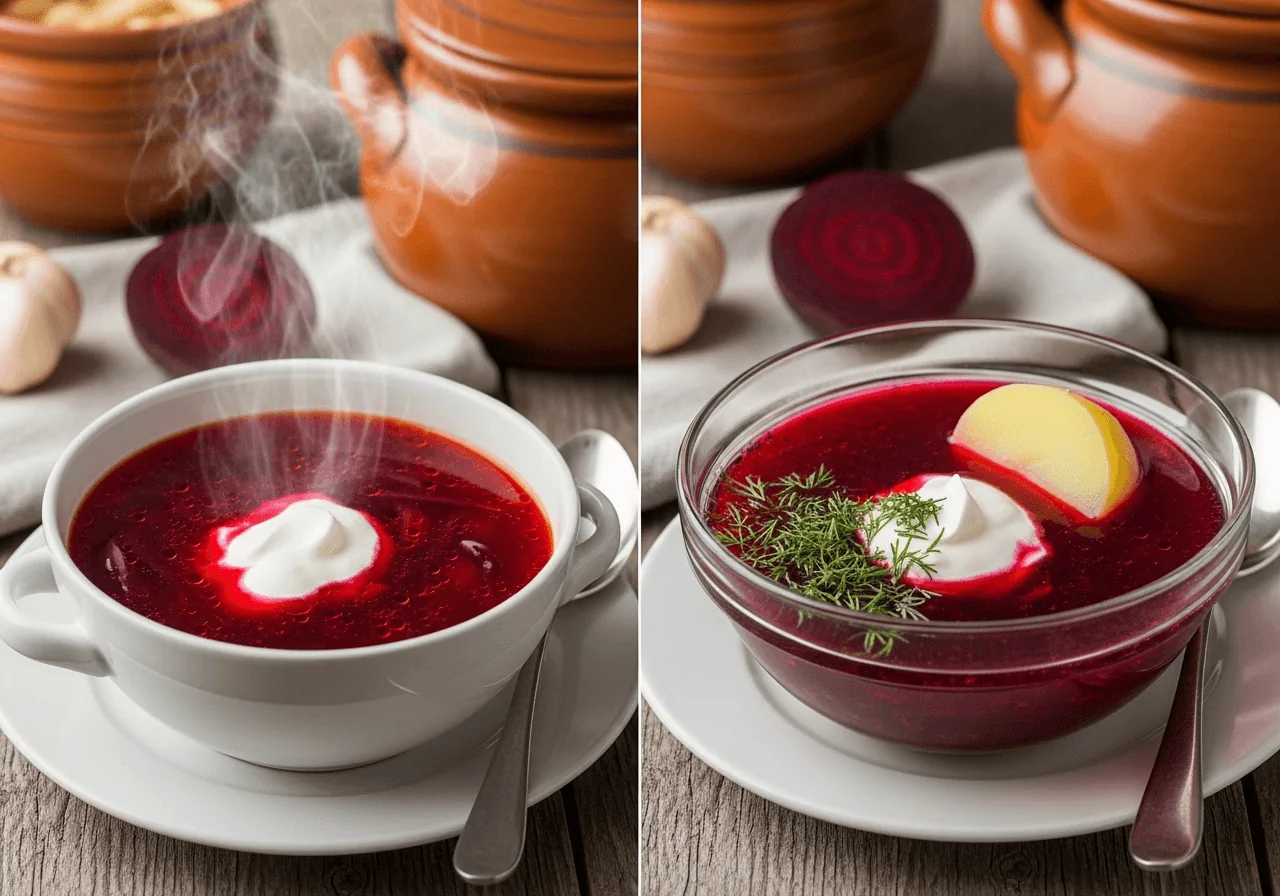
Borscht is a name shared by several Eastern European soups. Outside the region most people picture one of them, the red beet soup with a spoonful of sour cream on top, but the word covers more than that. Some borscht is served hot and some cold; some is thick enough to eat as a meal and some is strained until it runs clear. A few versions contain no beets at all. What they have in common is a sour note: fermented beet juice, a rye starter, kefir or soured milk, or vinegar or lemon juice added at the end.
The plant behind the Polish name
The Polish word is older than the beet. In Polish, barszcz first meant hogweed, a wild plant, and the first soup of that name was hogweed soured like sauerkraut; the name stayed after the ingredient changed. The first recorded recipe dates to 1580, a 17th-century aristocratic cookbook seasoned the soup with poppy seed and almonds, and the beet version appears in cookbooks around 1735. In Ukrainian the name sounds close to борщівник, the name of the plant, and many believe the soup was named after it, but there is no firm evidence for that. A history of the dish published by Їzhakultura calls the idea most probably a modern invention, since hogweed was never used in borshch, and places the dish’s invention most likely in the 17th century.
English got its spelling from a third language. The extra “t” in borscht comes from the Yiddish spelling, and Eastern European Jews who began arriving in America in large numbers in the 1880s brought the soup with them.
The red branch
Three hot beet soups are what most readers mean by borscht, and each one took a different turn. Ukrainian borscht is the thick one, a meat broth with cabbage, potatoes, carrots and beets, finished with sour cream and dill. Its flavour, colour and ingredients change from region to region, and the same Їzhakultura history puts it plainly: there is no borshch, only types of borshch. In 2022 UNESCO inscribed the culture of Ukrainian borscht cooking on its List of Intangible Cultural Heritage in Need of Urgent Safeguarding.
Polish barszcz czerwony runs clear. Its sourness comes from zakwas buraczany, beet juice left to ferment for about a week, and it often opens Wigilia, the meatless Christmas Eve supper, served with small mushroom uszka.
Jewish beet borscht comes in two forms. Cooks made meat versions eaten without sour cream and lighter vegetarian ones that could take it, and the sour cream turned the red soup pink. It is served hot or cold. For all three side by side, see our comparison of Jewish, Ukrainian and Polish borscht.
Borscht served cold
Summer has its own branch. Lithuanian šaltibarščiai (the name means “cold borscht”) is a cold soup of kefir and cooked beets with cucumber, green onions, dill and hard-boiled egg. The beets turn the kefir bright pink, and hot potatoes come on a separate plate. It is related to Polish chłodnik litewski. Chłodnik is a dish of its own, not a chilled barszcz: thick, made with soured milk, kefir or buttermilk plus cucumber and dill, and eaten on hot summer days.
White borscht
Poland also has barszcz biały, white borscht, with no beets in it. In many homes it is simply another name for żurek, the soup soured with a fermented rye starter. Some regions keep them apart, using żur for the plain soured broth and biały barszcz for the version with potatoes, sausage or bacon. Even in Poland the distinction confuses people.
Taste for sourness
Whichever version you make, taste it before it goes to the table. Clear barszcz should be clearly sour but not sharp, with a gentle sweetness underneath. A little vinegar or lemon juice at the end balances the soup, but zakwas gives a softer, rounder sourness that vinegar alone cannot.
Frequently Asked Questions
What is borscht?
A name shared by several sour soups from Eastern Europe. The best-known versions are made with beets, but the name also covers Lithuanian cold beet soup with kefir and Polish white borscht soured with a rye starter.
Does borscht have to contain beets?
No. Polish barszcz was first made from soured hogweed, and Polish white borscht, which in many homes is the same soup as żurek, is made without beets and soured with a rye starter.
What makes borscht sour?
A soured liquid: fermented beet juice (zakwas buraczany in Polish kitchens, russel in Jewish ones), a fermented rye starter for żurek, kefir or soured milk in cold versions, or vinegar or lemon juice added at the end.
Is borscht served hot or cold?
Both. The Ukrainian borscht and Polish barszcz czerwony on this site are served hot, Jewish beet borscht is served either way, and Lithuanian šaltibarščiai is a cold soup, with hot potatoes on the side.
Why is it spelled borscht in English?
The extra t comes from the Yiddish spelling. Eastern European Jews brought the soup to America when they began arriving in large numbers in the 1880s.
Further Reading & Sources
This entry draws on the sources below and on the recipes it links to elsewhere on this site. They are listed for readers who want to go further.
- Marek Kępa. “Polish Food 101 – Barszcz.” Culture.pl, April 2015. culture.pl
- Karolina Klesta. “Polish Red Borscht Barszcz Czerwony Recipe.” Polish Foodies, 1 December 2021. polishfoodies.com
- Olena Braichenko. “About borshch.” їzhakultura, 11 October 2018. yizhakultura.com
- Oleh Pavliuk. “Den ukrainskoho borshchu: u chomu unikalnist tsiiei stravy. Poiasniuie etnohrafynia” [Ukrainian Borshch Day: what makes the dish unique, explained by an ethnographer]. Suspilne, 3 December 2021 (in Ukrainian). suspilne.media
- UNESCO. “Culture of Ukrainian borscht cooking.” List of Intangible Cultural Heritage in Need of Urgent Safeguarding, 2022, nomination file No. 01852. ich.unesco.org
- Polonist Test Kitchen. “Beet Zakwas: Fermented Beet Juice.” The Polonist, 4 September 2019, updated 5 June 2023. polonist.com
- Magdalena Kasprzyk-Chevriaux. “The 12 Dishes of Polish Christmas.” Culture.pl, December 2013, updated December 2022. culture.pl
- Yvette Alt Miller. “Borscht: The Favorite Jewish Soup.” Aish, 1 April 2025. aish.com
- Daniel Zhang. “A Brief History of Borshch.” Smithsonian Folklife Festival blog, 3 July 2023. festival.si.edu
- Joan Nathan. “Talk of the Table | Borscht: Hot and Cold and Red All Over.” Moment Magazine, 11 October 2011. momentmag.com
- “Making and savouring Lithuania’s iconic pink soup: tips from a food expert.” LRT English, 30 May 2025, no author named. lrt.lt
- “What is pink soup?” Go Vilnius, the official tourism agency of Vilnius, no author or date given. govilnius.lt
- Viktorija Lideikytė. “Lietuvių šlovinamų šaltibarščių sezonas – atidarytas: savo receptą turi kone kiekvienas.” LRT.lt, 9 April 2020 (in Lithuanian). lrt.lt
- Polonist Test Kitchen. “Chłodnik: Polish Cold Beet Soup, Lithuanian-style.” The Polonist, 18 April 2021, updated 5 June 2023. polonist.com
- Zuzanna Kwapińska. “Żurek, znaczy się biały barszcz.” Narodowe Centrum Kultury, project “Ojczysty – dodaj do ulubionych,” no date given (in Polish). nck.pl
- Natalia Mętrak-Ruda. “Polish Food 101 – Żur.” Culture.pl, 29 April 2021. culture.pl
Leave a Reply