

Traditional Żurek Recipe: Sour Rye Soup for Easter
Active time: ~1 hour | Starter: 4–7 days ahead | Serves: 6 | Difficulty: Medium
Quick Overview
- Start the rye starter (zakwas) four to seven days before you plan to cook
- Simmer the white sausage and root vegetables in stock for 30–40 minutes
- Stir the starter well and pour it in gradually, tasting as you go
- Finish with crushed garlic and dried marjoram, and cream if you like
- Serve with halved hard-boiled eggs, and boiled potatoes on the side
- For Lent and other fast days, see the meatless mushroom żur further down
What Żurek Is
Żurek is a Polish soup soured with zakwas, a starter of rye flour and water left to ferment for several days. The name comes from the Middle High German word for “sour.”¹˒² Żur and żurek are the same dish, and in some homes and regions it also goes by biały barszcz, white borscht.¹
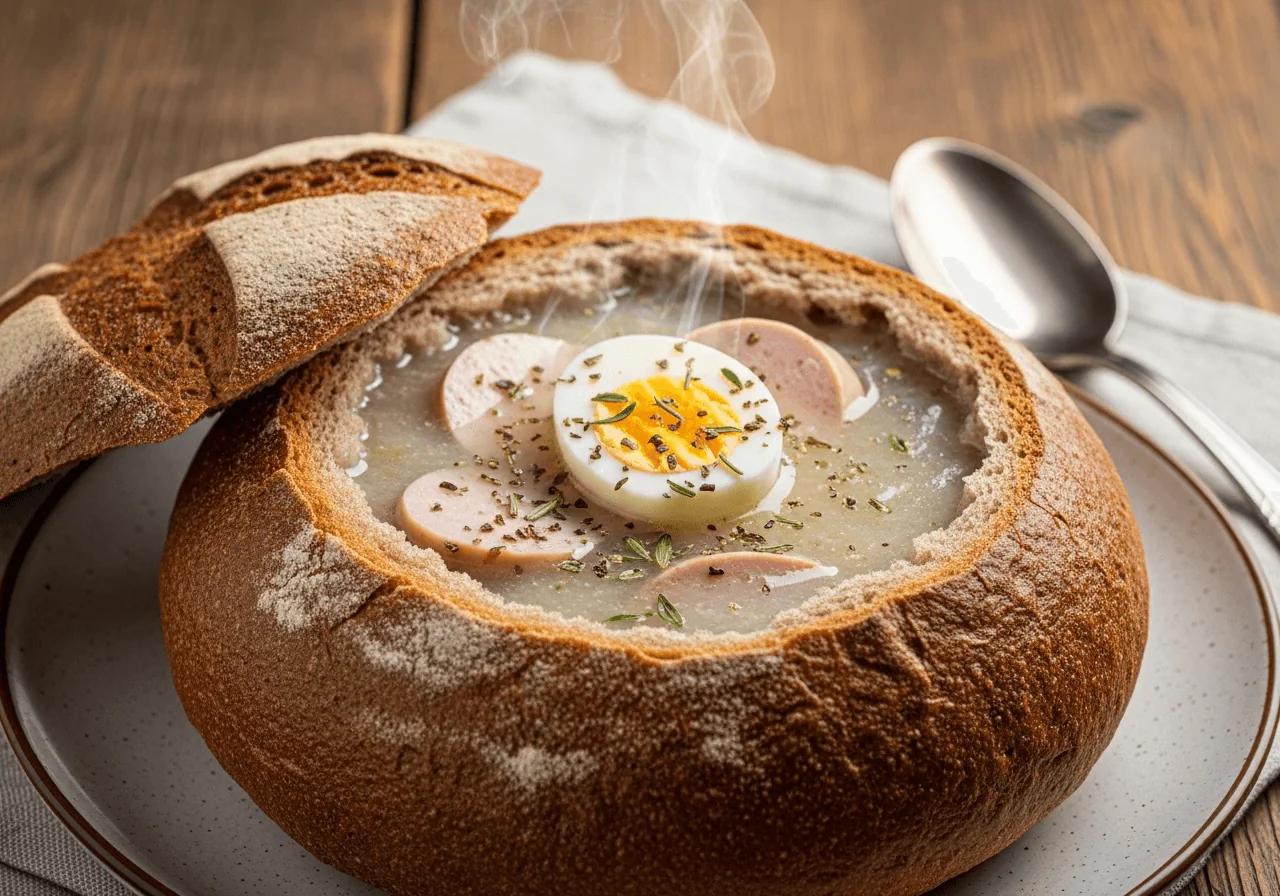
The Easter version is the one most people know: a creamy, pale soup with white sausage and a halved hard-boiled egg, seasoned with garlic and marjoram, and sometimes poured into a bowl made from a hollowed loaf of bread.²˒³
History and Cultural Roots
Żur began as a humble dish. Before the word żur spread, the soup was called kisiel, after the fermented starter it was made from.¹ It belonged to what the Polonist calls the “cuisine of the poor,” served in peasant homes, and because it needed no meat it suited the Church’s fast days well.⁴
Above all it was the soup of Lent. A language note published by Poland’s National Centre for Culture describes the Lenten żur as a thin, watery soup eaten alongside salted herring, without any pieces of white sausage.¹ By the end of the fast people were tired of both, and in Holy Week villages held a mock “burial of żur and herring” to say goodbye to them.¹˒²˒⁵
On the Easter Table
Today the same soup has changed sides. Żurek, or white borscht, is the most popular Easter soup in Poland, and the modern Easter bowl is filling and generous, with sausage and especially eggs.⁵ Eggs and white sausage, an unsmoked pork sausage seasoned with marjoram and garlic, are both staples of the Easter morning meal that follows the blessing of the food baskets on Holy Saturday.³ The soup is just as well liked the rest of the year, especially in Upper Silesia.²˒⁴
Traditional Żurek Recipe
This recipe was compiled by Heritage Healthy Kitchen from a comparison of published recipes; the sources are listed at the end of this article. Figures that are Heritage Healthy Kitchen’s own estimates rather than taken from a published source are marked as such.
Published starters use about 60 to 100g of wholemeal rye flour for every 500ml of water and ferment for three to eight days.⁶˒⁷˒⁸˒⁹ The soups use 300 to 500ml of starter for 1 to 2 litres of stock and 300 to 500g of white sausage; some fry smoked bacon into the base, and most finish with a few spoonfuls of cream.⁴˒⁹˒¹⁰˒¹¹ This version sits in the middle of those ranges. The jar size and the number of servings are Heritage Healthy Kitchen estimates.
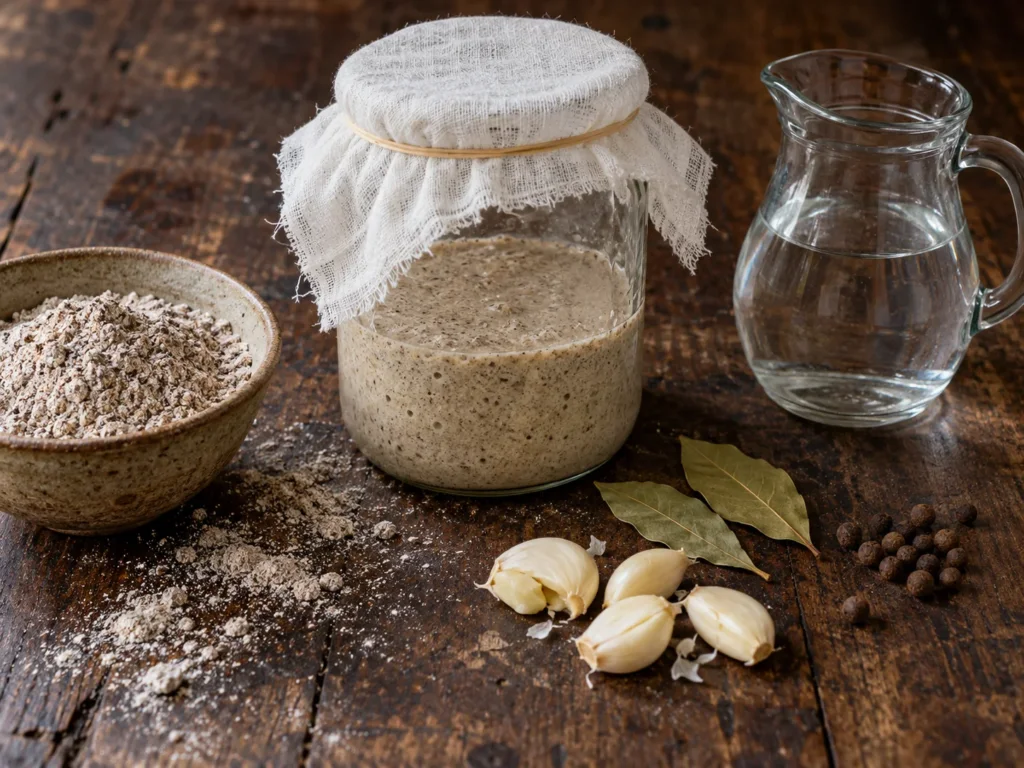
Part One: The Zakwas (Rye Starter)
Ingredients for the zakwas
- 100g (about ¾ cup) wholemeal or dark rye flour
- 500ml (2 cups) water, boiled and cooled completely, or filtered water
- 4 garlic cloves, peeled and lightly crushed
- 2 bay leaves and 4 allspice berries (optional)
How to make the zakwas
- Mix. Put the flour into a clean jar of about 750ml to 1 litre (an estimate) and stir in the water until smooth, then add the garlic and the spices, if using.⁶˒⁷
- Cover. Cover the jar with gauze or a clean cloth held with an elastic band. Don’t seal it.⁶˒⁷
- Ferment. Leave the jar somewhere warm and out of the sun; around 25°C (77°F) is ideal.⁶ Most recipes stir it once a day with a clean spoon.⁷˒⁸
- Check it. After four to seven days it should smell pleasantly and distinctly sour, but not sharp.⁶˒⁸ A pale foam on top is normal and can be skimmed off; mould or a bad smell means the batch should be thrown away.⁷
- Strain and store. Strain out the garlic and spices, pour the starter with its flour into a clean jar, close it and keep it in the fridge for up to two weeks.⁶˒⁷˒⁸
Part Two: The Soup
Ingredients
- 2 litres (8½ cups) chicken or mixed meat stock⁴
- 150g (5 oz) smoked bacon, diced (optional)
- 1 medium onion, diced
- 2 medium carrots and 1–2 parsley roots (or a piece of celeriac), peeled and left whole
- 500g (1.1 lb) fresh, uncooked white sausage (biała kiełbasa)⁴
- 3 bay leaves and 4–5 allspice berries, if your starter was made without spices
- 300–500ml (1¼–2 cups) zakwas⁴˒¹⁰
- 2 garlic cloves, crushed
- 1 tablespoon dried marjoram
- 3 tablespoons cream, 30–36% fat (optional)
- 1 tablespoon grated horseradish (optional)
- Salt and freshly ground black pepper
- 6 eggs, hard-boiled and halved
- Boiled potatoes, to serve (optional)
Instructions
- Heat the stock. Bring the stock to a simmer in a large pot.
- Fry the base. If using bacon, fry it in a dry pan until the fat runs, then add the onion and cook until both are golden. Tip them into the stock. Without bacon, soften the onion in a little oil.⁴˒¹⁰
- Simmer the sausage. Add the whole carrots and parsley roots, the spices if needed, and the whole sausages. Simmer gently for 30–40 minutes, until the stock tastes meaty and the sausage is cooked through.⁴
- Lift out. Fish out the bay leaves and allspice. Lift out the sausages and vegetables and slice them.⁴
- Add the starter. Shake or stir the starter well, since the flour settles at the bottom. Pour in 300ml, taste, and add more, up to about 500ml, until the soup is as sour as you like.⁴˒¹⁰˒¹¹
- Season. Add the garlic and marjoram and cook gently for 4–5 minutes as the soup thickens slightly.⁴
- Finish. Take the pot off the heat and return the sliced sausage and vegetables. If using cream, mix it first with a few spoonfuls of hot soup, then stir it in. Add the horseradish now, if using, rather than cooking it.⁴ Season with salt and pepper.
- Serve. Ladle into bowls with the egg halves. Boiled potatoes can go into the bowls or on the side.¹¹
To serve in a bread bowl, cut the top off a round loaf, hollow it out and ladle in the hot soup just before serving.²˒³
Meatless Mushroom Żur for Lent and Fast Days
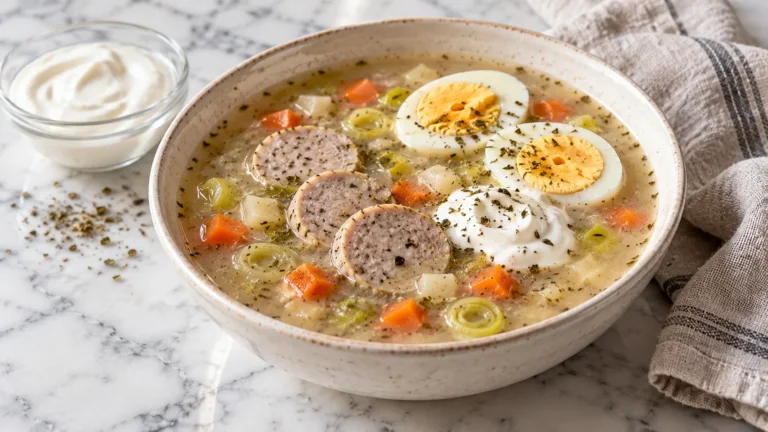
This is the older, plainer żur: a broth of root vegetables and dried forest mushrooms, soured with the same zakwas. Żur was especially popular on fast days, and a fast kept the old Polish way meant no meat and no dairy, so there’s no cream or sausage here.¹² It also suits the Christmas Eve table: a published recipe counts mushroom żur among the twelve Wigilia dishes, and in Małopolska it is one of the regional Wigilia soups.¹³˒¹⁴ The recipe follows that published żur, with no fat at all; potatoes are cooked separately and added to each bowl.¹³ A meatless żurek from the same author adds a spoonful of marjoram; here it’s optional.¹⁵ It serves four, which is a Heritage Healthy Kitchen estimate based on the 1.4 litres the recipe makes.

Ingredients
- 40g (1½ oz) dried forest mushrooms, such as porcini¹³
- 500ml (2 cups) water for soaking and cooking the mushrooms
- 1 litre (4 cups) water for the broth
- 2 carrots, 1 parsley root or parsnip, a piece of celeriac and a piece of leek or 1 onion
- 1 bay leaf, 3 allspice berries and a few peppercorns
- 250–400ml (1–1⅔ cups) zakwas¹³
- 1 teaspoon salt and 2 garlic cloves, crushed (optional)
- 1 teaspoon dried marjoram (optional)
- About 400g (14 oz) potatoes, diced and boiled in salted water, to serve
Instructions
- Soak the mushrooms. Cover them with cold water and leave overnight.¹³
- Cook them. Bring the mushrooms to a boil in their soaking water, then cook on the lowest heat until soft, up to about 40 minutes.¹³
- Make the broth. Simmer the vegetables and spices in 1 litre of water for about an hour, then lift them out.¹³
- Combine. Add the mushrooms with their liquid, the salt and the garlic to the broth. Slice the mushrooms first if they’re large.¹³
- Sour it. Stir the starter and add it gradually; homemade starter is often stronger than bought, so start with about 250ml. Heat for a few minutes until the soup thickens slightly, and add the marjoram if using.¹³
- Serve. Put a spoonful of boiled potatoes in each bowl and ladle the soup over.¹³
Kitchen Tips
Use wholemeal rye flour for the starter. All the published starters call for wholemeal or dark rye flour, the kind sold as type 2000 in Poland.⁶˒⁷˒⁸ Use water that has been boiled and cooled completely, or filtered, as the published recipes do.⁶˒⁸
Skip the bread crust. Some older instructions drop a piece of rye bread into the jar to speed things up, but it can make the starter go mouldy.⁶
Add the starter a little at a time. Every batch sours differently, and a strong homemade starter needs less than a bought one.¹³ Once it’s in, keep the soup at a gentle simmer for just a few minutes; the published recipes don’t boil it for long.⁴˒¹⁰
Cook the sausage before you serve it. White sausage is sold fresh and uncooked, so it needs its full simmer in the stock, or about 20 minutes of steaming.⁴˒⁹ If you can’t find white sausage, a recipe that pairs it with lightly smoked kiełbasa gives an idea of how a smoked one changes the soup.¹⁶
Marjoram goes in near the end. The published recipes add it with the garlic in the last minutes of cooking.⁴˒¹⁰˒¹¹
Nutritional Information
Traditional żurek: per serving (one sixth, with one egg, the bacon and the cream; potatoes not included)
- Calories: approximately 575–705 kcal
- Protein: ~34g
- Total fat: ~42g
- Saturated fat: ~14g
- Carbohydrates: ~31g
- Dietary fiber: ~5g
- Sodium: ~1,550mg
Without the bacon and the cream, a serving comes to about 515 kcal, 30g fat and 9g saturated fat. Each 100g of boiled potatoes adds about 75 kcal.
Meatless mushroom żur: per serving (one quarter, with about 100g of potatoes)
- Calories: approximately 165–205 kcal
- Protein: ~6.5g
- Total fat: under 1g
- Saturated fat: ~0.1g
- Carbohydrates: ~42g
- Dietary fiber: ~8.5g
- Sodium: ~600mg
Nutritional values are estimates based on standard ingredient databases (USDA FoodData Central) and will vary with the sausage, the stock and how much salt you add.
Storage and Reheating
The strained starter keeps in a closed jar in the fridge for up to two weeks.⁶˒⁷˒⁸ Leftover soup reheats well, covered, over low heat.¹⁰ Keep it in the fridge and eat it within about three days, with the eggs stored separately and added when serving; both are Heritage Healthy Kitchen estimates.
Traditional Żurek

Ingredients
The zakwas (start 4–7 days ahead)
- 100g (about ¾ cup) wholemeal or dark rye flour
- 500ml (2 cups) boiled and cooled water
- 4 garlic cloves, lightly crushed
- 2 bay leaves and 4 allspice berries (optional)
The soup
- 2 litres (8½ cups) chicken or mixed meat stock
- 150g (5 oz) smoked bacon, diced (optional)
- 1 medium onion, diced
- 2 carrots and 1–2 parsley roots (or a piece of celeriac), left whole
- 500g (1.1 lb) fresh white sausage (biała kiełbasa)
- 3 bay leaves and 4–5 allspice berries, if the starter has no spices
- 300–500ml (1¼–2 cups) zakwas
- 2 garlic cloves, crushed
- 1 tablespoon dried marjoram
- 3 tablespoons cream, 30–36% fat (optional)
- 1 tablespoon grated horseradish (optional)
- Salt and black pepper
- 6 hard-boiled eggs, halved
- Boiled potatoes, to serve (optional)
Instructions
- Mix the rye flour and water in a clean jar, add the garlic and spices, cover with gauze and leave somewhere warm, ideally around 25°C (77°F), for 4–7 days, stirring once a day. Strain and refrigerate.
- Fry the bacon until the fat runs, add the onion and cook until golden, then add both to the simmering stock.
- Add the whole carrots, parsley roots and sausages, plus spices if needed, and simmer for 30–40 minutes.
- Remove the spices; lift out the sausage and vegetables and slice them.
- Shake the starter, pour in 300ml, taste and add up to 500ml. Add the garlic and marjoram and cook gently for 4–5 minutes.
- Off the heat, return the sausage and vegetables, stir in the tempered cream and the horseradish if using, and season.
- Serve with halved eggs and boiled potatoes in the bowl or on the side.
Meatless Mushroom Żur for Lent
Ingredients
The soup
- 40g (1½ oz) dried forest mushrooms, such as porcini
- 500ml (2 cups) water for the mushrooms
- 1 litre (4 cups) water for the broth
- 2 carrots, 1 parsley root or parsnip, a piece of celeriac and a piece of leek or 1 onion
- 1 bay leaf, 3 allspice berries and a few peppercorns
- 250–400ml (1–1⅔ cups) zakwas
- 1 teaspoon salt
- 2 garlic cloves, crushed (optional)
- 1 teaspoon dried marjoram (optional)
- About 400g (14 oz) potatoes, diced and boiled, to serve
Instructions
- Soak the dried mushrooms in cold water overnight.
- Bring them to a boil in their soaking water and cook on the lowest heat until soft, up to about 40 minutes.
- Simmer the vegetables and spices in 1 litre of water for about an hour, then lift them out.
- Add the mushrooms with their liquid, the salt and the garlic to the broth.
- Stir in the starter gradually, starting with about 250ml, and heat for a few minutes until slightly thickened; add the marjoram if using.
- Put boiled potatoes in each bowl and ladle the soup over.
Frequently Asked Questions
What is the difference between żurek and barszcz biały?
Often none: in many homes the two names mean the same soup.¹ Some regions keep them apart, using żur for the plain soured broth and biały barszcz for the version with potatoes, sausage or bacon.¹ Even in Poland the distinction confuses people.²
Can I use a bought starter?
Yes. Jarred zakwas for żurek is sold in Polish shops. Bought starter tends to be milder than homemade, so you may need up to about 500ml for the same sourness.¹³
My starter isn’t sour after three days. What should I do?
Give it more time and a warmer spot. The published recipes ferment it for four to eight days, and about 25°C (77°F) is ideal.⁶˒⁷˒⁸ If it grows mould or smells bad rather than sour, throw it away and start again in a well-cleaned jar.⁷
Do the potatoes go into the soup?
Either way works. Some recipes serve boiled potatoes alongside the soup, others cook diced potatoes in the pot.¹¹˒¹⁵
Can I make żurek without meat?
Yes, and it’s the older way. For centuries żur was a meatless Lenten soup;¹˒² the meatless mushroom żur above is made with dried forest mushrooms and a vegetable broth.¹³
How do I serve żurek in a bread bowl?
Cut the top off a round loaf, hollow it out and ladle in the hot soup just before serving.²˒³ A crusty loaf holds the soup longer than a soft one (a Heritage Healthy Kitchen estimate).
Looking for a Lighter Version?
Our Healthy Żurek keeps the same rye starter and white sausage, but uses half as much sausage, no bacon, a homemade vegetable broth and Greek yogurt in place of cream.
Further Reading & Sources
The recipe is a compilation based on the published recipes listed here; these links are provided for readers who want to explore further.
- Kwapińska, Zuzanna. “Żurek, znaczy się biały barszcz.” Narodowe Centrum Kultury, project “Ojczysty – dodaj do ulubionych” (no date given). nck.pl
- Mętrak-Ruda, Natalia. “Polish Food 101 – Żur.” Culture.pl, April 29, 2021. culture.pl
- “The Staples of Polish Easter Cuisine.” Culture.pl, February 21, 2023 (no author given). culture.pl
- Polonist Test Kitchen. “Żurek: Polish Sour Rye Soup.” The Polonist, April 28, 2019, updated June 5, 2023. polonist.com
- Rudzka, Magdalena. “Obyczaje wielkanocne w Polsce. Wiesz, czym są bziuki i krzyżoki?” National Geographic Polska, April 18, 2025. national-geographic.pl
- Polonist Test Kitchen. “Zakwas Żytni: Sour Rye Starter for Żurek (and other soups).” The Polonist, June 15, 2019, updated June 5, 2023. polonist.com
- Ania (AniaGotuje.pl). “Jak zrobić zakwas na żur i żurek.” AniaGotuje.pl (no date given). aniagotuje.pl
- Killebrew, Kimberly. “Zakwas na Żurek (Polish Sour Rye Flour Starter).” The Daring Gourmet, February 24, 2025. daringgourmet.com
- Mościńska, Julia. “Żurek wielkanocny według Magdy Gessler. Ten błąd popełniamy najczęściej.” Eska.pl, April 17, 2025. eska.pl
- Ania (AniaGotuje.pl). “Żurek staropolski.” AniaGotuje.pl (no date given). aniagotuje.pl
- Wachowicz, Ewa. “Żurek na pieczonej kiełbasie według Ewy Wachowicz.” Smaker.pl, April 16, 2022. smaker.pl
- Polonist Test Kitchen. “Lenten Sour Rye Soup with Herring.” The Polonist, March 12, 2021, updated June 5, 2023. polonist.com
- Ania (AniaGotuje.pl). “Żur wigilijny.” AniaGotuje.pl (no date given). aniagotuje.pl
- jbuczynska. “Potrawy wigilijne – najlepsze smaki z 8 regionów Polski!” National Geographic Polska, December 13, 2018. national-geographic.pl
- Ania (AniaGotuje.pl). “Żurek wegetariański.” AniaGotuje.pl (no date given). aniagotuje.pl
- Dabrowski, Monika. “Polish Żurek Soup Recipe.” Everyday Healthy Recipes, March 27, 2023, updated April 5, 2026. everydayhealthyrecipes.com
Disclaimer
The information in this article is provided for educational and informational purposes only. Heritage Healthy Kitchen makes no representations or warranties regarding the accuracy or completeness of any content on this site. Nutritional values are estimates only and will vary depending on the specific ingredients, brands, and measurements used. This content is not intended as dietary, medical, or professional nutritional advice. Always consult a qualified healthcare provider regarding any dietary needs or health conditions. Heritage Healthy Kitchen is not responsible for any outcomes resulting from the use of recipes or information published on this site.
You Might Also Like
More heritage recipes from our kitchen

Leave a Reply