
Active time: about 45 minutes | Total time: about 4 hours, plus overnight soaking | Serves: 16 | Difficulty: Moderate
Quick Overview
- Soak poppy seeds in scalded milk overnight, then grind them into a fine paste
- Cook the ground seeds with honey, butter, and sugar into a thick filling, then stir in walnuts and raisins
- Make an enriched yeast dough with butter, egg yolks, and milk, and let it rise until doubled
- Roll out the dough, spread the filling to the edges, and roll it tightly into a log
- Let the log rise briefly, then bake until deeply golden
- Cool completely before slicing and glazing
What Makowiec Is
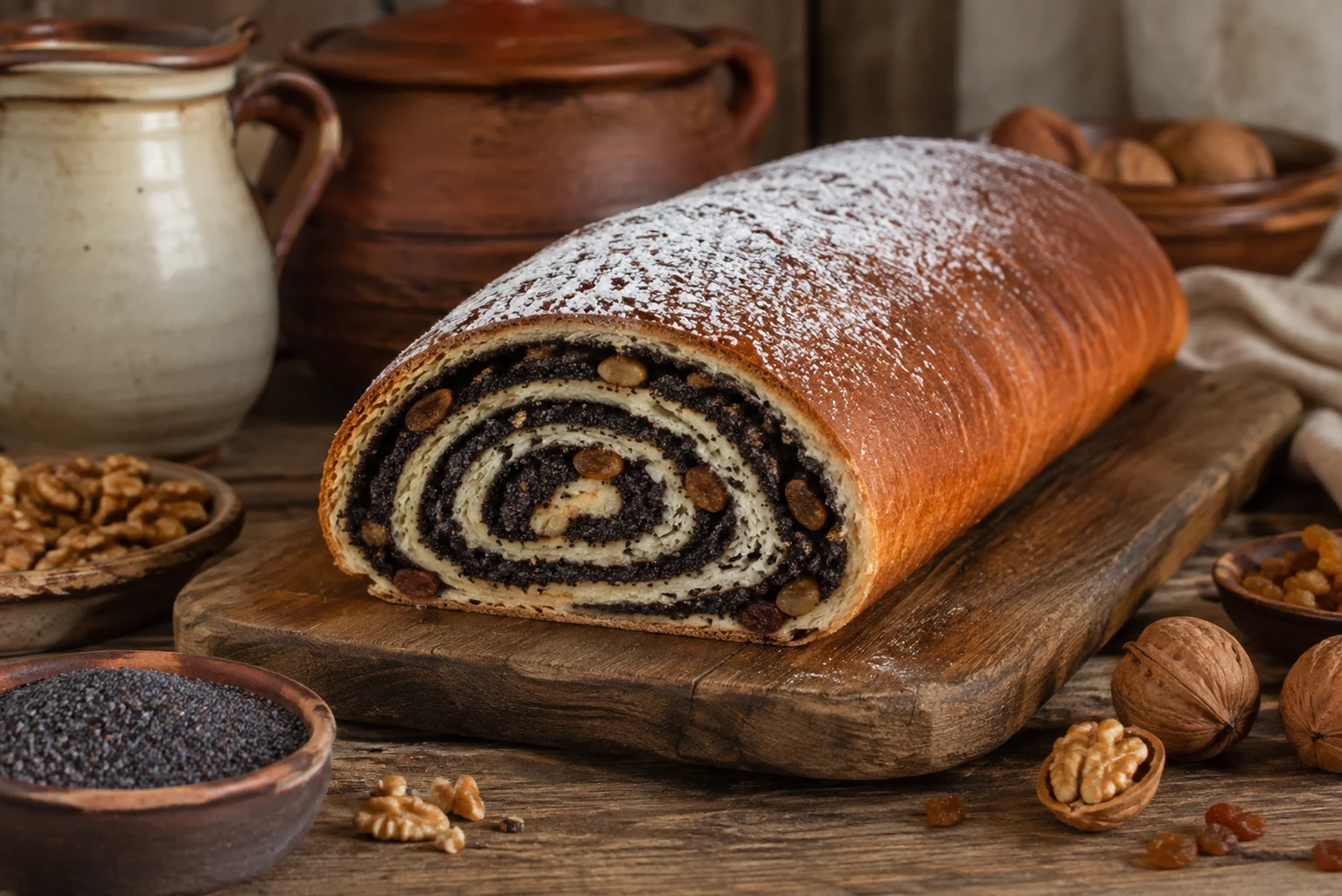
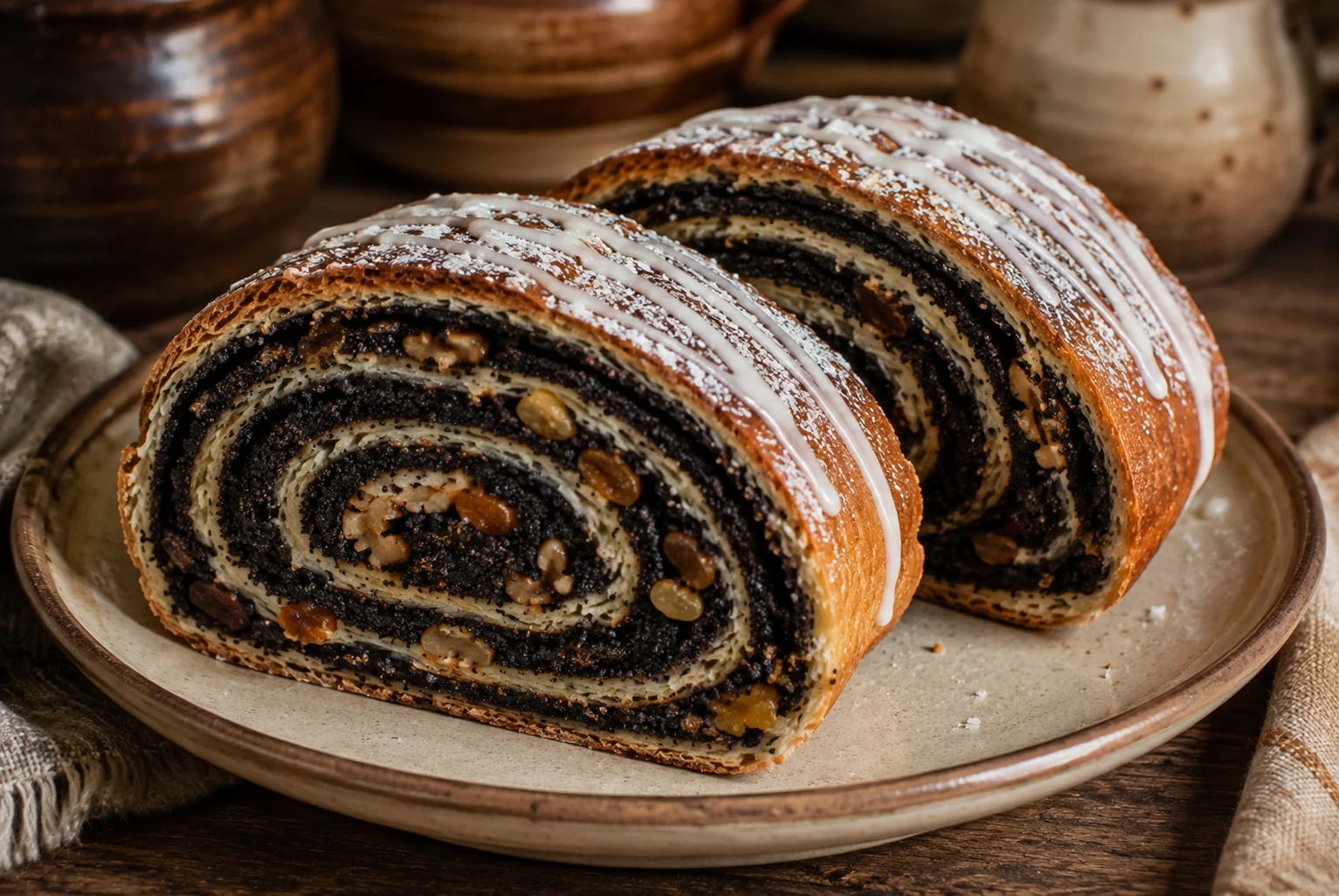
Makowiec (pronounced mah-KOH-vyets) is a Polish yeasted roll built around a dense, dark filling of ground poppy seeds bound with honey, butter, walnuts, and raisins.2,6 The dough is rolled thin, spread with the filling, and coiled into a tight spiral log, so that every slice shows the same swirl of pastry and poppy paste.3
It belongs to a wider family of Central and Eastern European poppy seed rolls. Hungarian mákos bejgli, Czech makový závin, and the Yiddish mohn roll are close relatives, each shaped by its own dough and filling ratio.3
Makowiec is one of the fixed points of the Polish festive table, appearing at both Christmas and Easter alongside cheesecake and other holiday pastries.1,2 It also turns up outside the holidays, in miniature versions sold as an everyday bakery snack, though its heaviest presence is still on those two festive tables.1
Origins and Symbolism: Between Life, Death, and the Christmas Table
Poppy seeds carry more symbolic weight in Polish tradition than almost any other pantry ingredient, which is why they turn up at Christmas, Easter, weddings, and funerals alike.2 In pre-Christian Slavic belief, poppies were thought to open a passage between the living and the dead, and seeds were baked into dishes left out for deceased relatives believed to return and visit on certain nights of the year.2 Ancient Greek myth placed poppies on the shores of Lethe, the river of forgetting in the underworld, a separate strand of the same symbolic idea taking root in a different part of Europe.2
Christianity added a second origin story rather than replacing the first. An apocryphal legend held that poppies sprang up where the blood of Christ fell during the crucifixion.1,2 The two explanations, pagan and Christian, sat side by side rather than competing, which is part of why the same dish feels equally at home on a Christmas Eve table and at a graveside remembrance.
Poppy seed oil was already a kitchen staple by the 15th century.2 A 1903 article by physician Józef Peszke, tracing the history of old Polish cuisine, notes that poppy seed and hemp seed oil were the two most common finishing oils, whether bought or pressed fresh at court, and that cooks took care to keep both from turning rancid.2
Chef Stanisław Czerniecki did not include a poppy seed recipe in his cookbook Compendium Ferculorum, but he listed the seed among the kitchen’s essential ingredients and used it as a unit of comparison, instructing cooks to chop onions as finely as poppy seeds.2 That offhand reference says as much about how familiar the ingredient already was as any recipe would.
Makowiec turns up in royal anecdotes from later centuries too. In 1681, the royal baker of King Jan III Sobieski reportedly built an enormous makowiec decorated with a likeness of the king’s wife, Marysieńka, much to the ruler’s amusement.1,2 A later king, Stanisław August Poniatowski, is said to have received a roll over four meters long, so heavy it had to be carried in by the baker’s nine children.2
Regional Variations
Makowiec’s dough-to-filling ratio and shape shift considerably by region. In Silesia, kołocz śląski takes a rectangular, streusel-topped form and is traditionally served at weddings.2 Around the villages of Ejszeryszki, Sędziszów, and Kościelec, bakers use a distinctive cold-water method: instead of rising in a warm spot, the dough is submerged in cold water and left until it floats to the surface, a sign that it’s ready to shape.2
The most extreme version comes from Lubartów, a town in eastern Poland’s Lubelszczyzna region. Makowiec lubartowski reduces the pastry casing to a thin wrapper around an almost solid core of poppy seeds, honey, nuts, and raisins.1,2 Poland’s Ministry of Agriculture and Rural Development has described it as having a thin dough layer and thick poppy filling, going as far as calling it the most Polish of all Polish cakes.1 It’s popular enough locally to have inspired a folk song, written by a resident of a village near the town, celebrating its aroma and flavor.1
One more variation belongs to the 20th century rather than folk tradition. An apple-and-poppy-seed version invented sometime in the 1970s picked up the nickname “Japanese makowiec,” despite having no actual connection to Japan. It’s a naming quirk from the Polish People’s Republic era, the same era that produced “herring Japanese-style,” another dish with no real ties to Asian cuisine.2
Traditional Makowiec Recipe
Recipe developed independently by Heritage Healthy Kitchen. Sources for further reading are listed at the end of this article.
Ingredients
For the Poppy Seed Filling
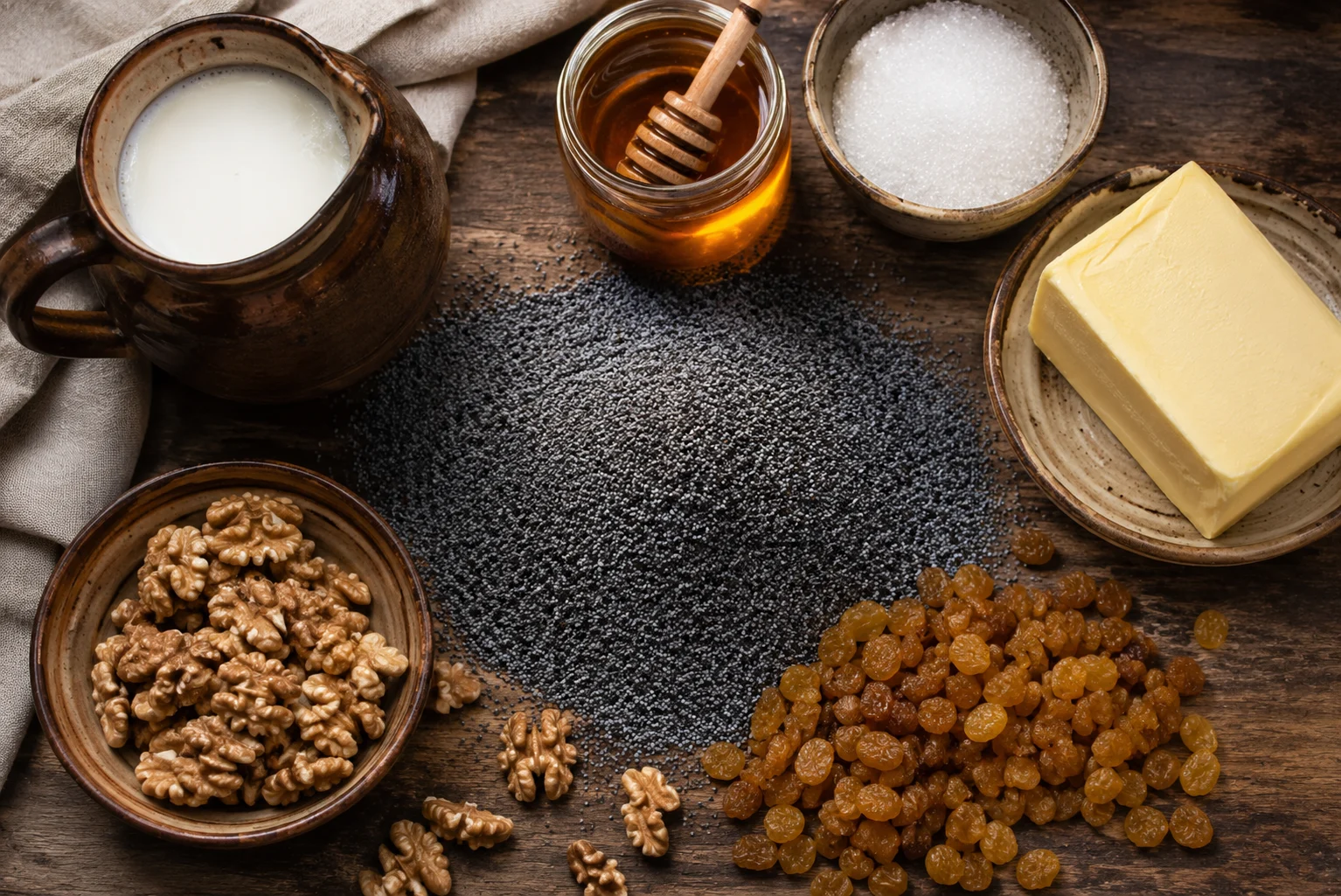
- 300g (2 cups) poppy seeds
- 200ml (generous ¾ cup) whole milk
- 100g (⅓ cup) honey
- 50g (¼ cup) granulated sugar
- 50g (3½ tbsp) unsalted butter
- 80g (⅔ cup) walnuts, finely chopped
- 80g (generous ½ cup) raisins
- 2 large egg whites
- Zest of ½ lemon
For the Dough
- 500g (4 cups) all-purpose flour
- 100g (½ cup) granulated sugar
- 100g (7 tbsp) unsalted butter, softened
- 2 large egg yolks
- 120ml (½ cup) whole milk, warmed
- 12g (about 4 tsp) active dry yeast
- ½ tsp salt
- Zest of ½ lemon
For the Glaze (optional)
- 100g (¾ cup plus 2 tbsp) powdered sugar
- 1 tbsp fresh lemon juice
- 1–2 tsp water, as needed
Instructions
- Soak the poppy seeds. Bring the milk just to a simmer, pour it over the poppy seeds in a heatproof bowl, cover, and let stand at room temperature for at least 4 hours, or overnight in the refrigerator.
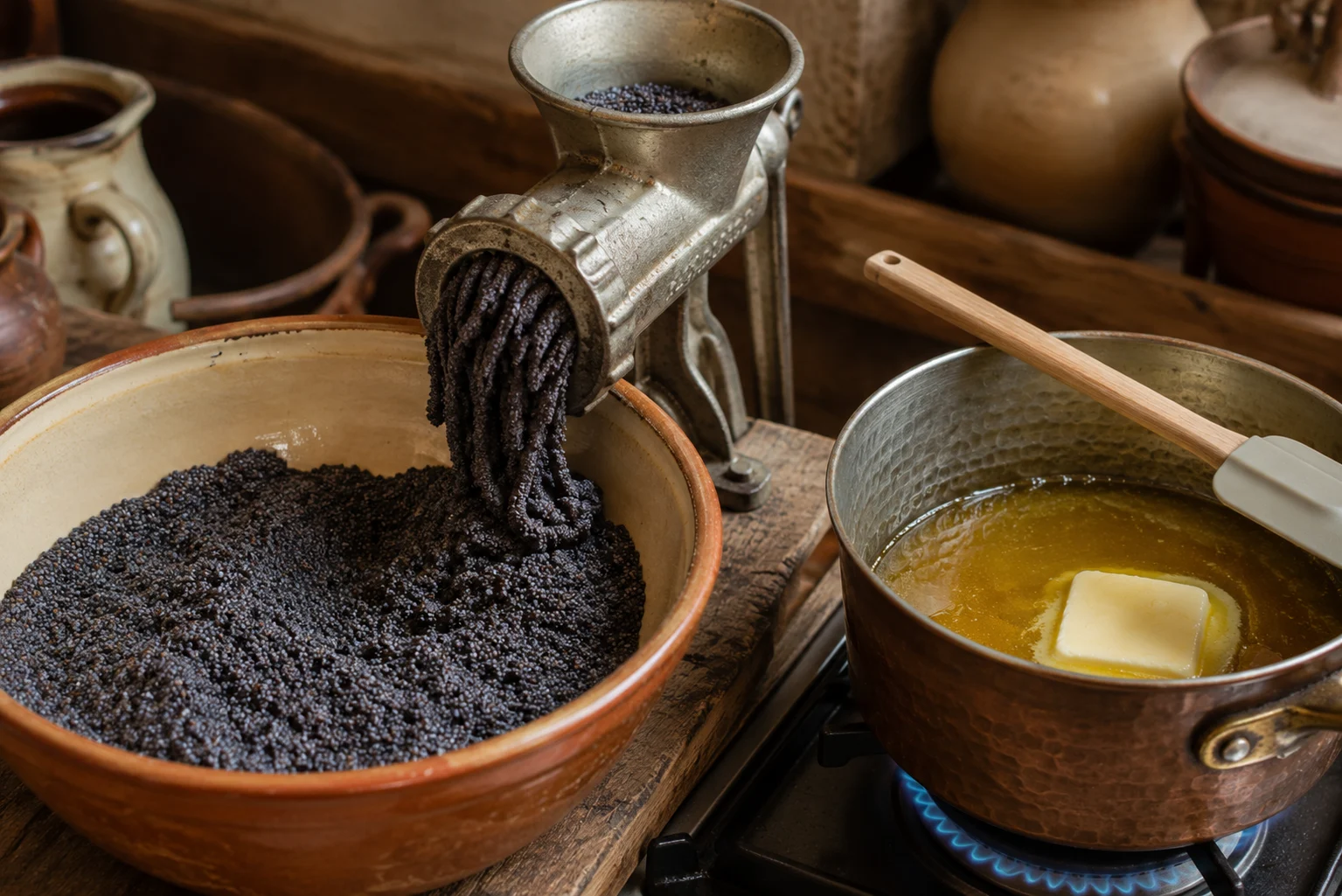
- Grind the filling base. Drain off any liquid the seeds haven’t absorbed, then run the softened seeds through a meat grinder or food processor two to three times, until they form a fine, dark paste.
- Cook the filling. Combine the ground poppy seeds, honey, sugar, and butter in a saucepan. Cook over low heat, stirring constantly, for 8–10 minutes until thickened and glossy. Off the heat, stir in the walnuts, raisins, and lemon zest. Let cool completely.
- Start the dough. Warm the milk until lukewarm, stir in the yeast with a pinch of the sugar, and let stand until foamy, about 10 minutes.
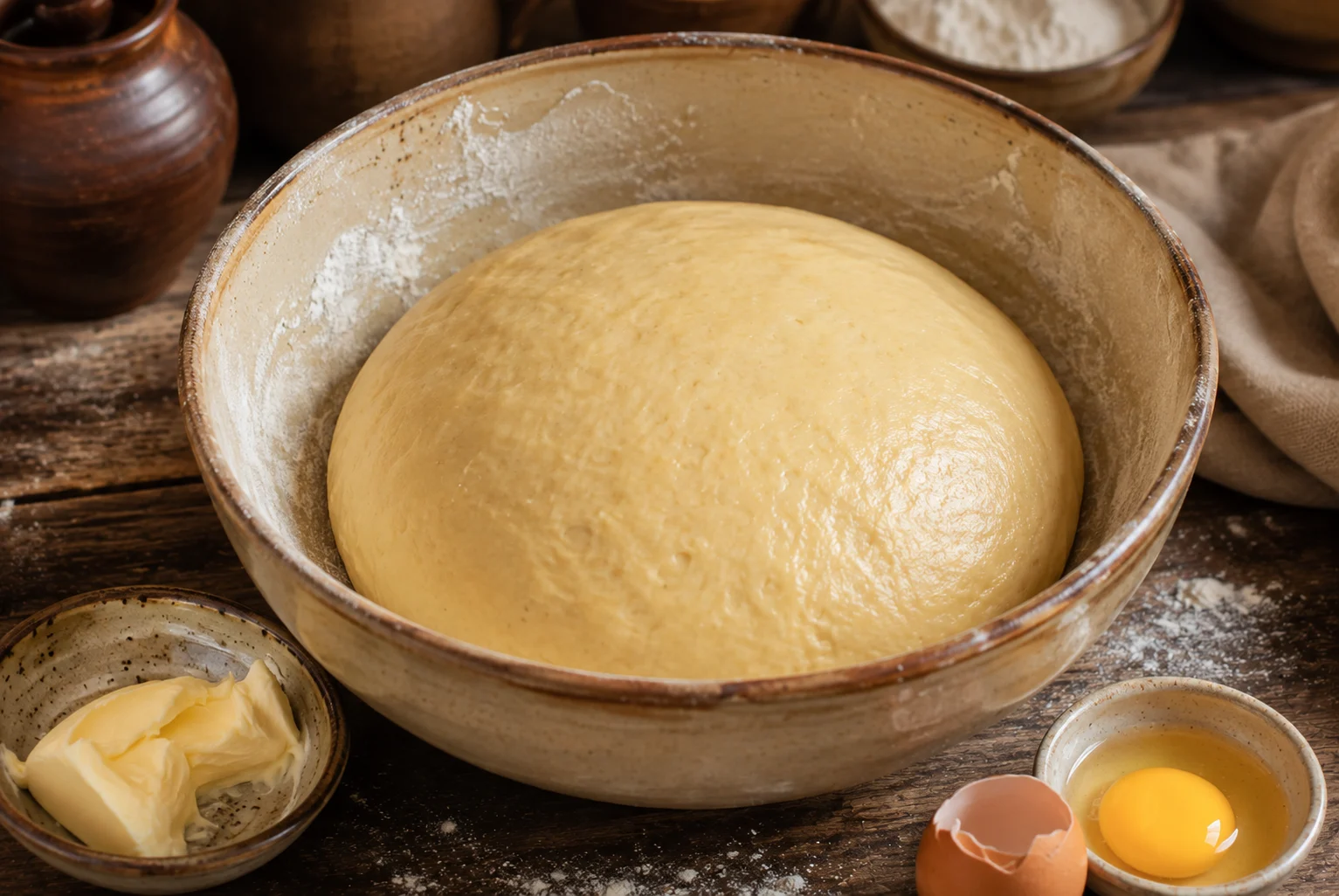
- Mix and knead. In a large bowl, combine the flour and salt. Add the yeast mixture, remaining sugar, egg yolks, softened butter, and lemon zest. Knead for about 10 minutes, until smooth and elastic.
- First rise. Cover and let rise in a warm place until doubled, about 1.5–2 hours.
- Finish the filling. Whip the egg whites to soft peaks and gently fold them into the cooled poppy seed filling. This keeps the filling from spilling out when the roll is sliced.
- Assemble the roll. On a floured surface, roll the dough into a rectangle about 1cm thick. Spread the filling evenly, leaving a small border on all sides. Starting from a long edge, roll tightly into a log and pinch the seam to seal.
- Second rise. Place the log seam-side down on a parchment-lined baking sheet, tent loosely with the parchment, and let rise for 20–30 minutes.
- Bake. Bake at 180°C (350°F) for 40–45 minutes, until deeply golden. Tent with foil partway through if the top browns too quickly.
- Cool and glaze. Let the roll cool completely on a wire rack before slicing. Whisk the powdered sugar with lemon juice and a little water until thick but pourable, then drizzle over the cooled roll.
Kitchen Tips
Grind the poppy seeds more than once. A single pass through a grinder leaves most of the seeds intact; two or three passes break them down into the fine paste that gives makowiec its texture.2
Don’t skip the egg whites in the filling. Folding in whipped whites binds the poppy paste so it stays inside the roll instead of spilling out with the first cut.6
Control the shape while baking. Wrapping the assembled log loosely in parchment before it goes into the oven keeps it from spreading or losing its coil.6
Let the roll cool completely before slicing. A warm roll compresses under the knife and the filling smears; a fully cooled one slices into clean spirals.
Nutritional Information
Per serving (1 of 16 slices)
- Calories: approximately 390–475 kcal
- Protein: approximately 9–11g
- Total fat: approximately 18–22g
- Carbohydrates: approximately 50–62g
- Dietary fiber: approximately 5–7g
- Sugars: approximately 23–28g
- Calcium: approximately 250–305mg
- Sodium: approximately 80–100mg
Nutritional values are estimates calculated from the specific ingredient quantities in this recipe, using standard reference values. They will vary depending on slice thickness and the exact ratio of filling to dough.
Poppy seeds are the nutritional standout in this recipe. A 100-gram portion delivers around 1,250mg of calcium and 25g of fiber, alongside meaningful amounts of magnesium and zinc.4 Walnuts add polyunsaturated fat that clinical trials have linked to improved cholesterol markers, which offsets some of the butter carried by the dough and filling.5
Storage and Reheating
Makowiec keeps at room temperature, wrapped or covered with a towel, for up to 4 days; refrigeration isn’t necessary unless the kitchen runs hot.6 The roll also freezes well. Wrap it tightly before glazing, since icing turns sticky and runny once thawed.6
Thaw a frozen roll at room temperature for about 2 hours, then glaze it just before serving rather than in advance.6 Makowiec is normally served at room temperature rather than reheated, since warming softens the poppy filling in a way that changes its texture.
Traditional Polish Makowiec

Ingredients
For the Poppy Seed Filling
- 300g (2 cups) poppy seeds
- 200ml (generous ¾ cup) whole milk
- 100g (⅓ cup) honey
- 50g (¼ cup) granulated sugar
- 50g (3½ tbsp) unsalted butter
- 80g (⅔ cup) walnuts, finely chopped
- 80g (generous ½ cup) raisins
- 2 large egg whites
- Zest of ½ lemon
For the Dough
- 500g (4 cups) all-purpose flour
- 100g (½ cup) granulated sugar
- 100g (7 tbsp) unsalted butter, softened
- 2 large egg yolks
- 120ml (½ cup) whole milk, warmed
- 12g (about 4 tsp) active dry yeast
- ½ tsp salt
- Zest of ½ lemon
For the Glaze (optional)
- 100g (¾ cup plus 2 tbsp) powdered sugar
- 1 tbsp fresh lemon juice
- 1–2 tsp water, as needed
Instructions
- Soak the poppy seeds. Bring the milk just to a simmer, pour it over the poppy seeds in a heatproof bowl, cover, and let stand at room temperature for at least 4 hours, or overnight in the refrigerator.
- Grind the filling base. Drain off any liquid the seeds haven’t absorbed, then run the softened seeds through a meat grinder or food processor two to three times, until they form a fine, dark paste.
- Cook the filling. Combine the ground poppy seeds, honey, sugar, and butter in a saucepan. Cook over low heat, stirring constantly, for 8–10 minutes until thickened and glossy. Off the heat, stir in the walnuts, raisins, and lemon zest. Let cool completely.
- Start the dough. Warm the milk until lukewarm, stir in the yeast with a pinch of the sugar, and let stand until foamy, about 10 minutes.
- Mix and knead. In a large bowl, combine the flour and salt. Add the yeast mixture, remaining sugar, egg yolks, softened butter, and lemon zest. Knead for about 10 minutes, until smooth and elastic.
- First rise. Cover and let rise in a warm place until doubled, about 1.5–2 hours.
- Finish the filling. Whip the egg whites to soft peaks and gently fold them into the cooled poppy seed filling. This keeps the filling from spilling out when the roll is sliced.
- Assemble the roll. On a floured surface, roll the dough into a rectangle about 1cm thick. Spread the filling evenly, leaving a small border on all sides. Starting from a long edge, roll tightly into a log and pinch the seam to seal.
- Second rise. Place the log seam-side down on a parchment-lined baking sheet, tent loosely with the parchment, and let rise for 20–30 minutes.
- Bake. Bake at 180°C (350°F) for 40–45 minutes, until deeply golden. Tent with foil partway through if the top browns too quickly.
- Cool and glaze. Let the roll cool completely on a wire rack before slicing. Whisk the powdered sugar with lemon juice and a little water until thick but pourable, then drizzle over the cooled roll.
Frequently Asked Questions
What does makowiec taste like?
The filling is dense, faintly bittersweet, and nutty, closer to a poppy seed paste than a jam, sweetened mainly with honey and balanced by tart raisins and lemon zest. The dough itself is mild and slightly sweet, similar to a soft brioche.
Can eating makowiec cause a positive drug test?
It can, in a narrow sense. Poppy seeds naturally carry trace amounts of morphine and codeine on their surface from contact with the plant’s sap, and washing or cooking reduces these compounds by around 90 percent without eliminating them entirely.4 Eating a slice won’t cause any intoxication, but it has been documented to raise morphine levels in blood or urine tests enough to register, a quirk well known in Poland and studied by Polish forensic researchers.1,2
What’s the difference between makowiec and Ukrainian makivnyk or Hungarian mákos bejgli?
All three are poppy seed rolls built on the same basic idea, a yeast dough wrapped around a ground poppy seed filling, but each culture developed its own dough enrichment, filling ratio, and shape.3 Makowiec is distinctly Polish in its honey, nut, and raisin filling, and it’s tied to both Christmas and Easter rather than a single holiday.
Can I use a store-bought poppy seed filling instead of making it from scratch?
Yes, though results vary. Many ready-made fillings are sweetened with corn syrup or plain sugar rather than honey and contain little actual nut or fruit content, so a homemade filling generally tastes richer and less cloying.6
Why did my filling spill out when I sliced the roll?
This usually means the egg whites were skipped or under-whipped. Folded whipped egg whites bind the poppy filling into a cohesive mass that holds its shape once the roll is cut.6
Can makowiec be frozen?
Yes, and it freezes well. Wrap the un-glazed roll tightly in plastic, then thaw it at room temperature before adding the glaze.6
What is “Japanese makowiec”?
It’s an apple-and-poppy-seed variation invented in Poland sometime in the 1970s, with no actual connection to Japan. The name is a quirk from that era, which also produced dishes like “herring Japanese-style” with just as little relation to Asian cuisine.2
Looking for a Lighter Version?
Makowiec’s filling brings real nutritional strengths to the table, mainly from the poppy seeds and walnuts, but the butter, sugar, and honey in both the dough and filling add up quickly. The Healthy Makowiec recipe on this project works from the same spiral roll, with less added sugar, a whole grain dough option, and a filling that leans more on the poppy seeds’ own flavor instead of butter and honey to carry it.
Read the Healthy Makowiec recipe
Further Reading & Sources
The following sources were consulted in researching the history, cultural symbolism, and technique behind traditional Polish makowiec. Heritage Healthy Kitchen’s recipe was developed independently; these links are provided for readers who want to explore further.
- “Makowiec: The Most Scandalous Cake in the World?” Culture.pl. culture.pl/en/article/makowiec-the-most-scandalous-cake-in-the-world — royal anecdotes, the Lubartów regional variation, and the forensic science behind the cake’s morphine reputation.
- “The Polish ‘Makowiec’: An Intoxicating Cake?” Culture.pl. culture.pl/en/article/the-polish-makowiec-an-intoxicating-cake — poppy seed symbolism, regional dough variations, historical sourcing on poppy oil, and the “Japanese makowiec.”
- “Makowiec (pastry).” Wikipedia. en.wikipedia.org/wiki/Makowiec_(pastry) — cross-cultural naming and technique overview for poppy seed rolls across Central and Eastern Europe.
- “Poppy seeds: Nutrition and health benefits.” Medical News Today, medically reviewed by Sade Meeks, MS, RD. medicalnewstoday.com/articles/poppy-seeds — USDA nutrient data for poppy seeds and EFSA findings on trace opiate compounds.
- “Health benefits of walnuts.” Harvard Health Publishing. health.harvard.edu/blog/health-benefits-of-walnuts-201808131672 — clinical trial evidence on walnut consumption and cardiovascular markers.
- “Makowiec: Polish Poppy Seed Roll.” The Polonist. polonist.com/poppy-seed-roll-makowiec — regional and alternative names, filling technique, storage, and freezing guidance.
Disclaimer
The information in this article is provided for educational and informational purposes only. Heritage Healthy Kitchen makes no representations or warranties regarding the accuracy or completeness of any content on this site. Nutritional values are estimates only and will vary depending on the specific ingredients, brands, and measurements used. This content is not intended as dietary, medical, or professional nutritional advice. Always consult a qualified healthcare provider regarding any dietary needs or health conditions. Heritage Healthy Kitchen is not responsible for any outcomes resulting from the use of recipes or information published on this site.
Cook by Occasion
This recipe is part of our Wigilia menu.
You Might Also Like
More heritage recipes from our kitchen


Leave a Reply