
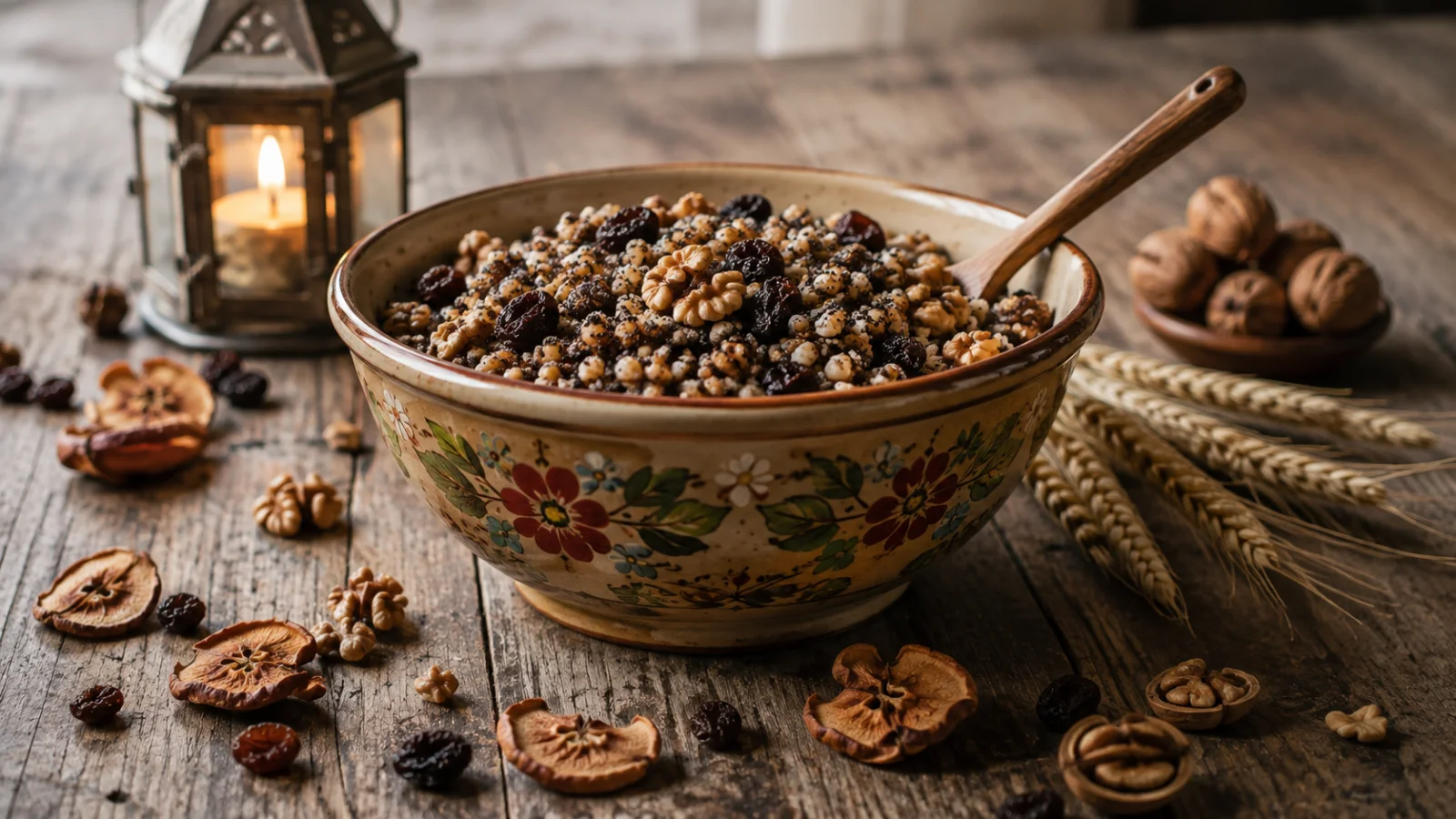
Active time: ~40 minutes (plus overnight soaking) | Total time: ~2.5 hours | Serves: 6 | Difficulty: Easy
Quick Overview
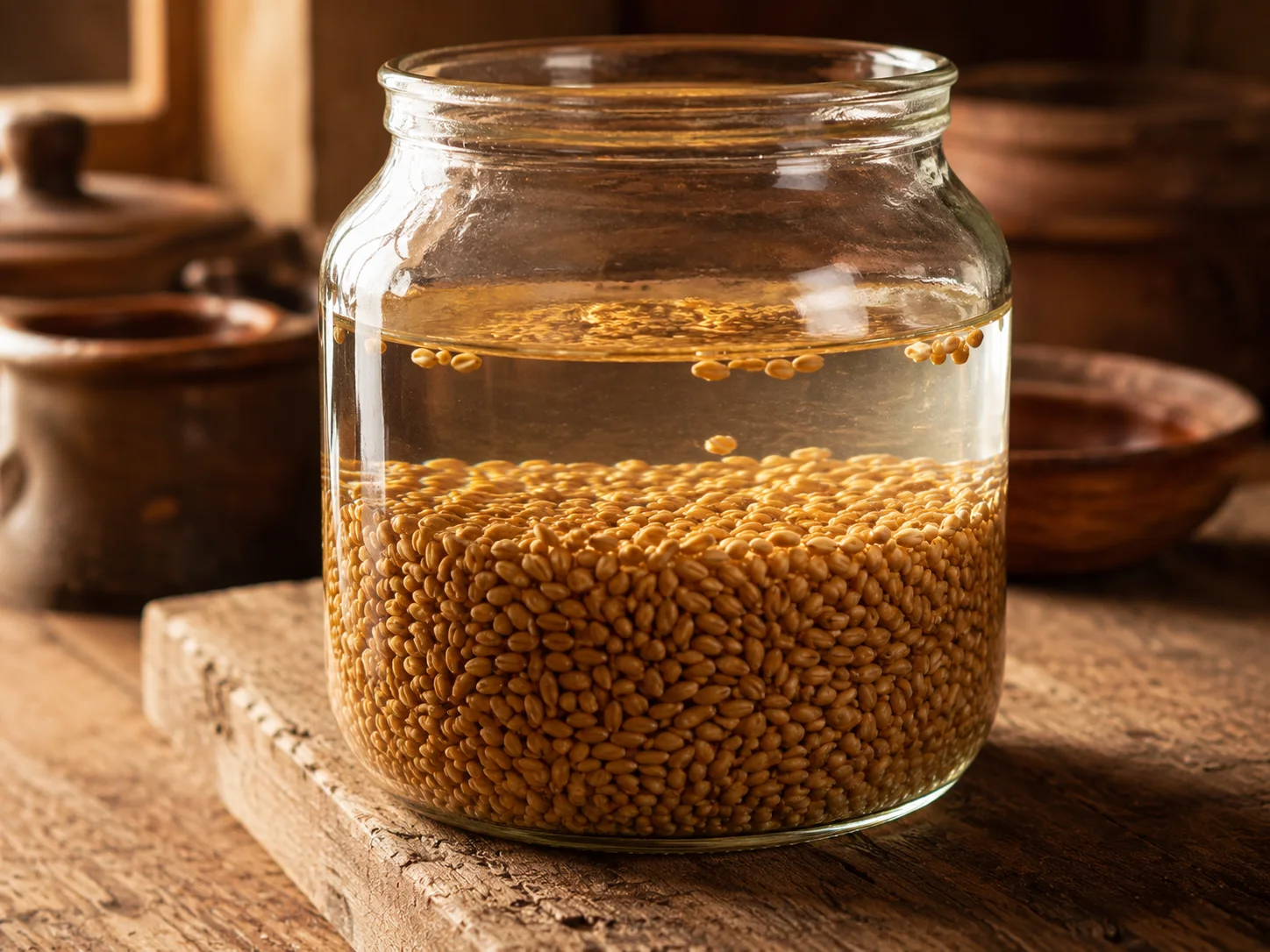
- Soak whole wheat berries overnight, then simmer them until fully tender
- Scald the poppy seeds in hot water, drain, and grind them into a fine, milky paste
- Toast the walnuts, then stir them together with the cooked wheat, ground poppy seeds, honey, and raisins
- Let the mixture rest so the honey and poppy seeds work their way through the grain
- Serve at room temperature, traditionally as the very first dish of the Christmas Eve supper
What Kutia Is
Kutia is a ritual dish of cooked wheat or barley grain mixed with ground poppy seeds and sweetened with honey.1 Walnuts and raisins are common additions.5 It is one of the oldest of the twelve dishes served at Sviata Vecheria, the Ukrainian Christmas Eve “Holy Supper,” and it is traditionally the very first thing anyone at the table eats that night.1,4,5
Almost nothing about kutia is casual. What goes into the bowl, where the bowl sits in the house, who takes the first spoonful, and what happens to that spoonful afterward all follow a sequence of ritual that is, in places, older than the holiday itself.2,4 Outside the handful of ritual evenings it belongs to, kutia rarely appears on a Ukrainian table at all.
A Dish Older Than Christianity
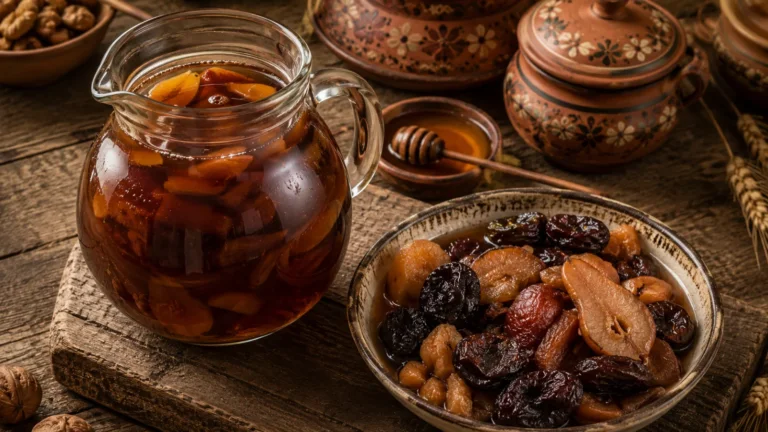
Long before Christianity reached Ukraine, the winter solstice was a time to honor the dead. Ukrainians believed the sky briefly opened during this stretch of the year, letting animals speak, letting people glimpse the future, and letting the souls of deceased relatives cross back from the other world to visit and protect their descendants.4 Kutia and its companion drink, uzvar, a dried-fruit compote, sat at the center of that observance — food old enough that Ukrainians once called them the “food of the gods.”4
The dish is genuinely ancient. Ukrainian ethnographer Fedir Vovk dated the origins of kutia, along with uzvar, to the Neolithic era.5 When Christianity reached Ukraine in 988, the old solstice celebration of the sun’s return blended with the celebration of Christ’s birth, and the first star rising in the evening sky — the signal Ukrainian families still wait for before the meal begins — came to represent the Star of Bethlehem as well.2,4
The name may be older than the ritual itself. Linguists trace “kutia” to a Greek root meaning either “bean” or “grain,” a loanword that entered Ukrainian, Belarusian, and Polish in closely related forms.5
The Rituals of Sviata Vecheria
The Christmas Eve version, bahata kutia, or roughly “rich kutia,” is meant to be the most generous of the year. It stands apart from holodna kutia, a plainer version tied to the stricter fast of Epiphany Eve, and shchedra kutia, or “generous kutia,” served on the eve of the old New Year.1,3 Three eves, three bowls, three chances during the darkest weeks of winter to run through the same small ceremony.
That ceremony has stayed remarkably consistent. The head of the household takes the first spoonful, goes to the yard or a window, and formally invites the frost to come share the meal — a plea to keep the coming year’s crops from freezing.2,4 Coming back inside, he throws that same spoonful up at the ceiling. However many grains stick is read as a forecast: a good wheat crop, a strong swarm of bees, and, if poppy seeds cling alongside the grain, hens that lay generously through the year ahead.2,5
The rest of the ritual is about who else gets fed. A portion of kutia traditionally went out to the cattle.4 Children carried bowls of it to their godparents and grandparents as part of the evening’s rounds.1,4 And once the family finished eating, three spoonfuls of every dish, kutia included, were set aside on a separate plate, spoons and all, for the souls of relatives who had died — food left out overnight so they, too, would have had dinner.2,5
On the Holiday Table
Kutia is made twice in one season. On 13 January it returns as shchedra kutia, the generous version for Shchedryi Vechir and Malanka, richer than the fasting bowl that opens Sviata Vecheria,³ and that is where it sits on our Malanka menu.
Traditional Kutia Recipe
Recipe developed independently by Heritage Healthy Kitchen. Sources for further reading are listed at the end of this article.
Ingredients
For the kutia (serves 6)
- 1 cup (about 190g) whole wheat berries
- 1/3 cup (about 50g) poppy seeds
- 1/2 cup (about 60g) walnuts, chopped
- 1/3 cup (about 50g) raisins
- 1/3 cup (about 113g) honey
- Water, as needed
- 1/4 tsp salt
Instructions
Step 1: Soak the wheat
Rinse the wheat berries under cold water until it runs clear. Place them in a bowl, cover with at least 2 inches of cold water, and let them soak overnight, 8–12 hours.
Step 2: Cook the wheat
Drain the wheat berries and transfer them to a heavy pot with about 3 cups of fresh water and the salt. Bring to a boil, then reduce to a gentle simmer, cover, and cook for 1.5–2 hours, stirring occasionally and topping up water as needed, until the grains are fully tender and have burst slightly. Drain off any remaining liquid.
Step 3: Scald and grind the poppy seeds
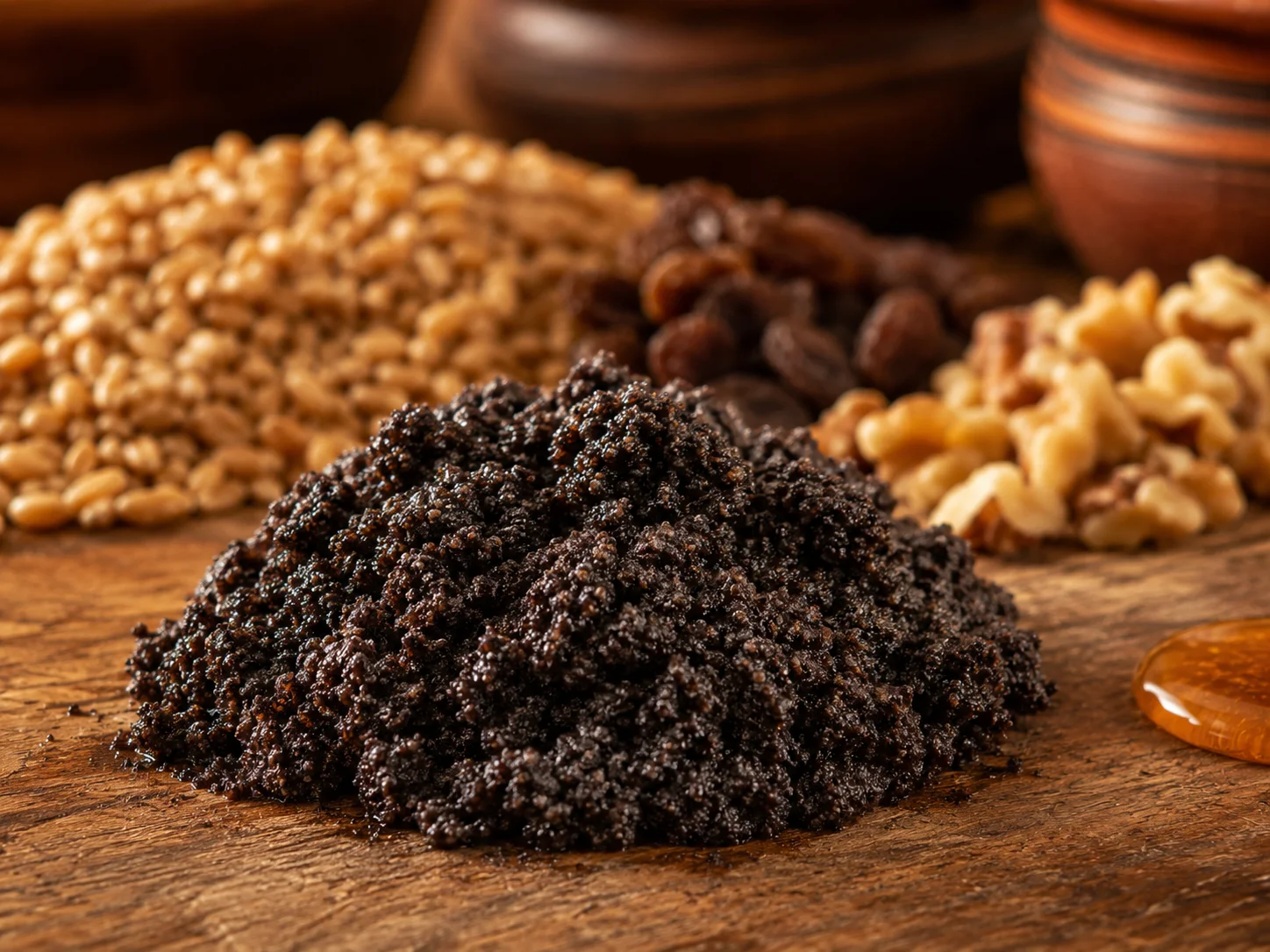
While the wheat cooks, rinse the poppy seeds, then cover them with boiling water and let them sit for 30 minutes. Drain thoroughly. Grind the softened seeds in a food processor, a spice grinder, or with a mortar and pestle until they release their oils and turn into a fine, pasty, milky-looking mixture.7
Step 4: Toast the walnuts
In a dry skillet over medium heat, toast the chopped walnuts for 3–4 minutes, stirring often, until fragrant. Set aside to cool.
Step 5: Combine
In a large bowl, combine the cooked wheat berries, ground poppy seeds, honey, raisins, and toasted walnuts. Stir until everything is evenly distributed.
Step 6: Rest and serve
Cover and let the kutia sit at room temperature for at least an hour, or refrigerate for several hours, so the honey and poppy seeds work their way through the grain. Serve at room temperature or chilled, traditionally as the first dish of the meal, with a small spoonful for everyone at the table.
Kitchen Tips
Use water, not milk. Because kutia is the first of the fasting dishes served on Christmas Eve, the traditional version contains no dairy.5 If a recipe calls for milk, it’s a modern variation rather than the ritual original.
Don’t skip the salt in the cooking water. It’s a small amount against a sweet dish, but it rounds out the honey and poppy seeds rather than sitting flat; most cooks add it directly to the wheat as it simmers.
Grinding matters more than most home cooks expect. Whole poppy seeds have a hard outer coat and release very little flavor on their own; properly ground seeds turn sweet and nutty as their oils are released, which is what gives correctly made kutia its characteristic milky look.7
Wheat berries vary by type. Hard wheat holds its shape and stays pleasantly chewy, while softer wheat cooks faster and turns mushier. Either works, but start checking for tenderness around the 90-minute mark rather than trusting a fixed cook time.
If wheat berries are hard to find, pearl barley is a documented traditional substitute for kutia.1 It also cooks noticeably faster than whole wheat berries, so start checking for tenderness earlier.
For a slightly lighter batch, cut the honey to about 3½ tablespoons (75g) instead of the full 1/3 cup, and stir 2 tablespoons of ground chia seeds in with the poppy seeds before grinding. That trade removes roughly 31 grams of added sugar from the whole batch, about 5 grams per serving, and raises fiber from around 6.5 grams to 8 grams per serving; calories barely move, since the fiber-rich chia offsets what the honey loses.9,10 A pinch of cinnamon helps cover the lost sweetness if the result tastes a little flat.
Nutritional Information
Per serving (1 of 6 servings)

- Calories: approximately 265–325 kcal
- Protein: ~6–8g
- Total fat: ~9–12g
- Carbohydrates: ~44–53g
- Fiber: ~6–7g
Nutritional values are estimates based on standard ingredient databases. They will vary depending on the type of wheat used, how much honey is added, and portion size.
Storage and Reheating
Kutia keeps well, covered, in the refrigerator for up to two weeks, since honey and its low moisture content help preserve it.7 The wheat berries will firm up as the dish chills; this is normal and not a sign of spoilage.
Kutia is traditionally served cold or at room temperature rather than reheated, so there’s rarely a need to warm it. If the grains feel too firm after refrigeration, stir in a spoonful of warm water or a little extra honey to loosen the texture before serving.
Traditional Kutia

Ingredients
For the kutia (serves 6)
- 1 cup (about 190g) whole wheat berries
- 1/3 cup (about 50g) poppy seeds
- 1/2 cup (about 60g) walnuts, chopped
- 1/3 cup (about 50g) raisins
- 1/3 cup (about 113g) honey
- Water, as needed
- 1/4 tsp salt
Instructions
- Soak whole wheat berries overnight, then simmer them until fully tender
- Scald the poppy seeds in hot water, drain, and grind them into a fine, milky paste
- Toast the walnuts, then stir them together with the cooked wheat, ground poppy seeds, honey, and raisins
- Let the mixture rest so the honey and poppy seeds work their way through the grain
- Serve at room temperature, traditionally as the very first dish of the Christmas Eve supper
Frequently Asked Questions
Can I use barley or rice instead of wheat berries?
Yes. Barley is a documented traditional variation of kutia.1 Rice-based kutia also exists in parts of Ukraine, including Poltava, Luhansk, and Odesa regions, though it’s generally considered a more recent regional variation rather than the older wheat tradition.8 Cooking times will be shorter for barley and considerably shorter for rice, so check for tenderness rather than following the wheat timing above.
Is kutia vegan?
The version made with water rather than milk is naturally vegan, since Christmas Eve kutia belongs to a set of fasting dishes that traditionally exclude dairy and eggs.5 Just confirm the honey fits your own dietary preferences, since some vegans avoid it.
Why do people throw a spoonful of kutia at the ceiling?
It’s part of an old harvest-forecasting ritual: the number of grains that stick is read as a sign of how good the coming year’s crops and beekeeping will be.2,5 It’s a bit of fun theater for a modern table, though obviously optional.
What’s the difference between kutia and kolyvo?
Kolyvo is a closely related ritual grain dish, but it leaves out the poppy seeds and is served specifically at memorial services rather than at Christmas.5 Visually and texturally, the two are easy to confuse.
Are poppy seeds safe to eat in a dish like this?
Yes. The U.S. FDA does not generally advise consumers to avoid poppy seed-containing foods; its safety concerns are specifically about consuming concentrated poppy seed “tea,” not about seeds used in cooking.6 A dish like kutia, where the seeds are scalded, ground, and mixed through a large batch of grain, is a very different situation from that concentrated brew.
Can kutia be made a day or two ahead?
Yes, and it’s traditional to do so. Kutia is meant to sit for at least a few hours before serving so the honey and ground poppy seeds distribute through the grain, and it keeps well refrigerated for up to two weeks.7
Does the whole family really eat from one bowl?
Traditionally, yes. Everyone present takes a spoonful from the same bowl of kutia before any other dish is served, a small act of shared unity that opens the Christmas Eve meal.4 Many modern households plate individual servings instead, but the communal version is the older custom.
Further Reading & Sources
The following sources were consulted in researching the history, ritual, and cultural background of traditional kutia. Heritage Healthy Kitchen’s recipe was developed independently; these links are provided for readers who want to explore further.
- “Kutia.” Internet Encyclopedia of Ukraine, Canadian Institute of Ukrainian Studies, University of Toronto/University of Alberta. encyclopediaofukraine.com — Kutia — definition, the wheat-or-barley recipe, the bahata kutia and holodna kutia distinction, and the harvest-divination custom.
- “Christmas.” Internet Encyclopedia of Ukraine, Canadian Institute of Ukrainian Studies, University of Toronto/University of Alberta. encyclopediaofukraine.com — Christmas — the Sviat-Vechir ritual sequence, the frost-invitation and ceiling-throwing custom, and the practice of setting food aside for deceased relatives.
- “Malanka.” Internet Encyclopedia of Ukraine, Canadian Institute of Ukrainian Studies, University of Toronto/University of Alberta. encyclopediaofukraine.com — Malanka — the New Year’s Eve “Shchedra kutia” and Shchedryi Vechir tradition.
- Poshyvailo, Tetiana. “‘Food of the Gods’ for Ukrainian Christmas: Kutia and Uzvar.” Smithsonian Center for Folklife and Cultural Heritage. folklife.si.edu — Kutia and Uzvar — pre-Christian ancestor-worship origins, the frost and ceiling rituals, and a recipe demonstrated at the 2023 Smithsonian Folklife Festival.
- “Kutia.” Wikipedia. en.wikipedia.org/wiki/Kutia — etymology, ethnographer Fedir Vovk’s Neolithic-era dating, ceiling-throwing forecast details, the kolyvo distinction, and the dish’s Lenten, dairy-free status.
- “Opiate Alkaloids on Poppy Seeds.” U.S. Food and Drug Administration. fda.gov — Opiate Alkaloids on Poppy Seeds — food-safety guidance on poppy seeds and opiate alkaloids in the food supply.
- Kravchuk, Natasha. “Kutia Recipe (Sweet Wheat Berry Pudding).” Natasha’s Kitchen. natashaskitchen.com — Kutia Recipe — poppy seed scalding and grinding technique, and storage guidance.
- “Kutia With Rice, Authentic Recipe.” TasteAtlas. tasteatlas.com — Kutia With Rice — regional rice-based variations of kutia found in Poltava, Luhansk, Odesa, and Donetsk.
- “Added Sugar.” The Nutrition Source, Harvard T.H. Chan School of Public Health. nutritionsource.hsph.harvard.edu/added-sugar — honey’s classification as an added sugar and baking guidance on reducing added sugar in a recipe by a quarter to a third.
- “Chia Seeds.” The Nutrition Source, Harvard T.H. Chan School of Public Health. nutritionsource.hsph.harvard.edu/chia-seeds — chia’s fiber content per serving and its preparation as a poppy-seed-like ground addition.
Disclaimer
The information in this article is provided for educational and informational purposes only. Heritage Healthy Kitchen makes no representations or warranties regarding the accuracy or completeness of any content on this site. Nutritional values are estimates only and will vary depending on the specific ingredients, brands, and measurements used. This content is not intended as dietary, medical, or professional nutritional advice. Always consult a qualified healthcare provider regarding any dietary needs or health conditions. Heritage Healthy Kitchen is not responsible for any outcomes resulting from the use of recipes or information published on this site.
Cook by Occasion
This recipe is part of our Sviata Vecheria menu and our Malanka feast.
You Might Also Like
More heritage recipes from our kitchen

Leave a Reply