

Active time: ~40 minutes | Total time: ~3 hours (includes dough rising) | Serves: 8 | Difficulty: Easy
Quick Overview
- Proof yeast in warm water, then mix a simple flour, oil, and poppy seed dough
- Let the dough rise, roll it into thin ropes, and cut them into tiny pieces
- Bake the pieces until golden and let them cool into small, hard biscuits
- Soak poppy seeds in hot water, then blend and strain them into a milky liquid
- Sweeten the poppy milk with honey and serve it with the biscuits
What Kūčiukai Is
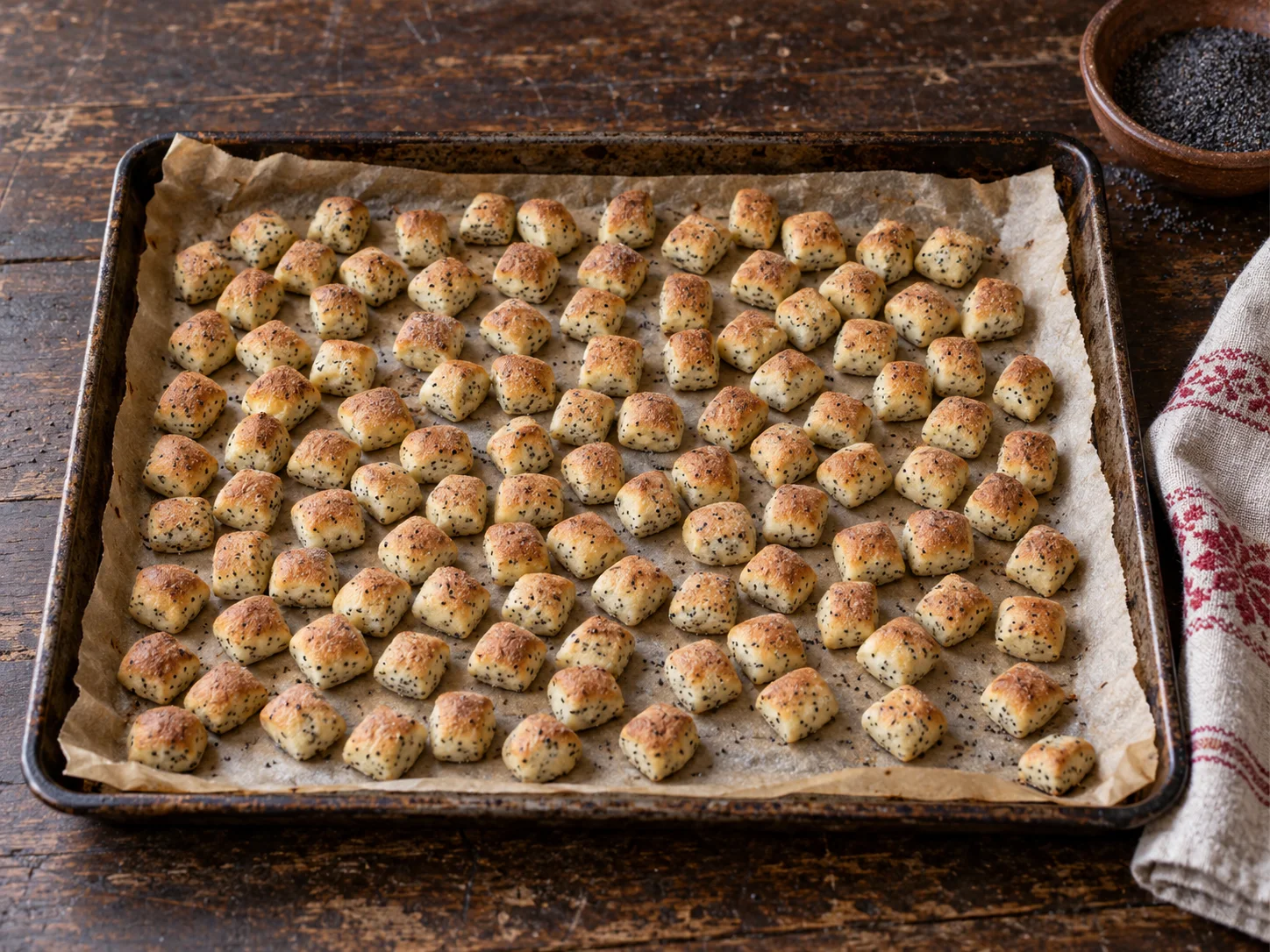
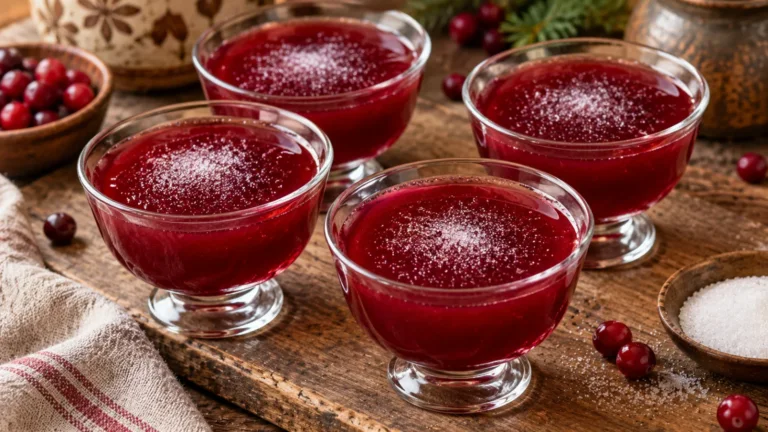
Kūčiukai are small biscuits made from a leavened dough with poppy seeds and baked until hard.3,13 They also go by šližikai or prėskutė,10 and across Lithuania they have nearly thirty names.1 On their own they’re only lightly sweet. They’re usually eaten with aguonų pienas, a milky drink pressed from poppy seeds, or with cranberry kissel, and the older custom was to drop the biscuits into the drink and eat them from a small bowl with a spoon.4,13
Kūčiukai belong to Kūčios, the Lithuanian Christmas Eve supper on December 24, where they are a humble dessert among the twelve dishes.3,4 Shops and home kitchens start making them as Christmas approaches, and once the holiday is over they disappear until the next December.13,14
History and Cultural Roots
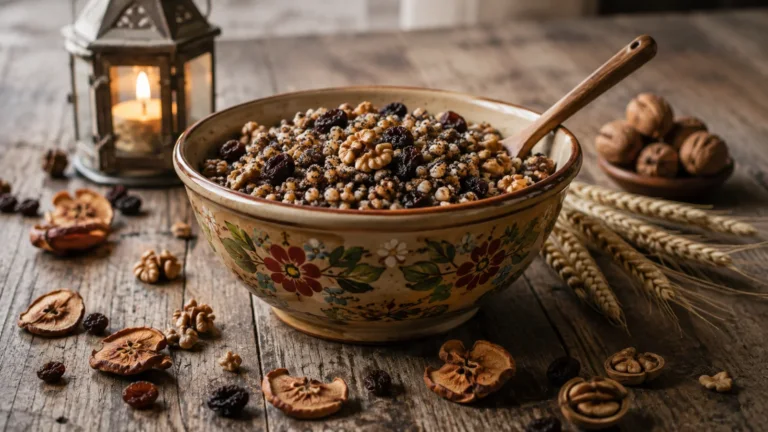
The name comes from kūčia, or from Kūčios, the name of the holiday itself.4 Kūčia was the older dish, a mixture of boiled grains, and it was only later replaced by the kūčiukai familiar today.9 The biscuits took time to settle into their present form, too. The first recorded kūčiukai recipe called for a stiff dough boiled in water and milk, while modern versions are baked.4
In Lithuanian ethnology, a kūčiukas is a symbolic little loaf of bread meant for the souls of ancestors, and a century ago the biscuits were very plain, because they were fasting food.1 They are also known as “the bread of ghosts” and “the bread of the Last Supper.”10 The evening keeps room for the dead in other ways, too. An empty place is left at the Kūčios table for a family member who died that year or could not come,11,13 and after the meal the food was traditionally left on the table overnight for the souls of relatives, who were believed to return.11,12
The supper itself is a fast, traditionally twelve dishes with no meat or dairy,11 although seven or nine dishes were sometimes served, and a full twelve was once associated with wealthier households.9 Kūčiukai fit the fast without any changes. A simple dough needs only flour, water, yeast, sugar, oil, and poppy seeds.1,2
Traditional Recipe
This recipe was compiled by Heritage Healthy Kitchen from a comparison of published recipes; the sources are listed at the end of this article. Figures that are Heritage Healthy Kitchen’s own estimates rather than taken from a published source are marked as such.
Kūčiukai (Poppy Seed Biscuits)
Per 100g of flour, the yeasted recipes compared here use about 40–50ml of water, 1–1.75g of dry yeast, 10–15g of sugar, 5–14g of oil, and anywhere from a few tablespoons to about 14g of poppy seeds. They roll the dough into strands from about 0.5cm thick to the width of a finger and bake at around 180°C (350°F) for 10–20 minutes.1,2,3 The amounts below sit inside those ranges. The 1cm length of each piece follows one published recipe;4 the total amount of dough and the number of servings are Heritage Healthy Kitchen estimates.
Ingredients (About 900g of Dough, an Estimate)
- 500g (4 cups) all-purpose flour
- 7g (2¼ tsp) active dry yeast
- 250ml (1 cup) warm water, plus a pinch of sugar for proofing
- 50g (¼ cup) granulated sugar
- 1 tsp salt
- 60ml (¼ cup) neutral oil, such as sunflower or vegetable, plus more for the bowl
- 40g (4½ tbsp) poppy seeds
Instructions
- Proof the yeast. Stir the yeast and a pinch of the sugar into the warm water and let it sit for 5–10 minutes, until foamy.
- Mix the dough. In a large bowl, combine the flour, remaining sugar, salt, and poppy seeds. Add the proofed yeast mixture and the oil, and mix until a shaggy dough forms.
- Knead and rise. Knead the dough on a floured surface for 8–10 minutes, until smooth and elastic. Place it in a lightly oiled bowl, cover, and let it rise in a warm spot for about 1 hour, until doubled.2,3
- Shape. Punch down the dough and divide it into four pieces. Roll each piece into a thin rope, about 1cm (½ inch) thick, and cut it into small pieces roughly 1cm long.2,4
- Second rise. Spread the pieces on a parchment-lined baking sheet, leaving a little space between them so they can rise, and let them rest for 20–30 minutes while the oven preheats to 180°C (350°F).1,3
- Bake. Bake for 12–15 minutes, until golden brown, rotating the tray halfway through. Let the biscuits cool and firm up completely before storing or serving.1,3
Aguonų Pienas (Poppy Milk)
Published recipes use 70–227g of poppy seeds for every 290–475ml of water, with about a tablespoon of honey or less.2,6,7 This version sits between them. The yield is a Heritage Healthy Kitchen estimate.
Ingredients (Makes About 500ml, an Estimate)
- 150g (about 1 cup) poppy seeds
- Just-boiled water, for soaking
- 600ml (2½ cups) cold water, divided
- 1 tbsp (about 20g) honey, or to taste

Instructions
- Soak the seeds. Put the poppy seeds in a heatproof bowl, cover them generously with just-boiled water, and leave them for at least 1 hour. Some cooks soak them overnight in hot water.2,6
- Drain and rinse. Drain the seeds, rinse them under cold water, and let them drain again.6
- Blend. Blend the seeds with about 150ml of the cold water until the mixture turns white, 1–4 minutes depending on the blender. Add the rest of the water and blend again briefly.2,6
- Strain. Pour the mixture through several layers of cheesecloth or a nut milk bag and squeeze out as much liquid as you can. Strain a second time if poppy grit comes through, then discard the pulp.2,6
- Sweeten and chill. Stir in the honey until it dissolves, then chill. Serve it poured over the biscuits in small bowls, or in glasses with the biscuits alongside.2,4
Kitchen Tips
Poppy milk depends on breaking the seeds down properly. Traditionally they were crushed in a clay bowl or pounded in a mortar with a wooden pestle, thinned with warm water, and sometimes strained through linen; today a meat grinder or coffee mill does the crushing,8 and a blender works the same way. Soaking first softens the seeds, and rinsing them afterwards, as one published recipe does, gets rid of the soaking water.6
Some recipes enrich the dough with butter or sour cream for a softer biscuit, and quick versions replace the yeast with baking powder.4,5 The version here sticks to water and oil, with no butter, eggs, or milk, so it stays within the Kūčios fast.11
For a heartier biscuit, part of the white flour can be swapped for whole wheat. One published recipe allows up to a quarter of the flour to be replaced and notes that whole wheat flour may absorb more water,4 and the Malsena recipe makes kūčiukai entirely from whole-grain wheat flour, with hemp seeds added.1
Leave a little space between the pieces on the tray. They keep rising before and during baking, and pieces that touch tend to bake into clumps.3
Nutritional Information
Per Serving (⅛ of the Biscuits)

- Calories: approximately 307–376 kcal
- Protein: approximately 6.9–8.5g
- Total fat: approximately 8.7–10.6g
- Saturated fat: approximately 0.9–1.1g
- Carbohydrates: approximately 50–61g
- Dietary fiber: approximately 2.6–3.2g
- Sodium: approximately 264–323mg
Nutritional values are estimates based on standard ingredient databases (USDA FoodData Central). They cover the biscuits only. Poppy milk is not included, because the share of the seeds that passes through the cloth varies from batch to batch and the pulp is discarded.
Most of the fat comes from the sunflower oil and the poppy seeds, which is why saturated fat stays at about a gram per serving.
Storage and Reheating
Once they’ve cooled completely, kūčiukai keep in an airtight container in a cool, dark cupboard. Many cooks bake them two or three days ahead, since Christmas Eve is a busy day in the kitchen.3,4 They also freeze well. Unbaked pieces can go straight from the freezer into a preheated oven for 15–20 minutes, and baked biscuits taste better if they’re warmed in the oven for a few minutes after thawing.4
Poppy milk keeps for up to 3 days in a closed jar or bottle in the refrigerator. Don’t leave it out for more than a couple of hours, and don’t freeze it.6 Stir or shake it before serving, since the poppy solids settle.
Traditional Kūčiukai

Ingredients
- 500g (4 cups) all-purpose flour
- 7g (2¼ tsp) active dry yeast
- 250ml (1 cup) warm water, plus a pinch of sugar for proofing
- 50g (¼ cup) granulated sugar
- 1 tsp salt
- 60ml (¼ cup) neutral oil, such as sunflower or vegetable
- 40g (4½ tbsp) poppy seeds
Instructions
- Proof the yeast. Stir the yeast and a pinch of the sugar into the warm water and let it sit for 5–10 minutes, until foamy.
- Mix the dough. In a large bowl, combine the flour, remaining sugar, salt, and poppy seeds. Add the proofed yeast mixture and the oil, and mix until a shaggy dough forms.
- Knead and rise. Knead the dough on a floured surface for 8–10 minutes, until smooth and elastic. Place it in a lightly oiled bowl, cover, and let it rise in a warm spot for about 1 hour, until doubled.
- Shape. Punch down the dough and divide it into four pieces. Roll each piece into a thin rope, about 1cm (½ inch) thick, and cut it into small pieces roughly 1cm long.
- Second rise. Spread the pieces on a parchment-lined baking sheet, leaving a little space between them, and let them rest for 20–30 minutes while the oven preheats to 180°C (350°F).
- Bake. Bake for 12–15 minutes, until golden brown, rotating the tray halfway through. Let the biscuits cool and firm up completely before storing or serving.
Frequently Asked Questions
What’s the difference between kūčiukai and kūčia?
Kūčia is the older Christmas Eve dish, a mixture of boiled grains, and the holiday’s name is tied to it.4,9 Kūčiukai, the small baked poppy seed biscuits, later took its place on most tables.9
How thick should the dough ropes be?
Published recipes range from about 0.5cm to ½ inch (about 1.3cm), or roughly the width of a finger.1,2,3 The 1cm rope in this recipe sits in the middle of that range.
Do kūčiukai have to be made with yeast?
No. Quick versions made with baking powder are common now, including one shared on Lithuanian public television, but a yeasted or naturally leavened dough is the more traditional approach.4,5
Are poppy seeds safe to eat?
In general, the U.S. Food and Drug Administration does not advise consumers to avoid foods containing poppy seeds. It notes some reports of negative effects linked to such foods, and its specific warning is against homemade poppy seed “tea,” made by rinsing unwashed seeds in cold water.15
Is this recipe vegan?
The biscuits are, as written: the dough uses flour, yeast, water, sugar, oil, and poppy seeds. The poppy milk uses honey, which can be replaced with sugar or maple syrup.6
Can kūčiukai be made ahead?
Yes. Most Kūčios dishes are made ahead,7 and kūčiukai can be baked two to three days in advance.4 Poppy milk keeps for up to 3 days in the refrigerator, so it can be made a day or two before.6
What can I serve instead of poppy milk?
Cranberry kissel (spanguolių kisielius) is the other traditional partner, and some families serve oat kissel. The biscuits can also simply be eaten dry.3,13
Further Reading & Sources
The recipe is a compilation based on the published recipes listed here; these links are provided for readers who want to explore further.
Published recipes
- Aleknaitė, Kristina. “Tradiciniai lietuviškų kūčiukų receptai – gudrybės, kurios neleis suklysti kepant namuose.” Alkas.lt, December 22, 2018. alkas.lt.
- Quist, Amy. “Kūčiukai with Poppy Seed Milk.” SPU Stories (Response), Seattle Pacific University, November 2021. stories.spu.edu.
- Ieva. “Traditional Lithuanian Kūčiukai (Mini Yeast-Leavened Christmas Breads).” Taste of Lithuania, February 2, 2024. tasteoflithuania.com.
- Ieva. “Lithuanian Christmas Eve Biscuits (Kūčiukai) – Quick Recipe.” Taste of Lithuania, January 1, 2024. tasteoflithuania.com.
- LRT TV news service. “How to make Lithuania’s Christmas Eve specialty – kūčiukai.” LRT English, December 24, 2021. lrt.lt.
- Ieva. “Poppy Seed Milk (Lithuanian Christmas Eve Drink).” Taste of Lithuania, May 29, 2024. tasteoflithuania.com.
- “Some ‘Kūčios’ favorites.” Draugas News, November 15, 2005 (no byline). draugas.org.
History, culture, and food safety
- “Aguonpienis.” Visuotinė lietuvių enciklopedija (Universal Lithuanian Encyclopedia; no author listed). vle.lt.
- “Kaip keitėsi lietuvių Kūčių stalas?” Alkas.lt, December 23, 2016 (no byline shown). alkas.lt.
- Aleknaite, Diana. “Spotlight on Lithuanian Culture! Chapter 12: Christmas Cookies.” Lithuanian World Center, December 22, 2022. lcenter.org.
- “A Feast for the Living – and the Dead.” Draugas News, November 15, 2007 (no byline). draugas.org.
- Ross, Darius James. “A traditional Lithuanian Christmas.” The Baltic Times, December 21, 2000. baltictimes.com.
- “Christmas traditions in Lithuania.” Vilnius With Locals, last updated October 27, 2025 (no author listed). vilniuswithlocals.com.
- Edmunds, Weronika. “Three Central European Christmas-Only Dishes.” 3 Seas Europe, December 25, 2022. 3seaseurope.com.
- “Opiate Alkaloids on Poppy Seeds.” U.S. Food and Drug Administration, content current as of April 21, 2026. fda.gov.
Disclaimer
The information in this article is provided for educational and informational purposes only. Heritage Healthy Kitchen makes no representations or warranties regarding the accuracy or completeness of any content on this site. Nutritional values are estimates only and will vary depending on the specific ingredients, brands, and measurements used. This content is not intended as dietary, medical, or professional nutritional advice. Always consult a qualified healthcare provider regarding any dietary needs or health conditions. Heritage Healthy Kitchen is not responsible for any outcomes resulting from the use of recipes or information published on this site.
Cook by Occasion
This recipe is part of our Kūčios menu.
You Might Also Like
More heritage recipes from our kitchen

Leave a Reply