

Active time: ~50 minutes | Total time: ~3½ hours | Serves: 12 | Difficulty: Medium
Quick Overview
- Choose the version: a lenten dough of flour, water, oil, and a little sugar for Sviata Vecheria, or a richer dough with milk, eggs, and butter for Christmas Day
- Knead the dough and let it rise until doubled in size
- Divide it into three portions and braid each into a ring: one large, one medium, one small
- Let the rings rest and bake until golden; the richer version is brushed with egg glaze first
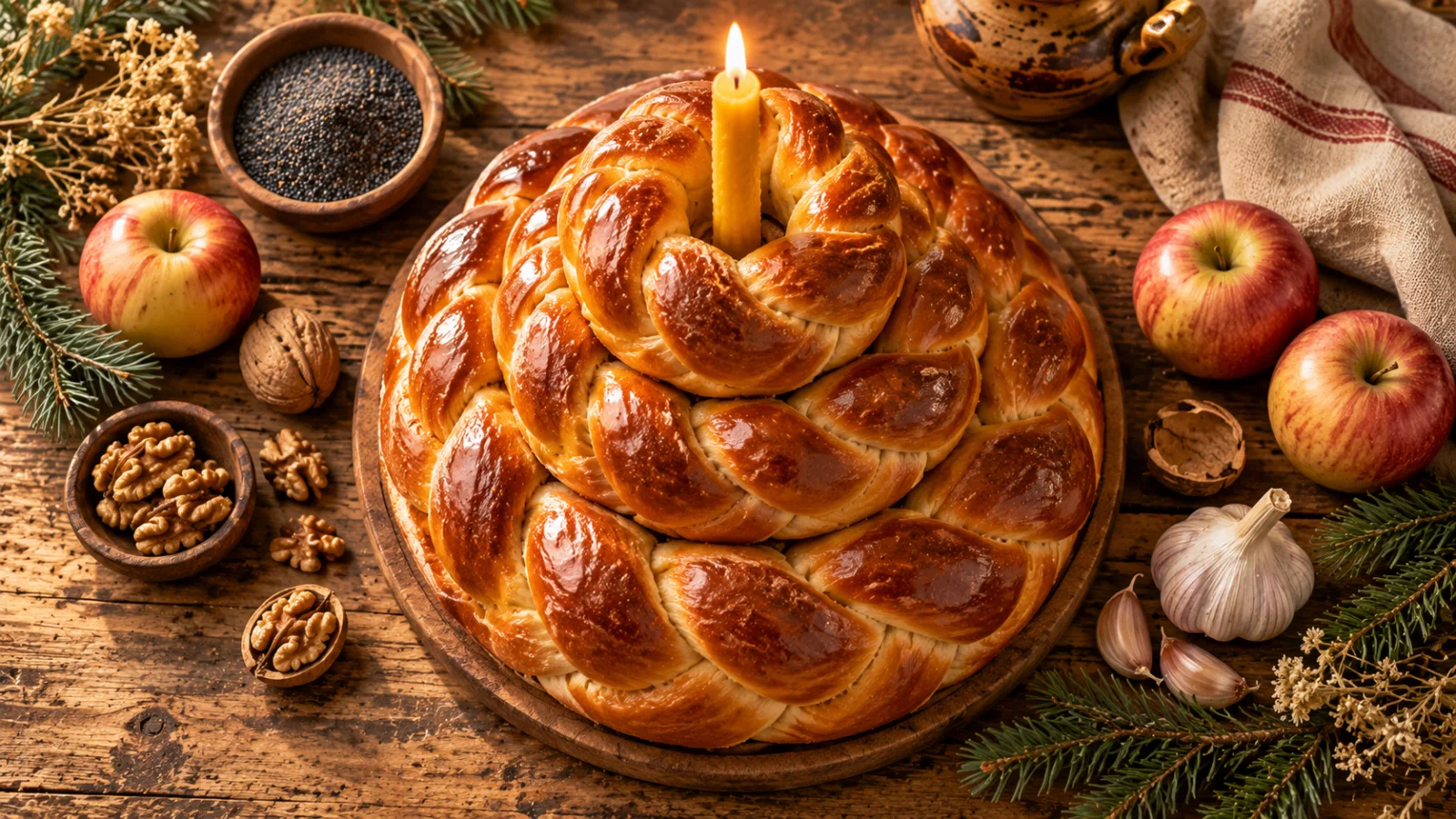
- Cool completely, stack the rings from largest to smallest, and set a candle in the center of the top ring
What Kolach Is
Kolach (колач, also called kalach, калач; plural kolachi) is a braided ritual bread that sits at the center of the table at Sviata Vecheria, the Ukrainian Christmas Eve supper.4,7 The Internet Encyclopedia of Ukraine lists the braided kalach first among the ritual breads Ukrainians bake from special doughs, alongside Easter paska, the filled bread knysh, wedding korovai, sweet babka, and egg bread. The kalach baked for Christmas and for funerals, it adds, symbolizes eternity.1
The bread is usually a round braid of white wheat dough,5,6,8 and on the Christmas Eve table it is set out with a lit candle.4,6 Accounts disagree about the dough, which is why this article gives two versions (see History & Cultural Roots).
The other dishes of the supper are collected on our Sviata Vecheria menu.
History & Cultural Roots
In Ukrainian tradition bread was regarded as holy and as a gift of God, and no significant family event took place without it.1 The Christmas Eve supper is rich in meatless dishes:1 twelve of them, meatless and milkless,2 a number that corresponds to the twelve apostles.3
The name is linked to kolo, “circle,” and the braided ring is read as a sign of the sun and of eternity.7,8 In Ukraine, Christmas itself merged with older local celebrations of the sun’s return.2 In some areas a spoonful of each course of the Christmas Eve supper was even mixed into the flour for a special kolach.8
Ïzhakultura notes that kalachi were carried along with the supper to grandparents, godparents, and sometimes the midwife, and that various kinds of Christmas kalachi are still baked today, especially in the western regions, and set on the table with a lit candle.4 In one account a hole was made in the bread for a tall wax candle, and the Christmas bread stood for the newborn Jesus.6
The most detailed local record comes from an ethnological study, Christmas in Pokuttia. There the kalachi, also called kolachi or strutsli, held an important place on the table, and there had to be three of them.5 His informants recall the three kolachi set out with a candle, walnuts, garlic, apples, and poppy seeds; stacked one on another and left until the feast of John the Baptist, then eaten or given to the hens; and standing for the unity of generations and respect for the dead.5
Whether that bread was lenten has no single answer. One account says the Christmas bread could be either lenten or made with milk and eggs, and that it wasn’t eaten at the supper but simply placed on the table.6 Others say it was eaten on Christmas Day,7,11 one of them because the bread was very rich and the Christmas fast was still on.11 A third source, citing an older ethnographic account, says the kalach was baked lean, without milk and eggs.12 So there are two versions below: a lenten kolach for the Sviata Vecheria table and a richer one, with milk and eggs, for Christmas Day.
One note on dates: the Orthodox Church of Ukraine moved Christmas from 7 January to 25 December in 2023, while letting parishes and monasteries keep the old calendar.9 On the new calendar, Sviata Vecheria falls on 24 December.
Traditional Kolach Recipe
This article gives two versions of the same bread, a lenten kolach for Sviata Vecheria and a richer kolach with milk and eggs for Christmas Day. Both recipes were compiled by Heritage Healthy Kitchen from a comparison of published recipes; the sources are listed at the end of this article. Figures that are Heritage Healthy Kitchen’s own estimates rather than taken from a published source are marked as such.
Lenten Kolach for Sviata Vecheria (No Milk, No Eggs)
Only one of the published recipes found for this article is fully lenten, and the proportions come from it: 1kg of flour, 500ml of water, 25g of yeast, 4 tablespoons of oil, 2 tablespoons of sugar, and 1 teaspoon of salt, scaled here to 750g of flour so the two versions match.12 It doesn’t say whether the yeast is fresh or dry. 25g per kilogram is a fresh-yeast amount, so the dry-yeast quantity is a conversion. The recipe gives the order of work (dissolve the yeast, mix, let the dough rise, braid it, let it rise again, bake at 180°C) but no rise times and no glaze.12 A second published recipe on a water-and-oil dough, which does add one egg, also braids three strands into a ring and gives the ring a second rise.13 The kneading and first-rise times are borrowed from the richer recipes, and the three-ring scaling and the bake times for the medium and small rings are Heritage Healthy Kitchen estimates, not published figures. With one fully lenten source behind it, judge the dough by feel and adjust (see Kitchen Tips).
Ingredients
For the dough (serves 12)
- 750g (about 6 cups) white wheat flour, plus extra for the work surface
- About 19g fresh yeast, or about 6g (2 tsp) instant dry yeast
- 20g (about 1½ tbsp) sugar
- About 4.5g (¾ tsp) fine salt
- 375ml (about 1½ cups) warm water
- 45ml (3 tbsp) neutral oil, plus a little for the bowl
For assembling
- 1 tall candle, preferably beeswax6,8
- Optional: a handful of walnuts, a few apples, a head of garlic, and a small bowl of poppy seeds, set beside the bread as one Pokuttia informant describes5
- Optional: a few evergreen sprigs7
Instructions

Step 1: Activate the yeast
Warm the water to about 36–37°C (97–99°F), the temperature one published recipe gives for its liquids.10 Dissolve the yeast and the sugar in it and leave for 10–15 minutes.12
Step 2: Mix and knead
Add the salt and the oil, then stir in the flour gradually until a soft dough forms.12 Knead on a lightly floured surface for 8–10 minutes until the dough is smooth and elastic.11 Resist adding much extra flour; a soft dough keeps the crumb tender.
Step 3: First rise
Place the dough in an oiled bowl, cover, and leave in a warm place for about 1 hour, until doubled in size.
Step 4: Divide the dough
Turn the dough out and divide it into three portions of roughly 600g, 450g, and 300g. Divide each portion into three equal strands.
Step 5: Braid the rings
Roll the strands of the largest portion into ropes about 70cm long, the medium portion about 55cm, and the small portion about 35cm. Braid each set of three ropes loosely, bend the braid into a ring, and pinch the ends together firmly so the seam is hidden. Place each ring on its own parchment-lined tray, leaving room for it to expand.
Step 6: Second rise
Cover the rings loosely and let them rest for 20–30 minutes, until visibly puffy. Heat the oven to 180°C (350°F) while they rise.12
Step 7: Bake
Leave out the egg glaze: the lenten dough has no egg, and the published recipe mentions no glaze at all.12 For a light sheen, brush the rings lightly with a little oil or sweetened water just before baking. Bake until golden: 35–40 minutes for the large ring,12 about 30–35 minutes for the medium, and about 25–30 minutes for the small. If a ring browns too quickly, cover it loosely with foil. The rings are done when the underside sounds hollow when tapped.
Step 8: Cool and assemble
Cool the rings completely on a wire rack. Set the large ring on a platter, place the medium ring on top, then the small ring on top of that. Stand the candle in the center of the top ring, held upright by a small candle holder or pressed into a small ball of dough. Arrange the optional walnuts, apples, garlic, poppy seeds, and evergreen sprigs around the base.
Christmas Day Kolach (With Milk and Eggs)
The three published recipes for a rich kalach each make a single braided ring. The proportions here sit within their range: milk is about 47% of the flour weight, against 40–57% milk (or milk and whey) in those recipes, and butter is about 11%, against roughly 7–20%. All three bake at 180°C after a first rise of about an hour.10,11 The three graduated rings are this recipe’s own scaling, so the ring weights, the shorter strand lengths, and the medium and small bake times are estimates, not published figures. The storage advice below is likewise practical guidance, not taken from a source.
Ingredients
For the dough (serves 12)
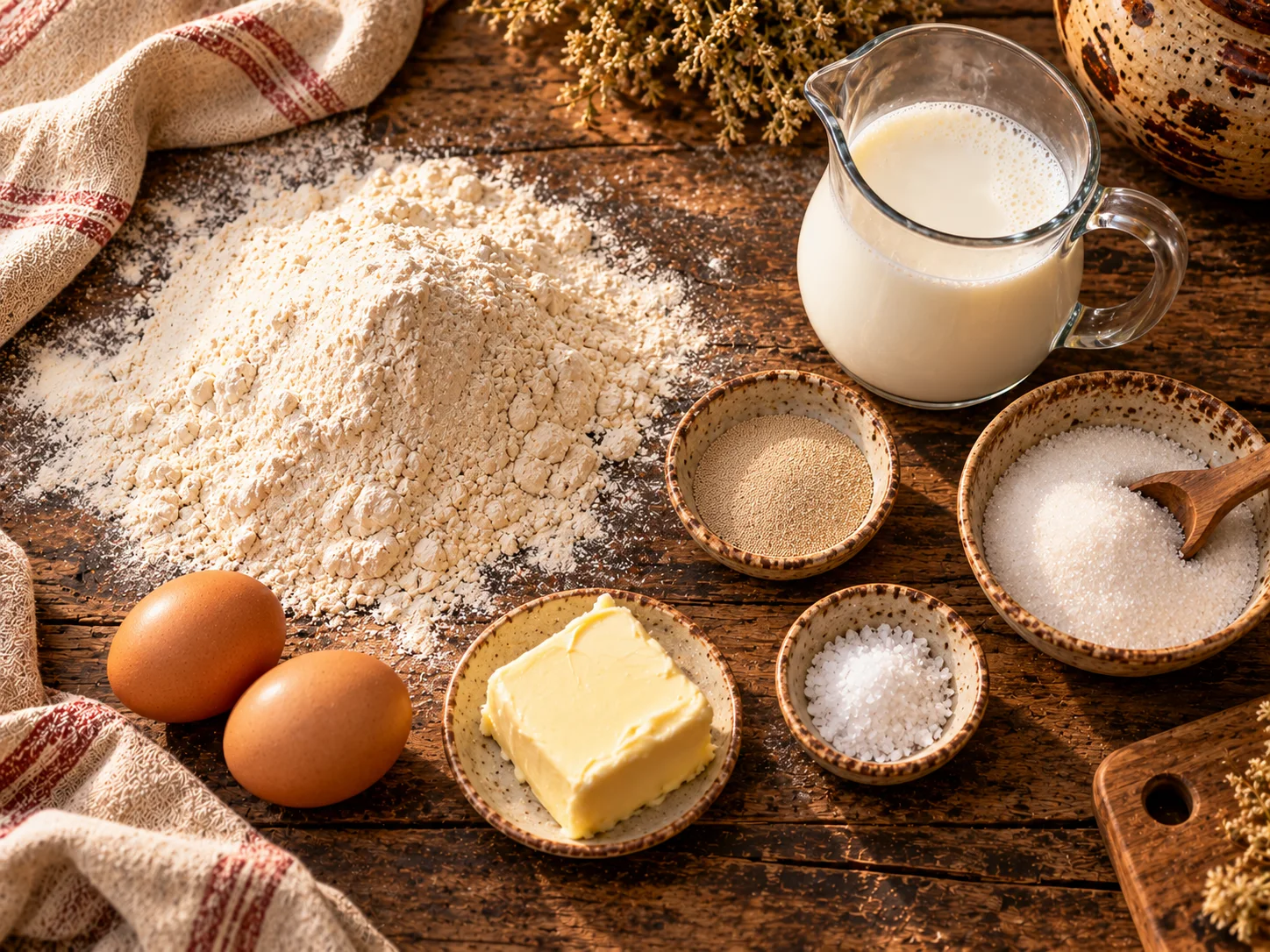
- 750g (about 6 cups) white wheat flour, plus extra for the work surface
- 7g (about 2¼ tsp) instant dry yeast, or about 21g fresh yeast
- 60g (about ¼ cup) sugar
- 9g (about 1½ tsp) fine salt
- 350ml (about 1½ cups) whole milk, lukewarm
- 2 large eggs, at room temperature
- 80g (about 5½ tbsp) unsalted butter, softened
- A little neutral oil for the bowl
For the glaze
- 1 large egg
- 15ml (1 tbsp) milk
For assembling
- 1 tall candle, preferably beeswax6,8
- Optional: a handful of walnuts, a few apples, a head of garlic, and a small bowl of poppy seeds, set beside the bread as one Pokuttia informant describes5
- Optional: a few evergreen sprigs7
Instructions
Step 1: Mix the dough
Warm the milk to about 36–37°C (97–99°F).10 Whisk the flour, yeast, sugar, and salt together in a large bowl. Beat the two eggs into the warm milk, pour the mixture into the flour, and stir until a rough dough forms. Add the softened butter in portions and work it in with your hands or with a dough hook.11
Step 2: Knead
Knead on a lightly floured surface for 8–10 minutes until the dough is smooth, elastic, and no longer sticks to your hands.11 Resist adding much extra flour; a soft dough gives a tender crumb.
Step 3: First rise
Place the dough in an oiled bowl, cover, and leave in a warm place for about 1 hour, until doubled in size.10,11
Step 4: Divide the dough
Turn the dough out and divide it into three portions of roughly 600g, 450g, and 300g. Divide each portion into three equal strands.
Step 5: Braid the rings
Roll the strands of the largest portion into ropes about 70cm long,10 the medium portion about 55cm, and the small portion about 35cm. Braid each set of three ropes loosely, bend the braid into a ring, and pinch the ends together firmly so the seam is hidden. Place each ring on its own parchment-lined tray, leaving room for it to expand.
Step 6: Second rise
Cover the rings loosely and let them rest for 20–30 minutes, until visibly puffy.11 Heat the oven to 180°C (350°F) while they rise.10,11
Step 7: Glaze and bake
Beat the glaze egg with the milk and brush it gently over each ring. Bake until deep golden brown: 30–35 minutes for the large ring,10,11 about 25–30 minutes for the medium, and about 20–25 minutes for the small. If a ring browns too quickly, cover it loosely with foil.11 The rings are done when the underside sounds hollow when tapped.
Step 8: Cool and assemble
Cool the rings completely on a wire rack. Set the large ring on a platter, place the medium ring on top, then the small ring on top of that. Stand the candle in the center of the top ring, held upright by a small candle holder or pressed into a small ball of dough. Arrange the optional walnuts, apples, garlic, poppy seeds, and evergreen sprigs around the base.
Kitchen Tips
Bake each ring on its own timing. The large ring weighs twice as much as the small one, so they don’t finish together. Put the large ring in first, or bake the rings on separate shelves, and take each one out as it colors.
Keep the braids loose. A braid pulled tight has nowhere to expand, and the strands split open in the oven.
The lenten dough has no egg or butter to soften it, so it is best on the day it is baked. That is practical guidance, not taken from a source.
Judge the dough by feel rather than by the clock. Flour differs from one country and brand to another in how much liquid it absorbs, so a dough that feels slack after kneading may need a tablespoon or two more flour, while a stiff one may need a splash of milk.
Cool the rings completely before stacking; warm bread compresses under the weight of the upper rings, and the stack leans.
Treat the candle with care. The tradition calls for a lit candle,4,8 but a lit flame near dry evergreen sprigs is a fire risk, so keep the greenery at the base, well away from the top ring, and never leave the candle burning unattended. Before slicing, remove the candle and any bread that wax has touched.
This dough is only mildly sweet. In one account, once the candle is lit the head of the household dips bread in honey and shares it with the table,8 so a small bowl of honey is worth setting out.
Nutritional Information
Per serving, lenten kolach (1 of 12 servings)
- Calories: approximately 240–295 kcal
- Protein: ~6–7g
- Total fat: ~3.5–4.5g
- Saturated fat: ~0.4g
- Carbohydrates: ~45–55g
- Fiber: ~1.6–2.0g
Per serving, Christmas Day kolach (1 of 12 servings)

- Calories: approximately 300–367 kcal
- Protein: ~8–10g
- Total fat: ~7–9g
- Saturated fat: ~4–5g
- Carbohydrates: ~49–60g
- Fiber: ~1.7–2.0g
Nutritional values are estimates based on standard ingredient databases (USDA FoodData Central) and will vary with the flour, the size of the slice, and, for the Christmas Day version, how much of the glaze the bread actually carries.
Storage and Reheating
Kolach is best on the day it is baked and still good the next day. Keep it wrapped in a clean cloth or in a bag at room temperature, and unstacked if it will sit for more than a few hours, since the upper rings flatten the lower ones.
For longer storage, slice the rings and freeze the slices in an airtight bag. Thaw at room temperature, then warm the slices for a few minutes in a 150°C (300°F) oven to refresh the crust.
Lenten Kolach for Sviata Vecheria

Ingredients
For the dough (serves 12)
- 750g (about 6 cups) white wheat flour, plus extra for the work surface
- About 19g fresh yeast, or about 6g (2 tsp) instant dry yeast
- 20g (about 1½ tbsp) sugar
- About 4.5g (¾ tsp) fine salt
- 375ml (about 1½ cups) warm water
- 45ml (3 tbsp) neutral oil, plus a little for the bowl
For assembling
- 1 tall candle, preferably beeswax
- Optional: a handful of walnuts, a few apples, a head of garlic, and a small bowl of poppy seeds, set beside the bread as one Pokuttia informant describes
- Optional: a few evergreen sprigs
Instructions
- Activate the yeast: Warm the water to about 36–37°C (97–99°F), the temperature one published recipe gives for its liquids. Dissolve the yeast and the sugar in it and leave for 10–15 minutes.
- Mix and knead: Add the salt and the oil, then stir in the flour gradually until a soft dough forms. Knead on a lightly floured surface for 8–10 minutes until the dough is smooth and elastic. Resist adding much extra flour; a soft dough keeps the crumb tender.
- First rise: Place the dough in an oiled bowl, cover, and leave in a warm place for about 1 hour, until doubled in size.
- Divide the dough: Turn the dough out and divide it into three portions of roughly 600g, 450g, and 300g. Divide each portion into three equal strands.
- Braid the rings: Roll the strands of the largest portion into ropes about 70cm long, the medium portion about 55cm, and the small portion about 35cm. Braid each set of three ropes loosely, bend the braid into a ring, and pinch the ends together firmly so the seam is hidden. Place each ring on its own parchment-lined tray, leaving room for it to expand.
- Second rise: Cover the rings loosely and let them rest for 20–30 minutes, until visibly puffy. Heat the oven to 180°C (350°F) while they rise.
- Bake: Leave out the egg glaze: the lenten dough has no egg, and the published recipe mentions no glaze at all. For a light sheen, brush the rings lightly with a little oil or sweetened water just before baking. Bake until golden: 35–40 minutes for the large ring, about 30–35 minutes for the medium, and about 25–30 minutes for the small. If a ring browns too quickly, cover it loosely with foil. The rings are done when the underside sounds hollow when tapped.
- Cool and assemble: Cool the rings completely on a wire rack. Set the large ring on a platter, place the medium ring on top, then the small ring on top of that. Stand the candle in the center of the top ring, held upright by a small candle holder or pressed into a small ball of dough. Arrange the optional walnuts, apples, garlic, poppy seeds, and evergreen sprigs around the base.
Christmas Day Kolach with Milk and Eggs
Ingredients
For the dough (serves 12)
- 750g (about 6 cups) white wheat flour, plus extra for the work surface
- 7g (about 2¼ tsp) instant dry yeast, or about 21g fresh yeast
- 60g (about ¼ cup) sugar
- 9g (about 1½ tsp) fine salt
- 350ml (about 1½ cups) whole milk, lukewarm
- 2 large eggs, at room temperature
- 80g (about 5½ tbsp) unsalted butter, softened
- A little neutral oil for the bowl
For the glaze
- 1 large egg
- 15ml (1 tbsp) milk
For assembling
- 1 tall candle, preferably beeswax
- Optional: a handful of walnuts, a few apples, a head of garlic, and a small bowl of poppy seeds, set beside the bread as one Pokuttia informant describes
- Optional: a few evergreen sprigs
Instructions
- Mix the dough: Warm the milk to about 36–37°C (97–99°F). Whisk the flour, yeast, sugar, and salt together in a large bowl. Beat the two eggs into the warm milk, pour the mixture into the flour, and stir until a rough dough forms. Add the softened butter in portions and work it in with your hands or with a dough hook.
- Knead: Knead on a lightly floured surface for 8–10 minutes until the dough is smooth, elastic, and no longer sticks to your hands. Resist adding much extra flour; a soft dough gives a tender crumb.
- First rise: Place the dough in an oiled bowl, cover, and leave in a warm place for about 1 hour, until doubled in size.
- Divide the dough: Turn the dough out and divide it into three portions of roughly 600g, 450g, and 300g. Divide each portion into three equal strands.
- Braid the rings: Roll the strands of the largest portion into ropes about 70cm long, the medium portion about 55cm, and the small portion about 35cm. Braid each set of three ropes loosely, bend the braid into a ring, and pinch the ends together firmly so the seam is hidden. Place each ring on its own parchment-lined tray, leaving room for it to expand.
- Second rise: Cover the rings loosely and let them rest for 20–30 minutes, until visibly puffy. Heat the oven to 180°C (350°F) while they rise.
- Glaze and bake: Beat the glaze egg with the milk and brush it gently over each ring. Bake until deep golden brown: 30–35 minutes for the large ring, about 25–30 minutes for the medium, and about 20–25 minutes for the small. If a ring browns too quickly, cover it loosely with foil. The rings are done when the underside sounds hollow when tapped.
- Cool and assemble: Cool the rings completely on a wire rack. Set the large ring on a platter, place the medium ring on top, then the small ring on top of that. Stand the candle in the center of the top ring, held upright by a small candle holder or pressed into a small ball of dough. Arrange the optional walnuts, apples, garlic, poppy seeds, and evergreen sprigs around the base.
Frequently Asked Questions
Why are there three loaves?
Sources give different reasons. One says three stacked kolachi stand for the Holy Trinity.7 A Pokuttia informant in the same study says they stand for the unity of generations and respect for the dead.5 In Podillia three ritual breads were stacked on the Christmas Eve table, and each was cut on a different feast: Christmas Day, New Year’s Day, and Epiphany.6
When is kolach actually eaten?
Accounts differ. One says that once the candle is lit, the head of the household dips bread in honey and shares it to begin the supper.8 Others say the bread was set on the table rather than eaten at the supper, and eaten on Christmas Day.6,7,11 A Pokuttia informant recalls the loaves lying until the feast of John the Baptist and then being eaten or given to the hens.5 Households have followed different customs, and none of these accounts cancels the others.
Is kolach lenten, given that Sviata Vecheria is a fast?
The sources are split. The twelve dishes of Sviata Vecheria are described as meatless and milkless.2 Some accounts describe kolach dough made with milk and eggs,6,8 and the published recipes for a rich kalach use milk, eggs, and butter.10,11 One source, citing an older ethnographic account, says the kalach was baked lean, without milk and eggs.12 Another says the Christmas bread could be either lenten or rich, and was set on the table rather than eaten at the supper.6 This article gives a lenten version for the Sviata Vecheria table and a richer one for Christmas Day. Which one a household bakes is its own choice.
What is the difference between kolach, paska, and korovai?
They are separate ritual breads. The Internet Encyclopedia of Ukraine lists the braided kalach, Easter paska, wedding korovai, and the filled knysh among the ritual breads, and notes that each has its own name, shape, recipe, and use.1 Kolach belongs to Christmas, and also to funerals,1,4 while paska is blessed on Easter morning.1 A smaller relative, kolachyky, is the diminutive form, a small braided roll.8
Do I have to light a candle?
A lit candle is part of the custom in several accounts,4,6,8 and a wax candle is the traditional choice.6,8 The bread bakes and tastes the same without it. If open flame is a concern at the table, leaving the candle out or placing it in a holder away from any greenery is a practical choice.
Further Reading & Sources
The following sources were consulted for the history and cultural background of kolach, together with the published recipes used for the proportions. The recipes are compilations based on the published recipes listed here; these links are provided for readers who want to explore further.
- Stechishin, S. “Traditional foods.” Internet Encyclopedia of Ukraine, Canadian Institute of Ukrainian Studies, University of Toronto/University of Alberta. encyclopediaofukraine.com — Traditional foods — the status of bread, ritual breads, the kalach as a symbol of eternity, the meatless supper, the blessing of paska.
- Odarchenko, Petro. “Christmas.” Internet Encyclopedia of Ukraine, Canadian Institute of Ukrainian Studies, University of Toronto/University of Alberta. encyclopediaofukraine.com — Christmas — the twelve meatless and milkless dishes; Christmas and the older celebrations of the sun’s return.
- Poshyvailo, Tetiana. “‘Food of the Gods’ for Ukrainian Christmas: Kutia and Uzvar.” Smithsonian Center for Folklife and Cultural Heritage, 12 December 2023. folklife.si.edu — Kutia and Uzvar — the twelve dishes and the apostles.
- Borysenko, Valentyna. “Обрядовий хліб — Історія перша, зимова” [Ritual bread — first story, winter]. yizhakultura.com, 13 December 2019. yizhakultura.com — Ritual bread — kalachi carried with the supper; candle on the table (in Ukrainian).
- Romaniv, Mykhailo. “Святвечірні страви. Уривок із книги «Різдво на Покутті»” [Sviatvechir dishes. Excerpt from the book Christmas in Pokuttia]. Локальна історія (localhistory.org.ua), 25 December 2025. localhistory.org.ua — Sviatvechir dishes — kalachi in Pokuttia and informants’ accounts (in Ukrainian).
- Kotsan, Yulia. “Традиції надвечір’я Христового Різдва” [Traditions of the eve of Christmas]. Religious Information Service of Ukraine (risu.ua), 2 January 2009. risu.ua — Traditions of Christmas Eve — lenten or rich Christmas bread set on the table, the dough, the candle, the three stacked breads of Podillia (in Ukrainian).
- Chraibi, Christine. “Sviat Vechir: Ukraine’s ancient Christmas Eve and its twelve sacred dishes.” Euromaidan Press, 24 December 2025. euromaidanpress.com — Sviat Vechir — the name, the sun and eternity reading, the three-stack, and when the bread is eaten.
- SaskToday. Article on bread in Ukrainian winter rituals, summarizing research compiled by Maureen Stefaniuk, curator of the Canora Ukrainian Heritage Museum (author and date not shown on the page). sasktoday.ca — Ukrainian winter bread — the dough, the stacked loaves, the honey custom, and kolachyky.
- The Kyiv Independent news desk. “Orthodox Church of Ukraine to switch to revised Julian calendar, celebrate Christmas on Dec. 25.” The Kyiv Independent, 24 May 2023. kyivindependent.com — calendar change — the Synod’s decision.
- Klopotenko, Yevhen. “Різдвяний калач. Автентичний рецепт від Євгена Клопотенка” [Christmas kalach: an authentic recipe]. klopotenko.com, December 2024. klopotenko.com — Christmas kalach — a published recipe (in Ukrainian).
- Khmelnytska, Vira. “Як приготувати калач на Різдво — рецепт традиційної випічки” [How to make kalach for Christmas: a traditional bake]. TSN.ua, 18 December 2025, with recipes by Valentyna Sayenko and Alona Moskovchenko. tsn.ua — Christmas kalach recipes — two published recipes; the rich bread eaten on Christmas Day (in Ukrainian).
- Pavliuk, Bohdana. “12 страв на Святвечір: що і чому має бути на святковому столі” [12 dishes for Sviatvechir: what and why]. Explainer (explainer.ua), 17 December 2025. explainer.ua — 12 dishes for Sviatvechir — the kalach baked lean, without milk and eggs, citing Voropai, and a recipe of flour, water, yeast, oil, sugar, and salt (in Ukrainian).
- Koropetska, Anastasiia, with Olena Braichenko and Kostiantyn Hrubych. “12 страв на Святвечір: що вони символізують та як їх приготувати” [12 dishes for Sviatvechir: what they symbolize and how to cook them]. Ukrainska Pravda. Zhyttia (life.pravda.com.ua), 22 December 2023, updated 23 December 2025. life.pravda.com.ua — 12 dishes for Sviatvechir — a kalach recipe on a water-and-oil dough with one egg, used here only for the method (in Ukrainian).
Disclaimer
The information in this article is provided for educational and informational purposes only. Heritage Healthy Kitchen makes no representations or warranties regarding the accuracy or completeness of any content on this site. Nutritional values are estimates only and will vary depending on the specific ingredients, brands, and measurements used. This content is not intended as dietary, medical, or professional nutritional advice. Always consult a qualified healthcare provider regarding any dietary needs or health conditions. Heritage Healthy Kitchen is not responsible for any outcomes resulting from the use of recipes or information published on this site.
Cook by Occasion
The lenten kolach is part of our Sviata Vecheria menu, and the richer Christmas Day kolach of our Rizdvo menu.
You Might Also Like
More heritage recipes from our kitchen
Leave a Reply