

Part of our Heritage Kitchen Glossary – short guides to the ingredients and techniques behind Eastern European cooking.
What kutia is
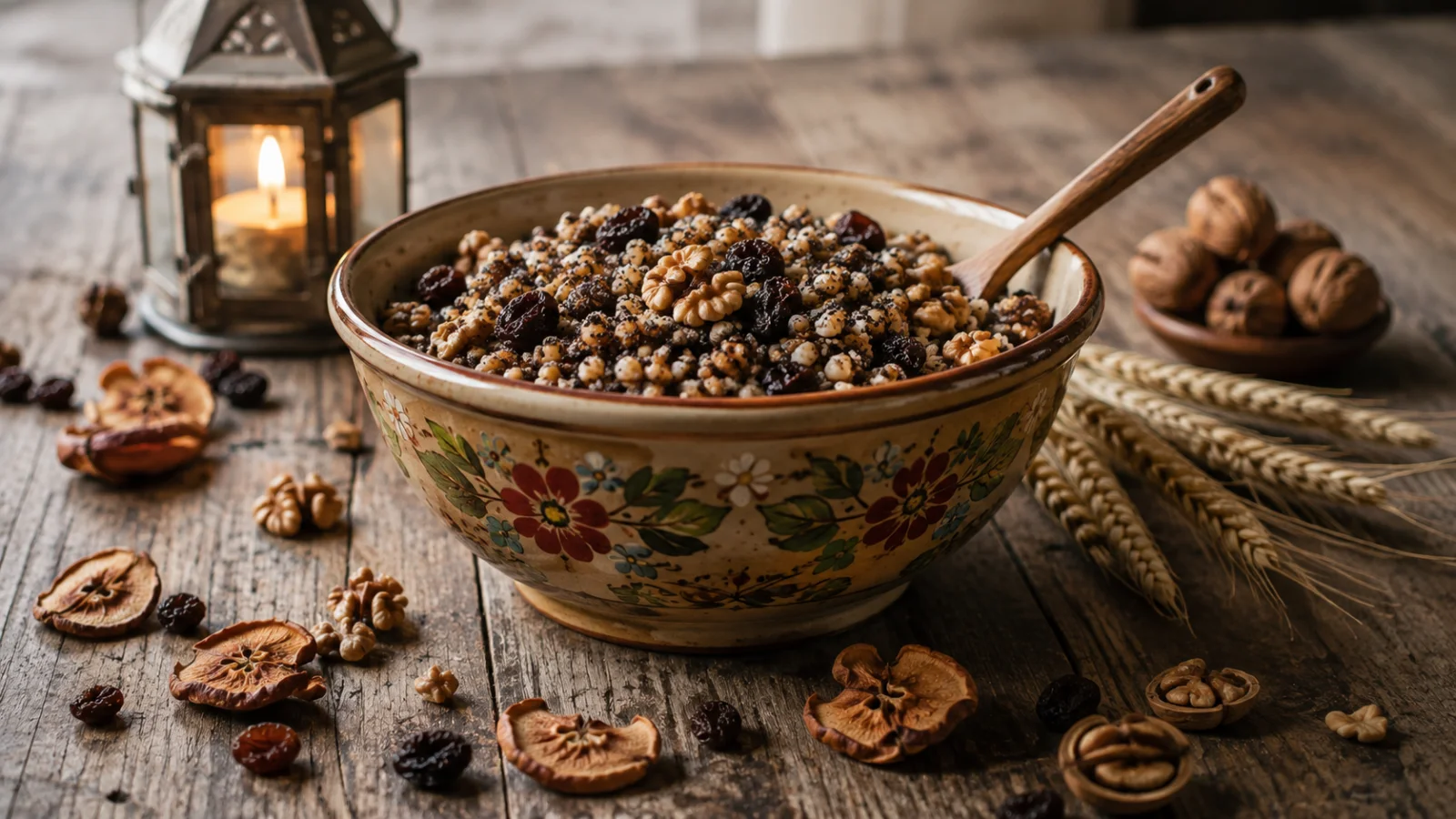
Kutia is a ritual dish of cooked wheat or barley grain with ground poppy seeds, eaten with honey. Walnuts and raisins or other dried fruit are common additions in published recipes. It is one of the oldest of the twelve dishes of Sviata Vecheria, the Ukrainian Christmas Eve “Holy Supper”, a meal without meat or milk. In many households it is the first dish eaten that night, though in some regions it closes the meal instead.
Where the name comes from
The Encyclopedia of Ukraine lists kutia among the Greek loanwords that became widespread in Ukrainian. It comes from Greek koukkía, “beans” or “seed”.
A dish older than Christianity
Before Christianity, the winter solstice in late December was a time to honor ancestors. According to an article published by the Smithsonian Center for Folklife and Cultural Heritage, people believed the sky opened at this time of year and the souls of dead relatives came back. Kutia and uzvar, a dried-fruit drink, were made to welcome them, and both are still known as the “food of the gods”. Christianity was adopted in Kyivan Rus’, the medieval state centered on Kyiv, in 988. Christmas then merged with the older celebration of the sun’s return, and many of the old customs carried over into the new holiday.
What happens to the first spoonful
When the kutia was served, the head of the household took the first spoonful, opened the window or went out into the yard, and invited the frost to eat kutia, an offering meant to keep the frost away from the crops. Back inside, he threw that spoonful at the ceiling. If many grains stuck, the family could expect a rich harvest and a good swarming of bees. Some of the kutia went to the cattle, and children carried it to their godparents and grandparents. After the meal, three spoonfuls of each dish were set on a separate plate, with spoons beside them, for the souls of dead relatives.
Three kutias
Three kutias are made between Christmas and Epiphany. Bahata kutia, roughly “rich kutia”, is the Christmas Eve one, a fasting dish cooked in water. Shchedra kutia, “generous kutia”, goes on the table on New Year’s Eve, the evening of Malanka. By then kutia no longer has to be lenten, and it is made with milk and butter. Holodna, or “hungry”, kutia is served on Epiphany Eve, January 5. Nobody eats during the day, and the family sits down only after the first star.
Where you will meet it on this site
Both recipes are in our Traditional Kutia article. The fasting kutia for Christmas Eve is made from wheat soaked overnight, poppy seeds steeped and ground, honey, walnuts and raisins; for shchedra kutia the wheat is cooked in milk. The braided kolach stands at the center of the same supper with a lit candle. The whole menu is on our Sviata Vecheria page, and kutia comes back on New Year’s Eve on our Malanka menu.
Frequently Asked Questions
What is kutia made of?
Cooked wheat or barley grain with ground poppy seeds, eaten with honey. Walnuts and raisins or other dried fruit are common additions in published recipes.
When is kutia eaten?
Three times between Christmas and Epiphany: on Christmas Eve as bahata kutia, on New Year’s Eve at Malanka as shchedra kutia, and on Epiphany Eve as holodna, or “hungry”, kutia.
Is kutia the first dish or the last?
In many households it is the first dish eaten at the Christmas Eve supper, and in some regions it closes the meal. Traditionally kutia and uzvar are the first dishes tasted, and family members eat from one bowl.
What does the word kutia mean?
It comes from Greek koukkía, “beans” or “seed”, one of the Greek loanwords that became widespread in Ukrainian.
What is the difference between kutia and uzvar?
Kutia is the sweetened grain dish; uzvar is a drink made from dried fruit. Both were made to welcome the souls of ancestors, and both are still known as the “food of the gods”.
Further Reading & Sources
This entry draws on the sources below and on the recipes it links to elsewhere on this site. They are listed for readers who want to go further.
- “Kutia.” Internet Encyclopedia of Ukraine, Canadian Institute of Ukrainian Studies; originally published in the Encyclopedia of Ukraine, vol. 2 (1988), no author named. encyclopediaofukraine.com
- Petro Odarchenko. “Christmas.” Internet Encyclopedia of Ukraine, Canadian Institute of Ukrainian Studies, updated 2005. encyclopediaofukraine.com
- George Y. Shevelov. “Hellenisms.” Internet Encyclopedia of Ukraine, Canadian Institute of Ukrainian Studies; originally published in the Encyclopedia of Ukraine, vol. 2 (1988). encyclopediaofukraine.com
- Tetiana Poshyvailo. “‘Food of the Gods’ for Ukrainian Christmas: Kutia and Uzvar.” Smithsonian Center for Folklife and Cultural Heritage, 12 December 2023. folklife.si.edu
- Wasyl Lencyk. “Christianization of Ukraine.” Internet Encyclopedia of Ukraine, Canadian Institute of Ukrainian Studies. encyclopediaofukraine.com
- “Malanka.” Internet Encyclopedia of Ukraine, Canadian Institute of Ukrainian Studies; originally published in the Encyclopedia of Ukraine, vol. 3 (1993), no author named. encyclopediaofukraine.com
- Kateryna Pulatova and Olha Zaitseva. “Shchedra kutia na Malanku: try retsepty obriadovoi stravy” [Shchedra kutia for Malanka: three recipes for the ritual dish]. UNIAN, 13 January 2025 (in Ukrainian). unian.ua
- Olha Shveda. “Druhyi Sviatvechir, abo ‘holodna kutia’. Holovni tradytsii” [The second Holy Evening, or “hungry kutia”: the main traditions]. Suspilne Lviv, 5 January 2025 (in Ukrainian). suspilne.media
Leave a Reply