

Active time: 15 minutes | Total cooking: 45 minutes | Chilling (optional): 4+ hours | Serves: 6 | Difficulty: Easy
Quick Overview
- Simmer whole beets in water or light vegetable broth with onion until tender, about 40 minutes
- Balance the flavor with lemon juice or vinegar and a small amount of sugar, the sweet-and-sour signature of Ashkenazi borscht
- Keep the soup pareve for a meat meal, or stir in sour cream for a dairy version — kosher tradition keeps the two separate, never mixed
- Serve hot in winter or chilled in summer, always with a boiled potato on the side
- This is one of the few traditional recipes on this site that gets no separate healthy adaptation, because the base recipe is already light, low in fat, and high in fiber as written
What Jewish Beet Borscht Is
Jewish beet borscht is the Ashkenazi branch of the wider Eastern European borscht family, distinct from both the Ukrainian borscht and Polish barszcz czerwony already on this site. Ukrainian borscht is a thick, hearty soup built on meat or bone stock, cabbage, and potatoes.2 Polish barszcz czerwony goes the other direction: a clear, strained ruby broth built around a fermented beet sour, left unwhitened by sour cream.2 Jewish beet borscht took a third path entirely, shaped less by regional cooking style and more by kosher law.
Because Jewish dietary law forbids mixing meat and dairy — a rule rooted in the biblical books of Exodus, Leviticus, and Deuteronomy4 — Ashkenazi cooks split borscht into two distinct versions early on: a hearty fleishig (meat) soup made with chicken or beef broth and eaten without sour cream, and a lighter, water-based milchig (dairy) soup that could be topped with sour cream at the table.3 The dairy version turned a soft pink once the sour cream was stirred in, and it’s this lighter, tangy-sweet beet soup that became identified with Jewish cooking specifically, distinguishing it from the heavier, often pork-flavored versions common among non-Jewish neighbors.3
Yiddish speakers also gave the soup its own name. The English word “borscht,” with its extra “t,” comes directly from the Yiddish באָרשט, and it’s this transliteration — not the Ukrainian or Polish spelling — that entered English, largely because Ashkenazi Jewish immigrants were the ones who popularized the soup across North America.1,2
Origins and the Ashkenazi Adaptation
Like its Ukrainian and Polish relatives, Jewish borscht traces back to a soup made from fermented hogweed, a wild plant once common across Eastern European meadows, long before beets entered the pot.1 The earliest Yiddish records of Jews cooking this kind of sour soup date to the 1500s, made much like the versions eaten by non-Jewish neighbors, with local and family variation deciding the exact recipe.3
Once beets replaced hogweed as the primary ingredient, regional taste took over. Jewish cooks in the Galician region of central Europe developed a reputation for a noticeably sweeter borscht, adding sugar alongside the traditional souring agents.2,3 Cooks elsewhere favored a plainer, more sour profile using lemon juice, vinegar, or a fermented beet concentrate called rosl in Yiddish.3 That word is worth pausing on: rosl is linguistically related to the Polish rosół, the word for broth used in the clear chicken soup already featured on this site — two words from a shared root, describing two very different Eastern European soups.2
From Eastern Europe to the Borscht Belt
Mass Jewish emigration from Eastern Europe, driven in part by the pogroms that began in the 1880s, carried borscht traditions across the Atlantic.1 In New York, one of the first companies producing kosher food on an industrial scale was I. Rokeach & Sons, founded in 1890 by Israel Rokeach, a Jewish scholar originally from Russia. Rokeach sold a light, vegetarian, water-based beet borscht in jars, modeled on the version he remembered from his own childhood, and it became many American Jews’ first association with the dish.3
In 1932, Tillie and Hyman Gold founded Gold’s in Brooklyn, specializing in beet products including bottled borscht. Between Rokeach’s and Gold’s products, the pareve, sweet-and-tangy beet version became the standard image of borscht for millions of American Jewish households, the pink-tinted soup people picture even now.3
That association deepened in the Catskill Mountains. When many mainstream American hotels refused Jewish guests through the early twentieth century, Jewish-owned resorts in the Catskills became the alternative, and the area came to be known, initially in mockery, as the Borscht Belt.1,2 At Grossinger’s, one of the largest resorts, kosher kitchens served milchig breakfasts and lunches and fleishig dinners, with borscht available all day, every day of the year.2,3 Since most guests visited in summer, the soup was typically served cold, closer to a beet smoothie than a hot bowl of soup.2
Holiday and Sabbath Traditions
Jewish beet borscht is tied to three points in the Jewish calendar, each for a different practical reason.
At Passover, root vegetables such as beets kept well in cellars through the winter, and by early spring they were often among the last fresh ingredients a family had on hand. Beet borscht, served with a boiled potato on the side, let Eastern European Jewish households put together a festive-feeling meal from limited stores just as Passover arrived.3 This vegetarian version, known as peysakhdiker borsht, is considered an essential dish of the holiday and was traditionally set to ferment around Purim so it would be ready roughly four weeks later.2
Seven weeks after Passover comes Shavuot, a holiday customarily associated with dairy foods. Chilled borscht finished with sour cream fit the occasion exactly, and it remains a popular Shavuot dish.2,3
On Shabbat, Jewish law prohibits heating liquid, which makes hot soup impractical for the third meal of the day, known as Seudah Shlishit, eaten late on Saturday afternoon. A cold beet soup finished with a dollop of sour cream solved that problem neatly and became a Shabbat fixture in its own right.2,3
On the Holiday Table
Beets have one more claim on the calendar. They are among the simanim, the symbolic foods eaten at the start of the Rosh Hashanah meal, where the Hebrew word for beet, selek, is heard as a wish that ill will be removed from the coming year.⁷
Traditional Jewish Beet Borscht Recipe
Recipe developed independently by Heritage Healthy Kitchen, drawing on Ashkenazi culinary tradition. Sources for further reading are listed at the end of this article.1,2,3
Ingredients
- 1.2 kg (about 8 medium beets), peeled and quartered
- 2.5 liters (10 cups) water or light vegetable broth
- 1 medium onion, quartered
- 2–3 tablespoons sugar, to taste
- 3–4 tablespoons fresh lemon juice, or 3 tablespoons white vinegar
- 1½ teaspoons salt, plus more to taste
- Freshly ground black pepper, to taste

To serve
- 6 small boiled potatoes, peeled
- Fresh dill, chopped
- Sour cream, for a dairy (milchig) version — omit to keep the soup pareve
- Hard-boiled eggs, halved (optional)
Method
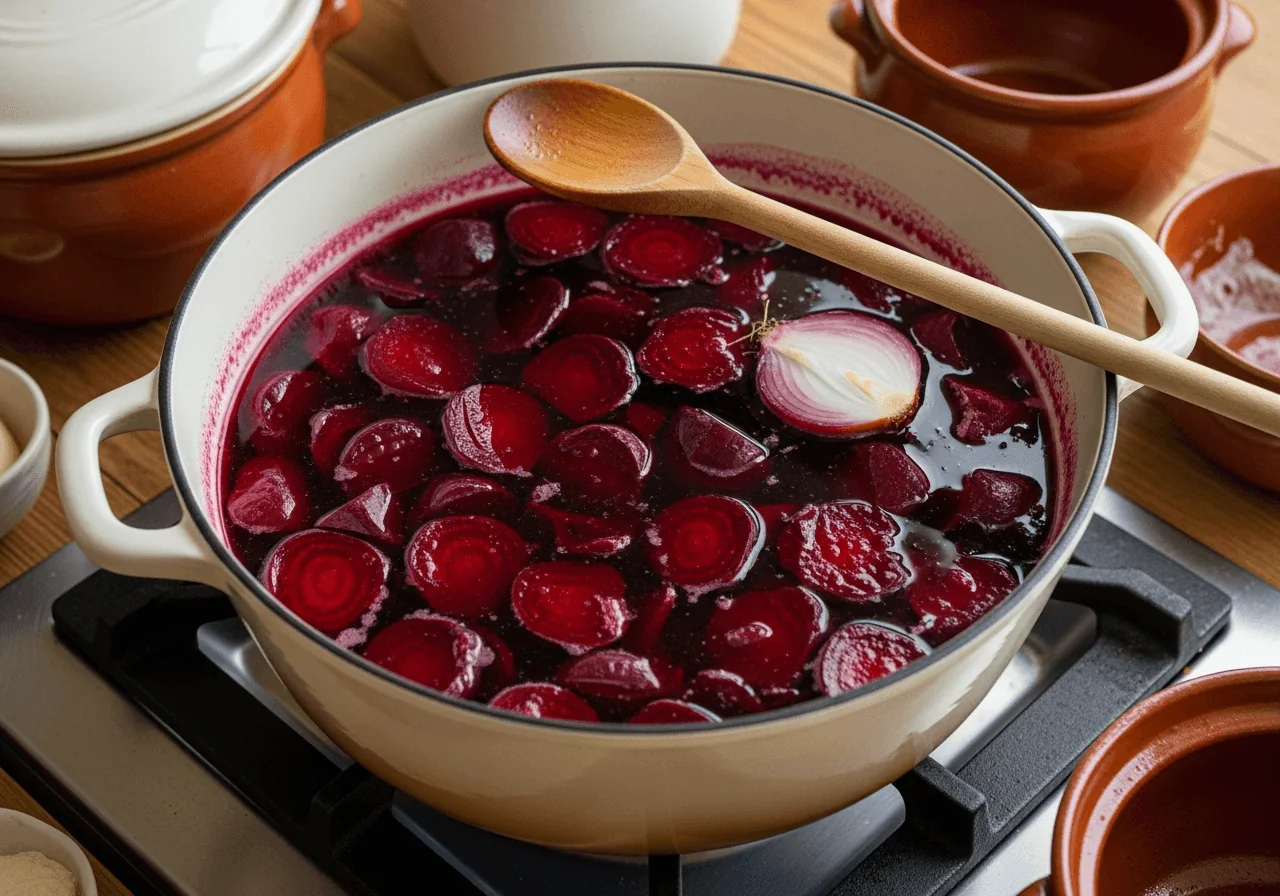
- Place the beets, onion, and water in a large pot. Bring to a boil, then reduce to a simmer.
- Cover partially and simmer for 35–40 minutes, until the beets are easily pierced with a fork.
- Remove the beets, let them cool enough to handle, then grate them coarsely on a box grater. Discard the onion or blend it into the broth. Return the grated beets to the pot.
- Stir in the sugar, lemon juice or vinegar, salt, and pepper. Taste and adjust — the soup should be clearly sweet and clearly sour at the same time, not muted.
- Serve hot, ladled over a boiled potato in each bowl, or refrigerate for at least 4 hours and serve cold with the potato on the side.
- Top with fresh dill and, for a dairy version, a spoonful of sour cream. Add hard-boiled egg halves if using.
Kitchen Tips
On the sweet-sour balance
There’s no single correct ratio here. Galician-style borscht leans sweeter; other traditions lean more sour, using lemon juice or vinegar with a lighter hand on the sugar.2,3 Start with the smaller amounts listed and adjust upward once you’ve tasted it.
On serving temperature
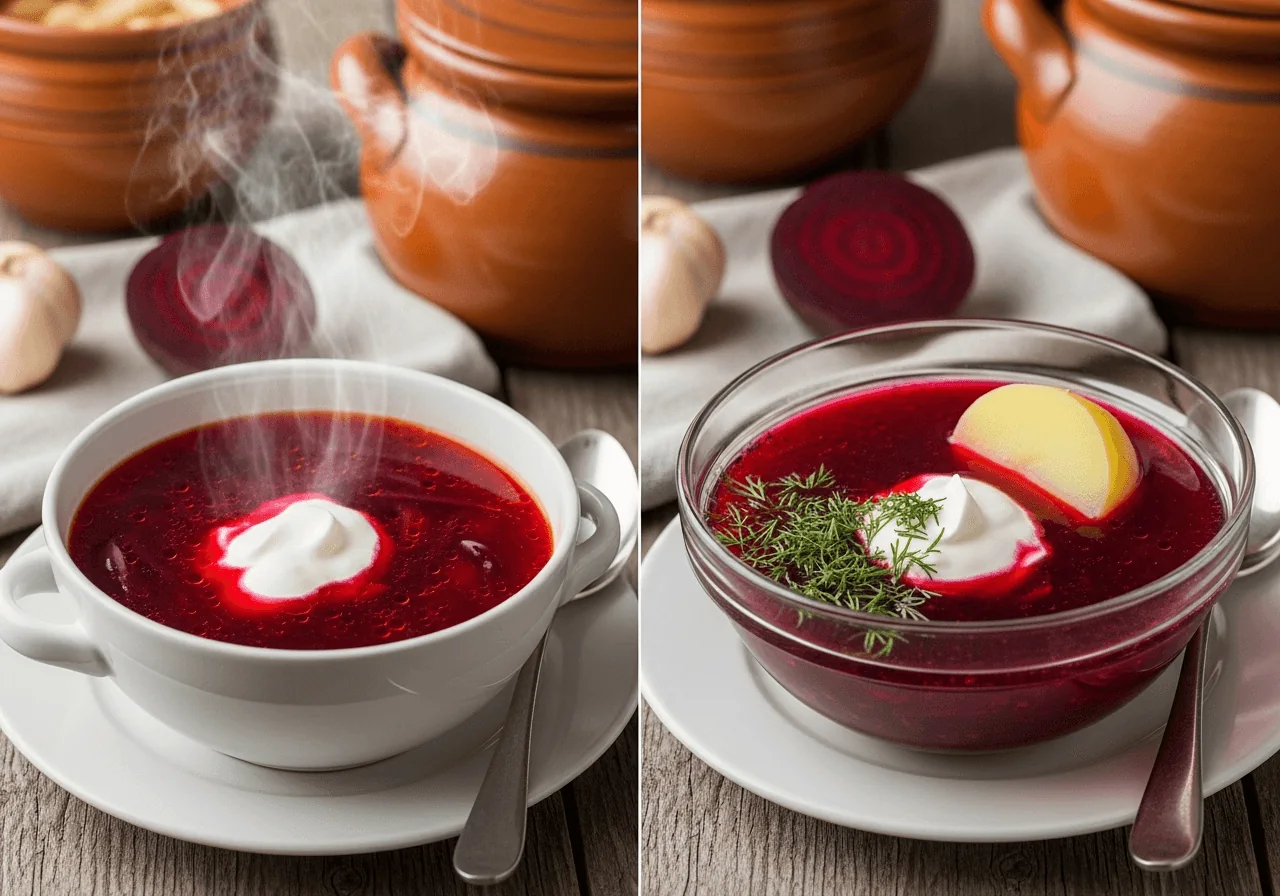
Hot or cold, the recipe doesn’t change — only what happens after the soup comes off the stove. For a cold version, chill it fully before adding the potato, dill, and sour cream, rather than trying to cool it quickly.
Why This Soup Never Needed a Healthy Makeover
Most dish pairs on Heritage Healthy Kitchen include a separate healthy adaptation article, built around specific ingredient swaps. This one doesn’t, on purpose. The traditional recipe above already fits the profile this project usually has to build toward: it’s water- or broth-based rather than cream-based, it has no fried or breaded component, and its main ingredient is a fiber-rich root vegetable rather than a refined starch.
Beets themselves carry the weight of the nutritional case. They’re low in calories relative to their nutrient content, and their deep color comes from betalains, plant pigments with antioxidant and anti-inflammatory properties.5 One cup of beetroot contains close to 4 grams of fiber, and beets are also a source of dietary nitrates, compounds linked to improved blood vessel function and blood pressure.5 Large cohort studies also link higher fiber intake to lower rates of heart disease and cardiovascular mortality — which is worth knowing, since a bowl of this soup delivers a meaningful share of a day’s fiber before any recipe changes are even on the table.6
The only ingredient here that adds meaningful saturated fat is the sour cream, and it’s optional by kosher design, not as a health-motivated substitution. That’s a different starting point from a dish that’s traditionally fried or built on a cream base, where a real adaptation is needed to bring it in line with current nutrition guidance. This one doesn’t need that step, so this article covers the traditional version only.
Nutritional Information
Values below are estimates for one serving of the soup itself (roughly 400ml / 1½ cups), calculated from the raw ingredient quantities in the recipe above using standard USDA figures. These are estimates only and exclude the potato, sour cream, and egg served alongside.
- Calories: approximately 100–120 kcal per serving
- Fat: under 0.5g
- Carbohydrates: approximately 25–28g
- Fiber: approximately 5–6g
- Protein: approximately 3–4g
- Sodium: moderate — depends on the salt used and whether broth or plain water forms the base
Adding a tablespoon of sour cream contributes roughly 25 additional calories and 2–2.5g of fat. A medium boiled potato served alongside adds approximately 130 calories, none of which is included in the figures above, since the potato is served on the side rather than blended into the soup.
Storage
Jewish beet borscht keeps well in the refrigerator for up to 4 days in a sealed container, and many people find the flavor improves slightly after a day, once the sweet and sour notes settle.
The soup freezes well for up to 3 months. Freeze it without the potato, sour cream, or egg, and add those fresh after reheating or thawing.
To reheat a hot version, warm gently on the stovetop rather than boiling hard, which helps preserve both color and flavor. A cold version needs no reheating — just a stir and a fresh dollop of sour cream if it’s separated slightly in the fridge.
Traditional Jewish Beet Borscht

Ingredients
- 1.2 kg (about 8 medium beets), peeled and quartered
- 2.5 liters (10 cups) water or light vegetable broth
- 1 medium onion, quartered
- 2–3 tablespoons sugar, to taste
- 3–4 tablespoons fresh lemon juice, or 3 tablespoons white vinegar
- 1½ teaspoons salt, plus more to taste
- Freshly ground black pepper, to taste
To serve
- 6 small boiled potatoes, peeled
- Fresh dill, chopped
- Sour cream, for a dairy (milchig) version — omit to keep the soup pareve
- Hard-boiled eggs, halved (optional)
Instructions
- Place the beets, onion, and water in a large pot. Bring to a boil, then reduce to a simmer.
- Cover partially and simmer for 35–40 minutes, until the beets are easily pierced with a fork.
- Remove the beets, let them cool enough to handle, then grate them coarsely on a box grater. Discard the onion or blend it into the broth. Return the grated beets to the pot.
- Stir in the sugar, lemon juice or vinegar, salt, and pepper. Taste and adjust — the soup should be clearly sweet and clearly sour at the same time, not muted.
- Serve hot, ladled over a boiled potato in each bowl, or refrigerate for at least 4 hours and serve cold with the potato on the side.
- Top with fresh dill and, for a dairy version, a spoonful of sour cream. Add hard-boiled egg halves if using.
Frequently Asked Questions
What’s the real difference between Jewish beet borscht and Ukrainian or Polish borscht?
The biggest difference is what shaped each version. Ukrainian borscht developed as a hearty, meat-and-vegetable soup tied to regional cooking traditions. Polish barszcz czerwony developed toward clarity and restraint, built on a fermented zakwas and strained clear.2 Jewish beet borscht developed around kosher law instead, which is why it split into separate meat and dairy versions rather than settling on one standard recipe.2,3
Is Jewish beet borscht always vegetarian?
No. There’s also a hearty meat version made with chicken or beef stock and eaten without sour cream.2,3 The recipe in this article is the lighter, dairy-optional version most associated with Jewish cooking today.
Why is this soup connected to both Passover and Shavuot, which are weeks apart?
Each holiday draws on a different feature of the same soup. At Passover, beets were often among the last fresh vegetables left in storage by early spring, making the soup a practical, festive option with limited ingredients.3 At Shavuot, seven weeks later, the custom of eating dairy foods lines up naturally with the sour cream topping.2,3
Why do some versions of this soup taste much sweeter than others?
That’s regional, not a sign that one version is more “authentic” than another. Cooks in Galicia built a reputation for a noticeably sweet borscht, while cooks elsewhere kept it plainer and more sour, leaning on lemon juice or vinegar instead of sugar.2,3 Both are traditional. Adjust the sugar and lemon juice in this recipe to whichever direction you prefer.
Can this be made ahead of time?
Yes, and it’s traditional to do so. The flavor tends to deepen after a day in the refrigerator, which makes this a good soup to prepare the day before serving, particularly for a cold summer version.
Is there a healthy version of this recipe on the site?
No, and that’s intentional. Heritage Healthy Kitchen publishes a separate healthy adaptation for dishes that need specific swaps to bring them in line with current nutrition guidance. This soup doesn’t need that treatment: it’s already water- or broth-based, low in fat, and built around a fiber-rich vegetable as written. The traditional recipe above is the one to use.
What can I serve alongside this soup?
A boiled potato is the standard accompaniment, served either in the bowl or on the side. Dark rye bread, hard-boiled eggs, and a small plate of fresh cucumbers or radishes also pair well, especially with the cold version in summer.
Further Reading & Sources
This recipe was developed independently by Heritage Healthy Kitchen. The following sources are provided for further reading on the history, culture, and nutrition covered in this article.
- Zhang, Daniel. “A Brief History of Borshch.” Smithsonian Folklife Festival. https://festival.si.edu/blog/a-brief-history-of-borshch — History of the Ashkenazi Jewish variant of borscht, its role in Passover and Shavuot, and the origins of the Borscht Belt.
- “Borscht.” Wikipedia. https://en.wikipedia.org/wiki/Borscht — Etymology, the fleishig/milchig kosher variants, Galician sweetening tradition, Passover and Shavuot customs, and the history of the Borscht Belt.
- Alt Miller, Yvette. “Borscht: The Favorite Jewish Soup.” Aish. https://aish.com/borscht-the-favorite-jewish-soup/ — Detailed history of Ashkenazi borscht, the Rokeach and Gold’s companies, and the Catskills Borscht Belt.
- “Kashruth.” Encyclopaedia Britannica. https://www.britannica.com/topic/kashruth — Overview of Jewish dietary law, including the separation of meat and dairy.
- Thomsen Ferreira, Sarah, RD. “5 Health Benefits of Beets.” Cleveland Clinic Health Essentials. https://health.clevelandclinic.org/the-health-benefits-of-beets — Fiber content, betalains, nitrates, and other nutritional properties of beets.
- “Fiber.” The Nutrition Source, Harvard T.H. Chan School of Public Health. https://nutritionsource.hsph.harvard.edu/carbohydrates/fiber/ — Research on dietary fiber intake and heart disease risk.
- “What Goes on the Rosh HaShanah Seder Plate?” Reform Judaism. reformjudaism.org — beets among the simanim and the selek wordplay at the New Year table.
Disclaimer
This article is for educational and informational purposes only and is not intended as medical or nutritional advice. Nutritional values provided are estimates and may vary depending on specific ingredients used, preparation methods, and serving sizes. If you have specific dietary needs or health conditions, please consult a qualified healthcare provider or registered dietitian before making changes to your diet.
Cook by Occasion
This recipe is part of our Rosh Hashanah menu and our Shabbat table.
You Might Also Like
More heritage recipes from our kitchen



Leave a Reply