

Traditional Rosół Recipe: Clear Chicken Soup with Noodles
Active time: ~30 minutes | Total time: ~3–3½ hours | Serves: 6 | Difficulty: Easy
Quick Overview
- Put the chicken in cold water and bring it up slowly, just short of a boil
- Skim off the foam until no more rises
- Char the cut side of an onion and add it with the root vegetables and spices
- Simmer on the lowest heat for 2–3 hours, never boiling and never stirring
- Add lovage and parsley near the end, then salt, and strain through a fine sieve
- Serve the clear broth over fine egg noodles with parsley
What Rosół Is
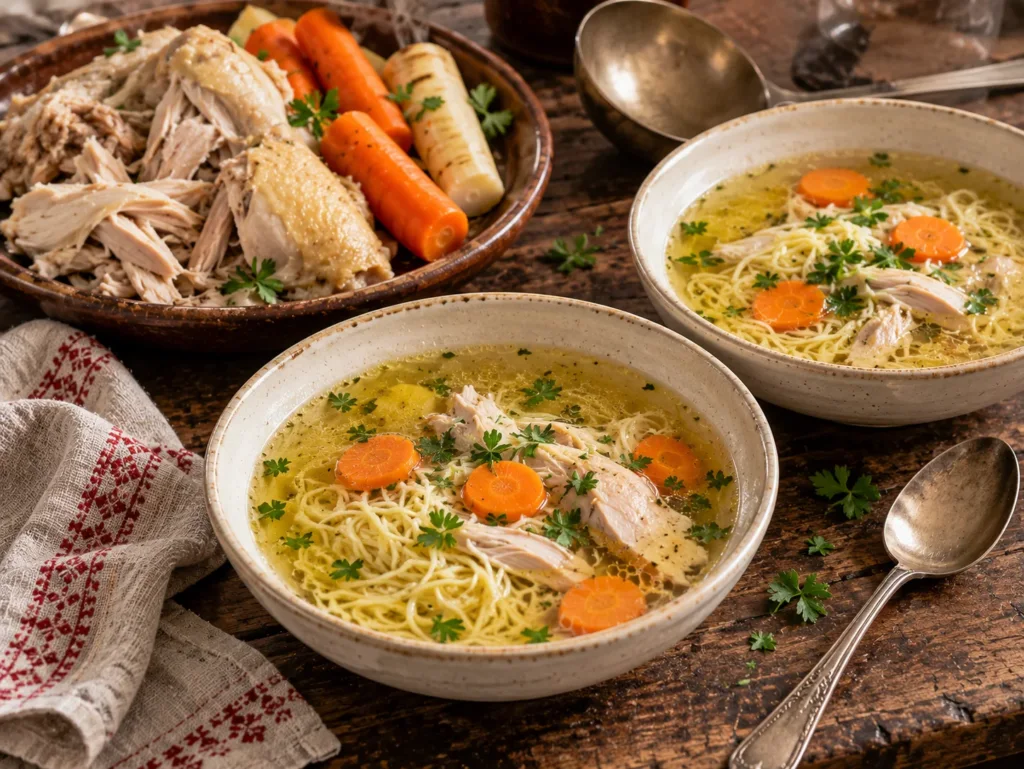
Rosół is the clear Polish broth, most often made with chicken. A hen or chicken pieces simmer very slowly with carrots, parsley root, celeriac, leek and a blackened onion, and the strained broth is served with fine egg noodles and chopped parsley.¹˒² Carrot, parsley root, celery and leek make up the canonical set of vegetables.³
What sets rosół apart from an everyday stock is how it looks. A good one is lightly golden and completely clear, and almost every step of the method is there to keep it that way.²˒⁴
History and Cultural Roots
Rosół is the soup of the Polish Sunday. Until recently, chicken soup or broth was served at every Sunday lunch in Polish homes.⁴ It went on the stove early on Sunday morning and cooked until the whole family could sit down together.¹ The pot is only meant to mrugać, to “wink,” as Polish cooks say, and the spots of fat on the surface are called oka, “eyes.”¹ Because it takes that kind of time and care, Culture.pl calls rosół the food equivalent of the “Sunday best,” and it usually opens wedding feasts too.¹ Leftovers have their use too: broth from Sunday often becomes the stock for Monday’s tomato soup.¹
Older Polish cookbooks treated broth as the foundation of the kitchen. Elżbieta Kiewnarska, in her 1929 book Soups and Sauces, wrote that it should smell mouth-watering and be “lightly golden and absolutely clear.”⁴ The everyday broth of those books was often made with beef: one recipe calls for 400 grams of beef per person, started in cold water and cooked for three to six hours. Broth made from several kinds of meat was sometimes called “royal broth.”⁴
Rosół is also a common home remedy for colds and flu in Poland.⁴ Many cultures reach for chicken soup when someone has a cold, and warm liquids might ease stuffiness by increasing mucus flow.⁵
Traditional Rosół Recipe
This recipe was compiled by Heritage Healthy Kitchen from a comparison of published recipes; the sources are listed at the end of this article. Figures that are Heritage Healthy Kitchen’s own estimates rather than taken from a published source are marked as such.
The published recipes use a whole chicken or about 1.5kg of chicken pieces, with 2 to 3 litres of water or just enough to cover, and simmer it for 2 to 3 hours or longer.²˒⁶˒⁷˒⁸ They differ in how many vegetables go in, from two carrots to six; this version sits in the middle. The number of servings and the portion sizes are Heritage Healthy Kitchen estimates.
Ingredients
For the broth (serves 6)
- 1 chicken, about 1.5–2kg (3.3–4.4 lb), whole or cut up, or 1.5kg (3.3 lb) chicken pieces such as legs, thighs and wings²˒⁶
- 3 litres (about 12½ cups) cold water⁶
- 3–4 carrots, peeled
- 2 parsley roots (or parsnips), peeled
- ½ celeriac (celery root), peeled
- 1 leek, white and light green parts, halved lengthwise and rinsed
- 1 medium onion, unpeeled, halved
- ¼ small savoy cabbage (optional)²˒⁷
- A small bunch of fresh lovage, or 1–2 tablespoons dried (optional)²˒⁶
- A small bunch of fresh parsley
- 6–8 black peppercorns, 4–5 allspice berries and 2 bay leaves⁶˒⁷˒⁸
- Salt, added at the end

To serve
- Fine egg noodles (makaron nitki), cooked separately⁶
- Chopped fresh parsley
- Pieces of the cooked chicken and carrot, if you like²
Instructions

- Start cold. Put the chicken in a large pot, cover it with the cold water and bring it up slowly until it almost boils. It must not boil.⁶
- Skim. Skim off the white or grey foam with a spoon until no more rises.⁶˒⁷
- Char the onion. Meanwhile, hold the onion halves cut side down over a gas flame, or set them in a dry pan, until the cut surface is blackened.²˒⁶˒⁸
- Add the vegetables. Add the carrots, parsley roots, celeriac, leek, charred onion, cabbage if using, and the peppercorns, allspice and bay leaves. Don’t add salt yet.²˒⁶
- Simmer. Turn the heat to the lowest setting. The surface should barely move. Simmer for 2–3 hours without stirring.²˒⁶˒⁸
- Add the herbs. For the last 30 minutes, add the lovage and parsley.²
- Strain and season. Lift out the chicken and vegetables, strain the broth through a fine sieve and season it with salt.²˒⁶
- Serve. Put a portion of cooked noodles in each bowl, ladle the hot broth over them and add chicken, sliced carrot and parsley.²˒⁶
Kitchen Tips
Cloudy broth comes from boiling and stirring. When the broth comes to a full boil, the proteins break into tiny particles and the liquid stops being clear, so keep it at the barest simmer and leave it alone.²
You can rescue a cloudy pot. Chill the strained broth until cold, stir in two egg whites, then heat it slowly while stirring constantly and strain it through gauze.²
Cook the noodles separately. Noodles left in the pot overnight swell up and can cloud the broth.⁷
The onion is a matter of taste. Some cooks char it and others don’t.³ Most published recipes do, and a blackened onion is part of the classic pot.¹˒²˒⁸
Don’t worry about the fat on top. A few droplets of fat on the surface are normal; they are the oka Polish cooks talk about.¹ If you want less, chill the broth and lift off some of the fat before reheating.
Nutritional Information
Per serving (one sixth: about 400ml broth, 60g chicken with skin, 100g cooked noodles and a little carrot)
- Calories: approximately 380–465 kcal
- Protein: ~30g
- Total fat: ~14.5g
- Saturated fat: ~3.8g
- Carbohydrates: ~42g
- Dietary fiber: ~2g
- Sodium: ~635mg
Nutritional values are estimates based on standard ingredient databases (USDA FoodData Central). The portion sizes are Heritage Healthy Kitchen estimates, and the values will vary with the chicken, how much fat you lift off and how much salt you add.
Storage and Reheating
Cool the broth and refrigerate it within 2 hours, dividing a large pot into shallow containers so it cools faster.⁹ It keeps in the fridge for 3 to 4 days or in the freezer for 3 to 4 months.⁹ Store the noodles separately and cook fresh ones when you serve the soup, so they don’t swell in the broth.⁷ Reheat the broth until it is steaming hot.
A Lighter Way to Make It
Rosół is already a light soup, but a few changes make it lighter still. Take the skin off the chicken before it goes into the pot; the American Heart Association advises removing poultry skin before cooking.¹⁰ Bone-in thighs and breasts keep the meaty flavor. Then chill the strained broth overnight and lift off the hardened fat, as the same guidance suggests for meat juices.¹⁰
For more fiber, keep some of the cooked carrots, parsley roots and leek in the bowl, as some published recipes do, and use whole wheat noodles: refining wheat strips away virtually all of its fiber.²˒¹¹ Salt only at the end, about ¼–½ teaspoon for the whole pot, and taste before adding more; the AHA recommends no more than 2,300mg of sodium a day for adults.¹²
With all of these changes, a serving has about half the fat and less than half the saturated fat, roughly three times the fiber and 40 to 50 percent less sodium. The calories stay about the same, because the bowl holds more noodles and vegetables. These figures are Heritage Healthy Kitchen estimates.
Traditional Rosół

Ingredients
For the broth
- 1 chicken, about 1.5–2kg (3.3–4.4 lb), whole or cut up, or 1.5kg (3.3 lb) chicken pieces
- 3 litres (about 12½ cups) cold water
- 3–4 carrots, peeled
- 2 parsley roots (or parsnips), peeled
- ½ celeriac (celery root), peeled
- 1 leek, white and light green parts, halved and rinsed
- 1 medium onion, unpeeled, halved
- ¼ small savoy cabbage (optional)
- A small bunch of fresh lovage, or 1–2 tablespoons dried (optional)
- A small bunch of fresh parsley
- 6–8 black peppercorns, 4–5 allspice berries and 2 bay leaves
- Salt, added at the end
To serve
- Fine egg noodles (makaron nitki), cooked separately
- Chopped fresh parsley
- Pieces of the cooked chicken and carrot, if you like
Instructions
- Put the chicken in a large pot, cover with the cold water and bring it up slowly until it almost boils; it must not boil.
- Skim off the foam until no more rises.
- Blacken the cut side of the onion halves over a gas flame or in a dry pan.
- Add the vegetables, charred onion, cabbage if using, and the spices. No salt yet.
- Simmer on the lowest heat for 2–3 hours without stirring; the surface should barely move.
- Add the lovage and parsley for the last 30 minutes.
- Lift out the chicken and vegetables, strain through a fine sieve and season with salt.
- Ladle the hot broth over cooked noodles and add chicken, carrot and parsley.
Frequently Asked Questions
Why did my rosół turn out cloudy?
Almost always because it boiled or was stirred. At a full boil the proteins break into tiny particles that cloud the liquid.² Keep it at the barest simmer, and if it does turn cloudy, clarify it with egg whites as described in the tips above.²
Parsley root or parsnip?
Parsley root belongs to the classic Polish set of soup vegetables.³ Some published recipes use parsnip instead, and either works.⁷
Can rosół be made with beef?
Yes. Older Polish cookbooks often made the everyday broth with beef, about 400 grams per person, and broth from several kinds of meat was called “royal broth.”⁴ Chicken rosół is the one most people know today.¹
Why isn’t pork used in rosół?
Pork is usually left out. One Polish writer suggests the reason may be that it wouldn’t give a clear enough broth.³
Do I have to char the onion?
No. Some cooks char it and some don’t.³ Most published recipes do, and the classic pot includes a blackened onion.¹˒²
How long does rosół keep, and can I freeze it?
In the fridge, 3 to 4 days; in the freezer, 3 to 4 months.⁹ Freeze the broth without the noodles and cook fresh noodles when you serve it.⁷
Further Reading & Sources
The recipe is a compilation based on the published recipes listed here; these links are provided for readers who want to explore further.
- “All Saints’ Day Soup? The Sunday Soup?: A Soup for Every Occasion.” Culture.pl, April 19, 2023 (no author given). culture.pl
- Polonist Test Kitchen. “Rosół: Polish Chicken Soup with Noodles.” The Polonist, May 8, 2019, updated June 6, 2023. polonist.com
- Bikont, Piotr. “Skąpany w rosole,” Newsweek, January 28, 2007, quoted in “Jak skomponować dobry rosół?” Zintegrowana Platforma Edukacyjna (Polish Ministry of Education). zpe.gov.pl
- “The Secrets of Polish Broth.” Culture.pl, February 7, 2017 (no author given; translated from the Polish original of October 7, 2016). culture.pl
- Mayo Clinic Staff. “Cold remedies: What works, what doesn’t, what can’t hurt.” Mayo Clinic, July 12, 2024. mayoclinic.org
- Klesta, Karolina. “Rosół: The Authentic Polish Chicken Soup from Babcia’s Kitchen.” Polish Foodies, August 11, 2025. polishfoodies.com
- Britton, Lois. “Rosół (Polish Chicken Soup).” Polish Housewife, May 19, 2017, updated November 23, 2019. polishhousewife.com
- Anna. “Polish Chicken Soup {Rosół} with Homemade Noodles.” Polish Your Kitchen, January 28, 2016. polishyourkitchen.com
- “Leftovers and Food Safety.” USDA Food Safety and Inspection Service, updated July 31, 2020. fsis.usda.gov
- “Picking Healthy Proteins.” American Heart Association, last reviewed August 28, 2024. heart.org
- “Whole Grains.” The Nutrition Source, Harvard T.H. Chan School of Public Health (updated January 14, 2025). nutritionsource.hsph.harvard.edu
- “How much sodium should I eat per day?” American Heart Association, last reviewed July 15, 2025. heart.org
Disclaimer
The information in this article is provided for educational and informational purposes only. Heritage Healthy Kitchen makes no representations or warranties regarding the accuracy or completeness of any content on this site. Nutritional values are estimates only and will vary depending on the specific ingredients, brands, and measurements used. This content is not intended as dietary, medical, or professional nutritional advice. Always consult a qualified healthcare provider regarding any dietary needs or health conditions. Heritage Healthy Kitchen is not responsible for any outcomes resulting from the use of recipes or information published on this site.
You Might Also Like
More heritage recipes from our kitchen

Leave a Reply