
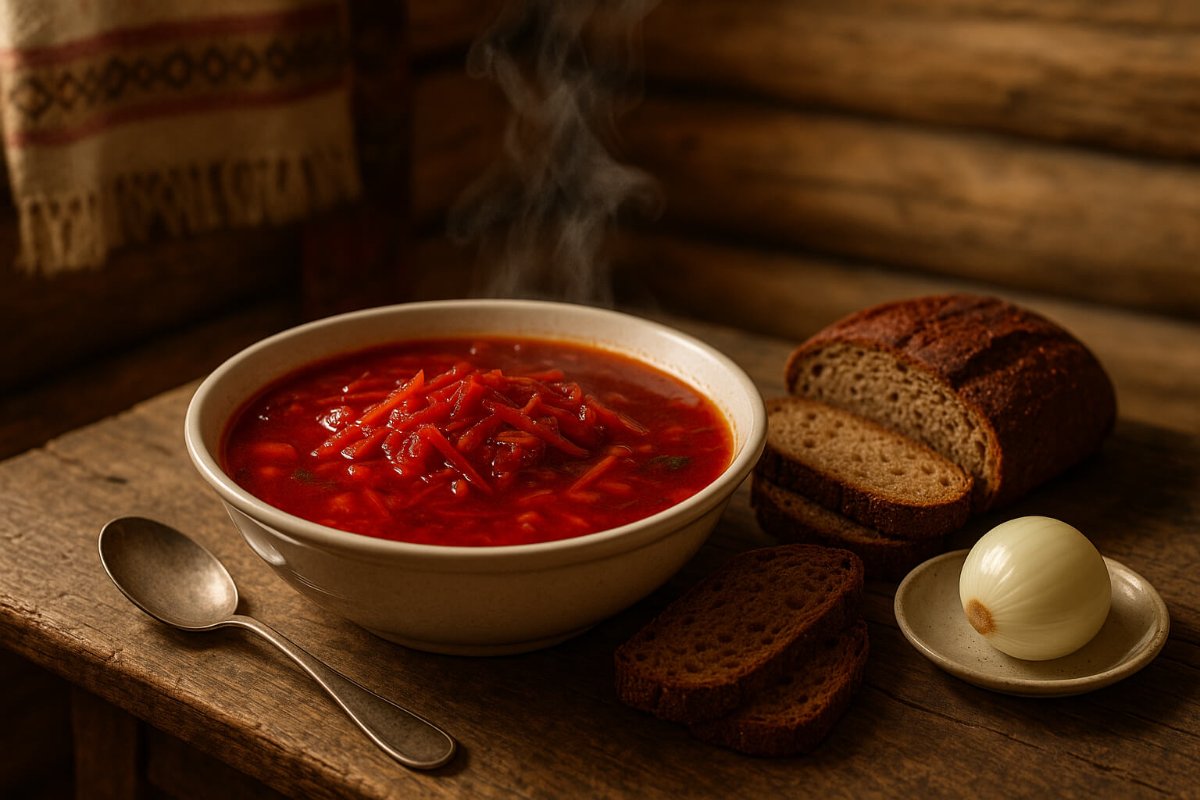
Part of our Heritage Kitchen Glossary – short guides to the dishes, ingredients and techniques of Eastern European cooking.
Three tables, three bowls, the same crimson color – and three genuinely different soups. Ukrainian borscht, Polish barszcz czerwony, and Jewish beet borscht all start from the same root vegetable, grew up in overlapping towns across the same stretch of Europe, and ended up almost nothing alike on the plate. One is a thick meal in a bowl, one is a clear jewel-toned broth, and one splits into two separate versions depending on what else is on the table that day.
Three soups, one beet
Ukrainian borscht is the hearty original: a thick, opaque soup built on a meat or bone broth, loaded with cabbage, potatoes, carrots and shredded beets, finished with sour cream and dill. UNESCO recognized the “Culture of Ukrainian borscht cooking” as Intangible Cultural Heritage in 2022. There is a lighter keto and plant-based version for anyone who wants the flavor without the potatoes and pork.
Polish barszcz czerwony goes the opposite direction. It is a clear, strained ruby broth built around zakwas buraczany, a beet sour fermented five to seven days ahead, then combined with a separately simmered vegetable broth and strained twice until it runs transparent. No cabbage or potatoes go into the soup itself, and traditionally no sour cream is stirred in – it is sipped from a cup or bowl on Christmas Eve alongside mushroom-filled uszka dumplings. A lighter version pairs both together in one recipe.
Jewish beet borscht took a third path, shaped less by regional style than by kosher law. Because Jewish dietary law keeps meat and dairy separate, Ashkenazi cooks split borscht into a fleishig, or meat, version made with bone broth and never topped with sour cream, and a milchig, or dairy, version – a simple water-based soup of beets, lemon juice and sugar, finished with sour cream at the table. It is the only one of the three traditionally served cold as often as hot, and the only one with no separate healthy adaptation on this site, since the base recipe is already light as written.
Same root, different rules
These soups did not travel between countries so much as grow up side by side inside them. Jewish, Polish and Ukrainian families shared markets, seasons, and the same wild hogweed that all three soups were originally fermented from before beets took over the pot sometime after the 16th century. What split the recipe three ways was not distance, but the rules each household cooked under: kosher law shaped the Jewish version’s meat-or-dairy divide, Polish Christmas Eve fasting traditions shaped barszcz’s clear, meatless broth, and Ukrainian farmhouse cooking shaped a version built to feed a table on bone stock and whatever root vegetables were sitting in the cellar.
The name changed along the way too. The English word “borscht,” with its extra “t,” comes from the Yiddish word for the soup rather than the Ukrainian or Polish spelling – a legacy of the Ashkenazi Jewish immigrants who popularized it across North America, eventually giving the Catskill resort region its nickname, the Borscht Belt.
Which one should you make?
For a hearty one-bowl dinner, Ukrainian borscht is the answer, or the lighter version if you want it without the potatoes. For a formal holiday starter, Polish barszcz czerwony with uszka is the one to fall back on. And for something you can make ahead, serve cold in summer, and keep pareve for a meat meal, Jewish beet borscht is by far the simplest of the three. All three start with the same beet – the differences are entirely in the rules each cook was working under.
Leave a Reply