

Active time: ~30 minutes | Total time: ~2½ hours | Makes: 12 rolls | Difficulty: Medium
Quick Overview
- Proof the yeast in warm milk with the sugar
- Mix in the flour, salt, egg and oil and knead a soft, slightly sticky dough
- Leave it to rise until doubled
- Shape 12 balls and set them close together in a round pan for a second rise
- Glaze, bake until golden and brush with garlic oil straight from the oven
What Pampushky Are
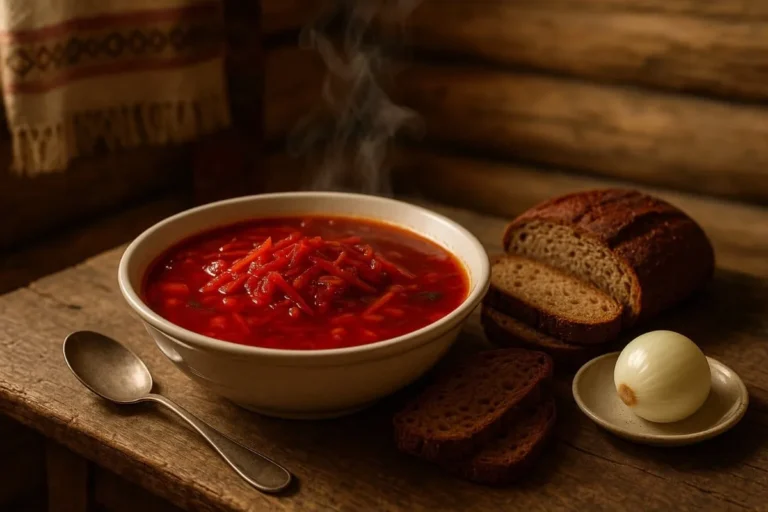
Pampushky are soft, round yeast rolls, and in Ukraine the savory kind belongs with borscht. They bake side by side in one pan, so they pull apart into separate buns with pale, tender sides. While still hot from the oven they are brushed with sunflower oil mixed with crushed garlic and chopped dill or parsley.1,2,3 UNESCO’s description of Ukrainian borscht cooking says the soup is typically served with bread or garlic buns,4 and these are the buns.
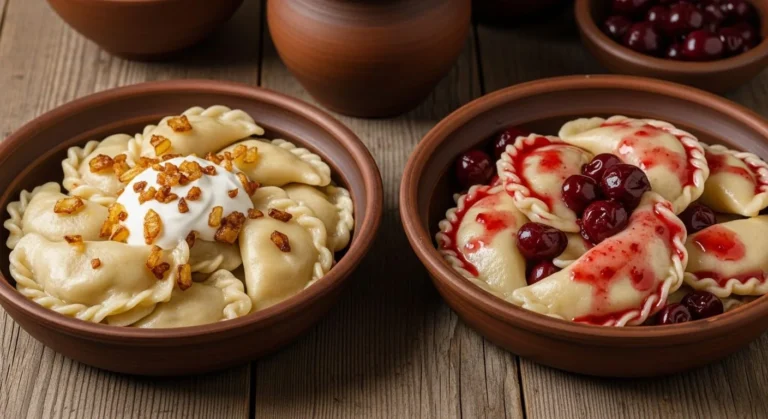
The word covers more than this one roll. Pampushky can also be sweet, filled with poppy seeds or fruit preserves, and fried like doughnuts instead of baked.1,5
History and Cultural Roots
Nobody knows for certain where the name and the method came from. The Kyiv Independent notes that the word and the technique are thought to derive from the German pfannkuchen, and that both the fried and the baked versions gained popularity in the second half of the 19th century.1
Today the baked garlic roll is the most common accompaniment to borscht,1 and recipe writers treat the pairing as close to automatic. One published Ukrainian recipe puts it plainly: in Ukraine, pampushky are rarely served without borscht.6 When UNESCO added the culture of Ukrainian borscht cooking to its List of Intangible Cultural Heritage in Need of Urgent Safeguarding in 2022, the garlic buns made it into the description of the dish.4
Pampushky also have a place at Sviata Vecheria, the Christmas Eve supper of twelve dishes, as small yeast buns, sometimes plain and sometimes filled with poppy seeds or fruit preserves. Every dish of that supper is made without meat, dairy, eggs or animal fat, with vegetable oil only,5 so the pampushky for it are made without milk or eggs. The recipe below, with milk and an egg, is the everyday version; the FAQ explains how to make it without them.
Traditional Pampushky Recipe
This recipe was compiled by Heritage Healthy Kitchen from a comparison of published recipes; the sources are listed at the end of this article. Figures that are Heritage Healthy Kitchen’s own estimates rather than taken from a published source are marked as such.
The published recipes agree on the essentials. For 375–450g of flour they use about 225–250ml of warm liquid, milk in some and water in others, from 1½ teaspoons to 10g of dried yeast, a teaspoon to a tablespoon of sugar, or honey in one, and from ½ teaspoon to 8g of salt.2,7,6,8,3 Some add an egg to the dough and others leave it out, and the fat in the dough runs from none at all to 100g of butter or sunflower oil.7,6,2,8,3 The rolls are glazed with egg or egg yolk before baking6,8,3 and brushed with garlic oil as soon as they come out of the oven.2,7,6,8,3 The amounts below sit inside those ranges. The weight of each ball, the size of the pan for 12 rolls, the milk in the glaze and the storage times are Heritage Healthy Kitchen’s estimates.
Ingredients (makes 12 rolls)
The dough
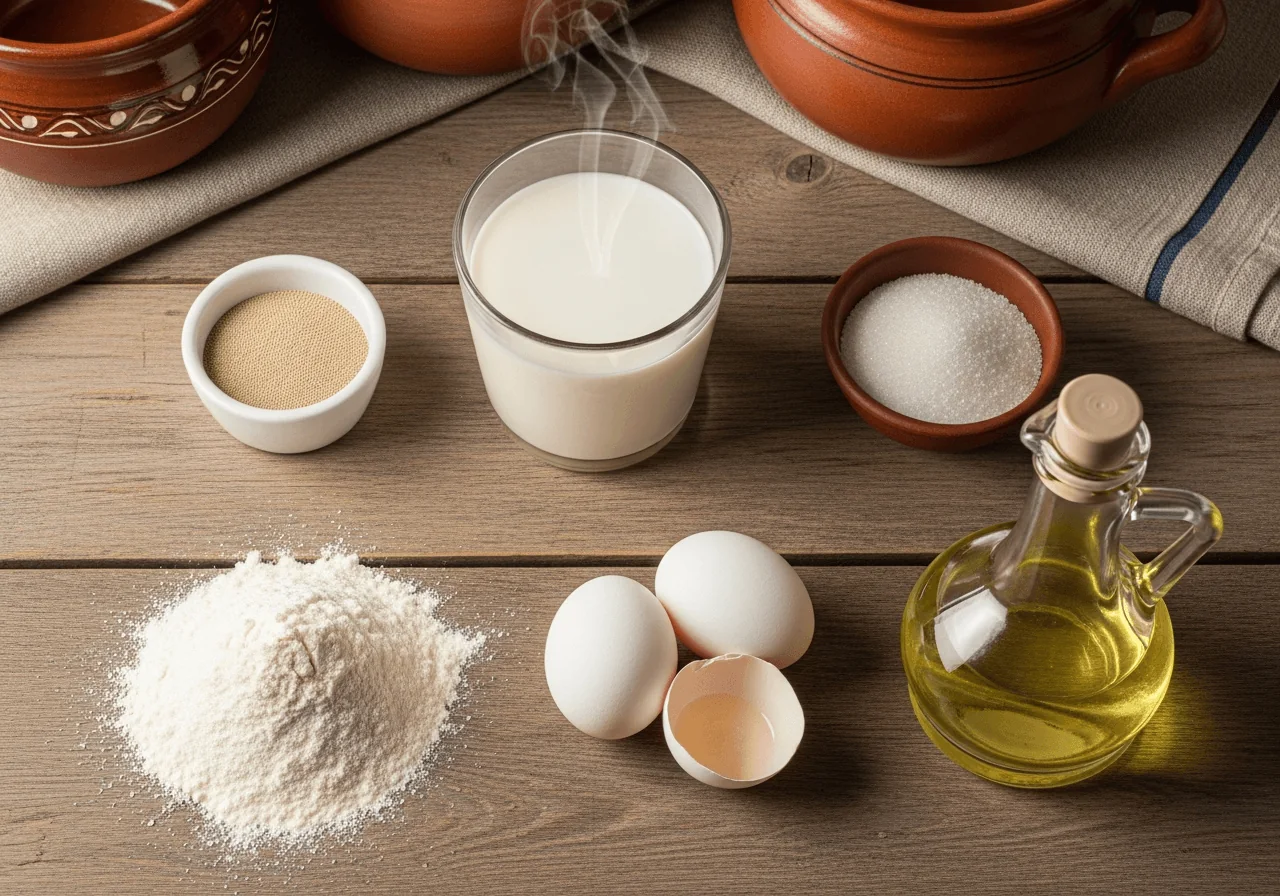
- 450g (about 3½ cups) all-purpose flour, plus a little for dusting
- 250ml (1 cup) milk, warmed to about 38°C (100°F)
- 7g (2¼ teaspoons, 1 packet) active dry yeast
- 1 tablespoon sugar
- 1 teaspoon salt
- 1 egg, at room temperature
- 3 tablespoons sunflower oil, plus more for the bowl and pan
The glaze
- 1 egg yolk beaten with 1 tablespoon milk
The garlic topping
- 3–4 garlic cloves, crushed or very finely chopped
- 2 tablespoons sunflower oil
- 2 tablespoons warm water
- ½ teaspoon salt
- 3 tablespoons finely chopped dill, parsley or both
Method
- Proof the yeast. Stir the sugar into the warm milk, sprinkle in the yeast and leave for about 10 minutes, until the surface turns foamy.7,6,8 If it doesn’t foam at all, the yeast isn’t working and the dough won’t rise, so start again with fresh yeast.
- Mix and knead. Combine the flour and salt in a large bowl, add the yeast mixture, the egg and the oil, and stir until a rough dough forms. Turn it out onto a lightly floured surface and knead for a few minutes, until smooth and elastic.7,6 The dough should stay soft and a little sticky; add more flour only a spoonful at a time.7
- First rise. Put the dough in an oiled bowl, cover it with a towel and leave it somewhere warm until doubled in size, about 45 minutes to 1½ hours.2,6,7,8
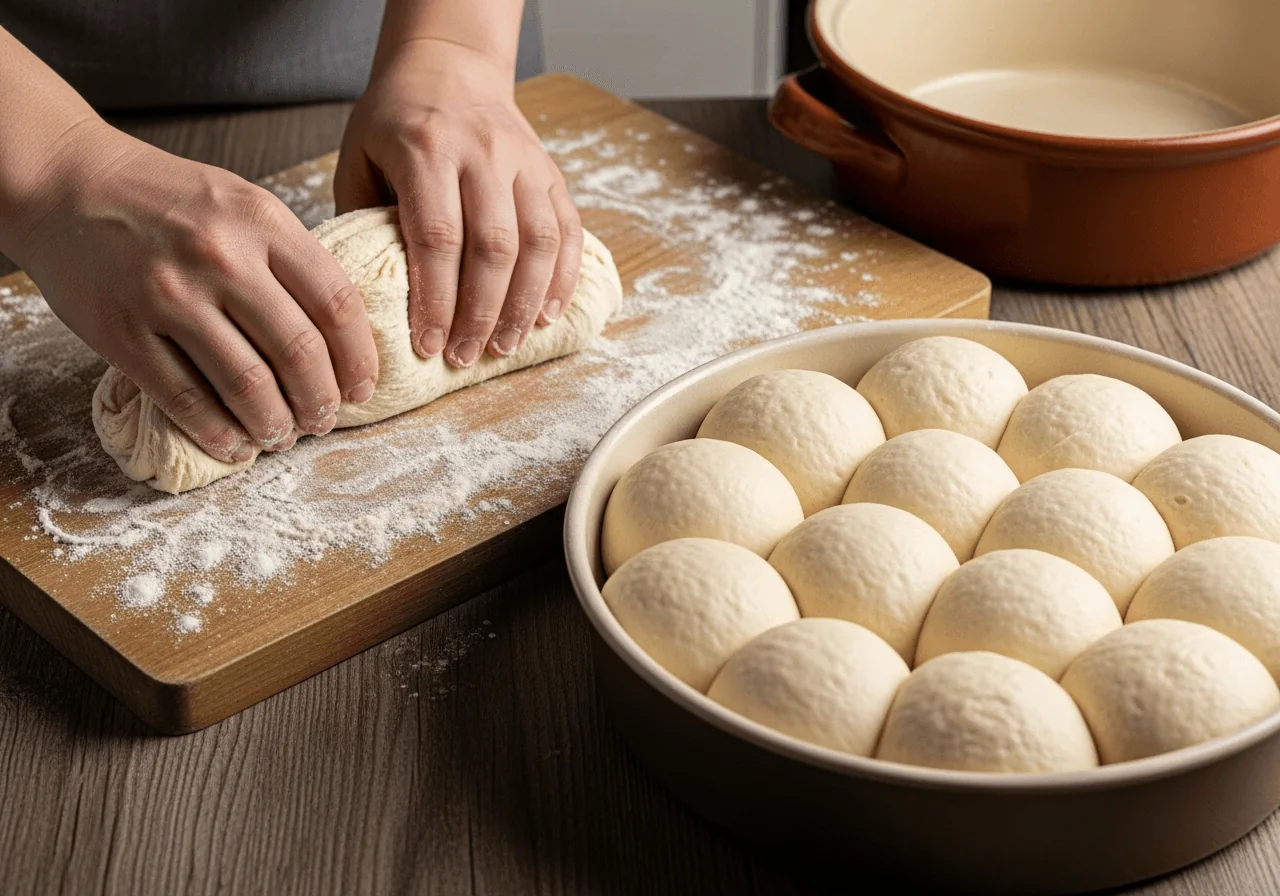
- Shape. Punch the dough down gently, divide it into 12 equal pieces, about 70g each (an estimate), and roll each into a smooth ball.2,7 Set them close together in an oiled round pan about 25cm (10 inches) across, an estimate for 12 rolls, so they join as they rise.3 A rectangular dish of about 28 x 16cm works too.2
- Second rise. Cover and leave for 20–40 minutes, until visibly puffed.7,2,8 Meanwhile heat the oven to 180°C (350°F).2,8
- Glaze and bake. Brush the rolls with the yolk glaze8 and bake for 25–30 minutes, until deep golden.2,8
- Make the garlic topping. While the rolls bake, stir together the garlic, oil, warm water, salt and herbs.8,2,6
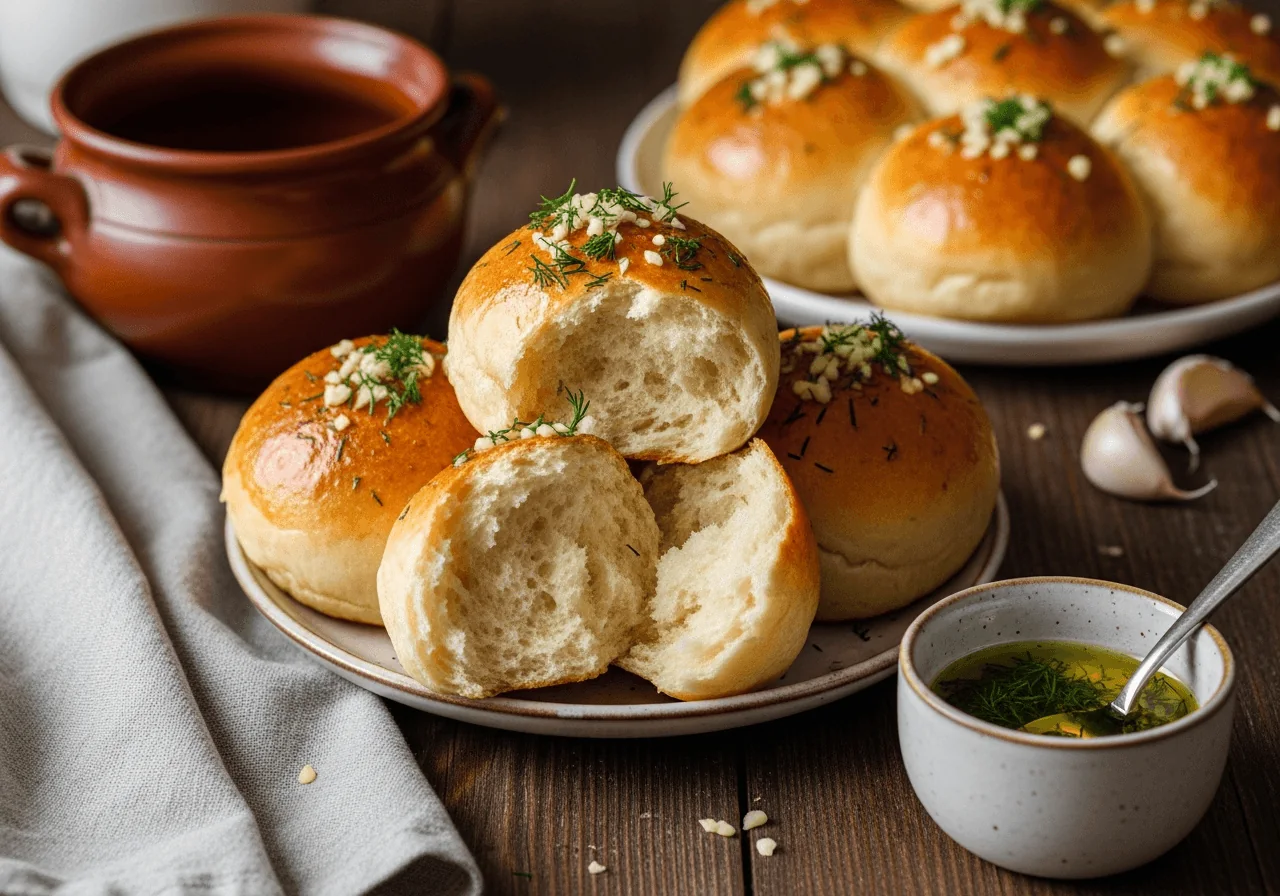
- Brush and serve. As soon as the rolls come out of the oven, brush or spoon the garlic topping over them while they are still hot, so it soaks in.2,7,3 Serve warm, with borscht.6,8
Kitchen Tips
Keep the dough soft. A slightly sticky dough holds more water, and that water turns to steam in the oven and opens up the crumb. Work in too much flour and the rolls bake up dense and bread-like.7
Decide whether the rolls should touch. Baked close together, they join into one round as they rise, much as hot cross buns do, and pull apart with soft, pale sides.3 Some recipes space them an inch or so apart instead, and then each roll gets a crust all the way round.6,7
To spread the work over two days, start the dough as a sponge the evening before: dissolve the yeast and sugar in the warm liquid, stir in half the flour, cover and leave it in the fridge overnight, then add the rest of the flour and the salt in the morning and knead.3 One published topping also adds a tablespoon of vinegar to the garlic oil for a sharper finish.2
A Lighter Way to Make Them
Pampushky are already made with oil rather than butter. That fits the NHS advice to swap saturated fats such as butter for unsaturated ones such as sunflower oil.9 Some cooks also bake them with buckwheat or rye flour, or a mix of flours, rather than wheat alone.2 Whole-grain flour keeps the bran, the fiber-rich outer layer of the grain that refining removes.10 Swapping half the white flour for whole-wheat flour more than doubles the fiber in a roll, from about 1.2g to 2.7g, by Heritage Healthy Kitchen’s estimate. Expect a slightly denser crumb, though: it is refined flour that makes light, airy bread.10
The garlic oil is the other place to trim. Every gram of fat, whatever kind, provides 9kcal,9 so one tablespoon of oil in the topping instead of two saves about 10kcal a roll. The NHS suggests garlic, herbs or lemon juice in place of salt,11 and with this much garlic and dill on top the salt in the topping can go altogether, which takes about a third of the sodium off each roll. Together these changes make a roll about 15kcal lighter, Heritage Healthy Kitchen estimates.
Nutritional Information
Per roll, with the garlic topping (one twelfth of the recipe):
- Calories: approximately 195–240 kcal
- Protein: 5–6g
- Total fat: 7–8g, of which saturated about 1.3g
- Carbohydrates: 28–35g
- Fiber: about 1g
- Sugars: about 2g
- Sodium: 280–340mg
Nutritional values are estimates based on standard ingredient databases (USDA FoodData Central). They vary with the flour, the size of the rolls and how much of the garlic topping goes on.
Serving and Storage
Pampushky are best eaten the day they are baked.6 Leftovers keep for a day or two at room temperature, wrapped in a clean towel or in an airtight container, and can be frozen without the topping for up to 2 months. To warm them, wrap them loosely in foil and heat for 8–10 minutes at about 170°C (340°F), then brush with a fresh batch of garlic topping. The storage and reheating times here are Heritage Healthy Kitchen’s estimates.
Further Reading & Sources
The recipe is a compilation based on the published recipes listed here; these links are provided for readers who want to explore further.
- Mia Billetdeaux. (13 December 2023). Celebrating the Ukrainian way: The 12 dishes of Christmas. The Kyiv Independent. Pampushky as sweet and savory yeast rolls, fried or baked; the name thought to derive from the German pfannkuchen; both versions popular from the second half of the 19th century; baked garlic pampushky as the most common accompaniment to borsch.
- Yevhen Klopotenko. (12 January 2021, updated 29 January 2026). Naikrashche dopovnennia do borshchu: pampushky z chasnykom ta kropom [The best companion to borscht: pampushky with garlic and dill]. klopotenko.com. Published recipe (12 rolls, no egg, butter or the same amount of sunflower oil, garlic-dill oil with vinegar); pampushky also made with buckwheat or rye flour, or a mix.
- Olia Hercules. Ukrainian Garlic Bread (Pampushky). Guest recipe on nigella.com, from her book Mamushka; no date given on the page. Published recipe made with water and no egg in the dough (8 buns, overnight sponge, 24cm round tin, buns joining as they rise, egg glaze, garlic-parsley oil); pampushka as a word for a plump woman.
- UNESCO. (2022). Culture of Ukrainian borscht cooking. List of Intangible Cultural Heritage in Need of Urgent Safeguarding, nomination file No. 01852. Borscht “typically served with bread or garlic buns.”
- Christine Chraibi. (24 December 2025). Sviat Vechir: Ukraine’s ancient Christmas Eve and its twelve sacred dishes. Euromaidan Press. The supper’s dishes made without meat, dairy, eggs or animal fat; pampushky among the twelve, plain or filled with poppy seeds or fruit preserves.
- Anna Voloshyna. (24 April, year not given on the page). Ukrainian Garlic and Dill Pampushky. annavoloshyna.com. Published recipe (16 rolls, egg in the dough and egg glaze, garlic-dill oil); pampushky “rarely served without borscht”; best eaten the day they are baked.
- Nataliia Savchenko. (9 September 2022, updated 10 May 2026). Ukrainian Pampushky (Garlic and Dill Bread Rolls). Sava’s Kitchen. Published recipe (12 rolls, one egg, olive oil); a soft, sticky dough holds more water, which turns to steam in the oven; too much flour makes the rolls dense.
- Victor. (16 September 2019, updated 28 December 2021). Pampushki. Taste of Artisan. Only the author’s first name is given on the page. Published recipe made with water and no egg in the dough (9 rolls, egg-yolk glaze, garlic sauce with water and herbs).
- NHS. (page last reviewed 14 April 2023). Facts about fat. nhs.uk. Every gram of fat provides 9kcal; swap saturated fats such as butter for unsaturated ones, including sunflower oil.
- Harvard T.H. Chan School of Public Health. Whole Grains. The Nutrition Source. The bran as the fiber-rich outer layer; refining removes virtually all of wheat’s fiber and gives the fluffy flour of light, airy breads.
- NHS. (page last reviewed 17 April 2023). Salt in your diet. nhs.uk. No more than 6g of salt a day for adults; herbs, spices, garlic or lemon juice instead of salt.
Disclaimer
The information in this article is provided for educational and informational purposes only. Heritage Healthy Kitchen makes no representations or warranties regarding the accuracy or completeness of any content on this site. Nutritional values are estimates only and will vary depending on the specific ingredients, brands, and measurements used. This content is not intended as dietary, medical, or professional nutritional advice. Always consult a qualified healthcare provider regarding any dietary needs or health conditions. Heritage Healthy Kitchen is not responsible for any outcomes resulting from the use of recipes or information published on this site.
Traditional Pampushky

Ingredients
The dough
- 450g (about 3½ cups) all-purpose flour, plus a little for dusting
- 250ml (1 cup) milk, warmed to about 38°C (100°F)
- 7g (2¼ teaspoons, 1 packet) active dry yeast
- 1 tablespoon sugar
- 1 teaspoon salt
- 1 egg, at room temperature
- 3 tablespoons sunflower oil, plus more for the bowl and pan
The glaze
- 1 egg yolk beaten with 1 tablespoon milk
The garlic topping
- 3–4 garlic cloves, crushed or very finely chopped
- 2 tablespoons sunflower oil
- 2 tablespoons warm water
- ½ teaspoon salt
- 3 tablespoons finely chopped dill, parsley or both
Instructions
- Proof: Stir the sugar into the warm milk, add the yeast and leave about 10 min, until foamy.
- Knead: Mix with the flour, salt, egg and oil; knead a few minutes to a soft, slightly sticky dough.
- Rise: Cover and leave somewhere warm until doubled, 45 min to 1½ hours.
- Shape: Divide into 12 balls and set them close together in an oiled round pan, about 25cm. Rise 20–40 min. Heat the oven to 180°C (350°F).
- Bake: Brush with the yolk glaze and bake 25–30 min, until deep golden.
- Finish: Stir together the garlic, oil, water, salt and herbs and brush over the hot rolls. Serve warm with borscht.
Frequently Asked Questions
What does pampushka mean?
Pampushky is the plural of pampushka.7 Besides the roll, the word can describe a good-looking, plump woman.3
Why are pampushky served with borscht?
Garlic rolls are simply the usual thing to eat with it: UNESCO’s description of the dish says borscht is typically served with bread or garlic buns,4 and the baked garlic roll is its most common accompaniment.1
Are pampushky always savory?
No. The word covers both sweet and savory yeast rolls, fried like doughnuts or baked like dinner rolls.1 Sweet ones are often filled with poppy seeds or fruit preserves.5
Can I make pampushky without milk and eggs?
Yes. Some published recipes make the dough with about 225ml of warm water instead of milk and with no egg.8,3 Leave out the egg glaze as well and the rolls contain no dairy or eggs, which is how pampushky are made for Sviata Vecheria, the Christmas Eve supper, where every dish is prepared without meat, dairy, eggs or animal fat.5
Why did my pampushky come out dense?
Most often there was too much flour: a soft, slightly sticky dough holds more water, which turns to steam in the oven and makes the rolls light.7 The other usual cause is a short rise. Let the dough double before shaping it.2,6
Can I start the dough the day before?
Yes. Dissolve the yeast and sugar in the warm liquid, stir in half the flour, cover and leave it in the fridge overnight; finish the dough the next morning.3
You Might Also Like
More heritage recipes from our kitchen

Leave a Reply