
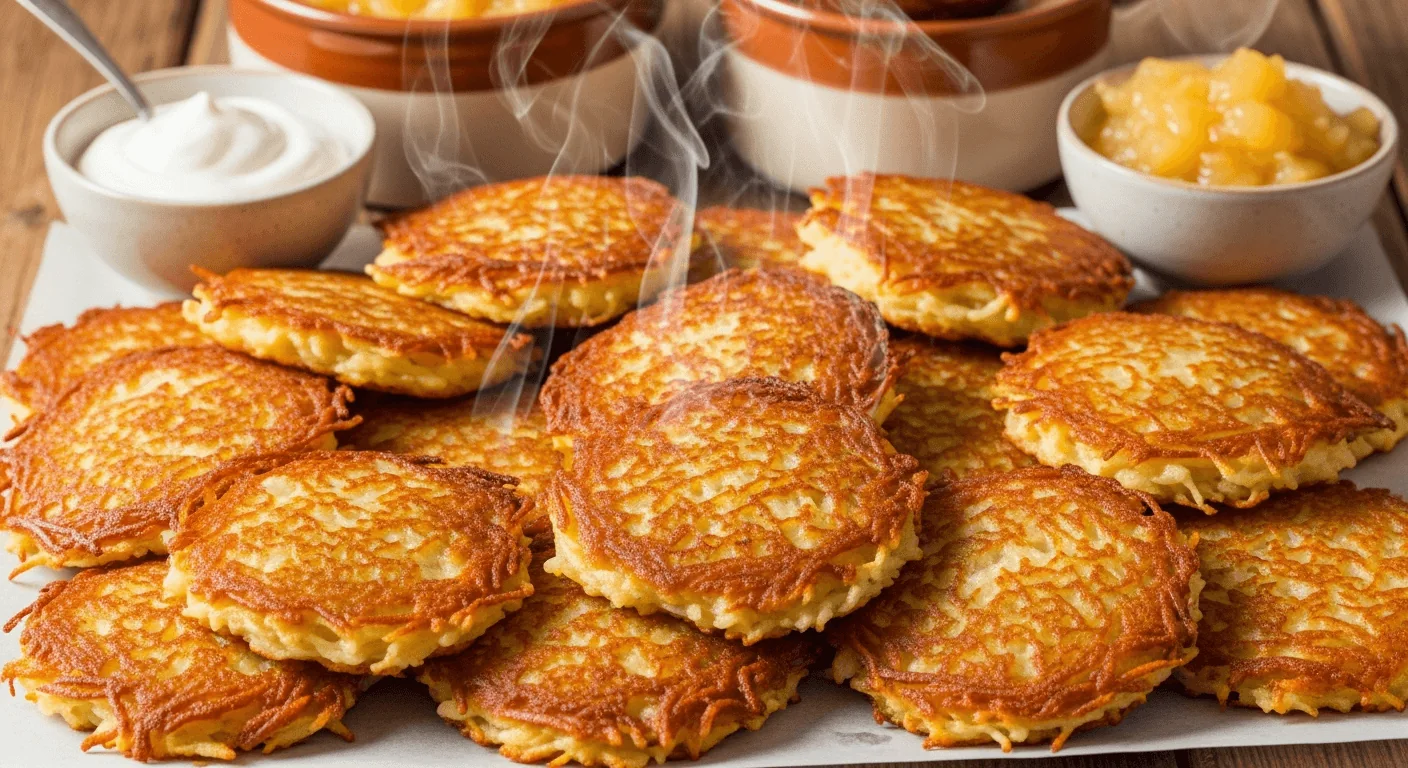
Active time: ~35 minutes | Total time: ~45 minutes | Serves: 4–5 (about 16–18 pancakes) | Difficulty: Easy
Quick Overview
- Grate the potatoes and onion on the large holes of a grater
- Squeeze out the liquid, let the starch settle and keep it
- Mix in eggs, matzo meal, salt and pepper, then rest the batter 10 minutes
- Fry spoonfuls in ¼ inch (6mm) of hot oil until deep golden on both sides
- Drain, salt while hot and serve with sour cream or applesauce
What Latkes Are
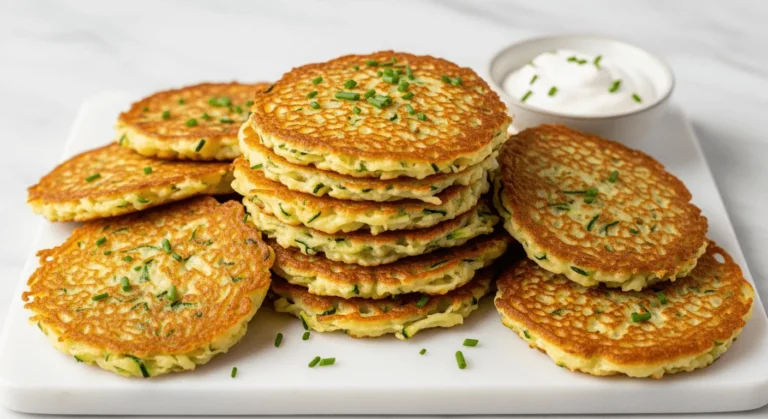
Latkes are fried potato pancakes from Ashkenazi Jewish cooking: grated potato and onion bound with egg and a little matzo meal or flour, fried in oil until the edges turn dark and crisp. For many Jewish families they are the dish of Hanukkah, largely because of the oil they’re fried in.1,2
Latke is Yiddish for “pancake.”1 The word goes back to the Slavic oladka, a small fried pancake, and further to the Greek word for olive oil.3 In modern Hebrew latkes are called levivot, a word taken from the Book of Samuel, where King David’s daughter Tamar prepares levivot for her brother.1
History and Cultural Roots
Hanukkah remembers a single flask of pure oil in the Temple, enough to burn for one day, that lasted for eight. Eating food made with oil recalls that miracle, and latkes, fried in oil, are one way of keeping the custom.1 The earliest written mention of fried pancakes served for Hanukkah is a 1322 poem by Rabbi Kalonymus ben Kalonymus, which describes levivot “large and round, the whole size of the frying pan.”3
Those pancakes were not made of potato. An article in The Nosher traces an older Hanukkah food: cheese, eaten in memory of Judith, who in the story fed the Assyrian general Holofernes salty cheese and wine and beheaded him once he had passed out drunk.3,1 Ricotta pancakes began as a Hanukkah food in Italy and spread through Europe. In Italy and Central Europe they were fried in olive oil or butter, but in Eastern Europe the easiest fat to come by, especially in winter, was schmaltz, rendered chicken fat. Kosher law keeps meat and dairy apart, so the cheese gave way to root vegetables such as turnips, or to rye or buckwheat flour.3 Chabad.org presents this account as one theory.1
The potato came later. It reached Europe from South America and became a staple in Eastern Europe only in the mid-1800s. The turning point was the crop failures of 1839 and 1840 in Ukraine and Poland, when farmers planted potatoes on a large scale to stave off famine. Potatoes became cheaper than flour, and the potato latke became the default.3
Jewish immigrants who came to America in the early 20th century switched to neutral vegetable oil.3 Part of that story is Crisco, a vegetable shortening launched in 1911. It was kosher and pareve, neither meat nor dairy, so one fat could replace both schmaltz and butter, and a 1913 advertisement printed in English and Yiddish courted Jewish cooks directly.4 Some cooks still use schmaltz for part of the frying fat, for its savory flavor.5
The recipe never stopped changing. Fania Lewando’s Yiddish vegetarian cookbook, published in Vilna in the 1930s, has latkes alongside kugels and blintzes,6 and modern recipes fold in zucchini, spinach or beets.3
Traditional Latkes Recipe
This recipe was compiled by Heritage Healthy Kitchen from a comparison of published recipes; the sources are listed at the end of this article. Figures that are Heritage Healthy Kitchen’s own estimates rather than taken from a published source are marked as such.
Published recipes use from 450g to about 1.4kg of potatoes per batch, with one onion, one or two eggs, and a binder of matzo meal, flour or potato starch: from 3 tablespoons of matzo meal for about 1.1kg of potatoes to ¼ cup of potato starch for 450g.7,2,8 Matzo meal is ground matzo, unleavened bread made only from flour and water and baked, by Jewish tradition, within 18 minutes of mixing, before the dough can rise.12 They fry in about ¼ inch (6mm) of oil over medium-high heat.7,2,8 The amounts below, for 900g of potatoes, sit inside those ranges. The number of pancakes and servings is Heritage Healthy Kitchen’s estimate.
Ingredients (serves 4–5, about 16–18 pancakes)
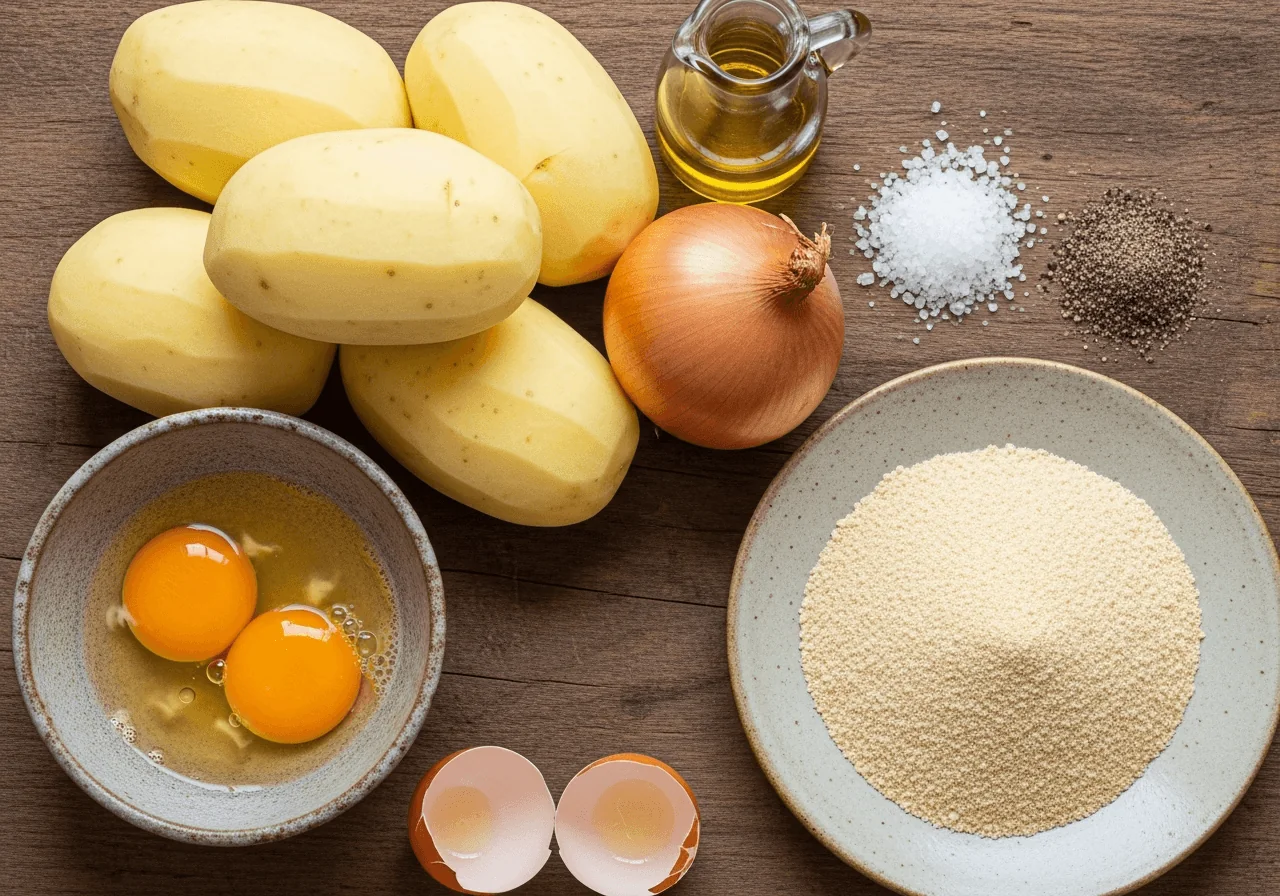
- 900g (about 2lb) starchy potatoes, such as russets, peeled
- 1 medium onion (about 150g), peeled
- 2 large eggs, beaten
- 3–4 tablespoons matzo meal (or all-purpose flour or potato starch)
- 1¼ teaspoons salt, plus a little for sprinkling
- ½ teaspoon freshly ground black pepper
- Neutral oil (sunflower, vegetable or peanut), for frying
For serving
- Sour cream
- Applesauce
Instructions
- Grate. Grate the potatoes and onion on the large holes of a box grater or with the shredding disk of a food processor. If you grate by hand, alternate between onion and potato, which helps keep the potato from darkening.7,2
- Squeeze, and keep the starch. Pile the shreds onto a clean kitchen towel or a double layer of cheesecloth, gather the corners and twist hard over a bowl until no more liquid comes out.2,5 Leave the liquid for a few minutes until a layer of white starch settles, then pour off the water and keep the starch.7,5
- Mix and rest. Put the potato and onion back in the bowl with the starch, eggs, matzo meal, salt and pepper, and mix with your hands.7,5 Let the batter sit for about 10 minutes so the matzo meal can absorb moisture and swell.5
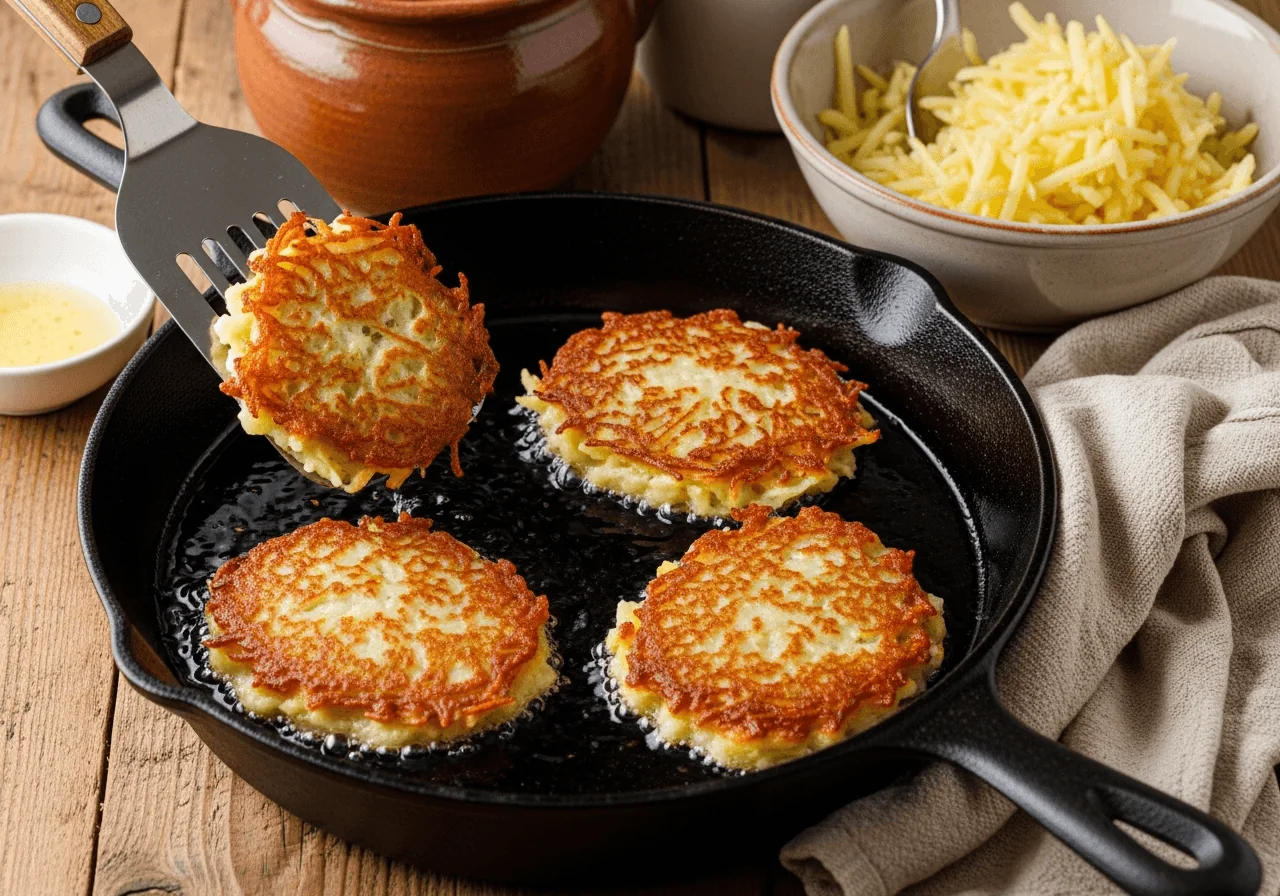
- Fry. Heat about ¼ inch (6mm) of oil in a large heavy skillet over medium-high heat until it shimmers.7,2 Drop in heaping tablespoons of batter, flatten them gently and fry, turning once, until deep golden and crisp, about 3–4 minutes per side. Work in batches so the pan isn’t crowded.7,8
- Drain and serve. Drain on paper towels and sprinkle lightly with salt while still hot.8 Serve straight away with sour cream, applesauce or both.7,1
Kitchen Tips
Squeeze harder than seems necessary. A double layer of cheesecloth twisted around the handle of a wooden spoon gets out noticeably more liquid than hands alone,5 and wringing the shreds a second time after a 2-minute rest helps too.2
Keep the heat at medium-high. Latkes fried over lower heat soak up oil, turn greasy and are more likely to fall apart, because they don’t brown and set quickly enough.5 Heating the dry pan for a couple of minutes before the oil goes in helps keep them from sticking.2
To keep a batch warm while you fry the rest, hold it in a low oven, about 95°C (200°F), for no more than 30 minutes. Left longer, latkes pick up a burned flavor.5
Use starchy potatoes, such as russets; they are high in starch and low in water.9,2 Elsewhere, look for a floury variety: in the UK, Maris Piper is the closest match.2 Skip any potato with a green tint under the skin. The color comes from solanine, which eaten in excess can cause stomach upset.9
Looking for a Lighter Version?
Our Healthy Latkes recipe keeps the grating, squeezing and binding, but cooks the pancakes in an air fryer or oven with about a tablespoon of oil, replaces part of the potato with zucchini and serves them with Greek yogurt.
Nutritional Information
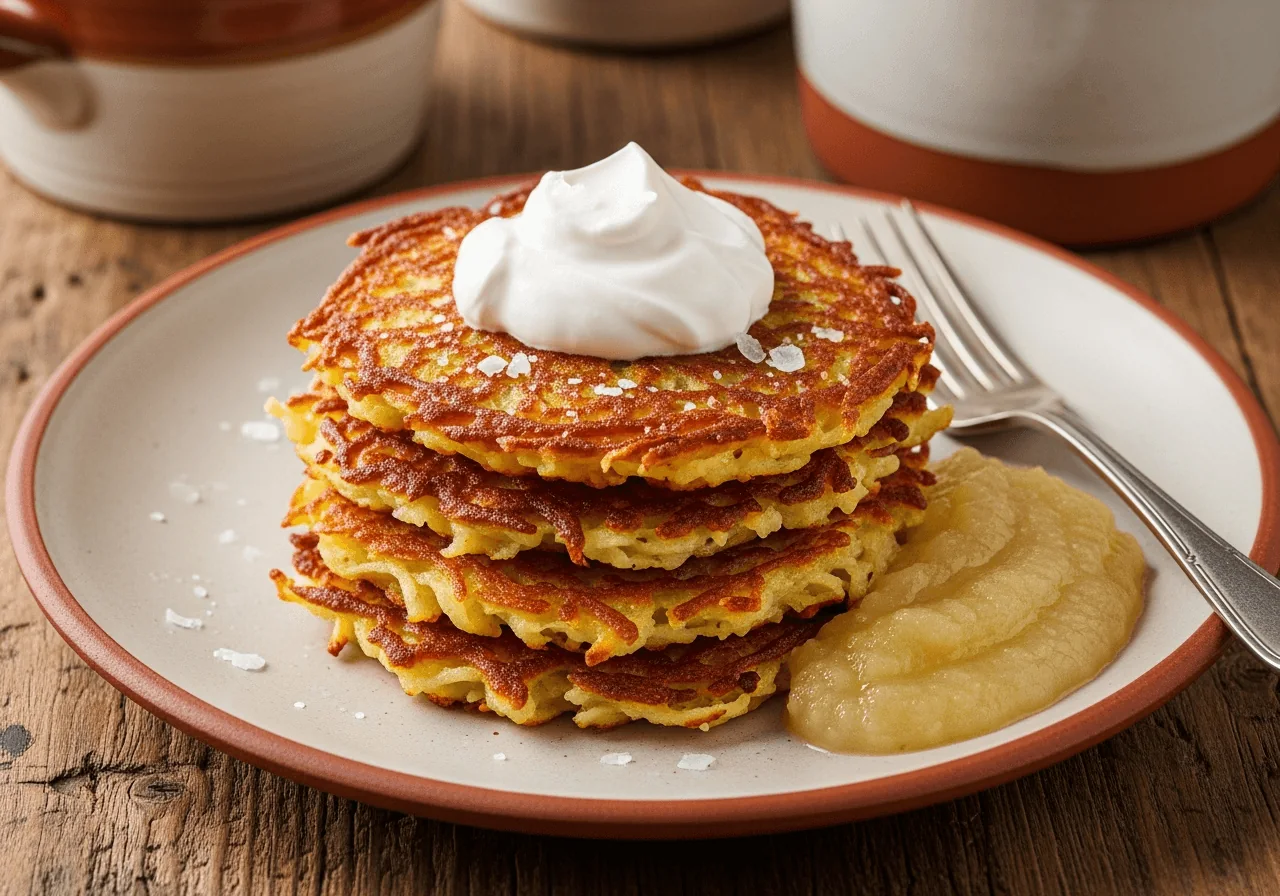
Per serving, 1 of 5 (about 3–4 latkes), before toppings:
- Calories: approximately 310–380 kcal
- Protein: 6.5–8g
- Total fat: 16–20g, of which saturated 2–2.5g
- Carbohydrates: 36–44g
- Fiber: about 3g
- Sodium: 525–640mg
With 2 tablespoons of sour cream, a serving comes to about 365–445 kcal.
Nutritional values are estimates based on standard ingredient databases (USDA FoodData Central). They vary with how much oil the latkes take up, the size of the potatoes and how much salt goes on at the end.
Storage and Reheating
Refrigerate leftover latkes in an airtight container and eat them within 3–4 days. Frozen, they keep safely for 3–4 months, though they lose moisture and flavor the longer they stay in the freezer.10 If you plan to freeze them, fry them a minute less, so they don’t get too dark when they recrisp.2
To freeze, cool the latkes completely on a rack, freeze them in a single layer on a baking sheet, then stack them between sheets of parchment in a bag or container. Reheat them straight from the freezer, without thawing, on a rack set over a baking sheet at 200°C (400°F) for about 10 minutes; thawed latkes go soggy.11 Latkes kept at room temperature for up to 4 hours recrisp on a baking sheet at 190°C (375°F) in about 5 minutes.8
Traditional Latkes

Ingredients
For the batter
- 900g (about 2lb) starchy potatoes, such as russets, peeled
- 1 medium onion (about 150g), peeled
- 2 large eggs, beaten
- 3–4 tablespoons matzo meal (or all-purpose flour or potato starch)
- 1¼ teaspoons salt, plus a little for sprinkling
- ½ teaspoon freshly ground black pepper
- Neutral oil (sunflower, vegetable or peanut), for frying
For serving
- Sour cream
- Applesauce
Instructions
- Grate: Potatoes and onion on the large holes, alternating if by hand.
- Squeeze: Twist hard in a towel or cheesecloth; let the liquid settle, pour it off and keep the starch.
- Mix: Add starch, eggs, matzo meal, salt and pepper; rest 10 min.
- Fry: ¼ inch (6mm) oil, medium-high; heaping tablespoons, flattened; 3–4 min per side, in batches.
- Serve: Drain, salt while hot; sour cream, applesauce or both.
Frequently Asked Questions
Sour cream or applesauce: which is more traditional?
Both. Applesauce is one of the most popular choices and sour cream the other, as long as the latkes aren’t served with meat, since kosher law keeps meat and dairy apart.1,3 When fried pancakes were cooked in schmaltz and became meat dishes, they were often served with jam.3
Why do my latkes come out soggy?
Almost always too much moisture or too little heat. Squeeze the shreds hard, keep the starch that settles out of the liquid, and fry over medium-high heat: at lower heat the latkes soak up oil and fall apart.5
Matzo meal, flour or potato starch?
All three hold the batter together. Potato starch gives a lighter, crisper latke and keeps it gluten-free.2 A batter made with matzo meal needs about 10 minutes’ rest before frying.5
Why were latkes once made with cheese?
Cheese was an older Hanukkah food, eaten in memory of Judith. When cooks in Eastern Europe fried in schmaltz, kosher law ruled out the cheese, and root vegetables or rye and buckwheat flour took its place, long before the potato.3,1
Can latkes be made ahead?
Yes. Fry them a minute less than usual, cool them completely, freeze them in a single layer and reheat them straight from the freezer in a hot oven.2,11
Are latkes only for Hanukkah?
Hanukkah is when most families make them, because of the oil.1 They work at other times too; some cooks serve them at brunch, under a poached or fried egg.2
What potato works best?
A starchy potato such as a russet, which is high in starch and low in water.9,2 In the UK, Maris Piper is the closest equivalent.2
Further Reading & Sources
The recipe is a compilation based on the published recipes listed here; these links are provided for readers who want to explore further.
- Yehuda Altein. 10 Latke Facts Every Jew Should Know. Chabad.org (no date given on the page). Oil and the Hanukkah miracle; latke is Yiddish for “pancake”; levivot in modern Hebrew, from the Book of Samuel; cheese as an older Hanukkah food, in memory of Judith; the cheese-to-chicken-fat change given as one theory; applesauce and sour cream, the latter as long as the latkes are not eaten with meat.
- Deb Perelman. (21 December 2008, revised). potato latkes, even better. Smitten Kitchen. Published recipe: 450g russet potato, 1 small onion (about 115g), ¼ cup potato starch or flour, 1 teaspoon salt, 1 egg; coarsely shredded; wrung out twice; dry pan heated before ¼ inch of oil goes in; starchy baking potatoes (Maris Piper in the UK); potato starch for a lighter, crisper, gluten-free latke; cooked a minute less if they are to be frozen; latkes as brunch beyond Hanukkah.
- Susannah Brodnitz. (8 December 2022). The Real History of Potato Latkes Will Surprise You. The Nosher, My Jewish Learning. Judith and cheese at Hanukkah in the Middle Ages; the 1322 poem by Kalonymus ben Kalonymus; ricotta pancakes from Italy (after Gil Marks); schmaltz in Eastern Europe and the move to turnips, rye or buckwheat flour; jam with meat pancakes; potato a staple in Eastern Europe from the mid-1800s, the crop failures of 1839 and 1840; latke from Slavic oladka and Greek elaion; vegetable oil in America; zucchini, spinach and beets in modern recipes.
- Ilena Moses. (22 May 2024). What Makes Crisco So Jewish? The Nosher, My Jewish Learning. Crisco launched in 1911; kosher and pareve, so it replaced both schmaltz and butter; a 1913 advertisement in English and Yiddish.
- Patty Catalano. (updated 22 December 2020). I Tried 5 Latke Recipes and This Is What I Learned. The Kitchn. Squeezing in cheesecloth twisted around a wooden spoon; keeping the starch for a creamier center and crisper crust; resting matzo-meal batter about 10 minutes; latkes fried at too low a heat soaked up oil and fell apart; kept warm in a 200°F oven for up to 30 minutes, longer gives a burned flavor; schmaltz as part of the frying fat.
- Rachel Ringler. (20 September 2021). This Jewish Restaurateur Died in the Holocaust, But Her Vegetarian Cookbook Lives On. The Nosher, My Jewish Learning. Fania Lewando’s Yiddish vegetarian cookbook, Vilna, 1937, with kugels, blintzes and latkes.
- Joan Nathan. Joan Nathan’s Classic Latkes. Saveur (first published in the December 2007 issue; updated 4 December 2025). Published recipe: 1 medium onion, 3 large Yukon Gold potatoes (about 1.1kg), 3 tablespoons matzo meal, 2 eggs, chives; onion and potato grated alternately to keep the potato from darkening; liquid squeezed out, starch kept; ¼ inch of oil, medium-high heat, about 8 minutes per batch, turning once; applesauce or sour cream.
- Andrew Zimmern. (7 December 2020). Andrew Zimmern’s Perfect Potato Latkes Recipe. The Nosher, My Jewish Learning. Published recipe: 1.4kg potatoes in all (a third boiled and riced), 1 large onion, 2 eggs, 1 cup matzo meal, 2 teaspoons salt; ¼ inch of oil, about 7 minutes per batch, turning once; salted after draining; kept at room temperature up to 4 hours and reheated at 375°F for about 5 minutes. Used here for ranges only.
- The Nutrition Source. Potatoes. Harvard T.H. Chan School of Public Health (no author or date given on the page). Starchy potatoes are high in starch and low in water and suit frying; a green tint below the skin comes from solanine, which eaten in excess can cause stomach upset.
- USDA Food Safety and Inspection Service. Leftovers and Food Safety. Leftovers keep 3 to 4 days in the refrigerator and 3 to 4 months frozen; safe to reheat from frozen without thawing.
- Shannon Sarna. (7 November 2023). How to Freeze Latkes. The Nosher, My Jewish Learning. Cool completely, freeze in a single layer, then stack between parchment; reheat from frozen at 400°F for about 10 minutes, on a rack; thawed latkes go soggy.
- Rabbi Yissachar Dov Krakowski. (25 February 2026). Understanding the Not-So-Simple Matzah. OU Kosher. Matzah as bread that has not risen, made from flour and water alone and fully baked within 18 minutes of mixing.
Disclaimer
The information in this article is provided for educational and informational purposes only. Heritage Healthy Kitchen makes no representations or warranties regarding the accuracy or completeness of any content on this site. Nutritional values are estimates only and will vary depending on the specific ingredients, brands, and measurements used. This content is not intended as dietary, medical, or professional nutritional advice. Always consult a qualified healthcare provider regarding any dietary needs or health conditions. Heritage Healthy Kitchen is not responsible for any outcomes resulting from the use of recipes or information published on this site.
Cook by Occasion
This recipe is part of our Hanukkah menu.
You Might Also Like
More heritage recipes from our kitchen


Leave a Reply