

Prep: 20 minutes | Cooking: about 1 hour 10 minutes | Serves: 6 | Difficulty: Easy
Quick Overview
- Cut carrots and sweet potatoes into even chunks so they cook at the same pace
- Soften a sliced onion in olive oil in an ovenproof pot
- Add the vegetables and prunes, then pour in orange juice, water, and honey, and season with cinnamon and salt
- Bake covered at 200°C (400°F) for 40 minutes
- Uncover, stir, and bake 20–25 minutes more, until the vegetables are tender and the liquid has thickened into a glaze
- Serve warm as a side dish, or make a day ahead and reheat
What Tzimmes Is
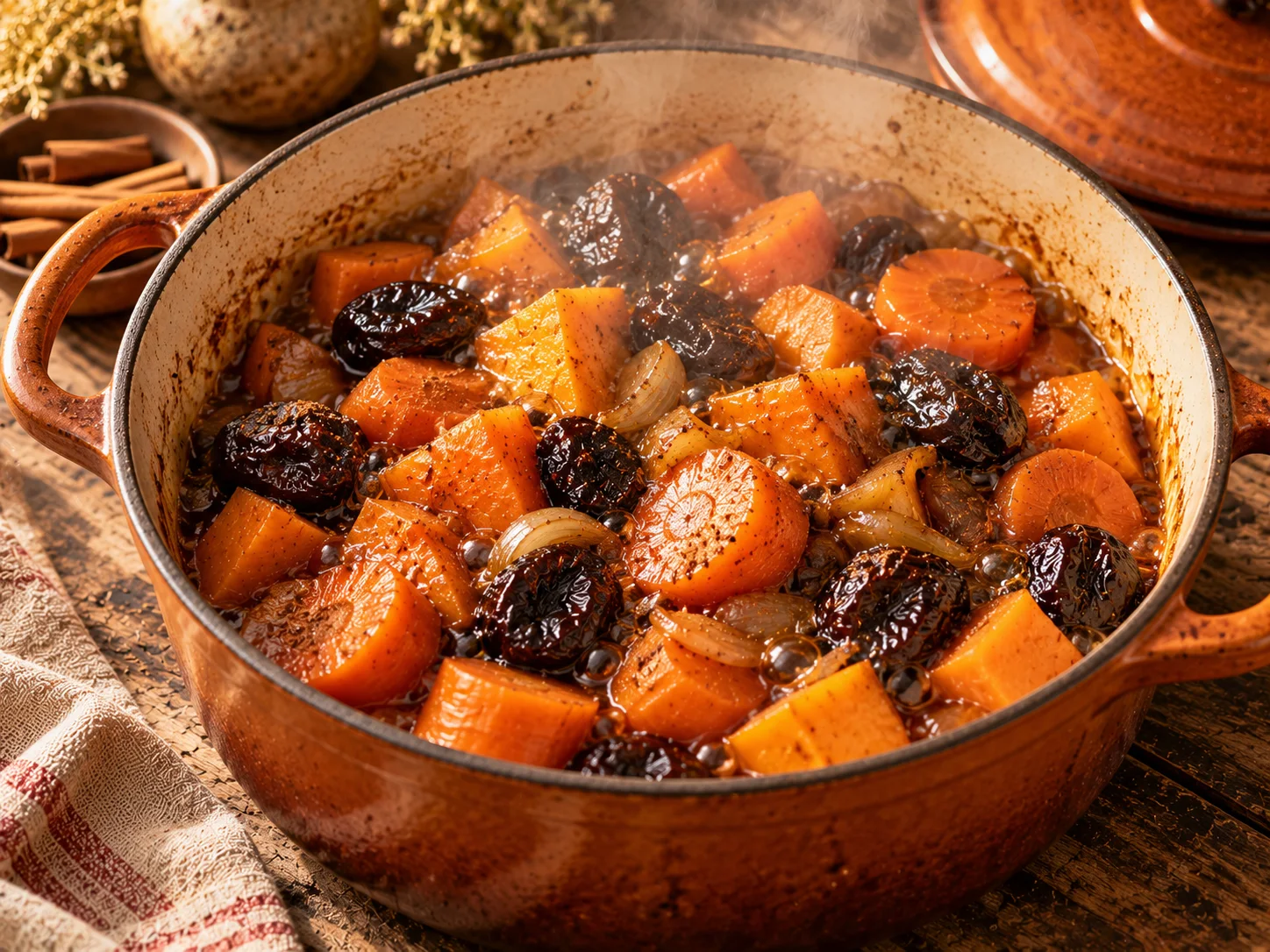
Tzimmes is a slow-cooked Ashkenazi Jewish stew of sweet root vegetables and dried fruit. The most familiar version combines carrots, sweet potatoes, and prunes, cooked together in orange juice and honey until the pieces are tender and glazed.4 6 8 It is usually a side dish, a stewy one with juices that are good for mopping up with a piece of challah.4 Meat versions, such as a beef tzimmes with chuck, prunes, and sweet potatoes, turn it into a main course.3
Tzimmes is most closely associated with Rosh Hashanah, the Jewish New Year, when sweet foods are served for a pleasant year ahead.4 5 Tablet calls it a classic of Ashkenazi High Holiday dining, from the first night of Rosh Hashanah through the last days of Sukkot.2 3 It is also often served at Passover: vegetables, dried fruit, and juice contain no leavened grain (chametz) and none of the legumes (kitniyot) that Ashkenazi custom avoids during the holiday.4 9 Beyond the festivals, Ashkenazi Jews eat it throughout the year.3
History and Cultural Roots
The dish first appeared on Jewish tables in medieval Germany. The Encyclopedia of Jewish Food explains that a tzimmes has to have at least one root vegetable.1 Carrots joined the pot only in the 15th century; cut into rounds, they resembled coins.1
Older recipes used other roots: an 1896 Yiddish cookbook gave a turnip tzimmes simmered with schmaltz and sugar.1 2 One writer on Yiddish culture calls tzimmes a cousin to cholent, another slow-cooked Ashkenazi dish.1
As Jews moved from the Rhineland across Central Europe to Poland and farther east, the dish went with them. Eastern European immigrants then brought it to the United States in the 19th century, and in Jewish-American kitchens carrots and sweet potatoes became the standard tzimmes vegetables.1 2
The link to the autumn holidays is partly a matter of season: tzimmes is built from fall produce such as carrots and sweet potatoes, which makes it a natural staple for Rosh Hashanah and Sukkot.3 On the Rosh Hashanah table, a carrot tzimmes is described as stewed carrot slices with onions, prunes, honey, fruit juice, and warm spices such as cinnamon and ginger, served alongside other symbolic foods such as honeyed apples, round challah, and pomegranate.5
Traditional Tzimmes Recipe
This recipe was compiled by Heritage Healthy Kitchen from a comparison of published recipes; the sources are listed at the end of this article. Figures that are Heritage Healthy Kitchen’s own estimates rather than taken from a published source are marked as such.
Ingredients
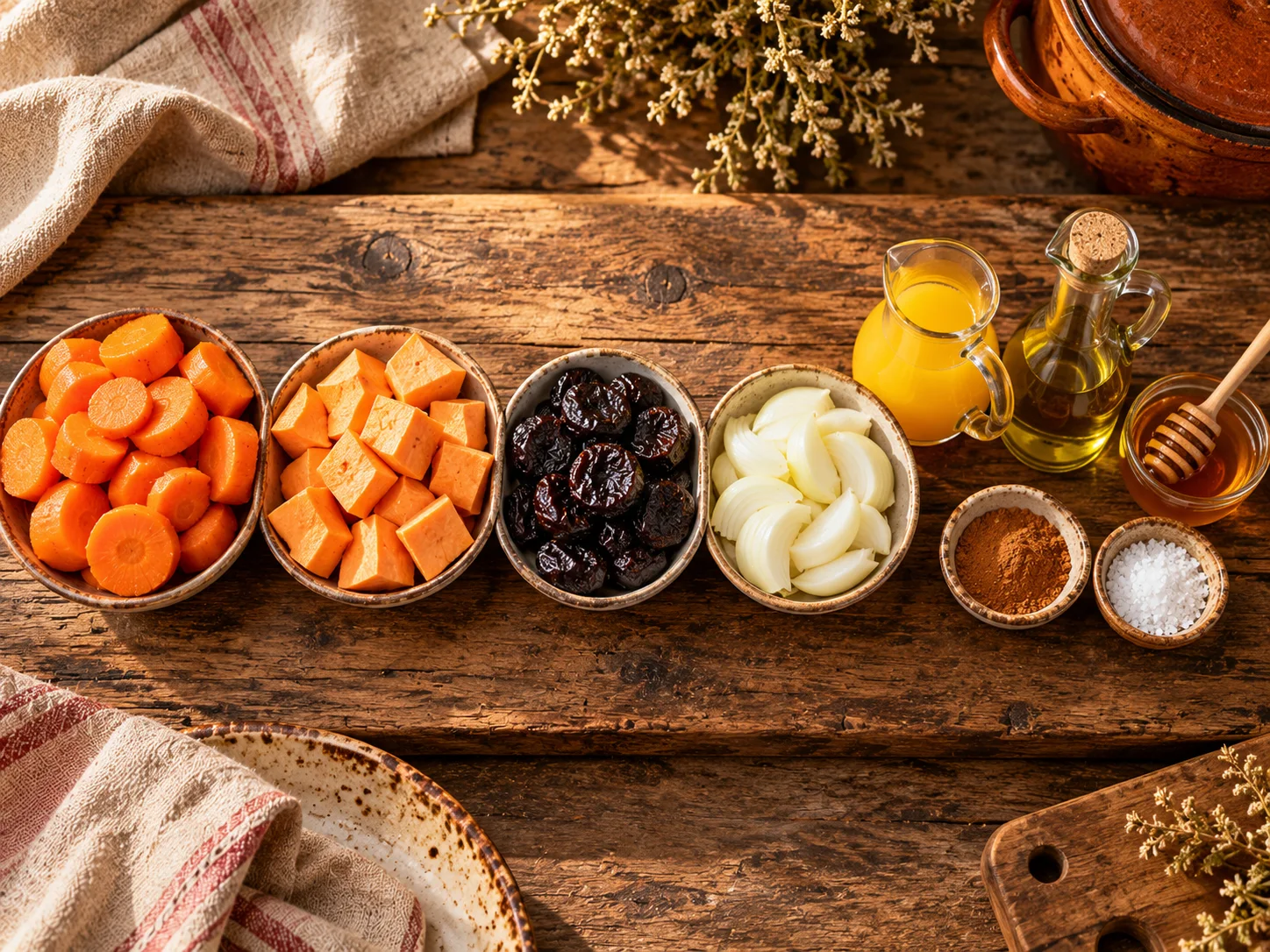
The vegetables and fruit
- 700g (about 1.5 lb) carrots, cut into 2.5–4cm (1–1½ inch) chunks or thick rounds
- 500g (about 1.1 lb) sweet potatoes, cut into 2.5–4cm (1–1½ inch) chunks
- 200g (about 1⅛ cups) pitted prunes, left whole
- 1 medium onion (about 110g), sliced
The cooking liquid and seasoning
- 3 tablespoons (45ml) olive oil
- 250ml (1 cup) orange juice
- 120ml (½ cup) water
- 3 tablespoons (about 63g) honey
- ½ teaspoon ground cinnamon
- 1 teaspoon salt
Method
Step 1: Prepare the vegetables
Heat the oven to 200°C (400°F). Wash the carrots well and cut them into even pieces; peeling is optional if they are scrubbed.4 Peel the sweet potatoes and cut them to the same size as the carrots.
Step 2: Soften the onion
Warm the olive oil in a large ovenproof pot or Dutch oven over medium heat. Add the sliced onion and cook, stirring, until soft and lightly golden, 5–7 minutes (Heritage Healthy Kitchen estimate).6

Step 3: Combine
Add the carrots, sweet potatoes, and prunes to the pot. Sprinkle over the cinnamon and salt. Pour in the orange juice and water, drizzle over the honey, and stir until everything is coated. Bring to a simmer on the stovetop. If using a baking dish instead of a pot, transfer everything to the dish and cover it tightly with foil.
Step 4: Bake covered
Cover and bake for 40 minutes, until the vegetables have begun to soften.4 8
Step 5: Bake uncovered
Remove the lid, stir gently, and return to the oven for 20–25 minutes. The vegetables should be tender when pierced with a knife, and the liquid should have reduced to a thick, glossy glaze.2 4 8 Taste and adjust the salt before serving.
Kitchen Tips
Squeeze the orange juice fresh. One recipe calls fresh juice non-negotiable, since carton juice lacks the brightness of a fresh orange.4
Adjust the sweetness. This recipe uses 3 tablespoons of honey. Taste the liquid before the pot goes into the oven and change it to suit the household. The honey can also be reduced or left out entirely: one published beef version treats it as optional, with the prunes and orange juice still sweetening the dish.3 Leaving out all 3 tablespoons removes roughly 30 kcal and 9g of sugars per serving (Heritage Healthy Kitchen estimate).
Change the dried fruit. Prunes are the standard, but published recipes also use dates, apricots, and raisins, either alone or in a mix.4 7 8 A mix of large pieces of pitted dates, prunes, and dried apricots works, although one type alone is enough.4
Stovetop alternative. Sauté the onion, add everything else, and simmer for about 1 hour.6
Roasting variation. One cook swaps the orange juice for vegetable stock, adds red onions for aromatic depth, and roasts everything in a hot oven.2 Another recipe parboils the carrots and sweet potatoes for 15 minutes before baking them with the fruit.7
Make it ahead. Tzimmes can be roasted up to 24 hours in advance and refrigerated, which frees the oven on a busy holiday.4

Nutritional Information
Per serving (1/6 of the recipe)
- Calories: approximately 290–350 kcal
- Protein: ~3–4g
- Total fat: ~7–8g
- Carbohydrates: ~58–71g
- Sugars: ~31–38g
- Dietary fiber: ~8–10g
Values are Heritage Healthy Kitchen estimates calculated from the recipe above using USDA FoodData Central.10 They will vary with the size of the vegetables, the brand of prunes and honey, and the exact amount of oil used. Sodium is not included because the amount of added salt varies by household.
Storage and Reheating
Refrigerate cooked tzimmes in an airtight container for up to 4 days, or freeze it for up to 3 months.4
To reheat, warm it covered in an oven at 160°C (325°F) until hot throughout, adding a splash of water if the glaze has tightened (Heritage Healthy Kitchen estimate). Frozen tzimmes is best thawed overnight in the refrigerator first (Heritage Healthy Kitchen estimate).
Traditional Tzimmes

Ingredients
The vegetables and fruit
- 700g (about 1.5 lb) carrots, cut into 2.5–4cm (1–1½ inch) chunks or thick rounds
- 500g (about 1.1 lb) sweet potatoes, cut into 2.5–4cm (1–1½ inch) chunks
- 200g (about 1⅛ cups) pitted prunes, left whole
- 1 medium onion (about 110g), sliced
The cooking liquid and seasoning
- 3 tablespoons (45ml) olive oil
- 250ml (1 cup) orange juice
- 120ml (½ cup) water
- 3 tablespoons (about 63g) honey
- ½ teaspoon ground cinnamon
- 1 teaspoon salt
Instructions
- Prepare the vegetables: Heat the oven to 200°C (400°F). Wash the carrots well and cut them into even pieces; peeling is optional if they are scrubbed. Peel the sweet potatoes and cut them to the same size as the carrots.
- Soften the onion: Warm the olive oil in a large ovenproof pot or Dutch oven over medium heat. Add the sliced onion and cook, stirring, until soft and lightly golden, 5–7 minutes (Heritage Healthy Kitchen estimate).
- Combine: Add the carrots, sweet potatoes, and prunes to the pot. Sprinkle over the cinnamon and salt. Pour in the orange juice and water, drizzle over the honey, and stir until everything is coated. Bring to a simmer on the stovetop. If using a baking dish instead of a pot, transfer everything to the dish and cover it tightly with foil.
- Bake covered: Cover and bake for 40 minutes, until the vegetables have begun to soften.
- Bake uncovered: Remove the lid, stir gently, and return to the oven for 20–25 minutes. The vegetables should be tender when pierced with a knife, and the liquid should have reduced to a thick, glossy glaze. Taste and adjust the salt before serving.
Frequently Asked Questions
Is tzimmes really a Passover dish?
Yes, although it is best known for Rosh Hashanah. A tzimmes of vegetables, dried fruit, and juice is often served at Passover because it contains none of the foods forbidden during the holiday.4 Jewish tradition forbids chametz, meaning leavened wheat, barley, spelt, oats, and rye, in any form other than matzah, and Ashkenazi custom also forbids kitniyot, a category that includes legumes, corn, and rice.9 Matzah is unleavened bread made only from flour and water and baked, by Jewish tradition, within 18 minutes of mixing, before the dough can rise.11 One historical account also describes Passover tzimmes topped with a kugel crust made of potato and matzo meal.1
Do the carrots and sweet potatoes need to be peeled?
Not necessarily. One published recipe cuts the vegetables into 4cm (1½-inch) chunks with no peeling and reports no major difference in taste, along with a large saving in time.4 This article’s recipe peels the sweet potatoes and leaves the peeling of well-washed carrots optional.
Does tzimmes always contain meat?
No. The version in this article is meat-free and works as a side dish. Meat versions do exist: a beef tzimmes pairs chuck with carrots, sweet potatoes, and prunes and takes about 2 hours 40 minutes in total.3
Is tzimmes meant to be very sweet?
It is a sweet dish by design, but the level varies by recipe. Published versions use anywhere from 2 tablespoons to ½ cup of honey, and two of them also add brown sugar or sugar.6 7 8 One beef version treats honey as an optional touch, with the prunes supplying the sweetness.3 Orange juice adds sweetness too, so the honey can be reduced to taste.
Why is carrot tzimmes eaten at Rosh Hashanah?
Carrots carry two meanings. Sliced, they resemble coins, and their Yiddish name, meiren, means “to multiply,” echoing the phrase “go forth and multiply” in Genesis.1 5 The dish is also sweet, and sweet foods are served at Rosh Hashanah for a pleasant year ahead.5
Further Reading & Sources
The recipe is a compilation based on the published recipes listed here; these links are provided for readers who want to explore further.
- Baur, Joe. “The History of Tzimmes.” The Nosher, My Jewish Learning (9 August 2021).
- Koenig, Leah. “The Trouble With Tsimmes—and How to Fix It.” Tablet Magazine (20 September 2018).
- Pinson, Elka. “Beef Tzimmes.” Saveur (updated 22 September 2025).
- Firkser, Rebecca. “Tzimmes.” The Kitchn (7 September 2022).
- Altman-Traub, Melissa, MS, RDN, LDN. “Rosh Hashanah.” eatright.org, Academy of Nutrition and Dietetics (reviewed 23 February 2023).
- Szokovski, Miriam. “Traditional Rosh Hashanah Tzimmes.” Chabad.org.
- Edelstein, Florence. “Carrot and Prune Tzimmes.” Reform Judaism, from June Feiss Hersh, Recipes Remembered (2011).
- Stevenson, Amy, for Food Network Kitchen. “Tzimmes.” Food Network (2024).
- Spitzer, Jeffrey. “Kitniyot: Not Quite Hametz.” My Jewish Learning (10 January 2024).
- U.S. Department of Agriculture. FoodData Central.
- Krakowski, Yissachar Dov. “Understanding the Not-So-Simple Matzah.” OU Kosher (25 February 2026).
Disclaimer
The information in this article is provided for educational and informational purposes only. Heritage Healthy Kitchen makes no representations or warranties regarding the accuracy or completeness of any content on this site. Nutritional values are estimates only and will vary depending on the specific ingredients, brands, and measurements used. This content is not intended as dietary, medical, or professional nutritional advice. Always consult a qualified healthcare provider regarding any dietary needs or health conditions. Heritage Healthy Kitchen is not responsible for any outcomes resulting from the use of recipes or information published on this site.
Cook by Occasion
This recipe is part of our Passover menu and our Rosh Hashanah menu.
You Might Also Like
More heritage recipes from our kitchen


Leave a Reply