
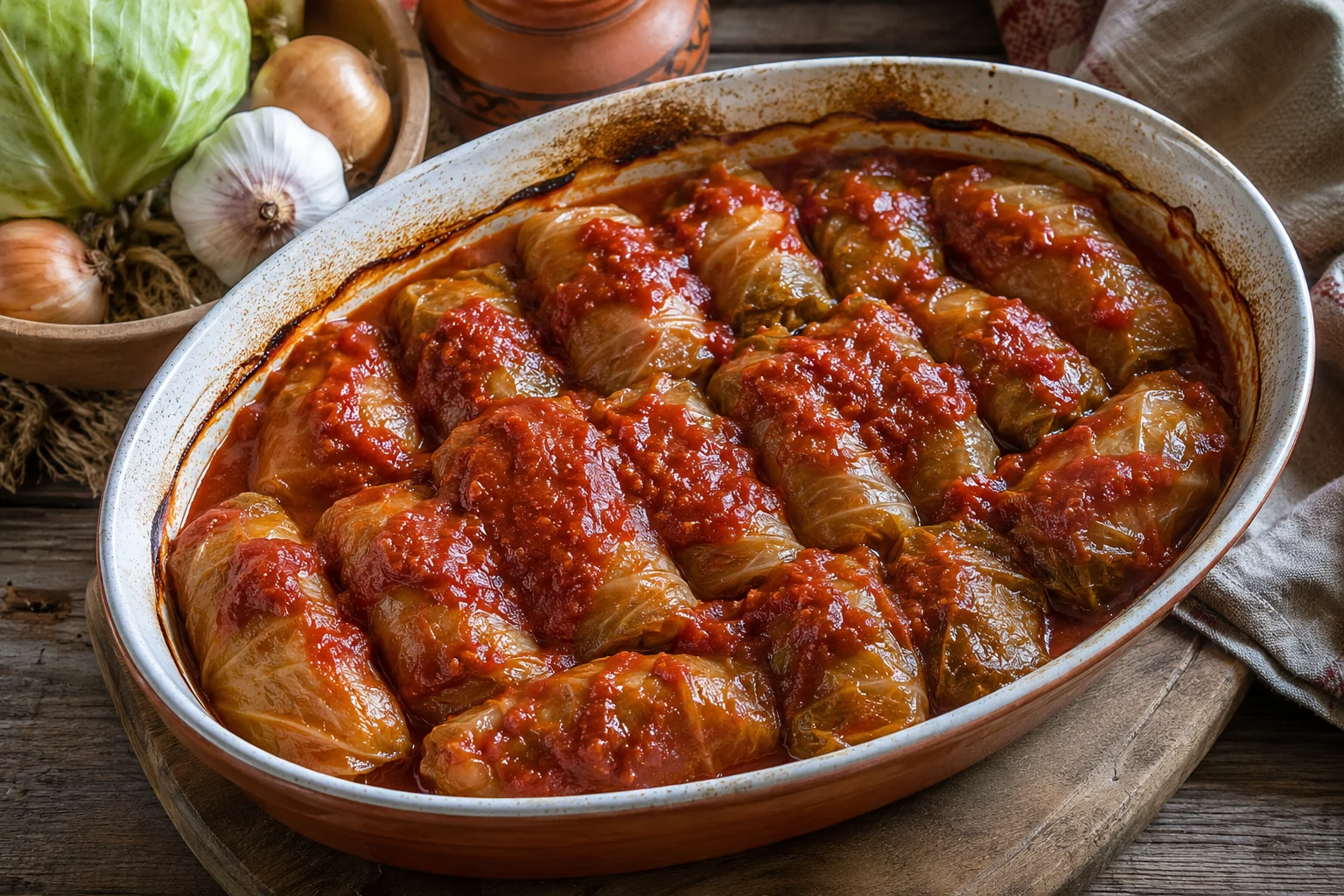
Prep: ~1 hour | Cooking: 2–3 hours | Serves: 6–8 | Makes: approximately 16–18 rolls | Difficulty: Intermediate
Quick Overview
- Soften a whole head of cabbage, either by blanching leaf by leaf or freezing and thawing the head whole
- Mix the filling raw: ground beef, partially cooked rice, grated onion, egg, salt, and pepper
- Roll each leaf around a spoonful of filling, tucking the sides in as you go
- Build the sauce: crushed tomatoes, brown sugar, lemon juice, and, if you like, a handful of raisins
- Layer the rolls in a heavy pot, cover with sauce, and simmer or bake for 2 to 3 hours
- Rest for 15 minutes before serving. The rolls hold together better once they’ve cooled slightly
What Holishkes and Prakas Are
Holishkes are Ashkenazi Jewish stuffed cabbage rolls: blanched or softened cabbage leaves wrapped around a filling of ground beef and rice, then simmered in tomato sauce.1 5 The same dish is called prakas, or prakes, in households whose families came from Romania, Moldova, or southern Ukraine. The name depends on where in Eastern Europe your grandmother’s kitchen was, not on the recipe itself.2
What sets the Jewish version apart from its Polish and Ukrainian cousins isn’t the wrapping technique — it’s the sauce. Ukrainian holubtsi lean on tomato and sour cream, and Polish gołąbki usually stick to a plain tomato sauce, while holishkes are deliberately sweet and sour, built on brown sugar and lemon juice rather than either of those. The dish is eaten year-round, but it shows up most reliably in the fall, around the Sukkot holiday.1 5
Two Names, Two Trade Routes
Most of the Yiddish names for stuffed cabbage fall into one of two families, and both point to a different journey the dish took to reach a Jewish kitchen. The first is Slavic: golubtses, holeptshes, and holishkes all descend from words for “dove” (Polish gołąb, Ukrainian holub, Russian golub), on the idea that a rolled cabbage leaf resembles a bird’s breast on a plate.2 This is the same root behind the Polish gołąbki and Ukrainian holubtsi.
The second family is Turkish. Prakes comes from Turkish yaprak, meaning leaf — by way of Ladino-speaking Sephardic Jews, who called stuffed grape leaves yaprakes and brought the word into Romania, Moldova (once called Bessarabia), and southern Ukraine, where it eventually lost its first syllable.2 A linguistic map published in the Language and Culture Atlas of Ashkenazic Jewry shows just how sharp the boundary was: prakes held the southeastern corner of the Yiddish-speaking world, while golubtses and related dove-forms covered most of the rest, reaching as far north as Lithuania.2
The two families collided in an odd place: Philadelphia. Jewish residents there, regardless of which part of Europe their families actually came from, settled on “prakas” as the name — to the point that a Philadelphia native ordering prakas at a New York restaurant in the 1960s left the waiter completely baffled.2 Nobody has fully explained why the term won out there rather than elsewhere, though heavier immigration from Romania, Bessarabia, and southern Ukraine to Philadelphia and Baltimore in that era is the leading guess.2
Where the dish came from in the first place follows a related geographic logic. According to Jewish food historian Gil Marks, Jews in Russia and Poland learned stuffed cabbage from the Tatars during the 16th century, while Jewish communities in Hungary and the Balkans learned it from their Ottoman Turkish neighbors.1 Both routes trace back to a wider Ottoman tradition of stuffing vegetables and leaves, a technique that also reached Ashkenazi kitchens through trade routes running from the Baltic to Anatolia.4 Local spicing still carries the trace of that spread: Hungarian Jewish versions use marjoram, Syrian Jewish versions add cinnamon, and Persian Jewish versions add dill and mint.1
Sukkot, a Yiddish Pun, and the Sweet-and-Sour Sauce
Cabbage was cheap and in season in the fall, which made stuffed cabbage a natural fit for Sukkot, the harvest festival. The filled leaf itself was taken as a symbol of a full harvest.1 A popular explanation ties the dish to the following day, Simchat Torah, on the grounds that two rolled cabbages sitting side by side resemble a pair of Torah scrolls.1 5
The Forward’s Yiddish desk offers a more specific account, tied to Hoshana Rabbah, the seventh day of Sukkot rather than the holiday that follows it. The high point of that day’s prayer service includes the phrase kol mevaser, mevaser v’omer — “the voice of the herald heralds and says.” Kol sounds like the German word for cabbage, kohl, and vaser is Yiddish for water, giving rise to a custom of eating cabbage cooked in water on that day. Cooks then dressed up the plain kohl mit vaser with a sweet-and-sour sauce to make it worth eating.3
Kosher dietary law also shaped the sauce. A meat dish can’t include dairy, which rules out the sour cream that finishes many Slavic versions of stuffed cabbage.6 Lemon juice and sugar, sometimes with a pinch of citric acid known as “sour salt,” deliver a similar sweet-tart balance without it. That workaround is a large part of why holishkes tastes so different from gołąbki and holubtsi.
The tomato-forward version most people know today is largely an American development. It was during the wave of Eastern European Jewish immigration to the United States in the 19th and 20th centuries that the dish took on the tomato stew and sweet-and-sour variations now considered standard.1
Traditional Holishkes Recipe
Recipe developed independently by Heritage Healthy Kitchen, drawing on traditional Ashkenazi Jewish culinary methods. Sources for further reading are listed at the end of this article.
Ingredients
The cabbage
- 1 large head of white cabbage (approximately 1.8kg / 4 lb)

The filling
- 700g (1.5 lb) ground beef
- 150g (¾ cup) long-grain rice, partially cooked (see method)
- 1 large onion, grated or finely diced (about 150g)
- 1 large egg
- 1 teaspoon salt
- ½ teaspoon black pepper
The sauce
- 800g (28 oz) canned crushed tomatoes
- 400ml (1⅔ cups) water
- 1 medium onion, sliced (about 150g)
- 60g (¼ cup, packed) brown sugar, or more to taste
- 60ml (¼ cup) fresh lemon juice, or more to taste
- 50g (⅓ cup) raisins (optional)
- ¾ teaspoon salt
- 1 bay leaf
Method

Step 1: Soften the cabbage
Two methods work. For the traditional route, core the cabbage and lower the whole head into boiling water, peeling off leaves with tongs as they soften. That takes about 10–15 minutes of rotating and peeling. For a shortcut, freeze the whole head a day ahead and let it thaw fully at room temperature — the leaves come away soft and pliable with no boiling at all.7 Trim the thick center rib from each leaf so it rolls without cracking.
Step 2: Partially cook the rice
Rinse the rice, then boil in salted water for about 7 minutes and drain. It should still be firm in the center; it finishes cooking inside the roll during the long simmer.
Step 3: Mix the filling
Combine the ground beef, drained rice, grated onion, egg, salt, and pepper in a bowl and mix by hand until evenly distributed. Fry a small spoonful to taste for seasoning before rolling; there’s no adjusting it once the rolls are in the pot.
Step 4: Roll the cabbage
Lay a leaf flat, stem end toward you, and spoon about 2–3 tablespoons of filling onto the lower third. Fold in the sides, then roll from the stem end up into a snug parcel. Patch any tears with a scrap of spare leaf.
Step 5: Layer and cook
Line the bottom of a heavy pot with sliced onion and any torn or leftover cabbage leaves. Arrange the rolls seam side down in tight layers. Whisk together the crushed tomatoes, water, brown sugar, lemon juice, raisins if using, and salt, then pour over the rolls along with the bay leaf. They should be just covered.
For the stovetop: bring to a gentle boil, then reduce to a low simmer, cover, and cook for 2 to 2.5 hours, checking occasionally that the liquid hasn’t reduced too far. For the oven: cover tightly and bake at 160°C / 325°F for 2.5 to 3 hours.
Step 6: Rest and taste the sauce
Remove from heat and rest, covered, for 15 minutes. Taste the sauce and adjust the sweet-sour balance with more sugar or lemon juice before serving. This is where holishkes gets personal, and every family lands somewhere slightly different.
Kitchen Tips
The sweet-sour ratio is not fixed. Some households lean sweet with extra brown sugar and raisins; others favor a sharper sour edge with more lemon juice or a pinch of citric acid (“sour salt”). Taste the sauce partway through cooking and adjust — this is the one place in the recipe where personal and family preference genuinely overrides any standard measurement.
Ground turkey works as a substitute for beef in a pinch, but it releases less fat during the long simmer, so the filling can dry out. Adding a tablespoon of oil to the mixture helps offset that.
Holishkes taste better the next day. The sauce has time to work its way into the filling overnight, and the sweet-sour balance settles rather than sitting sharply on top. Making the dish a day before serving and reheating it gently is worth the extra planning.
Nutritional Information
Per serving of 2–3 rolls with sauce (approximately 350g)

- Calories: approximately 410–500 kcal
- Protein: ~20–24g
- Total fat: ~19–23g
- Carbohydrates: ~38–47g
- Dietary fiber: ~3–4g
- Sodium: ~760–930mg (varies with the amount of added salt and the sodium content of the canned tomatoes used)
Values are estimates based on standard ingredient databases, calculated from the recipe above and divided across 6–8 servings. They will vary depending on the fat content of the beef, the exact amount of sauce absorbed, and how much added sugar or salt is used.
Storage and Reheating
Cooked holishkes keep in the refrigerator for 4–5 days, stored in a sealed container with the sauce so the rolls don’t dry out. Reheat gently in a covered pot on the stove or in the oven at 160°C, covered, for 20–25 minutes.
Raw, unstuffed cabbage leaves and mixed filling both freeze well separately, but it’s simpler to freeze the rolls after assembly and before cooking. Arrange in a single layer until solid, then transfer to a container for up to 3 months. Cook from frozen, adding 20–30 minutes to the simmer or bake time.
Cooked holishkes also freeze well for up to 3 months. Defrost overnight in the refrigerator and reheat covered, with a splash of water if the sauce has thickened too much.
Traditional Jewish Stuffed Cabbage

Ingredients
The filling
- 700g (1.5 lb) ground beef
- 150g (¾ cup) long-grain rice, partially cooked (see method)
- 1 large onion, grated or finely diced (about 150g)
- 1 large egg
- 1 teaspoon salt
- ½ teaspoon black pepper
The sauce
- 800g (28 oz) canned crushed tomatoes
- 400ml (1⅔ cups) water
- 1 medium onion, sliced (about 150g)
- 60g (¼ cup, packed) brown sugar, or more to taste
- 60ml (¼ cup) fresh lemon juice, or more to taste
- 50g (⅓ cup) raisins (optional)
- ¾ teaspoon salt
- 1 bay leaf
Instructions
- Soften a whole head of cabbage, either by blanching leaf by leaf or freezing and thawing the head whole
- Mix the filling raw: ground beef, partially cooked rice, grated onion, egg, salt, and pepper
- Roll each leaf around a spoonful of filling, tucking the sides in as you go
- Build the sauce: crushed tomatoes, brown sugar, lemon juice, and, if you like, a handful of raisins
- Layer the rolls in a heavy pot, cover with sauce, and simmer or bake for 2 to 3 hours
- Rest for 15 minutes before serving. The rolls hold together better once they’ve cooled slightly
Frequently Asked Questions
What’s the actual difference between holishkes and prakas?
None, in terms of the finished dish. The two are the same recipe under different names, tracing back to two different linguistic paths into Yiddish: “holishkes” from Slavic words for dove, “prakas” from Turkish yaprak by way of Sephardic Ladino. Which term a family uses usually says more about where their ancestors settled in Eastern Europe than anything about how they cook it.2
What keeps the rolls from falling apart in the pot?
Three things, usually: an under-softened leaf that cracks under pressure, an overfilled roll with no room to expand, or loose packing that lets the rolls drift apart in the sauce. Fill conservatively, and arrange the rolls tightly enough in the pot that they hold each other in place.
Is stuffed cabbage really a Simchat Torah food, or is that a myth?
It’s more folklore than documented history. The visual resemblance between two rolled cabbages and a pair of Torah scrolls is a popular explanation, but the more specific, sourced tradition ties the dish to Hoshana Rabbah, the seventh day of Sukkot, shortly before Simchat Torah, through the kol mevaser / kohl mit vaser pun.1 3
Can the rolls be assembled a day ahead of cooking?
Yes. Roll the cabbage and refrigerate the uncooked rolls, covered, for up to a day before adding the sauce and cooking as usual. This also spreads the work out, since softening the cabbage and mixing the filling are the more time-consuming steps.
Can holishkes be made without meat?
Yes. A mix of mushrooms, sunflower seeds, and rice makes a filling with enough body to hold together through the long simmer, finished in the same sweet-and-sour sauce.3 Meat was also historically stretched with extra rice simply because it was expensive, which is part of why the grain-heavy version exists at all.1
Why do some recipes call for “sour salt” instead of lemon juice?
Sour salt is citric acid in crystal form, and many family recipes reach for it alongside or instead of lemon juice for a cleaner, more concentrated sourness without adding extra liquid to the sauce.1 Either works; lemon juice is easier to find and adjusts more predictably by taste.
Do I have to include raisins in the sauce?
No. Raisins are a common but optional addition that adds pockets of concentrated sweetness rather than sweetening the sauce evenly. Leave them out if the household prefers a cleaner sweet-sour balance without texture surprises.
A Lighter Version
A version of this recipe with 93% lean ground beef, brown rice, and a lighter sauce with less added sugar and sodium is covered in our Healthy Jewish Stuffed Cabbage article.
Further Reading & Sources
The following sources were consulted in researching the history, etymology, and cultural context of traditional Jewish stuffed cabbage. Heritage Healthy Kitchen’s recipe was developed independently; these links are provided for readers who want to explore further.
- Lieber, Chavie. “The Jews, Stuffed Cabbage and Simchat Torah.” Jewish Telegraphic Agency. jta.org — history of the dish’s arrival via Tatar and Ottoman routes, regional spicing variants, Sukkot symbolism, and the shift to tomato and sweet-and-sour sauces during American immigration, drawing on Jewish food historian Gil Marks.
- Philologos. “Philadelphia Prakas.” The Forward. forward.com — detailed etymology of “prakes” from Turkish yaprak via Sephardic Ladino, its geographic distribution per the Language and Culture Atlas of Ashkenazic Jewry, and the Philadelphia naming anomaly.
- Schaechter, Rukhl, and Eve Jochnowitz. “Delicious Sweet and Sour Stuffed Cabbage for Sukkot.” The Forward. forward.com — the Hoshana Rabbah pun (kol mevaser / kohl mit vaser) as the documented basis for the holiday custom.
- Calin, Lauren G. “What’s Yours Is Mine: The Shared Roots of Jewish Cuisine.” Foodish, ANU Museum of the Jewish People. foodish.anumuseum.org.il — Ottoman and Sephardic trade-route origins of stuffed-leaf dishes and their spread into Ashkenazi cooking.
- “Holishkes.” Wikipedia. en.wikipedia.org/wiki/Holishkes — general reference on naming variants and regional spicing.
- “Stuffed Cabbage.” Chabad.org. chabad.org — confirmation of the kosher requirement that meat dishes exclude dairy.
- “Sweet-and-Sour Stuffed Cabbage.” Chabad.org. chabad.org — freezing method for softening cabbage leaves without boiling.
Disclaimer
The information in this article is provided for educational and informational purposes only. Heritage Healthy Kitchen makes no representations or warranties regarding the accuracy or completeness of any content on this site. Nutritional values are estimates only and will vary depending on the specific ingredients, brands, and measurements used. This content is not intended as dietary, medical, or professional nutritional advice. Always consult a qualified healthcare provider regarding any dietary needs or health conditions. Heritage Healthy Kitchen is not responsible for any outcomes resulting from the use of recipes or information published on this site.
You Might Also Like
More heritage recipes from our kitchen

Leave a Reply