
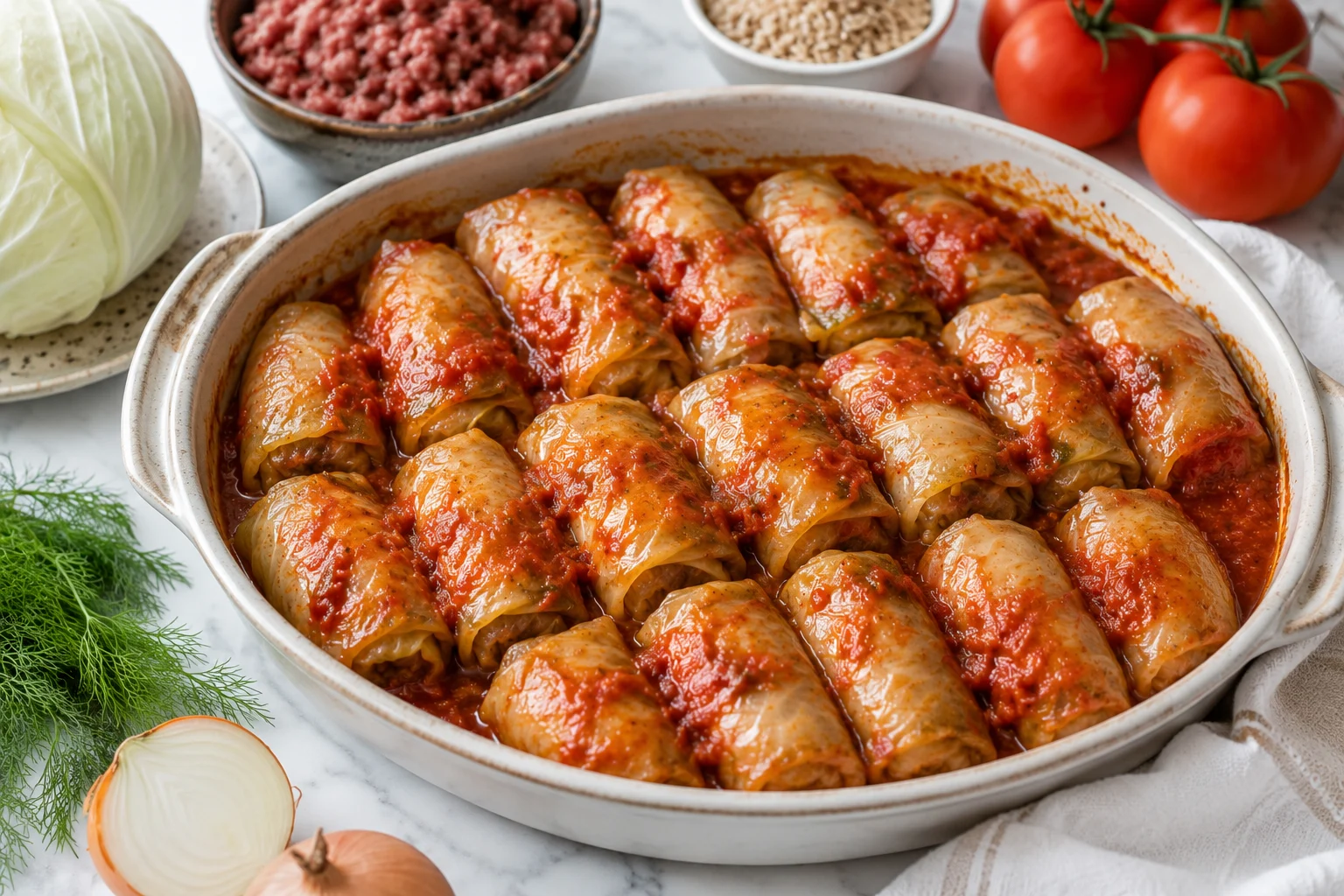
Prep: ~1 hour | Cooking: 2–3 hours | Serves: 6–8 | Makes: approximately 16–18 rolls | Difficulty: Intermediate
Quick Overview
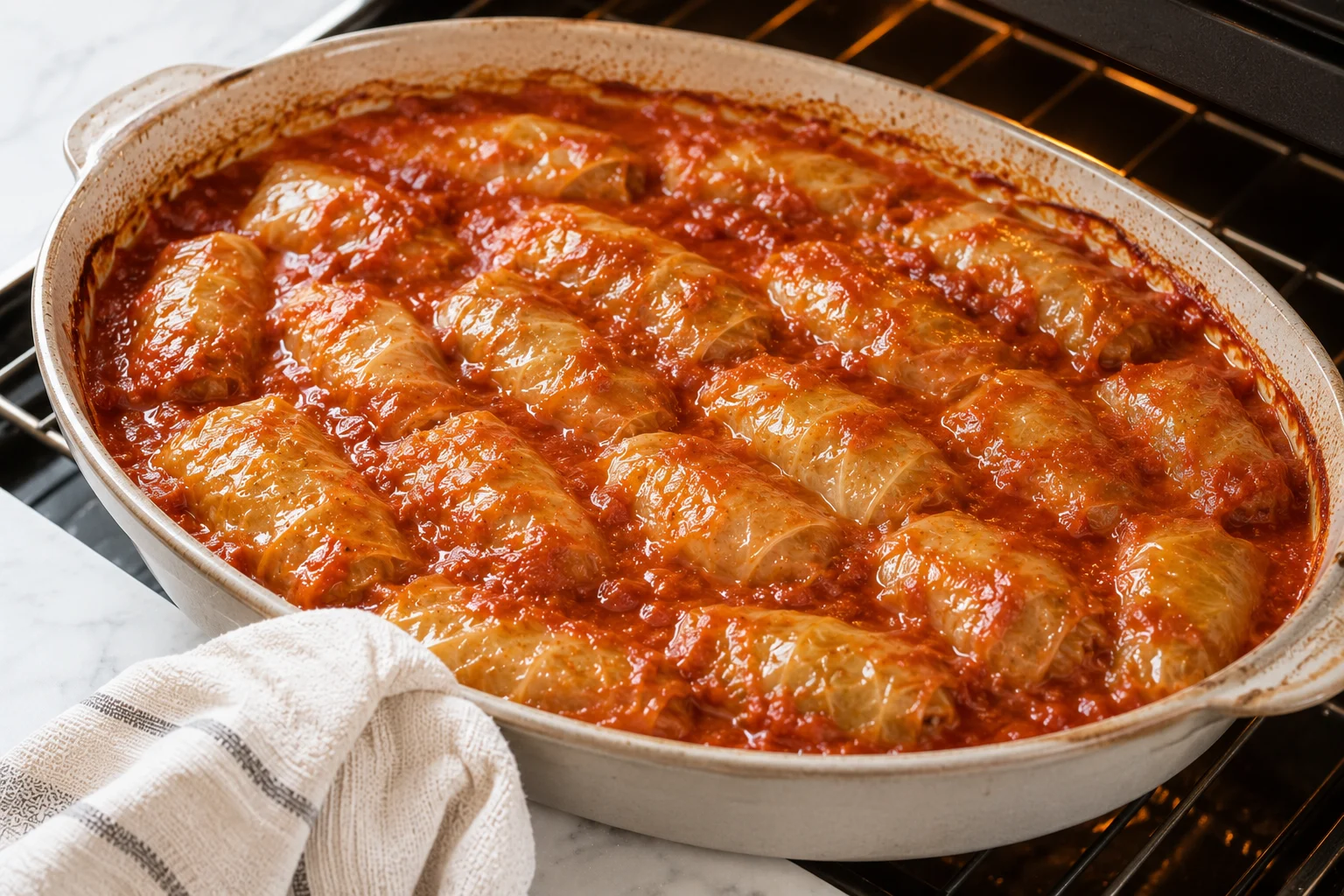
- The cabbage preparation is identical to the traditional version: boil or freeze-and-thaw, then peel and trim the ribs
- Replace regular ground beef with 93% lean ground beef; replace white rice with brown rice, half-cooked the same way but for longer
- The sauce changes the most: half the brown sugar, no-salt-added tomatoes, less added salt, and slightly more lemon juice to keep the sweet-sour balance sharp
- Raisins become optional and reduced, for those who want the sweetness
- Cooking method and time are unchanged: 2 to 3 hours, stovetop or oven
What This Version Changes — and What It Keeps
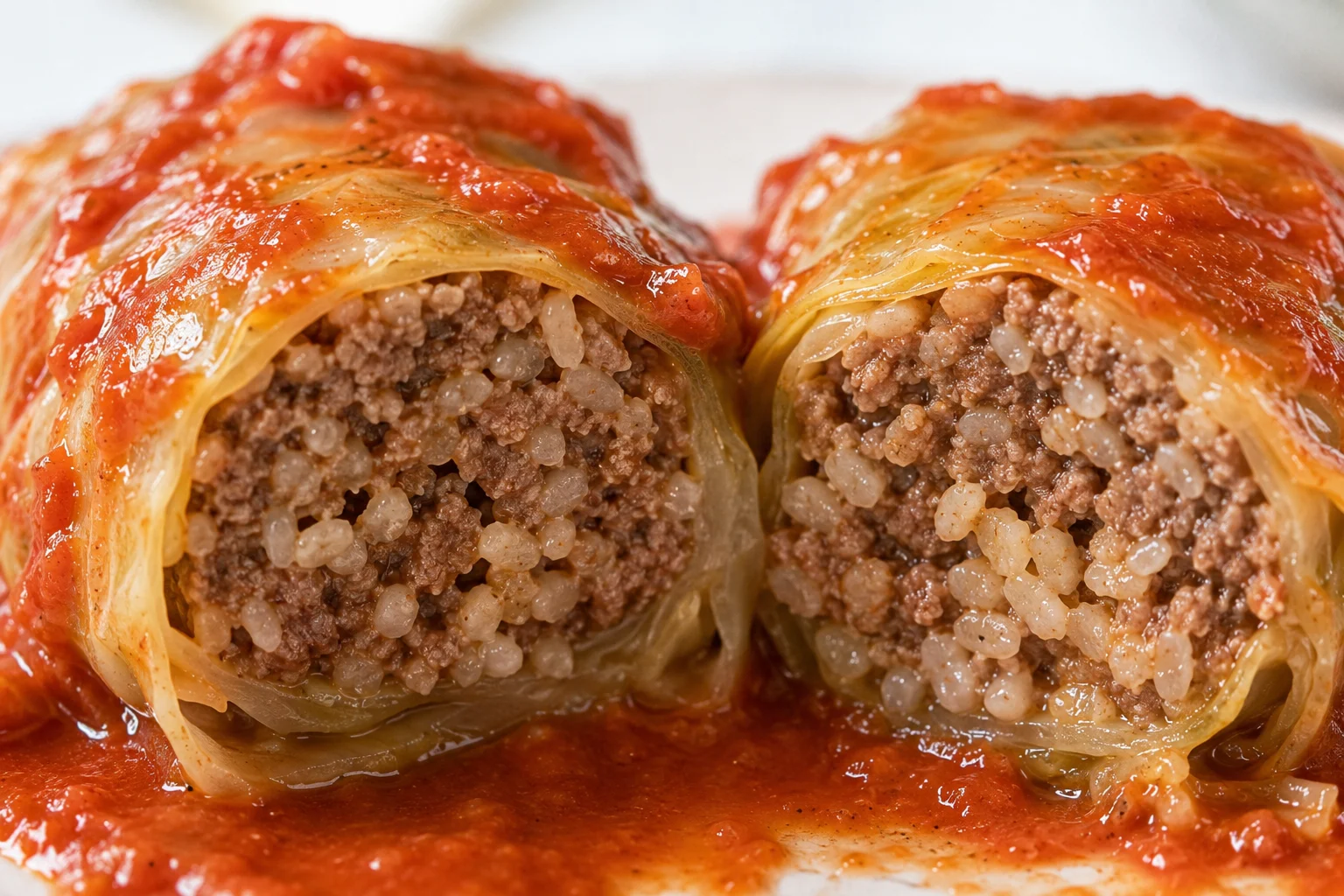
The cabbage, the rolling technique, the cooking time, and the sweet-and-sour identity of the sauce all stay exactly as they are in the traditional recipe. Holishkes without a tomato-lemon-sugar sauce would not be holishkes, so this version keeps all three of those ingredients — it just uses less of two of them.
What changes is the fat in the meat, the type of rice, and the sugar and sodium load in the sauce. These three swaps target the three biggest contributors to the traditional recipe’s calorie and sodium count without touching the shape, the technique, or the flavor profile that makes the dish recognizable.
Why These Swaps Work
93% lean ground beef instead of regular ground beef
Standard ground beef (80% lean, 20% fat) runs well above the fat threshold health authorities recommend for red meat. Mayo Clinic recommends choosing lean meats with less than 10% fat as one of the core steps in a heart-healthy diet, alongside the American Heart Association’s saturated fat targets.1 Cleveland Clinic dietitian Julia Zumpano, RD, specifically recommends 90% lean ground beef over standard ground beef because diets high in saturated fat are linked to higher blood cholesterol and heart disease risk.2
Ninety-three percent lean ground beef sits comfortably past that 10% threshold while still being widely available at most grocery stores. It behaves slightly differently in a long braise than fattier beef, since less natural fat is left to keep it moist, and the filling can turn a little firmer after two-plus hours of simmering. The sauce covering the rolls throughout cooking does most of the work of preventing that.
Brown rice instead of white rice
Brown rice keeps the bran and germ layers that milling strips from white rice, which is where most of the nutritional difference comes from. Harvard Health Publishing reports that brown rice delivers more fiber, magnesium, potassium, and B vitamins than white rice, along with a lower glycemic index — about 68 compared with 73 for white rice.3 Calorie content between the two is similar, so the benefit is in what comes bundled with the calories, not in the calorie count itself.3
In a filling that simmers for two-plus hours, brown rice needs a longer pre-cook than white rice before rolling. Otherwise it stays too firm inside the finished roll. Half-cooking it for 15 minutes instead of 7 gives it enough of a head start to finish properly during the long braise.
Less added sugar in the sauce
The traditional sauce leans on a generous amount of brown sugar plus raisins to build its sweet side. The Dietary Guidelines for Americans recommend limiting added sugar to less than 10% of daily calories, and the American Heart Association sets a stricter limit still — no more than about 24 grams a day for most women and 36 grams for most men, according to the Harvard T.H. Chan School of Public Health’s Nutrition Source.4 A single serving of the traditional sauce can account for a meaningful share of that daily allowance on its own.
Cutting the brown sugar by more than half and making the raisins optional brings the sauce’s added sugar down substantially without losing the sweet-sour identity of the dish. The natural sweetness of the tomatoes and the tartness of the lemon juice do more of the work. Harvard’s Nutrition Source suggests that a partial reduction in a recipe’s added sugar, rather than eliminating it outright, is usually enough to produce a real difference.4
Less sodium, with lemon juice picking up the slack
Standard canned tomatoes and two rounds of added salt, one in the filling and one in the sauce, add up. The American Heart Association recommends no more than 2,300 milligrams of sodium a day, and ideally closer to 1,500 milligrams, with Mayo Clinic noting that canned and processed foods are the largest contributor for most people.1 Switching to no-salt-added canned tomatoes removes one of those contributors directly.
Cutting the added salt further is easier here than in most recipes, because holishkes already contains lemon juice. Harvard’s Nutrition Source points out that citrus and sodium activate some of the same taste receptors, so a dish with citrus in it needs less added salt to taste seasoned than one without.5 A slightly larger amount of lemon juice than the traditional recipe uses helps the lower-salt sauce still taste balanced rather than flat.
Healthy Holishkes Recipe
Recipe developed independently by Heritage Healthy Kitchen. Sources for the nutritional claims above are listed at the end of this article.
Ingredients
The cabbage
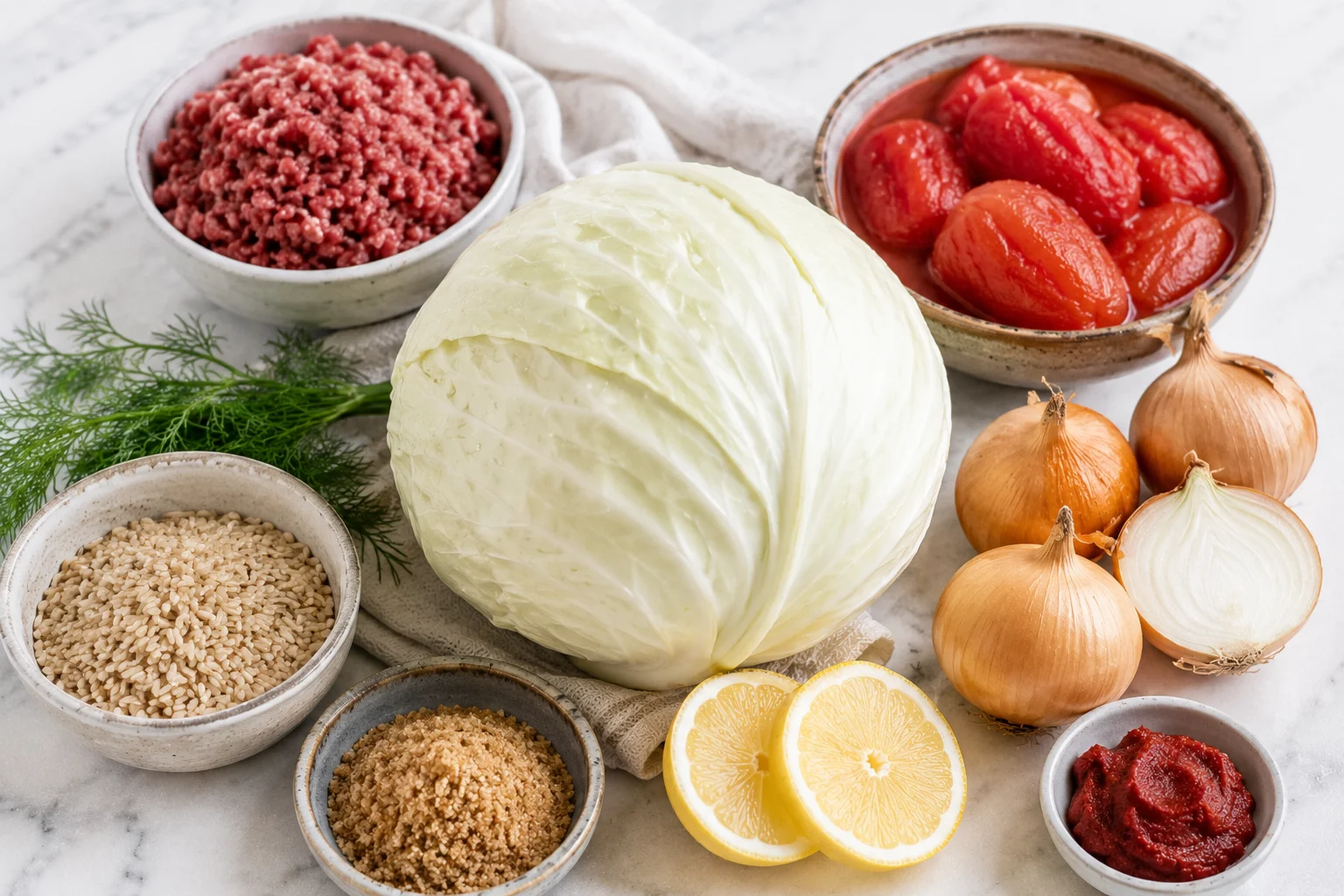
- 1 large head of white cabbage (approximately 1.8kg / 4 lb), same as the traditional version
The filling
- 700g (1.5 lb) 93% lean ground beef
- 150g (¾ cup) brown rice, half-cooked (see method)
- 1 large onion, grated or finely diced (about 150g)
- 1 large egg
- ¾ teaspoon salt
- ½ teaspoon black pepper
The sauce
- 800g (28 oz) no-salt-added canned crushed tomatoes
- 400ml (1⅔ cups) water
- 1 medium onion, sliced (about 150g)
- 25g (2 tablespoons) brown sugar, or more to taste
- 75ml (⅓ cup) fresh lemon juice, or more to taste
- 25g (3 tablespoons) raisins (optional)
- ½ teaspoon salt
- 1 bay leaf
Method
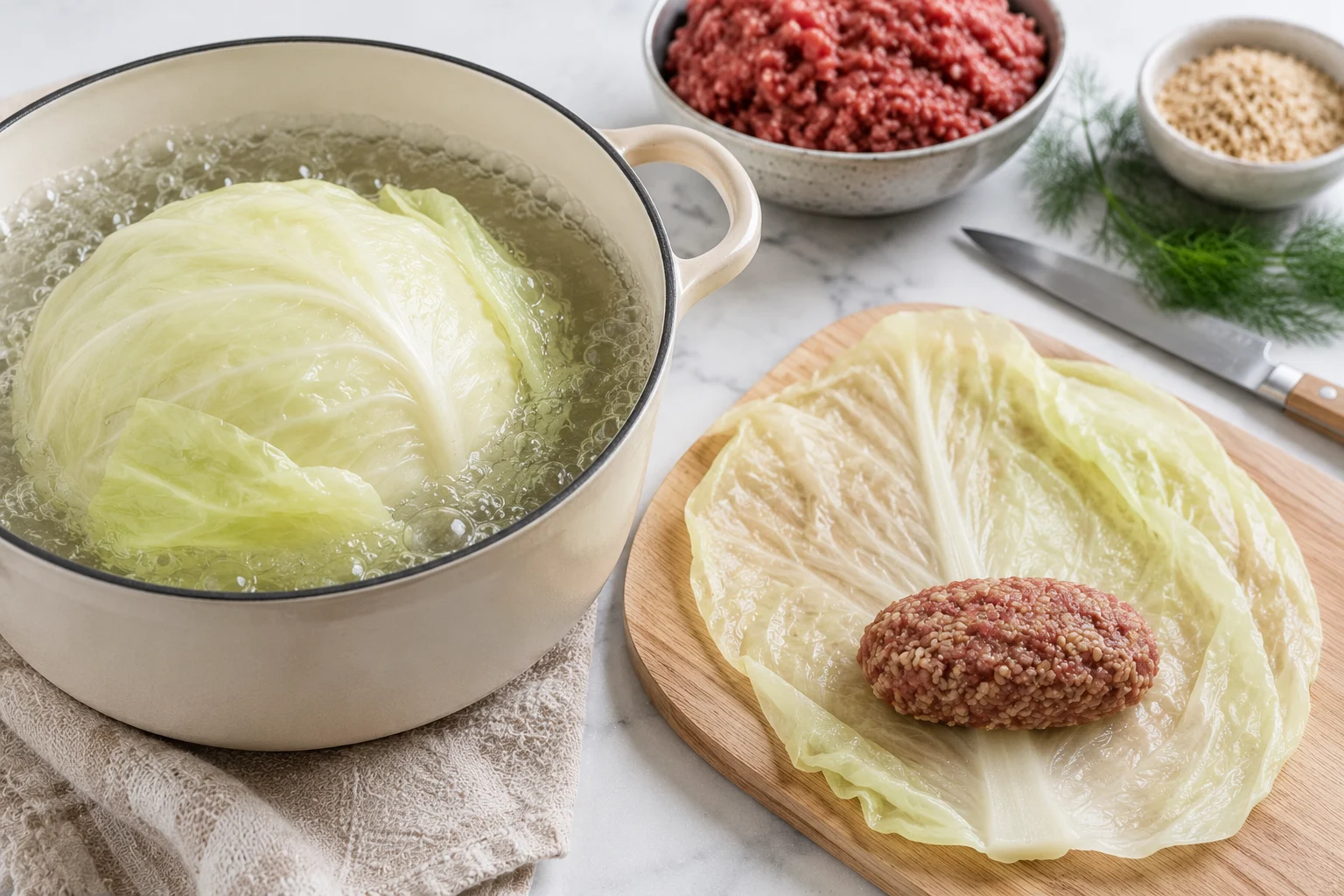
Step 1: Soften the cabbage
Prepare the cabbage exactly as in the traditional recipe: either core it and lower the whole head into boiling water, peeling off leaves as they soften, or freeze the head a day ahead and let it thaw fully before peeling. Trim the thick center rib from each leaf.
Step 2: Half-cook the brown rice
Rinse the brown rice, then boil in salted water for 15 minutes and drain. It should still have a firm bite in the center. Brown rice needs roughly twice the pre-cook time of white rice before it goes into the filling.
Step 3: Mix the filling
Combine the ground beef, drained rice, grated onion, egg, salt, and pepper in a bowl and mix by hand until evenly distributed. Fry a small spoonful to check the seasoning before rolling.
Step 4: Roll the cabbage
Lay a leaf flat, stem end toward you, and spoon about 2–3 tablespoons of filling onto the lower third. Fold in the sides, then roll from the stem end up into a snug parcel. Patch any tears with a scrap of spare leaf.
Step 5: Layer and cook
Line the bottom of a heavy pot with sliced onion and any torn or leftover cabbage leaves. Arrange the rolls seam side down in tight layers. Whisk together the crushed tomatoes, water, brown sugar, lemon juice, raisins if using, and salt, then pour over the rolls along with the bay leaf. They should be just covered.
For the stovetop: bring to a gentle boil, then reduce to a low simmer, cover, and cook for 2 to 2.5 hours. For the oven: cover tightly and bake at 160°C / 325°F for 2.5 to 3 hours. Because this filling has less fat protecting it, check the liquid level around the halfway point and top up with hot water if the rolls are no longer fully covered.
Step 6: Rest and taste the sauce
Remove from heat and rest, covered, for 15 minutes. Taste the sauce and adjust with more lemon juice or a little more brown sugar if needed. With less of both in the base recipe, small adjustments matter more than they do in the traditional version.
Nutritional Comparison
| Version | Calories | Protein | Fat | Sodium | Carbs | Fiber |
|---|---|---|---|---|---|---|
| Traditional (80/20 beef, white rice, full sugar) | ~410–500 kcal | ~20–24g | ~19–23g | ~760–930mg | ~38–47g | ~3–4g |
| Healthy (93% lean beef, brown rice, less sugar and salt) | ~290–354 kcal | ~23–28g | ~8–9g | ~460–560mg | ~31–38g | ~3–4g |
Figures are per serving of 2–3 rolls with sauce (approximately 350g), estimated from standard ingredient databases and divided across 6–8 servings. They will vary depending on the exact fat content of the beef, the brand of canned tomatoes, and how much sugar or lemon juice is added to taste.
Storage and Reheating
This version keeps in the refrigerator for 4–5 days in a sealed container with the sauce. Reheat gently in a covered pot on the stove or in the oven at 160°C, covered, for 20–25 minutes.
It freezes well both raw and cooked, for up to 3 months. Freeze raw rolls in a single layer until solid before transferring to a container, and cook from frozen with an extra 20–30 minutes added to the cooking time. The leaner filling is somewhat more prone to drying out on reheating than the traditional version, so add a splash of water to the sauce if it has thickened in storage.
Healthy Jewish Stuffed Cabbage (Holishkes)

Ingredients
The filling
- 700g (1.5 lb) 93% lean ground beef
- 150g (¾ cup) brown rice, half-cooked (see method)
- 1 large onion, grated or finely diced (about 150g)
- 1 large egg
- ¾ teaspoon salt
- ½ teaspoon black pepper
The sauce
- 800g (28 oz) no-salt-added canned crushed tomatoes
- 400ml (1⅔ cups) water
- 1 medium onion, sliced (about 150g)
- 25g (2 tablespoons) brown sugar, or more to taste
- 75ml (⅓ cup) fresh lemon juice, or more to taste
- 25g (3 tablespoons) raisins (optional)
- ½ teaspoon salt
- 1 bay leaf
Instructions
- The cabbage preparation is identical to the traditional version: boil or freeze-and-thaw, then peel and trim the ribs
- Replace regular ground beef with 93% lean ground beef; replace white rice with brown rice, half-cooked the same way but for longer
- The sauce changes the most: half the brown sugar, no-salt-added tomatoes, less added salt, and slightly more lemon juice to keep the sweet-sour balance sharp
- Raisins become optional and reduced, for those who want the sweetness
- Cooking method and time are unchanged: 2 to 3 hours, stovetop or oven
Frequently Asked Questions
Will 93% lean beef make the filling dry?
It can, if the sauce runs low during the long simmer. Regular ground beef has enough fat to self-baste; lean beef does not. Keep the rolls fully covered in sauce throughout cooking and check around the halfway mark, topping up with hot water if needed. Done this way, the filling stays moist without the extra fat.
Can I use ground turkey instead of lean beef?
Yes. 93% lean ground turkey has a similar fat profile to 93% lean ground beef and works as a direct substitute. It is slightly more prone to drying out during a long braise than lean beef, so keep an especially close eye on the sauce level.
Does brown rice really finish cooking properly inside the roll?
Yes, as long as it is half-cooked first. Fifteen minutes of boiling before rolling is enough for it to finish through the remaining braise without turning mushy or staying hard. Under-cooking it slightly at this stage is safer than over-cooking it — it has two more hours to go.
How much does cutting the sugar actually change the taste?
The sauce is noticeably less sweet than the traditional version, closer to a bright, tangy tomato sauce with a mild sweet edge rather than a fully sweet-and-sour one. The lemon juice becomes more prominent as a result. Anyone who prefers the fuller sweetness of the traditional version can add the brown sugar back in stages, tasting as they go.
Is no-salt-added canned tomatoes actually necessary, or is regular canned fine?
Regular canned crushed tomatoes work in this recipe, but they add sodium that is harder to control than salt added by hand at the stove. No-salt-added tomatoes put that control back with the cook, which matters more here because the recipe is already leaning on a reduced amount of added salt elsewhere.
Can the raisins be left out entirely rather than just reduced?
Yes, without any adjustment needed elsewhere in the recipe. Removing them further reduces the added sugar and gives a cleaner, more purely savory-tart sauce. The 25 grams called for here is already a reduced, optional amount — leaving it out is a small additional step in the same direction.
Which swap accounts for most of the calorie reduction?
The beef does the heaviest lifting. Dropping from 80/20 to 93/7 removes roughly 13 grams of fat per 100 grams of meat, which is the largest single change in the recipe by a wide margin. The reduced sugar and the switch to brown rice each contribute smaller reductions in carbohydrates on top of that, but the fat cut from the meat is where most of the calorie difference in the comparison table comes from.
The Traditional Version
The full recipe, along with the etymology of holishkes and prakas, the sweet-and-sour sauce’s connection to Sukkot, and the Yiddish pun behind the Hoshana Rabbah custom, is covered in our Traditional Jewish Stuffed Cabbage article.
Further Reading & Sources
The following sources were consulted for the nutritional claims and cooking guidance in this article. Heritage Healthy Kitchen’s recipe was developed independently; these links are provided for readers who want to explore further.
- “Heart-healthy diet: 8 steps to prevent heart disease.” Mayo Clinic. mayoclinic.org — American Heart Association guidance on choosing lean meats under 10% fat, and AHA sodium limits of 2,300mg (ideally 1,500mg) per day.
- “5 High-Cholesterol Foods to Avoid – and Which Ones You Should Eat.” Cleveland Clinic Health Essentials, Julia Zumpano, RD, LD. health.clevelandclinic.org — recommendation to choose 90% lean ground beef over standard ground beef, and the link between saturated fat and heart disease risk.
- “Brown rice versus white rice: A head-to-head comparison.” Harvard Health Publishing. health.harvard.edu — glycemic index data (68 vs. 73), fiber and micronutrient comparison, and near-identical calorie content between brown and white rice.
- “Added Sugar.” The Nutrition Source, Harvard T.H. Chan School of Public Health. nutritionsource.hsph.harvard.edu — Dietary Guidelines and American Heart Association added-sugar limits, and guidance on reducing sugar in a recipe by a fraction rather than eliminating it.
- “Take Action: How to Reduce Your Sodium Intake.” The Nutrition Source, Harvard T.H. Chan School of Public Health. nutritionsource.hsph.harvard.edu — citrus and sodium activating similar taste receptors, and moderate salt reductions being difficult for most people to detect.
Disclaimer
The information in this article is provided for educational and informational purposes only. Heritage Healthy Kitchen makes no representations or warranties regarding the accuracy or completeness of any content on this site. Nutritional values are estimates only and will vary depending on the specific ingredients, brands, and measurements used. This content is not intended as dietary, medical, or professional nutritional advice. Always consult a qualified healthcare provider regarding any dietary needs or health conditions. Heritage Healthy Kitchen is not responsible for any outcomes resulting from the use of recipes or information published on this site.
You Might Also Like
More heritage recipes from our kitchen

Leave a Reply