

Active time: ~30 minutes | Total time: ~12–18 hours (mostly unattended) | Serves: 6 | Difficulty: Easy
Quick Overview
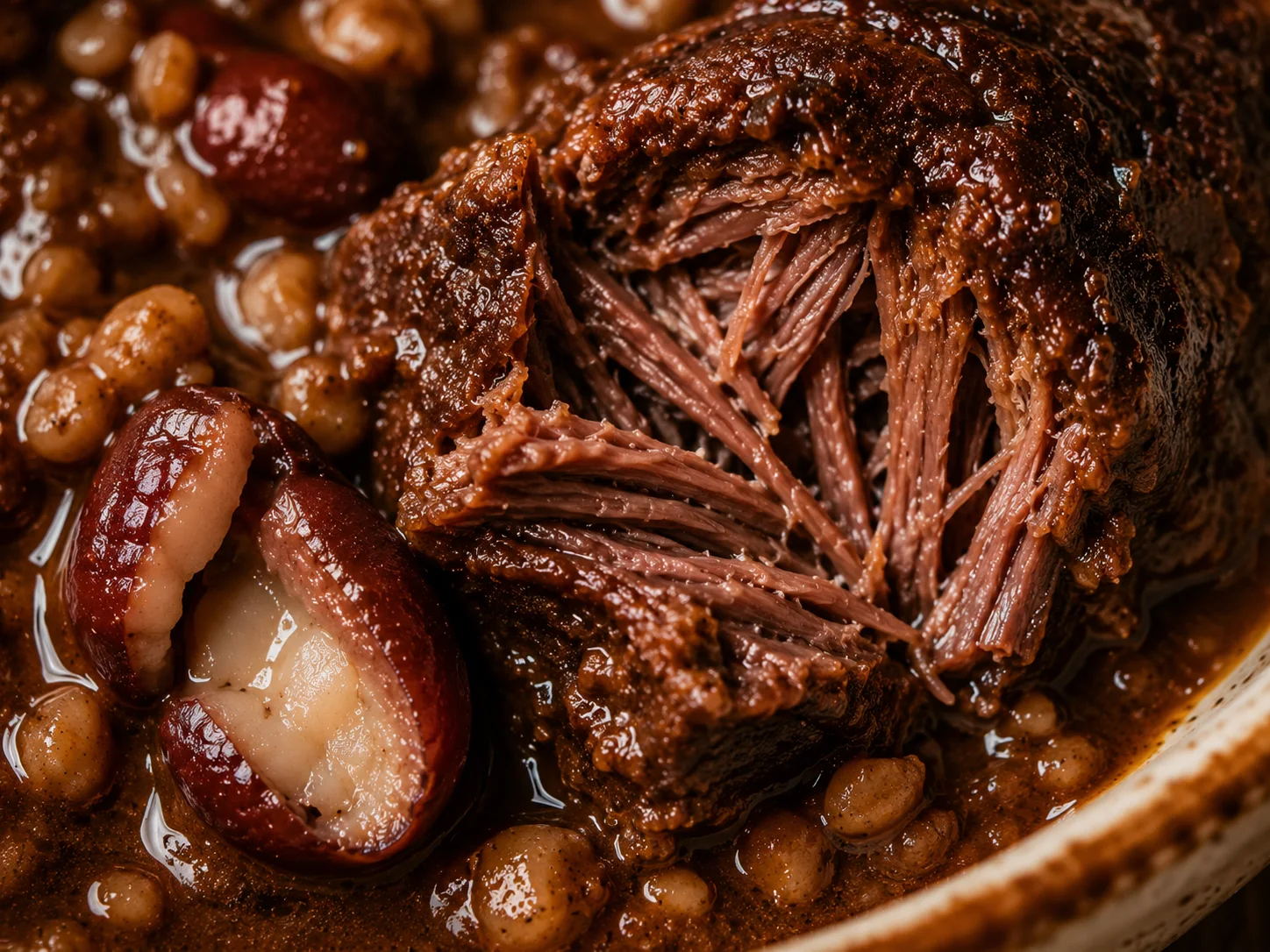
- Soak the dried beans overnight, then give them a hard boil in fresh water before they go into the pot
- Brown the beef and onions, then layer the potatoes, meat, beans, and barley into one heavy pot
- Season with paprika, pepper, and salt, and cover everything generously with broth or water
- Bring the whole pot to a full boil on the stovetop before sundown
- Transfer it to a low oven or a slow cooker and let it cook undisturbed for 12 hours or more
- Serve hot the next day, straight from the pot that never really stopped cooking
What Cholent Is
Cholent, also called schalet or chulent, and known as hamin in its Sephardic form, is a slow-cooked stew of meat, beans, barley, and potatoes that Ashkenazi Jewish families assemble on Friday and leave cooking overnight for the Saturday midday Sabbath meal.1,2 It exists because Jewish law forbids lighting a fire or actively cooking during Shabbat, so the entire pot goes in before sundown on Friday and comes out fully cooked, and still hot, on Saturday.1,4
The method has barely changed in centuries: everything goes into one heavy pot, the pot is brought to a full boil, and then it settles into a bare simmer that carries it through the night and into the next day.1 Ashkenazi households traditionally built theirs around beef, beans, barley, and potatoes,1,2 seasoned simply with salt and pepper.3
Cooked by a Law, Not a Recipe
The stew’s roots reach back to the Middle East, where the practice of long, slow overnight cooking spread to North Africa and, by the ninth century, to Spain.4 From there, culinary historians trace its path through Provence into France, where a version of the Sephardic dish known as hamin took on a new life among Ashkenazi Jewish communities before spreading into Germany.1 Cholent was first mentioned by name in 1180 CE, in the writings of Rabbi Yitzhak ben Moshe of Vienna, who described pots buried and warmed near a fire so they would be hot in time for the Sabbath meal.1
Nobody agrees on exactly where the word “cholent” comes from. One theory traces it to the Old French chaud (hot) and lent (slow); a more academic line, from the linguist Max Weinreich, connects it to the Latin calentem, “that which is hot,” by way of Old French.1 A third, folk theory derives it from the Yiddish shul ende, or “end of synagogue,” since the Sabbath meal was eaten right after Saturday services, though food historian Gil Marks has argued this can’t be right, since the word cholent was already in use in France before Yiddish existed as a language.3
From Shtetl Ovens to the Crock-Pot
Before home ovens and electricity, Ashkenazi families across Central and Eastern Europe sealed their pots with a flour-and-water paste and carried them to the local baker before sundown on Friday. The baker kept his oven fired all night, and families collected their pots on their way home from synagogue Saturday morning.1,2 The dish varied by region: mid-19th-century Polish cholent leaned heavily on potato and was seasoned with little more than onion and garlic, Hungarian versions skipped the potato in favor of paprika, and Lithuanian cholent tended toward a plainer, more peppery stew.1,4 Barley became the grain of choice across Eastern Europe, while German versions typically used spelt instead, following the wheat varieties each region’s agriculture favored.1 Many families also added kishke, a sausage-like casing stuffed with a seasoned flour mixture, to cook alongside the stew.2,3
Inventor Irving Naxon grew up hearing his mother describe walking her pot of cholent to the village bakery back in Lithuania, and the memory stayed with him. He wondered whether that same slow, steady heat could be built into an electric appliance, and the device he patented, first sold as the Naxon Beanery, became known to the world as the Crock-Pot.4 The dish has also long carried real emotional weight in Ashkenazi households: the food writer Claudia Roden has described the smell of cholent lifting the lid as the scent that once filled entire shtetl houses, and cited the 19th-century German poet Heinrich Heine’s fondness for writing about it as evidence of just how deep that attachment runs.2
Traditional Cholent Recipe
Recipe developed independently by Heritage Healthy Kitchen, drawing on traditional Ashkenazi cooking methods. Sources for further reading are listed at the end of this article.
Ingredients (serves 6)
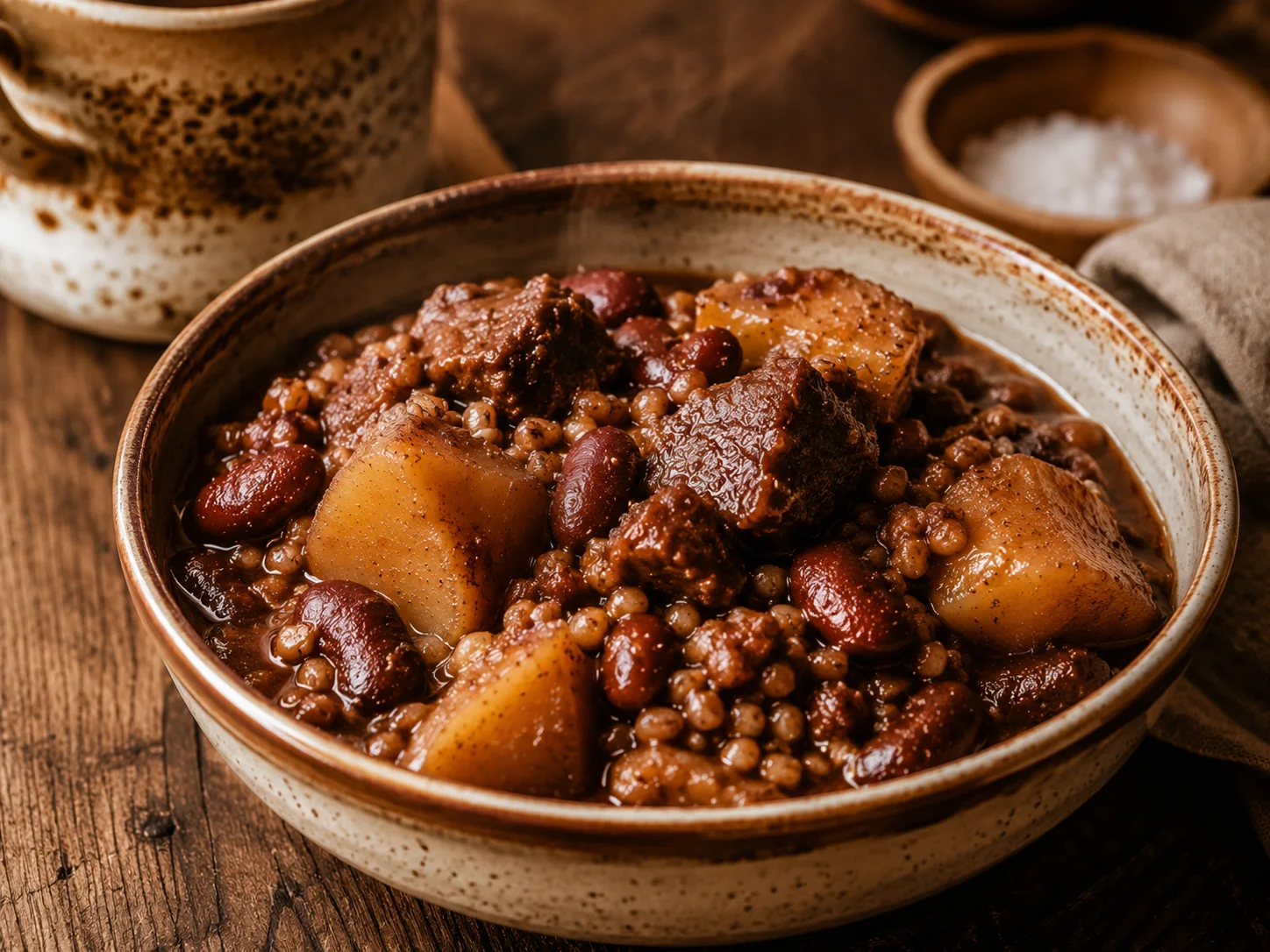
- 2 lbs (900g) beef chuck, cut into 2-inch chunks
- 1 cup (200g) dried kidney beans, or a mix of kidney and pinto beans
- ½ cup (100g) pearl barley
- 4 medium potatoes (about 700g), peeled and quartered
- 2 large onions (about 300g), sliced
- 4 cloves garlic, left whole
- 2 tablespoons (30ml) neutral vegetable oil
- 1½ tablespoons (about 11g) sweet paprika
- 1 teaspoon (about 2g) black pepper
- 1½ teaspoons (about 9g) fine salt, plus more to taste
- 4 cups (1 liter) low-sodium beef broth or water, plus more as needed

Instructions
- Soak and boil the beans: Rinse the dried beans and soak in plenty of water for at least 5 hours or overnight. Drain, cover with fresh water, and boil briskly for 30 minutes, then drain again. This step is not optional: raw or under-boiled kidney beans contain a natural toxin that low, slow heat does not reliably destroy, so a proper stovetop boil is essential before the beans go anywhere near a slow cooker or a low oven.6
- Brown the meat and onions: Heat the oil in a large, heavy pot or Dutch oven. Brown the beef chunks on all sides, then add the onions and cook until softened, about 8 minutes.
- Layer the pot: Spread the potatoes over the bottom of the pot, then add the browned beef and onions, followed by the boiled beans, barley, and whole garlic cloves.
- Season and add liquid: Sprinkle with the paprika, pepper, and salt, then pour in enough broth or water to cover everything by about an inch.
- Bring to a full boil: Set the pot over high heat and bring it to a rolling boil, uncovered, for a few minutes, the way this dish has been started for centuries before it settles into its long, slow cook.1
- Transfer to low heat: Cover tightly and move the pot to a 200°F (95°C) oven, or transfer everything to a slow cooker set to low.
- Cook low and slow: Let the cholent cook undisturbed for 12 to 18 hours. Check only if needed, adding a splash of hot water if it looks dry.
- Serve: Uncover carefully, since the pot will be very hot, and serve directly from it.
Kitchen Tips
Choose a well-marbled cut like chuck or brisket. Cholent is built for hours of slow cooking, and a lean cut of beef will turn dry and stringy long before the beans are ready; a fattier cut gets more tender the longer it goes.
Don’t skip browning the meat and onions before they go into the pot. That step builds a base flavor that a full day of gentle simmering can develop further but can’t create from nothing on its own.
Keep the lid on once the pot goes into the oven or slow cooker. Every time it’s lifted, heat escapes that the pot needs a long time to recover, especially in an oven that isn’t actively firing.
Nutritional Information
Per serving (1 of 6)
- Calories: approximately 630–780 kcal
- Protein: ~37–46g
- Total fat: ~30–37g
- Carbohydrates: ~54–66g
- Fiber: ~14–17g
- Sodium: ~715–875mg
Values are estimates, calculated ingredient-by-ingredient using standard reference data, and will vary with the exact cut of meat, the beans used, and how much salt is added. The beans and barley account for most of the fiber here, and beans in particular are a strong source of protein and folate as well: diets that include legumes regularly have been associated with lower cholesterol and reduced cardiovascular risk.5
Storage and Reheating
Refrigerate leftover cholent in an airtight container for up to 4 days. It reheats well on the stovetop over low heat or in the microwave, with a splash of water or broth stirred in if it has thickened too much.
For longer storage, freeze in individual portions for up to 3 months. Thaw overnight in the refrigerator before reheating gently, since the beans and potatoes can turn grainy if reheated too quickly from frozen.
Traditional Cholent

Ingredients
Ingredients (serves 6)
- 2 lbs (900g) beef chuck, cut into 2-inch chunks
- 1 cup (200g) dried kidney beans, or a mix of kidney and pinto beans
- ½ cup (100g) pearl barley
- 4 medium potatoes (about 700g), peeled and quartered
- 2 large onions (about 300g), sliced
- 4 cloves garlic, left whole
- 2 tablespoons (30ml) neutral vegetable oil
- 1½ tablespoons (about 11g) sweet paprika
- 1 teaspoon (about 2g) black pepper
- 1½ teaspoons (about 9g) fine salt, plus more to taste
- 4 cups (1 liter) low-sodium beef broth or water, plus more as needed
Instructions
- Soak and boil the beans: Rinse the dried beans and soak in plenty of water for at least 5 hours or overnight. Drain, cover with fresh water, and boil briskly for 30 minutes, then drain again. This step is not optional: raw or under-boiled kidney beans contain a natural toxin that low, slow heat does not reliably destroy, so a proper stovetop boil is essential before the beans go anywhere near a slow cooker or a low oven.6
- Brown the meat and onions: Heat the oil in a large, heavy pot or Dutch oven. Brown the beef chunks on all sides, then add the onions and cook until softened, about 8 minutes.
- Layer the pot: Spread the potatoes over the bottom of the pot, then add the browned beef and onions, followed by the boiled beans, barley, and whole garlic cloves.
- Season and add liquid: Sprinkle with the paprika, pepper, and salt, then pour in enough broth or water to cover everything by about an inch.
- Bring to a full boil: Set the pot over high heat and bring it to a rolling boil, uncovered, for a few minutes, the way this dish has been started for centuries before it settles into its long, slow cook.1
- Transfer to low heat: Cover tightly and move the pot to a 200°F (95°C) oven, or transfer everything to a slow cooker set to low.
- Cook low and slow: Let the cholent cook undisturbed for 12 to 18 hours. Check only if needed, adding a splash of hot water if it looks dry.
- Serve: Uncover carefully, since the pot will be very hot, and serve directly from it.
Frequently Asked Questions
Why is cholent cooked for so many hours?
Jewish law prohibits lighting a fire or cooking during Shabbat, so the pot is fully cooked and brought to a boil before sundown Friday, then left on low, steady heat until it’s served at Saturday’s midday meal.1,4
What’s the difference between cholent and hamin?
Both are overnight Sabbath stews built on the same principle, but cholent is the Ashkenazi version, typically built on beef, beans, barley, and potatoes, while hamin is the Sephardic version, popular throughout Israel and often made with chicken instead of beef and spiced more elaborately.3
Can cholent be made without meat?
Yes. Historically, families who couldn’t afford meat made cholent from beans and grain alone, and a vegetarian version made the same way today is a long-standing part of the dish’s own history, not a modern invention.2
Is it actually safe to leave a pot of food cooking overnight?
Yes, as long as it starts at a full boil and then holds a steady, gentle heat the entire time, which is exactly how a low oven or a slow cooker on low is designed to work. The one real safety step is boiling the beans properly beforehand, since a slow cooker’s low heat alone isn’t hot enough to neutralize the natural toxin in raw kidney beans.6
Why do some cholent recipes include kishke?
Kishke, a casing stuffed with a seasoned flour mixture, is a traditional Ashkenazi accompaniment that cooks directly in the pot alongside the stew, absorbing its flavor over the long hours of cooking.2,3
Did cholent really inspire the Crock-Pot?
According to his family, yes. Inventor Irving Naxon based his design on childhood stories of his mother carrying her pot of cholent to a Lithuanian bakery to cook overnight, and he patented the device first sold as the Naxon Beanery, later known worldwide as the Crock-Pot.4
How different are Polish, Hungarian, and Lithuanian cholent?
More than a shared name would suggest. Polish versions traditionally lean on potato with onion and garlic, Hungarian cholent skips the potato and adds paprika, and Lithuanian versions tend to be plainer and more peppery.1,4
Looking for a Lighter Version?
Traditional cholent is a rich, meat-and-bean stew built to sustain a full day of rest, and there’s real room to lighten it without losing what makes it cholent: more beans and root vegetables, a leaner cut of meat or none at all, and a lower-sodium broth. A separate Healthy Cholent article on this site walks through those adjustments in detail.
Further Reading & Sources
The following sources were consulted in researching the history and background of traditional cholent. Heritage Healthy Kitchen’s recipe was developed independently; these links are provided for readers who want to explore further.
- “Cholent.” Wikipedia. en.wikipedia.org/wiki/Cholent — origins in France and Germany, the 1180 CE first mention by Rabbi Yitzhak ben Moshe of Vienna, etymology theories, the Sabbath cooking prohibition, and regional Polish, Hungarian, and Lithuanian variations.
- Roden, Claudia. “Cholent: The Sabbath Stew.” My Jewish Learning. myjewishlearning.com/article/cholent-the-sabbath-stew — the baker’s oven tradition, the basic Ashkenazi ingredient list, kishke and dumpling accompaniments, and the dish’s emotional and cultural resonance.
- Avey, Tori. “Cholent.” Tori Avey. toriavey.com/cholent — the schalet and hamin naming variations, Gil Marks’ critique of the shul ende etymology theory, and the kishke tradition.
- Prichep, Deena. “Cholent: The Original Slow-Cooked Dish.” NPR, The Salt. npr.org — Cholent: The Original Slow-Cooked Dish — the Middle East-to-Spain historical path, Hungarian, Lithuanian, and Polish regional seasoning differences, and the Irving Naxon/Crock-Pot origin story.
- Harvard T.H. Chan School of Public Health. “Legumes and Pulses.” The Nutrition Source. nutritionsource.hsph.harvard.edu/legumes-pulses — the fiber, protein, and cardiovascular health profile of beans, a core ingredient in the stew.
- Peterson, Lisa. “Kidney Beans and Slow Cookers.” University of Illinois Extension. extension.illinois.edu — Kidney Beans and Slow Cookers — the safety reasoning behind soaking and hard-boiling dried kidney beans before slow cooking.
Disclaimer
The information in this article is provided for educational and informational purposes only. Heritage Healthy Kitchen makes no representations or warranties regarding the accuracy or completeness of any content on this site. Nutritional values are estimates only and will vary depending on the specific ingredients, brands, and measurements used. This content is not intended as dietary, medical, or professional nutritional advice. Always consult a qualified healthcare provider regarding any dietary needs or health conditions. Heritage Healthy Kitchen is not responsible for any outcomes resulting from the use of recipes or information published on this site.
Cook by Occasion
This recipe is part of our Shabbat table.
You Might Also Like
More heritage recipes from our kitchen



Leave a Reply