

Serves: 8 | Two versions: Chicken Cholent and Vegetarian Cholent | Difficulty: Easy
Quick Overview

- Soak pinto and white beans, and chickpeas for the vegetarian pot, overnight
- Brown skinless chicken thighs and drumsticks, or mushrooms
- Layer potatoes, carrots, onions, beans, barley and the chicken or mushrooms in one pot
- Season low-sodium broth with paprika and pepper, pour it over and bring to a boil before Shabbat
- Cook overnight in a low oven or slow cooker and serve at the Saturday midday meal
What This Version Changes — and What It Keeps
Both versions keep what makes cholent cholent: one pot of potatoes, beans and barley seasoned with paprika, brought to a boil before the Sabbath and left to cook overnight for the Saturday midday meal. The beans are the same pinto and white beans as in our traditional beef cholent, and so are the method and the timing.
What changes is the protein and the salt. The first version uses skinless chicken thighs and drumsticks in place of beef; the second leaves meat out and builds the stew on chickpeas, mushrooms and tomatoes. Neither is a modern invention. Chicken cholent left on low until the next day appears in published recipes, and families who could not afford meat made cholent from beans and grain alone; today vegetarians make meatless cholent.3,4 Both versions use less salt than the traditional recipe and rely on low-sodium broth.
Why These Swaps Work
Chicken and turkey have relatively low levels of saturated fat compared with red meat, notes Harvard Health Publishing.6 In this recipe that is where most of the difference comes from: about 1–2g of saturated fat per serving in the chicken version against 8–9g in the beef one, by our estimate.
The cut matters as much as the swap. Breast meat has very little collagen and turns dry and tough when it is heated much above 68°C (155°F), while thigh meat, which carries more collagen, is at its best at 77°C (170°F) and above.7 That is why this recipe uses thighs and drumsticks, which hold up to a night in the pot. Taking the skin off before cooking matters too: raw thigh meat has about 4g of fat per 100g, and thigh with its skin about 17g.8
In the vegetarian version, mushrooms take the place of the meat. They bring umami, a savory depth, and they are naturally low in sodium and fat; Mayo Clinic Health System suggests replacing a quarter to a half of the meat in a recipe with chopped mushrooms.9 Here they replace all of it, alongside the extra legumes.
The chickpeas supply protein and fiber that a stew of mushrooms and barley would lack. Legumes are an inexpensive source of protein, complex carbohydrates and fiber, and the fibers in them may help to lower blood cholesterol.10
Less salt and low-sodium broth deal with sodium directly. The American Heart Association sets 2,300mg a day as the upper limit for most adults, with an optimal goal of no more than 1,500mg, and notes that cutting back by 1,000mg a day can improve blood pressure.11 Both versions here use 1 teaspoon of salt instead of 1½.
Healthy Cholent Recipes
This recipe was compiled by Heritage Healthy Kitchen from published recipes and the sources for the swaps, all listed at the end of this article. Figures that are Heritage Healthy Kitchen’s own estimates rather than taken from a published source are marked as such.
The base, with its beans, barley, potatoes, onions and paprika and the overnight method, follows our traditional recipe, compiled from published ones.1,2 The chicken version follows a published recipe that sets chicken pieces cooking with pinto beans, barley, onions and potatoes and leaves the pot on low until the next day.3 The vegetarian version draws on published meatless recipes with tomatoes and a mix of beans and chickpeas.2,5 The weights of the vegetables and mushrooms and the number of servings are Heritage Healthy Kitchen’s estimates.
Version One: Chicken Cholent
Active time: ~35 minutes | Total time: ~13–17 hours, plus soaking the beans | Serves: 8
Ingredients
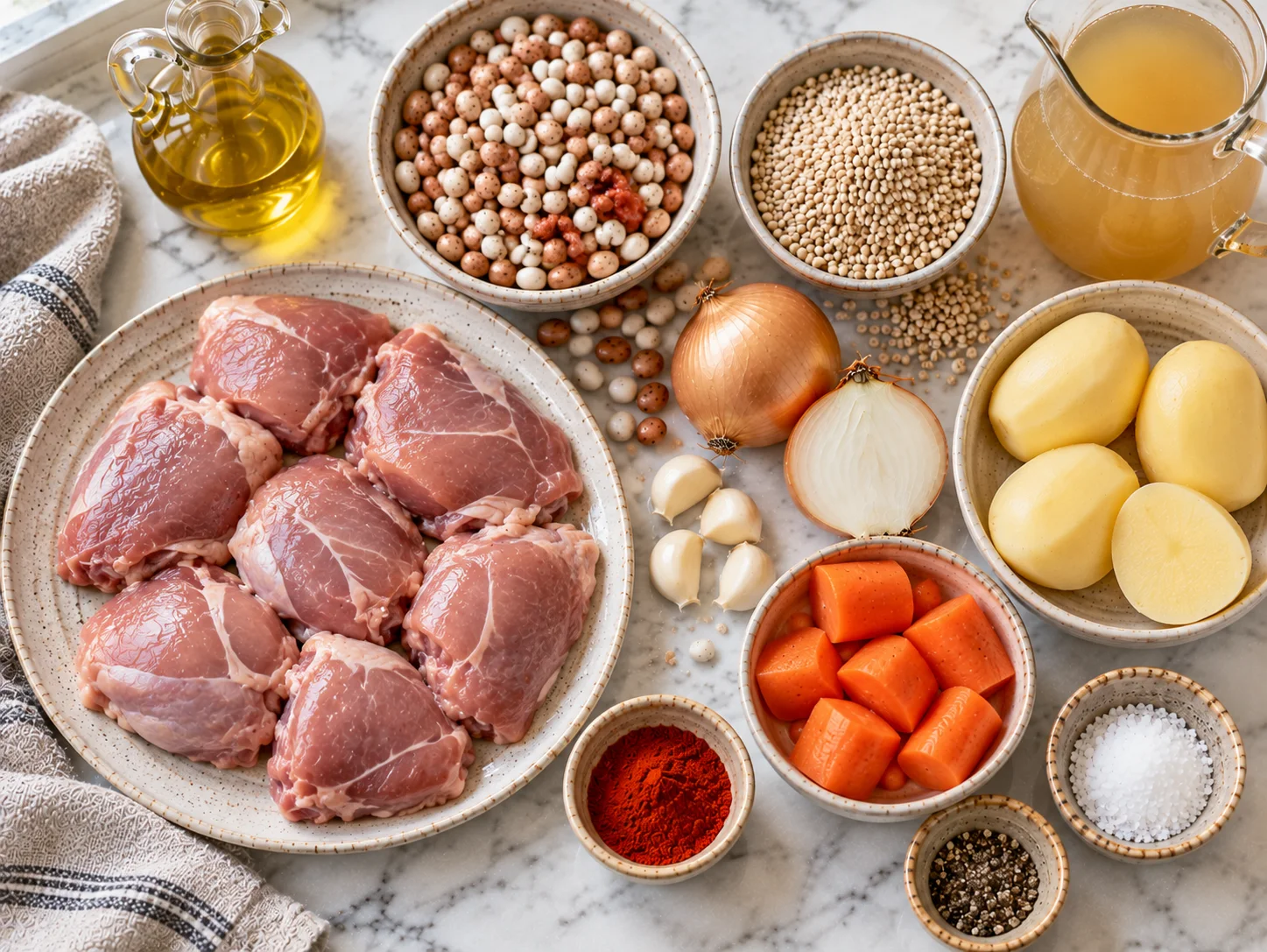
- 1.2kg (about 2½ lb) bone-in chicken thighs and drumsticks, skin removed
- 200g (1 cup) dried beans, half pinto and half white beans
- 100g (½ cup) pearl barley
- 500g (about 3 medium) potatoes, peeled and halved
- 2 medium carrots (about 150g), cut into chunks
- 2 large onions (about 300g), chopped
- 4 cloves garlic, peeled and left whole
- 1 tablespoon (15ml) olive oil
- 1 tablespoon (about 7g) sweet paprika
- ½ teaspoon black pepper
- 1 teaspoon (about 6g) fine salt
- About 1 liter (4 cups) low-sodium chicken broth or water, plus more as needed
Instructions
- Soak the beans. The day before, rinse the beans, pick out any stones and soak them in plenty of cold water for at least 6 hours or overnight. Drain and rinse.2
- Brown the chicken. Pat the chicken dry and season it with a little of the pepper. Heat the oil in a large, heavy ovenproof pot and brown the pieces on both sides, then lift them out.
- Soften the onions. Cook the onions in the same pot until soft and translucent, then lift them out.3
- Layer the pot. Lay the potatoes and carrots over the bottom of the pot, spread the onions over them and add the beans and barley. Put the chicken on top and tuck in the garlic.1,12
- Season and add the liquid. Stir the paprika, the rest of the pepper and the salt into the broth and pour it over. Add water until everything is covered.1,2
- Bring to a boil. Before Shabbat begins, set the pot over high heat and bring it to a boil.2
- Cook overnight. Cover tightly and move the pot to an oven heated to 95–100°C (200–212°F), or transfer everything to a slow cooker set to low, and leave it until the next day’s midday meal, 12–16 hours. If it looks dry, add a little water.1,2,3
- Serve. Take the lid off carefully and serve from the pot, lifting out the bones as you go.
Version Two: Vegetarian Cholent

Active time: ~35 minutes | Total time: ~13–17 hours, plus soaking the beans | Serves: 8
Ingredients
- 200g (1 cup) dried beans, half pinto and half white beans
- 185g (1 cup) dried chickpeas
- 100g (½ cup) pearl barley
- 400g (about 14 oz) cremini or white mushrooms, quartered
- 700g (about 4 medium) potatoes, peeled and halved
- 2 medium carrots (about 150g), cut into chunks
- 2 large onions (about 300g), chopped
- 4 cloves garlic, peeled and left whole
- 2 tablespoons (30ml) olive oil
- 1 tablespoon (about 7g) sweet paprika
- ½ teaspoon black pepper
- 1 teaspoon (about 6g) fine salt
- 1 can (400g / 14 oz) diced tomatoes
- About 1 liter (4 cups) low-sodium vegetable broth or water, plus more as needed
Instructions
- Soak the beans and chickpeas. The day before, rinse the beans and chickpeas, pick out any stones and soak them together in plenty of cold water for at least 6 hours or overnight. Drain and rinse.2
- Brown the mushrooms. Heat the oil in a large, heavy ovenproof pot over medium-high heat. Cook the mushrooms, stirring now and then, until they release their liquid and it evaporates.
- Add the vegetables. Add the onions and carrots and cook for 6–8 minutes, until the onions start to soften. Stir in the paprika and cook for 2 minutes more.5
- Layer the pot. Lift out the vegetables. Lay the potatoes over the bottom of the pot, spread the mushroom mixture over them and add the beans, chickpeas, barley and garlic. Pour the tomatoes over the top.1,5
- Season and add the liquid. Stir the pepper and salt into the broth and pour it over. Add water until everything is covered.1
- Bring to a boil. Before Shabbat begins, set the pot over high heat and bring it to a boil.2
- Cook overnight. Cover tightly and move the pot to an oven heated to 95–100°C (200–212°F), or transfer everything to a slow cooker set to low, and leave it for 12–16 hours. If it looks dry, add a little water.1,2,5
- Serve. Take the lid off carefully and serve straight from the pot.
Kitchen Tips
Barley soaks up a lot of liquid. Check that everything is covered before the pot goes into the oven, and if you add more grain, add more water as well.1
Read the sodium figure on the broth carton rather than relying on the words “low sodium” alone: on US labels the term allows up to 140mg per serving, and serving sizes differ from brand to brand.11
Nutritional Comparison
Per serving (one-eighth of the pot), set against our traditional beef cholent:

| Nutrient | Traditional Cholent | Chicken Cholent | Vegetarian Cholent |
|---|---|---|---|
| Calories | 475–580 kcal | 320–390 kcal | 330–405 kcal |
| Protein | 28–35g | 27–33g | 15–18g |
| Total fat | 22–27g | 6–8g | 5–7g |
| Saturated fat | 8–9g | 1–2g | about 1g |
| Carbohydrates | 41–50g | 39–47g | 59–72g |
| Fiber | 8–9g | 8–9g | 12–15g |
| Cholesterol | 90–115mg | 90–110mg | 0mg |
| Sodium | 530–650mg | 440–535mg | 410–500mg |
Nutritional values are estimates based on standard ingredient databases (USDA FoodData Central). They vary with the size of the chicken pieces and with broth or water.
Storage and Reheating
Refrigerate leftovers within 2 hours of serving, in shallow covered containers. Both versions keep for 3 to 4 days in the refrigerator or 3 to 4 months in the freezer.13
Reheat on the stove or in the microwave until the stew reaches 74°C (165°F), with a splash of water if it has thickened.13 Don’t reheat leftovers in a slow cooker.12
Chicken Cholent

Ingredients
Ingredients
- 1.2kg (about 2½ lb) bone-in chicken thighs and drumsticks, skin removed
- 200g (1 cup) dried beans, half pinto and half white beans
- 100g (½ cup) pearl barley
- 500g (about 3 medium) potatoes, peeled and halved
- 2 medium carrots (about 150g), cut into chunks
- 2 large onions (about 300g), chopped
- 4 cloves garlic, peeled and left whole
- 1 tablespoon (15ml) olive oil
- 1 tablespoon (about 7g) sweet paprika
- ½ teaspoon black pepper
- 1 teaspoon (about 6g) fine salt
- About 1 liter (4 cups) low-sodium chicken broth or water, plus more as needed
Instructions
- Soak: Soak the beans at least 6 hours or overnight; drain.
- Brown: Brown the chicken in the oil in a heavy ovenproof pot; lift out.
- Onions: Soften the onions in the same pot; lift out.
- Layer: Potatoes and carrots, onions, beans and barley, chicken on top, garlic.
- Liquid: Paprika, pepper and salt stirred into the broth; water to cover.
- Boil: Bring to a boil before Shabbat begins.
- Cook: Covered, 95–100°C (200–212°F) oven or slow cooker on low until the next day’s lunch, 12–16 hours.
- Serve: Serve from the pot, lifting out the bones.
Vegetarian Cholent
Ingredients
Ingredients
- 200g (1 cup) dried beans, half pinto and half white beans
- 185g (1 cup) dried chickpeas
- 100g (½ cup) pearl barley
- 400g (about 14 oz) cremini or white mushrooms, quartered
- 700g (about 4 medium) potatoes, peeled and halved
- 2 medium carrots (about 150g), cut into chunks
- 2 large onions (about 300g), chopped
- 4 cloves garlic, peeled and left whole
- 2 tablespoons (30ml) olive oil
- 1 tablespoon (about 7g) sweet paprika
- ½ teaspoon black pepper
- 1 teaspoon (about 6g) fine salt
- 1 can (400g / 14 oz) diced tomatoes
- About 1 liter (4 cups) low-sodium vegetable broth or water, plus more as needed
Instructions
- Soak: Soak the beans and chickpeas at least 6 hours or overnight; drain.
- Mushrooms: Cook the mushrooms in the oil until their liquid evaporates.
- Vegetables: Add onions and carrots, 6–8 min; stir in the paprika, 2 min.
- Layer: Potatoes, mushroom mixture, beans, chickpeas, barley, garlic; tomatoes on top.
- Liquid: Pepper and salt stirred into the broth; water to cover.
- Boil: Bring to a boil before Shabbat begins.
- Cook: Covered, 95–100°C (200–212°F) oven or slow cooker on low, 12–16 hours.
- Serve: Serve hot from the pot.
Frequently Asked Questions
Can I use chicken breast instead of thighs and drumsticks?
It isn’t a good idea. Breast meat has very little collagen and gets dry and tough when it is heated much above 68°C (155°F); thigh meat is at its best at 77°C (170°F) and above. ThermoWorks’ culinary editor goes as far as asking cooks not to use breast meat in slow cooker recipes at all.7
Is it safe to cook chicken overnight in a slow cooker?
Yes, if the chicken is fully thawed before it goes in and the lid stays on. The direct heat, the long cooking and the steam in the covered pot together destroy bacteria, and the food stays safe for as long as the cooker is running.12
Can I use canned beans and chickpeas?
Yes; one published vegan cholent uses canned red beans, white beans and chickpeas.5 Drain and rinse them, skip the soaking, and look for no-salt-added cans: canned white beans carry about 340mg of sodium per 100g, against 16mg for dried.8
Why are there no red kidney beans in this recipe?
Published cholent recipes use pinto, white or red beans and chickpeas, and at least one notes that slow-cooking kidney beans is not recommended.1 Pinto and white beans avoid the question altogether.
Looking for the Full Story?
This article is about the swaps. The history of cholent, its place on the Shabbat table and the beef recipe these versions start from are in our Traditional Cholent recipe.
Further Reading & Sources
The recipe is a compilation based on the published recipes listed here; these links are provided for readers who want to explore further.
The base recipes
- Tori Avey. (8 April 2016, updated 8 May 2023). Cholent. toriavey.com. Published recipe: beef, 1 cup dried beans (with the note that slow-cooking kidney beans is not recommended), ½ cup pearl barley, potatoes on the bottom of the pot, broth and water to cover, more liquid with more grain; 12–16 hours at 200°F or on low in a slow cooker.
- Jewish Museum Berlin. Tscholent, recipe sheet from the exhibition Kosher & Co (no author printed). Published recipe: beans soaked 6 hours, barley, potatoes, paprika; brought to a boil before Shabbat and left overnight at 210°F (100°C). Notes: poultry can replace the beef; for a vegetarian version, replace the meat with a large can of tomatoes.
- Deena Prichep. (22 February 2014). Cholent: The Original Slow-Cooked Dish. The Salt, NPR. Published recipe from Devora Wilhelm: chicken pieces with pinto beans, barley, potatoes and onions softened in oil, on high for 3–5 hours, then on low until the next day.
- Claudia Roden. Cholent: The Sabbath Stew. My Jewish Learning (no date printed on the page). Families who could not afford meat made cholent with beans and grain only; versions with chicken; vegetarians who make meatless cholent.
- Micah Siva. (2 November 2022). How to Make Vegan Cholent. The Nosher, My Jewish Learning. Published vegan recipe: onion, carrots and potato softened 6–8 minutes, sweet paprika cooked 2 minutes, barley, a can of diced tomatoes, broth, canned red beans, white beans and chickpeas; on the stove, or in a slow cooker on low overnight.
The swaps and food safety
- Howard E. LeWine, MD. Is poultry a good source of protein? Harvard Health Publishing (updated 9 March 2026). Chicken and turkey have relatively low levels of saturated fat compared with red meat, and a bit more unsaturated fat.
- Martin Earl. (21 May 2025). Chicken Breasts vs Chicken Thighs: A Thermal Explanation. ThermoWorks. Thigh meat contains more collagen than breast meat, which has very little; after Harold McGee, breast meat gets dry and tough much above 155°F (68°C), while thighs are best at or above 170°F (77°C); the author advises against chicken breast in slow cooker recipes.
- U.S. Department of Agriculture, FoodData Central (SR Legacy), via MyFoodData: chicken thigh, meat only, raw (FDC 173627); chicken thigh, meat and skin, raw (FDC 172385); white beans, raw (FDC 175202); white beans, canned (FDC 175204). Fat per 100g raw: thigh meat 4.1g, thigh with skin 16.6g. Sodium per 100g: dried white beans 16mg, canned white beans 340mg.
- Mayo Clinic Health System staff. (23 January 2023). Mushrooms make healthy meal magic. Mayo Clinic Health System. Mushrooms provide umami; replace one-quarter to one-half of the meat in a recipe with chopped mushrooms; mushrooms are naturally low in sodium and fat.
- The Nutrition Source. Legumes and Pulses. Harvard T.H. Chan School of Public Health. Legumes are an inexpensive source of protein, vitamins, complex carbohydrates and fiber; the fibers in legumes may help to lower blood cholesterol.
- American Heart Association. How much sodium should I eat per day? No more than 2,300 mg of sodium a day, with an optimal goal of no more than 1,500 mg; cutting back by 1,000 mg a day can improve blood pressure; “low sodium” on a label means 140 mg or less per serving.
- USDA Food Safety and Inspection Service. Slow Cookers and Food Safety (last updated 8 August 2013). Direct heat, lengthy cooking and steam in the covered pot combine to destroy bacteria; always thaw meat or poultry first; vegetables go in first; keep the lid in place; high for the first hour if possible, though low the whole time is safe; food stays safe while the cooker is operating; leftovers are not reheated in a slow cooker.
- USDA Food Safety and Inspection Service. Leftovers and Food Safety. Refrigerate within 2 hours in shallow covered containers; leftovers keep 3 to 4 days in the refrigerator or 3 to 4 months in the freezer; reheat to 165°F (74°C).
Disclaimer
The information in this article is provided for educational and informational purposes only. Heritage Healthy Kitchen makes no representations or warranties regarding the accuracy or completeness of any content on this site. Nutritional values are estimates only and will vary depending on the specific ingredients, brands, and measurements used. This content is not intended as dietary, medical, or professional nutritional advice. Always consult a qualified healthcare provider regarding any dietary needs or health conditions. Heritage Healthy Kitchen is not responsible for any outcomes resulting from the use of recipes or information published on this site.
Cook by Occasion
This recipe is part of our Shabbat table.
You Might Also Like
More heritage recipes from our kitchen

Leave a Reply