Traditional Ukrainian Holubtsi Recipe: Stuffed Cabbage Rolls, Every Region Different
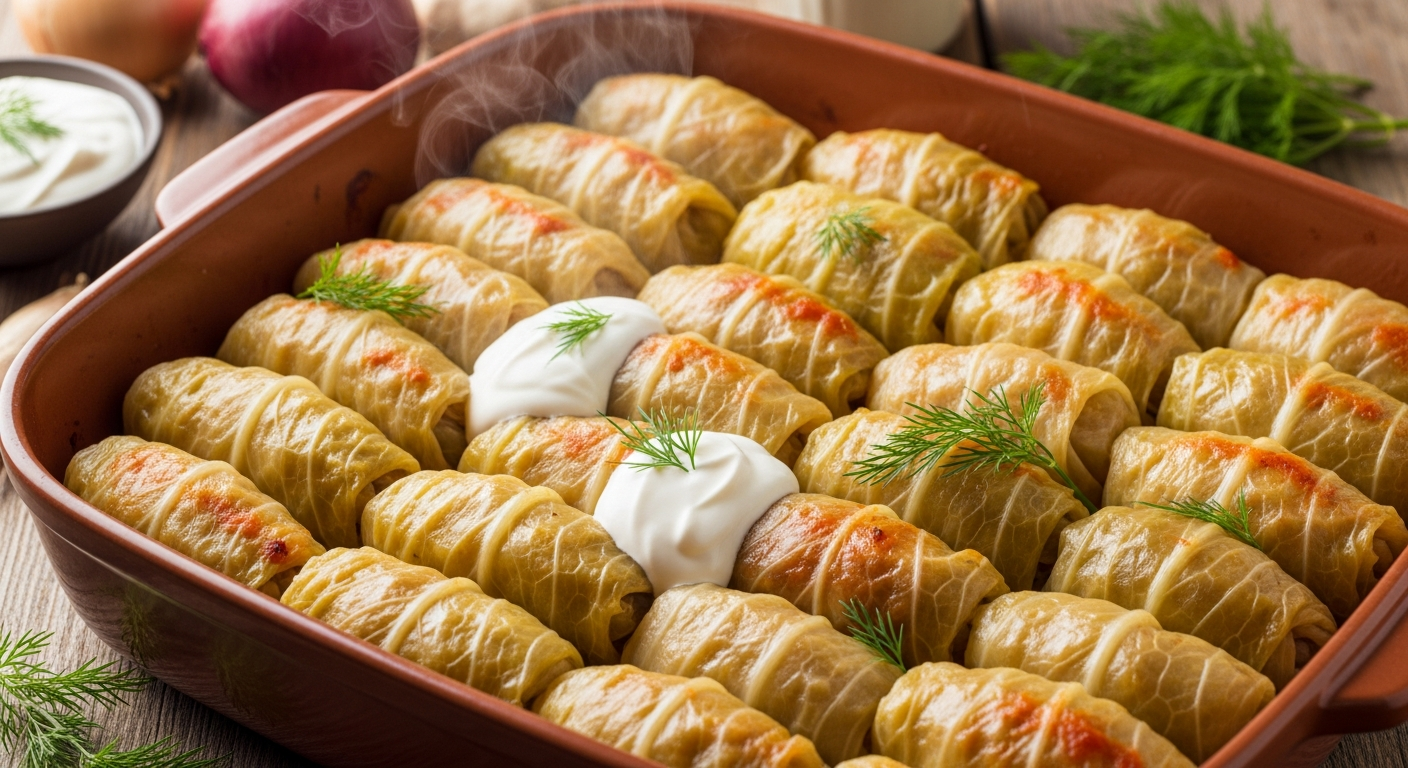
Prep: ~1 hour | Cooking: 1.5–2 hours | Serves: 6–8 | Makes: approximately 20–24 rolls | Difficulty: Intermediate
Quick Overview
- Blanch the whole cabbage head in boiling water, peeling leaves off as they soften — this takes patience but cannot be rushed
- Mix the filling raw: ground pork, half-cooked rice, fried onion, carrot, garlic, salt, and pepper
- Trim the thick rib from each leaf, place a generous spoonful of filling, and roll tightly — method described in detail below
- Layer the rolls tightly in a heavy pot or baking dish, pour over the tomato-sour cream sauce, and simmer or bake covered for 1.5 hours
- Rest for 15 minutes before serving — holubtsi firm up and the sauce thickens as they cool slightly
What holubtsi are
Holubtsi (голубці) are Ukrainian stuffed cabbage rolls: blanched cabbage leaves filled with a grain-and-meat mixture, then simmered or baked in sauce until the cabbage is tender and the filling is cooked through. The word comes from holub, the Ukrainian word for pigeon. The name likely refers to the shape — the rolled leaf with two ends tucked in does resemble a small bird.⁴
The dish is not one recipe. Depending on the region, the wrapper might be fresh cabbage, sauerkraut, beet leaves, or grape leaves. The filling might be rice with pork, buckwheat with mushrooms, or corn grits with pork cracklings. The size might be large enough to fill a hand or small enough to eat in two bites. What holds all of these variations together is the technique: grain and fat wrapped in a leaf, slow-cooked in a savory liquid until the whole thing becomes something more than its parts.¹
History and cultural roots
The Roman cookbook Apicius, dating to the fifth century AD, contains a recipe for stuffed cabbage leaves.⁴ Variations appear in cuisines from the Middle East, Central Asia, and across Eastern Europe, which tells you less about who invented holubtsi and more about how universal the idea is: a leaf is a natural vessel, grain and fat need a container, and a pot of simmering water does the rest.
In Ukraine, the dish was firmly established by the 18th century.³ Through that period, the filling was grain (millet, buckwheat, or corn grits) cooked with fried onion and pork cracklings (shkvarky). Meat was a holiday ingredient for most households. The cabbage rolls Ukrainians ate on ordinary days were effectively a grain-and-fat packet in a leaf, not the meat-forward dish most people know today.¹
That changed beginning in the 1920s. Rice became more widely available and affordable, and the standard filling shifted to rice mixed with ground meat. Tomato juice and tomato paste replaced kvas as the cooking liquid. The version that now appears on every Ukrainian table (rice and pork in a tomato-sour cream sauce) is less than a hundred years old.¹
Holubtsi appear at every significant occasion in Ukrainian life: weddings, Easter, birthdays, family Sunday dinners. On Christmas Eve, the Sviata Vecheria table holds twelve dishes, all meatless by tradition. Holubtsi are one of them — filled with rice and mushrooms, cooked without meat or animal fat.³ The same dish carries opposite meanings depending on which day it is made.
National heritage status
On May 4, 2023, the Ministry of Culture and Information Policy of Ukraine inscribed the preparation of holubtsi in the National Inventory of Elements of the Intangible Cultural Heritage of Ukraine.² The inscription recognized the dish not as a single recipe but as a living tradition carried differently across every region of the country — the knowledge of how to read the leaf, how to gauge when the filling is done, how to balance the sauce. Holubtsi join borscht on that list, which was inscribed by UNESCO in 2022 under urgent safeguarding measures.²
Regional variations: the wrapper
Fresh white cabbage is the standard wrapper across most of Ukraine and the one used in this recipe. The leaves are large, flexible after blanching, and neutral enough to let the filling speak. But the wrapper varies significantly by region and season.¹
Sauerkraut (pickled cabbage) leaves are used primarily in the Carpathian mountains and parts of western Ukraine. The leaves are already soft from fermentation, so no blanching is needed, and they add a pronounced sourness to the finished roll. These sour holubtsi taste noticeably different from the fresh-cabbage version: tangier, more complex, with a slight fermented undertone throughout. They are a winter staple where fresh cabbage becomes unavailable.¹
Beet leaves replace cabbage in spring, when the first young beet greens appear in the garden. They are softer than cabbage and have a slightly earthy flavor that comes through in the finished roll.¹
Grape leaves appear in southwest and southern Ukraine, particularly in areas with wine-producing traditions, when the vines come into leaf in late spring and early summer. The result is closer to Turkish or Greek dolma in character: smaller, more delicate, with the slight bitterness of fresh vine leaf.¹ ³
Regional variations: the filling and size
The filling tells you where in Ukraine the cook is from — sometimes more accurately than the accent. Wikipedia’s article on cabbage rolls, drawing on Ukrainian culinary sources, documents the following regional patterns:¹
By region
In the Carpathian region, the traditional grain is corn grits. The grits are lightly cooked, mixed with fried onion and pork cracklings, and used as the entire filling — no rice, and meat only on feast days.¹
In the Poltava region, buckwheat groats are preferred. Poltava cooking generally favors buckwheat over rice, and the holubtsi there carry that earthier, nutty character throughout.¹
In Polissia (the northern woodlands), buckwheat with forest mushrooms is a classic filling. The mushrooms here are foraged: dried porcini or mixed forest mushrooms that give the filling a deep, smoky quality.³
In Central Ukraine, rice and pork with tomato sauce became dominant after the 1920s and is now the most widely recognized version outside Ukraine.¹ ³
The size question
Size is where regional opinion gets pointed. In Left Bank Ukraine and the south, holubtsi are traditionally large — made from the whole cabbage leaf, filled generously. In Poltava, large holubtsi were considered better because they stayed juicier during the long simmer.¹
In the Carpathians and the Dniester region, the leaf is divided into smaller pieces, producing compact rolls. Here, historically, a cook who made large holubtsi was considered lazy. The two camps have held their positions for centuries.¹
Small, bite-sized holubtsi (sometimes called malenʹki holubtsi) also appear at festive tables as a symbol of abundance. Making small ones requires more time and skill than making large ones, which is part of the point.³
The meatless versions
Vegetarian holubtsi are not a modern adaptation. They predate the meat versions by centuries, and they remain central to Christmas Eve tables across Ukraine. The filling is typically buckwheat or rice with mushrooms and fried onion. There is no sour cream in the sauce on Christmas Eve — only tomato or mushroom broth, keeping the dish within Lenten rules.³ ⁴
Traditional holubtsi recipe
Recipe developed independently by Heritage Healthy Kitchen, drawing on traditional Ukrainian culinary methods. Sources for further reading are listed at the end of this article.¹²³⁴⁵
The recipe below is the Central Ukrainian standard: white cabbage, rice and pork filling, tomato-sour cream sauce. It makes approximately 20–24 rolls. Raw uncooked holubtsi freeze well for up to 3 months; cooked ones keep in the refrigerator for 4–5 days — making a large batch is worth the effort.
Ingredients
The cabbage
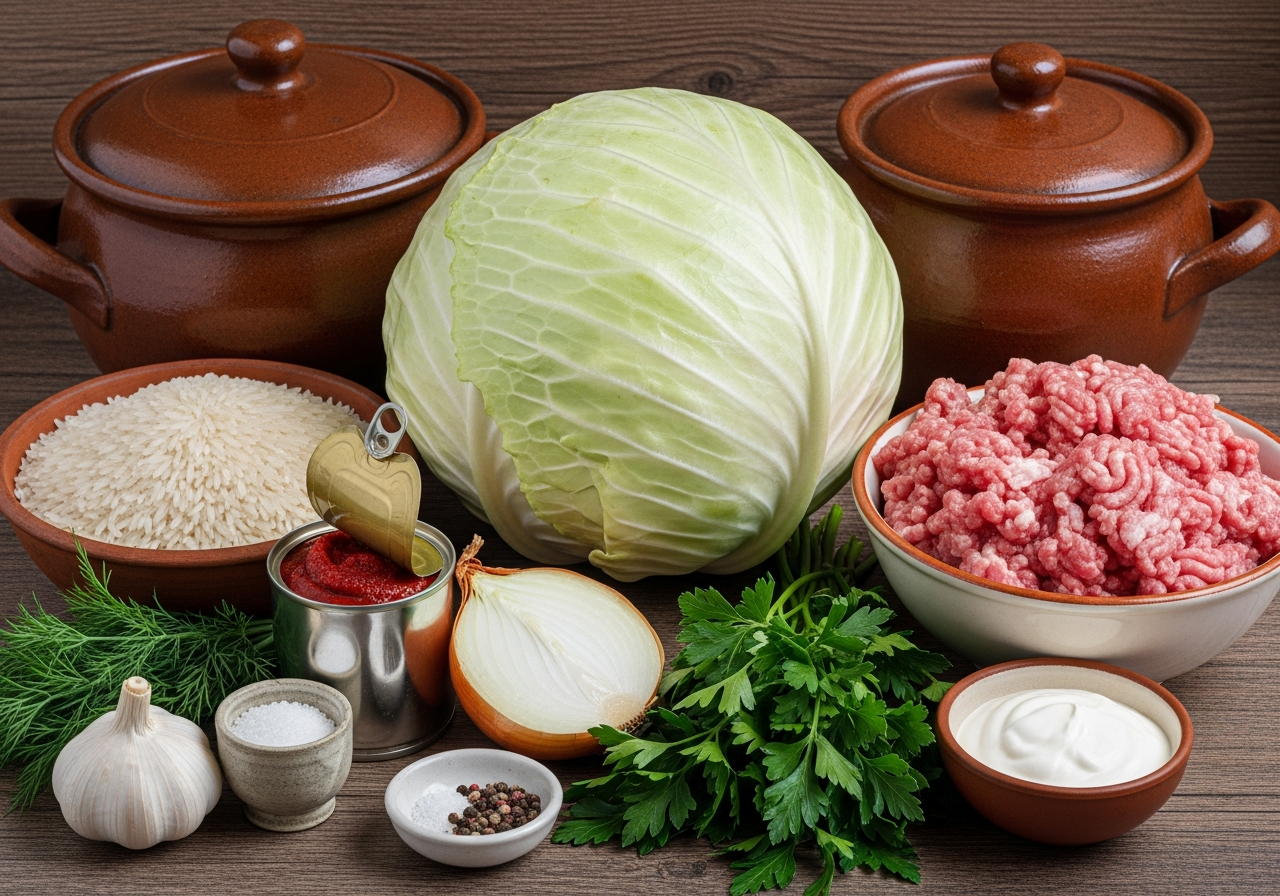
- 1 large head of white cabbage (approximately 1.5–2kg / 3.3–4.4 lb) — larger is better; small heads yield fewer usable leaves
The filling
- 600g (1.3 lb) ground pork, or a mix of pork and beef
- 200g (1 cup) short-grain or medium-grain rice, half-cooked (see method)
- 1 large onion, diced fine and fried until golden
- 1 medium carrot, grated and fried with the onion
- 3 garlic cloves, minced
- 1 egg (optional — helps the filling hold together)
- 1.5 teaspoons salt
- 1 teaspoon black pepper
- 1 tablespoon fresh dill or parsley, chopped (optional)
The sauce
- 400ml (1⅔ cups) tomato passata or 3 tablespoons tomato paste diluted in 350ml water
- 200ml (¾ cup) sour cream (smetana)
- 200ml (¾ cup) water or light chicken/vegetable stock
- 2 bay leaves
- Salt and pepper to taste
Method
Step 1: Prepare the cabbage leaves
Bring a large pot of water to a full boil. Using a sharp knife, cut a deep cone around the core of the cabbage to loosen the leaves. Lower the whole head into the boiling water. As the outer leaves soften (after 2–3 minutes), peel them off with tongs and transfer to a colander. Keep rotating the head and peeling as leaves become pliable — this takes 10–15 minutes and requires attention. You need 20–24 whole leaves without tears.
Once the leaves are cool enough to handle, trim the thick central rib from each one with a sharp knife or flatten it by pressing firmly with the heel of your hand. A flat rib allows the leaf to roll without cracking.
Step 2: Half-cook the rice
Rinse the rice under cold water until the water runs clear. Cook in salted water for exactly 7 minutes, then drain and rinse with cold water to stop cooking. The rice should be slightly underdone — it will finish cooking inside the roll. Fully cooked rice turns mushy during the long simmer.
Step 3: Make the filling
Fry the diced onion and grated carrot together in a tablespoon of oil over medium heat for 10–12 minutes until soft and lightly caramelized. Cool completely — adding hot onion to raw meat will partially cook the pork unevenly.
Combine the ground pork, cooled rice, cooled onion-carrot mixture, garlic, egg (if using), salt, pepper, and fresh herbs. Mix thoroughly with your hands until the ingredients are evenly distributed. Fry a small test piece in a pan and taste for seasoning before rolling. This step matters — there is no way to adjust seasoning once the holubtsi are rolled and in the pot.
Step 4: Roll the holubtsi
Place a cabbage leaf on a flat surface, inner side up, with the stem end closest to you. Spoon filling onto the lower third of the leaf: approximately 2–3 tablespoons for large holubtsi, 1–1.5 tablespoons for smaller rolls. The amount depends on the leaf size and your regional preference.
Fold the two sides of the leaf over the filling. Then roll from the stem end upward, tucking firmly as you go. The finished roll should be snug but not bursting. If the leaf tears at the edges, use a spare leaf to patch it — it will hold during cooking.
Step 5: Layer and cook
Use any leftover cabbage leaves to line the bottom of a heavy pot or deep baking dish — this prevents the rolls from scorching and adds flavor to the sauce. Arrange the holubtsi in tight layers, seam side down. Pack them close enough that they support each other and cannot unroll during cooking.
Mix the sauce: whisk together the tomato passata, sour cream, stock, and seasoning. Pour over the rolls until they are just covered — you may not need all of the sauce, or you may need a little more water. Add the bay leaves.
For the stovetop method: bring to a gentle boil, then reduce heat to very low. Simmer covered for 1.5 hours, checking occasionally to ensure the liquid has not reduced too much. Add a splash of water if the pot looks dry.
For the oven method: cover the pot or dish tightly with a lid or foil and bake at 180°C / 355°F for 1.5–2 hours, until the cabbage is completely tender and the filling is cooked through. Remove the cover for the last 15 minutes to let the sauce reduce and develop color on top.
Step 6: Rest before serving
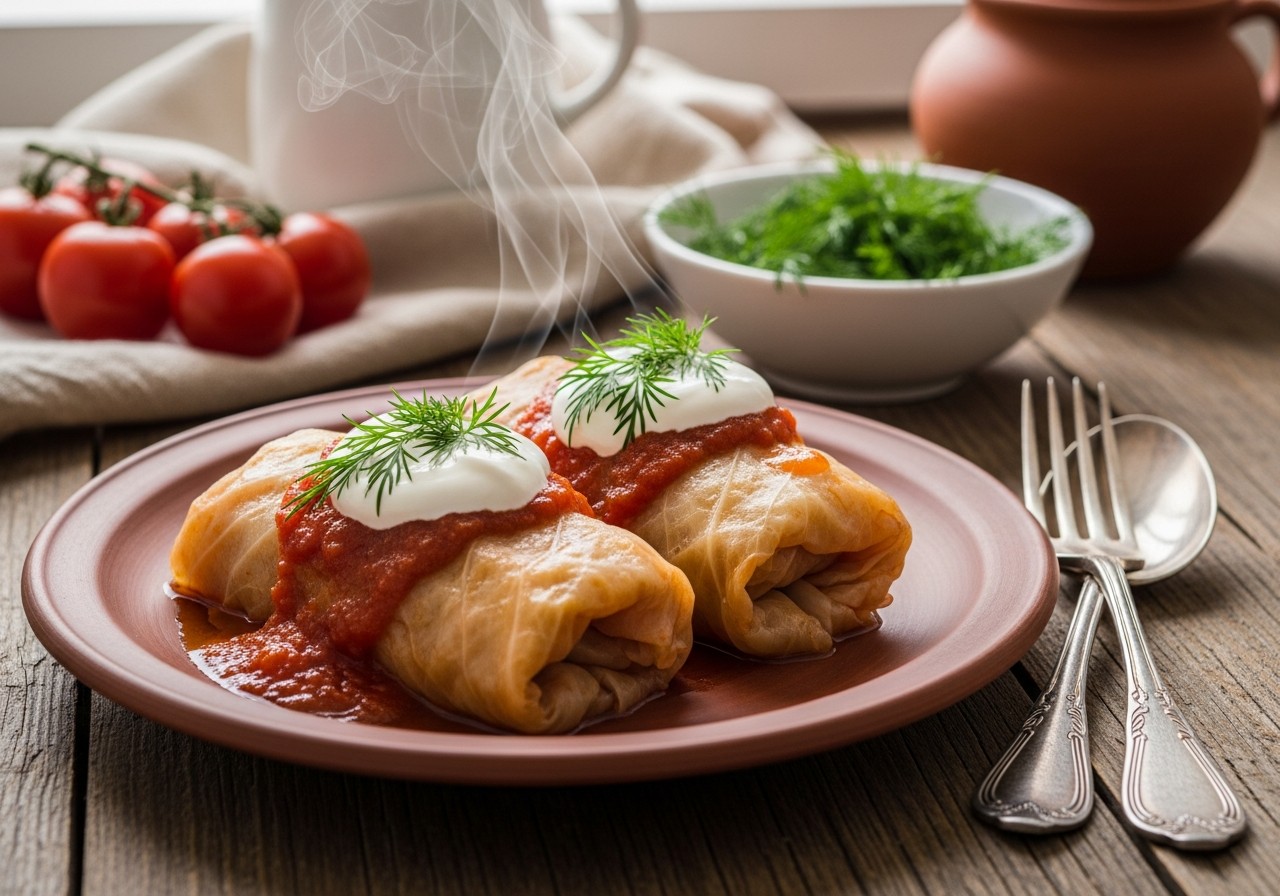
Remove from heat and rest, covered, for 15 minutes. The sauce thickens slightly and the rolls firm up — holubtsi taken straight from the pot can fall apart. Serve with cold sour cream on the side and thick rye bread or buckwheat.
Ліниві голубці — lazy holubtsi
There is an acknowledged shortcut version: instead of rolling individual holubtsi, you chop the cabbage roughly and layer it with the filling in a baking dish, like a casserole. This is called ліниві голубці — lazy holubtsi. It tastes nearly the same and takes a third of the time. It is also not what you serve at a wedding.¹
The lazy version is a legitimate weeknight dish. Cook the filling (ground pork and onion), then mix it directly with shredded raw or briefly blanched cabbage and the half-cooked rice, pour over the sauce, and bake at 180°C for about an hour. No rolling, no trimming ribs, no patching tears. If you are feeding a family on a Tuesday, this is worth knowing about.
Kitchen tips
The single most common mistake is overfilling. A tight, overfull roll will burst when the rice expands during cooking. Use less filling than you think is right the first time. After a few tries, you will develop a feel for how much a given leaf can hold without strain.
Fry a test piece before you roll. This takes two minutes and tells you whether the seasoning is right. Ground pork in particular needs more salt than raw tasting suggests — the cabbage and rice both dilute the flavor during the long cook.⁵
The rib is the enemy of a clean roll. It cracks the leaf rather than bending with it. Take the time to trim or flatten it. A torn leaf can be patched with a piece of spare leaf and will hold perfectly; a cracked rib will keep trying to unroll itself throughout the cooking.⁵
Pack the rolls tightly in the pot. Loosely arranged holubtsi unroll in the sauce. Tight packing keeps them in shape and also means the sauce is forced to saturate the filling from all sides rather than running around the outside.⁵
Holubtsi are better the next day. The sauce penetrates the filling overnight, the cabbage softens further, and everything melds. If you can make them a day ahead and reheat, do.
Nutritional Information
Per serving of 3–4 holubtsi with sauce (approximately 350g)
- Calories: approximately 330–370 kcal
- Protein: ~22g
- Total fat: ~14g
- Saturated fat: ~5g
- Carbohydrates: ~30g
- Dietary fiber: ~4g
- Sodium: ~600–750mg (varies with sour cream and seasoning)
Values are estimates based on standard ingredient databases. They will vary depending on the fat content of the pork, exact amount of sauce, sour cream fat percentage, and serving size.
Storage and freezing
Cooked holubtsi keep in the refrigerator for 4–5 days. Store in a sealed container with the sauce, which prevents the rolls from drying out. Reheat in a covered pot over low heat with a splash of water, or in the oven at 160°C covered with foil, for 20–25 minutes. Microwaving works but unevenly heats the filling — stir the sauce around the rolls halfway through.
Raw, uncooked holubtsi freeze very well for up to 3 months. Arrange them in a single layer on a tray to freeze solid, then transfer to bags or containers. Cook directly from frozen in a heavy pot with sauce, adding 20–30 minutes to the standard cooking time. Do not defrost first.
Cooked holubtsi also freeze well. Pack in containers with sauce. Defrost overnight in the refrigerator and reheat gently. The texture of the cabbage softens slightly after freezing but the flavor is unchanged.⁴
Traditional Ukrainian Holubtsi

Ingredients
The cabbage
- 1 large head white cabbage (1.5–2kg)
The filling
- 600g (1.3 lb) ground pork (or pork and beef)
- 200g (1 cup) short/medium-grain rice, half-cooked
- 1 large onion, diced and fried until golden
- 1 medium carrot, grated and fried with the onion
- 3 garlic cloves, minced
- 1 egg (optional)
- 1.5 tsp salt, 1 tsp black pepper
- 1 tbsp dill or parsley, chopped (optional)
The sauce
- 400ml tomato passata (or 3 tbsp paste + water)
- 200ml sour cream (smetana)
- 200ml water or light stock
- 2 bay leaves
- Salt and pepper
For serving
- Cold sour cream
- Rye bread
Instructions
- Prepare the cabbage leaves: Cut a deep cone around the core, lower the whole head into boiling water and peel off the leaves with tongs as they soften; trim the thick veins.
- Half-cook the rice: Rinse, boil 7 minutes, then drain and rinse cold. The rice should be slightly underdone — it finishes inside the rolls.
- Make the filling: Fry the diced onion and grated carrot until soft and lightly golden, then cool. Combine with the ground pork, half-cooked rice, garlic, egg, salt, pepper and dill.
- Roll the holubtsi: Place filling on the lower third of each leaf, fold the sides in and roll up firmly, seam side down.
- Layer and cook: Line the pot with spare leaves, pack the rolls seam down in tight layers, pour over the tomato and sour cream sauce with bay leaves, and simmer gently 1–1.5 hours.
- Rest before serving: Rest covered for 15 minutes, then serve with cold sour cream and rye bread.
Frequently Asked Questions
Why are my holubtsi falling apart in the pot?
Three likely causes: overfilling, under-blanched leaves, or loosely packed rolls. Each contributes. A leaf that has not softened enough will crack under the pressure of the expanding filling. An overfilled roll has no room to expand. Loose packing in the pot allows rolls to unravel in the liquid. Fix all three: blanch thoroughly, fill conservatively, and pack the rolls tight enough that they hold each other in place.⁵
Can I use raw rice instead of half-cooked rice in the filling?
Using raw rice is a traditional approach in some Ukrainian households. The rice absorbs the cooking liquid from the sauce and expands during the long simmer. The result is a denser, more rustic filling. The risk is that raw rice needs more liquid in the pot — if the sauce is too thin or the heat too high, the rolls can dry out before the rice is fully cooked. Half-cooking the rice first removes that uncertainty.⁵
What is the difference between large and small holubtsi?
Regional tradition, not technique. In Left Bank Ukraine and the south, large holubtsi made from the whole leaf are standard and considered better because the larger filling stays juicier during cooking. In the Carpathians and along the Dniester, the leaf is divided into smaller pieces and the rolls are compact. Historically, making large holubtsi was considered the lazy option in the western regions, and the cooks there were not quiet about it.¹
Can I use sauerkraut leaves instead of fresh cabbage?
Yes. Sauerkraut leaves need no blanching — they are already soft from fermentation. Rinse them under cold water first to reduce the salt, then squeeze dry before rolling. The finished holubtsi will be noticeably tangier and the sauce will pick up the sourness of the fermented cabbage. This is the Carpathian version, and many people prefer it to the fresh cabbage variety once they have tried it.¹
Is there a meatless version for Christmas Eve?
Yes, and it predates the meat version. The Sviata Vecheria (Christmas Eve) holubtsi are one of twelve meatless dishes required by tradition. The filling is typically buckwheat or rice with dried forest mushrooms and fried onion. The sauce contains tomato or mushroom broth but no sour cream and no meat stock. These holubtsi are lighter than the everyday version but have more depth, because the dried mushrooms carry significant umami.³
Do holubtsi actually get better the next day?
They do. Overnight, the sauce absorbs into the filling, the cabbage softens further, and the flavors even out. A freshly made pot of holubtsi is good; the same pot reheated the next morning is noticeably better. This is not sentimentality — the same physical process that improves bigos and borscht over time is at work here. Make them a day ahead if you can.¹ ⁵
Can holubtsi be made with chicken instead of pork?
Ground chicken works but produces a drier, lighter-tasting result. Pork fat is part of what keeps the filling moist during the long cook. If you use chicken, add a tablespoon of olive oil to the filling and be careful not to overcook — 1.5 hours at a gentle simmer is sufficient. Ground chicken can also be combined with mushrooms for a filling that has more moisture and flavor than chicken alone.
Looking for a lighter version?
Traditional holubtsi are substantial, and the fat content comes mainly from the pork and the sour cream sauce. A lighter version can use turkey or lean pork loin with a reduced-fat sauce without losing the essential character of the dish. Our Healthy Holubtsi article covers those adaptations in detail.
Further Reading & Sources
The following sources were consulted in researching the history, regional variations, and cultural context of traditional Ukrainian holubtsi. Heritage Healthy Kitchen’s recipe was developed independently; these links are provided for readers who want to explore further.
- “Cabbage Roll.” Wikipedia. en.wikipedia.org/wiki/Cabbage_roll — regional variation details for Ukrainian holubtsi, including filling types by region, size differences, and the transition to rice in the 1920s. Wikipedia’s Ukrainian holubtsi section draws on Ukrainian culinary scholarship.
- “The National List of Intangible Cultural Heritage of Ukraine Has Been Replenished with New Elements.” Visit Ukraine (official government travel portal, reporting on the Ministry of Culture and Information Policy decree). visitukraine.today — documentation of the May 4, 2023 inscription of holubtsi in Ukraine’s National Inventory of Intangible Cultural Heritage.
- “Holubtsi in Ukrainian Cuisine: History and Traditional Recipes.” The Taste of Ukraine. thetasteofukraine.com — cultural significance, festive traditions including the Christmas Eve meatless version, and the Polissia regional variation.
- “A Journey Through Time: 10 Engaging Historical Facts About Ukrainian Cabbage Rolls.” Ukrainian Recipes. ukrainian-recipes.com — historical context including the Apicius reference, the name origin, and the dish’s role in Ukrainian celebrations.
- “Cabbage Rolls (Ukrainian Holubtsi).” Cook the Story, by Christine Pittman. cookthestory.com — technique guidance from Ukrainian heritage, including filling ratios, rolling method, and the difference between par-cooked and raw rice in the filling.
Disclaimer
The information in this article is provided for educational and informational purposes only. Heritage Healthy Kitchen makes no representations or warranties regarding the accuracy or completeness of any content on this site. Nutritional values are estimates only and will vary depending on the specific ingredients, brands, and measurements used. This content is not intended as dietary, medical, or professional nutritional advice. Always consult a qualified healthcare provider regarding any dietary needs or health conditions. Heritage Healthy Kitchen is not responsible for any outcomes resulting from the use of recipes or information published on this site.
You Might Also Like
More heritage recipes from our kitchen
Leave a Reply