
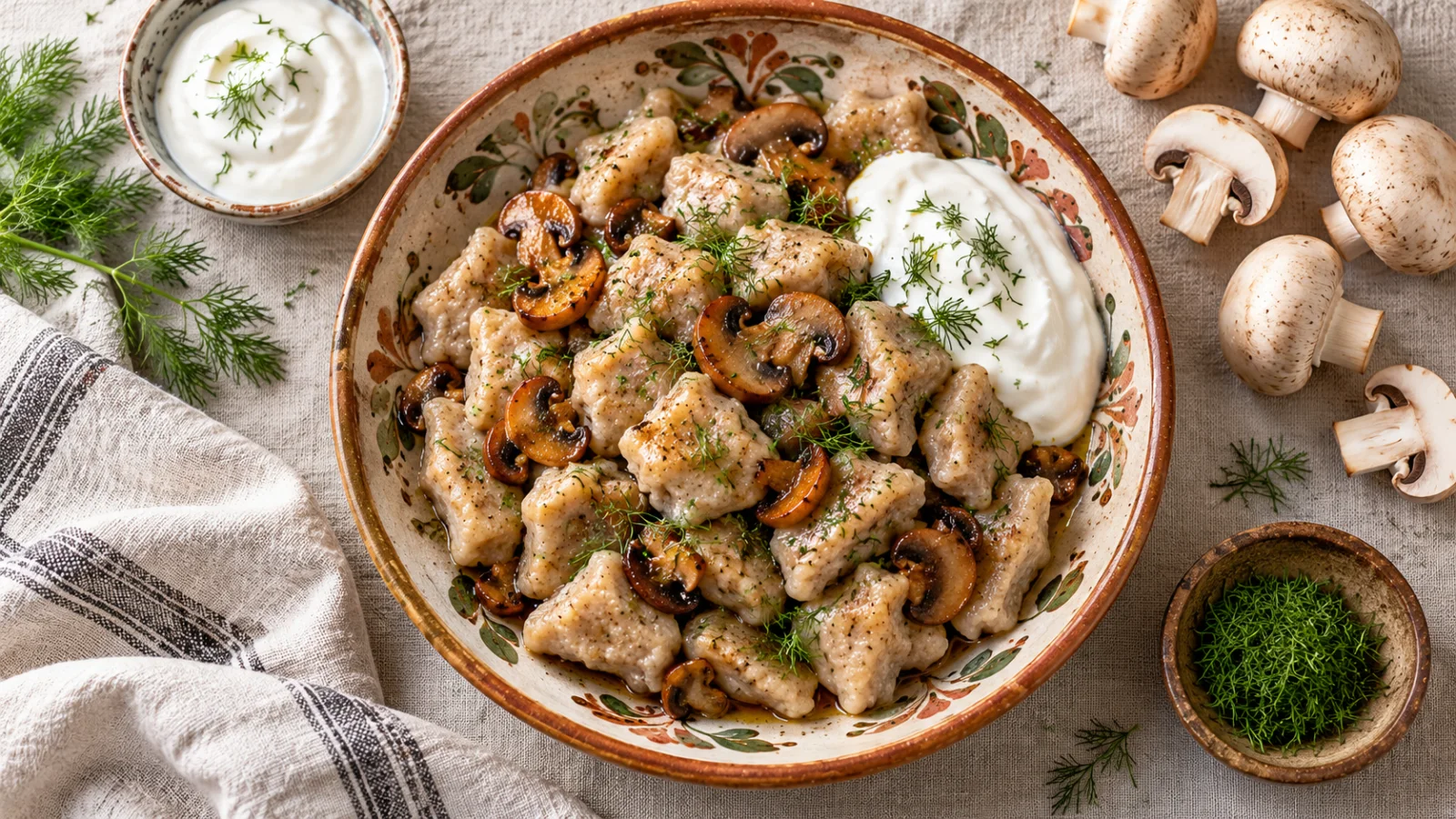
Active time: ~30 minutes | Total time: ~50 minutes | Serves: 4 | Difficulty: Easy
Healthy halushky keep the method of the boiled Ukrainian dumpling: a simple egg dough, cut or pinched into small pieces and dropped into salted water. What changes is what goes into the dough and onto the plate. Half the flour is buckwheat, olive oil takes the place of butter, sautéed mushrooms add savory depth, and Greek yogurt stands in for sour cream.
Quick Overview
- Replace half the all-purpose flour with buckwheat flour for more fiber and a savory, nutty note
- Mix the dough with olive oil instead of melted butter, then rest it for 20 minutes
- Roll the dough into ropes, cut it into small pieces, and boil until they float
- Sauté sliced mushrooms in olive oil until browned
- Toss the dumplings with the mushrooms and serve with a spoonful of plain Greek yogurt
What This Version Changes — and What It Keeps
The traditional version of this dish is a plain egg dough finished with melted butter and a spoonful of sour cream. That combination is much of what makes halushky comforting, and nothing in this adaptation is meant to replace it. It is a second way to make the same dumpling, for a cook who wants more fiber and protein and a different kind of fat on the plate. The full traditional recipe, with its butter and sour cream, is in our traditional halushky recipe.
Four ingredients change, and the rest of the recipe stays where it was:
- Flour. Half the all-purpose flour becomes buckwheat flour. Older halushky doughs were themselves a blend of wheat and buckwheat flour,1 so this is an old pairing.
- Fat in the dough. Olive oil replaces the melted butter, in a smaller amount.
- The finish. Mushrooms sautéed in olive oil replace the butter tossed over the dumplings. Mushroom gravy was already a traditional way to serve halushky,2,3 so the topping sits inside the dish’s own tradition.
- The dairy. Plain Greek yogurt replaces the sour cream, spoon for spoon.
What stays the same is the dumpling itself: an egg-and-flour dough, a 20-minute rest, ropes cut into pieces about 2 cm long, and a few minutes in boiling salted water until the pieces float. The dumplings are still served immediately, hot, with something cool and tangy on top.
Why These Swaps Work
Buckwheat flour for half of the wheat flour
Despite its name, buckwheat is not a type of wheat. It is the seed of a flowering plant related to rhubarb, and it contains no gluten.4 Cleveland Clinic’s dietitian notes that it contains both soluble and insoluble fiber, and that its glycemic index is low compared with other grains such as millet, bulgur wheat, and couscous; low-glycemic foods break down slowly and can help reduce spikes in blood sugar.4 The same source says buckwheat flour can replace all-purpose flour in certain baked goods.4
The numbers explain why the swap matters for fiber. Per 100 grams, whole-groat buckwheat flour has about 10 grams of fiber and 12.6 grams of protein, against 2.7 grams of fiber and 10.3 grams of protein for white all-purpose flour.5 In this recipe, replacing half the flour takes the fiber from roughly 2 grams to roughly 5–6 grams per serving. That is a useful gain, but it is a modest one. Because the buckwheat is blended with wheat flour, the low-glycemic benefit described above is diluted, so call this dumpling a more fiber-rich halushky, not a low-glycemic one.
Two cautions from the same source apply. Buckwheat allergy is rare but real, with symptoms ranging from itching and rash to anaphylaxis, and anyone with a known allergy should skip this recipe.4 And if you’re not used to much fiber, the advice is to add it gradually, about 5 extra grams a week, to avoid gas and cramps.4
Olive oil for butter
Harvard Health summarizes a study that followed about 221,000 people for 30 years and found that higher intake of plant oils, olive oil among them, was associated with a lower risk of death from cancer and cardiovascular disease, while higher butter intake was associated with higher risk. Even trading 10 grams of butter a day, less than a tablespoon, for the same amount of plant oil was linked with benefit.6 Harvard Health attributes the difference to the type of fat: plant oils are richer in unsaturated fats, while the saturated fat in butter tends to raise LDL cholesterol.6 The Harvard Nutrition Source gives the same advice in general terms, listing olive oil among the vegetable oils high in unsaturated fats and butter among the foods high in saturated fat that are best eaten in moderation.7 The study is observational, so it shows an association, not proof that any single swap changes a person’s health.
One point is easy to misread. Olive oil is not lower in calories than butter: per 100 grams, olive oil has 884 kcal and butter 717 kcal, because butter contains some water and milk solids.5 The saving here comes from using less fat overall. The compiled traditional recipe uses 78 grams of butter for four servings; this version uses 49 grams of olive oil, more than a third less, and the fat per serving falls from roughly 22 grams to roughly 17 grams.
Mushrooms for the browned-butter finish
Browned butter does a particular job in halushky: it gives the plain dumpling a savory, nutty flavor. Mushrooms can do a similar job with less fat. Harvard’s Nutrition Source describes mushrooms as low in calories and fat, and notes that chefs value them for umami, the savory taste created by glutamate, the same amino acid found in meats, fish, and cheeses.8 It lists sautéing mushrooms in olive oil and adding them to cooked whole grains as a serving idea, which is close to what happens in this recipe.8 It also recommends sautéing quickly over high heat to preserve nutrients, since boiling leaches water-soluble vitamins and potassium into the water.8
Greek yogurt for sour cream
Plain whole-milk Greek yogurt and sour cream are close in texture and tang, and quite different in composition. Per 100 grams, the yogurt has about 9 grams of protein and 5 grams of fat (97 kcal), while cultured sour cream has about 2.4 grams of protein and 19.4 grams of fat (198 kcal).5 At the 60 grams used here for four servings, the yogurt contributes about 5 grams of protein and 3 grams of fat to the whole batch, where the sour cream would contribute about 1.5 grams of protein and 12 grams of fat. The yogurt keeps the cool, sharp contrast to the warm dumplings, which is the reason sour cream was there in the first place.
Healthy Halushky Recipe
This recipe was compiled by Heritage Healthy Kitchen from published recipes and the sources for the swaps, all listed at the end of this article. Figures that are Heritage Healthy Kitchen’s own estimates rather than taken from a published source are marked as such.
The base is the same compiled egg dough as in the traditional recipe. Published egg-dough recipes call for one egg per 85–250 g of flour, 16–40 ml of water per 100 g of flour, and, in three of the four, roughly 16–30 g of butter per 100 g of flour; the fourth uses milk and no butter.9,10,11,12 Rest times run from none to 20–30 minutes, the dough is rolled into ropes and cut or diced into small pieces, and cooking takes from 3 minutes after the dumplings float to about 7 minutes after the water returns to the boil.9,10,11,12 This version uses 2 eggs and 300 g of flour, half of it buckwheat,1,4 a 20-minute rest, and about 3 minutes of cooking after the dumplings rise.
The healthier choices are adaptations of that base. Heritage Healthy Kitchen’s own estimates are the 50/50 flour split, the 110 ml of water (slightly more than the traditional 100 ml, to allow for the buckwheat flour), the 28 g of olive oil in the dough, which is below the published butter range, the 300 g of mushrooms and 21 g of oil for the topping, the 2-minute kneading time, the piece length of about 2 cm (¾ in), and the amount of yogurt for serving. Kefir doughs, common in Poltava recipes, are a different dough and are not used here.
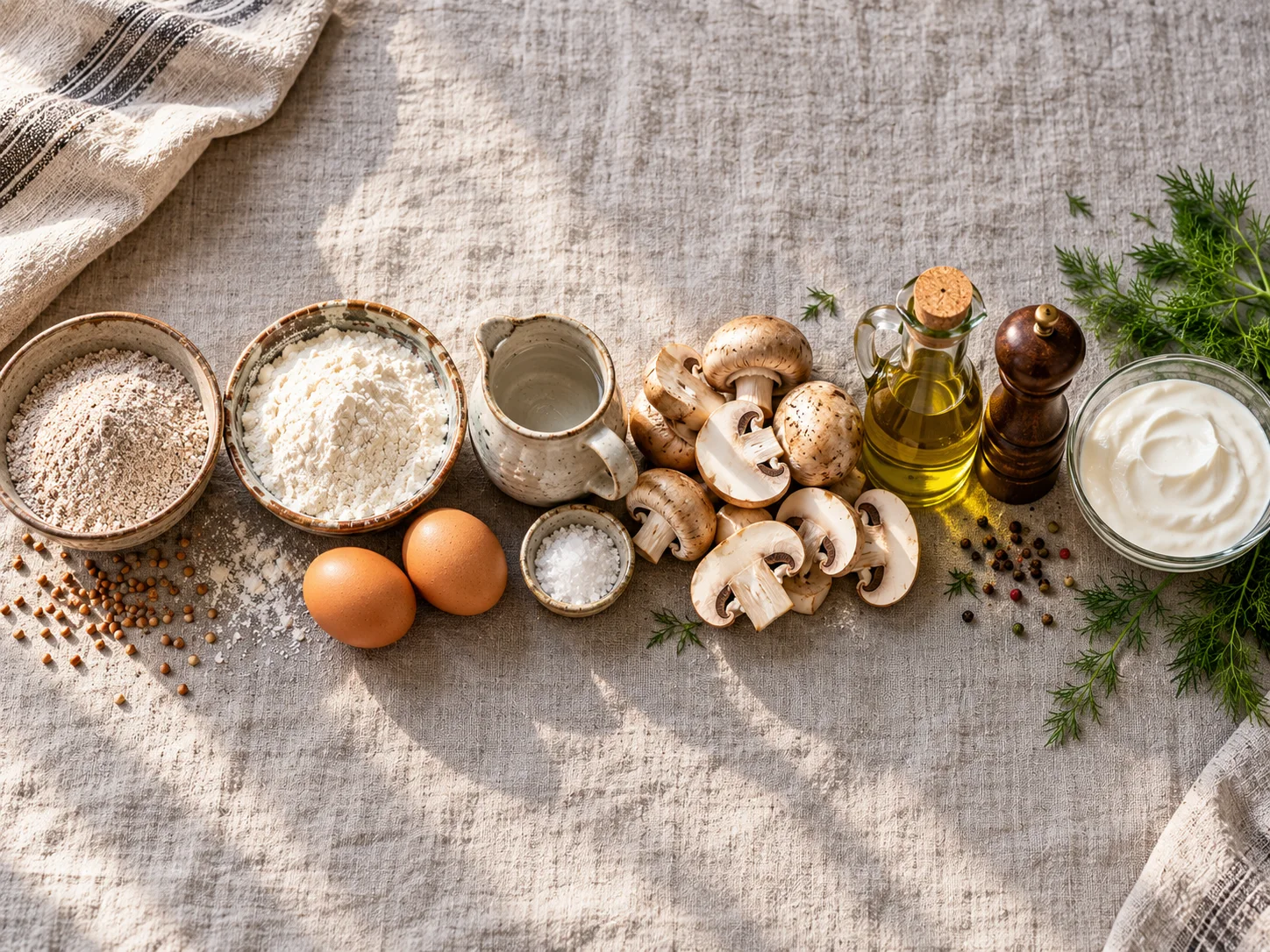
Ingredients
For the dough (serves 4)
- 150g (about 1¼ cups) buckwheat flour
- 150g (about 1¼ cups) all-purpose flour
- 2 large eggs
- 110ml (a scant ½ cup) water
- 28g (2 tbsp) olive oil
- ½ tsp salt
For the mushroom topping
- 300g (about 4 cups) white or cremini mushrooms, sliced
- 21g (1½ tbsp) olive oil
- Salt and pepper, to taste
- Fresh dill, chopped (optional)
For serving
- 60g (about ¼ cup) plain whole-milk Greek yogurt
Instructions

Step 1: Make the dough
In a large bowl, whisk the eggs with the water, 2 tablespoons of olive oil, and the salt. Stir the buckwheat and all-purpose flours together in a separate bowl, then gradually stir them into the egg mixture until a soft, slightly sticky dough comes together. Knead briefly, just until smooth, about 2 minutes. Cover and let it rest for 20 minutes.
Step 2: Shape the dumplings
Divide the dough into four pieces. On a lightly floured surface, roll each piece into a rope about 1.3 cm (½ inch) thick, or into a flat band of the same thickness. Cut it with a knife into pieces about 2 cm (¾ inch) long, or pinch off small pieces by hand. Handle the dough gently: with half the flour gluten-free, it tears more easily than an all-wheat dough.
Step 3: Boil
Bring a large pot of generously salted water to a rolling boil. Drop the dumplings in a few at a time, stirring gently so they don’t stick to each other or to the bottom of the pot.
Step 4: Cook until they float
Halushky are done about 3 minutes after they rise to the surface. Scoop them out with a slotted spoon rather than draining the whole pot at once.
Step 5: Sauté the mushrooms
While the dumplings cook, heat 1½ tablespoons of olive oil in a wide pan over medium-high heat. Add the mushrooms in a single layer and let them sit undisturbed for 1–2 minutes before stirring, so they brown rather than steam. Cook for 5–6 minutes in total, stirring occasionally, until browned and any released liquid has cooked off. Season with salt and pepper.
Step 6: Serve
Toss the drained dumplings with the mushrooms. Serve immediately, with a spoonful of Greek yogurt on top and a scattering of fresh dill, if using.
Kitchen Tips
Don’t skip the rest. Twenty minutes lets the flour absorb the water, and a dough that looks a little dry or crumbly straight after mixing often evens out after resting. If the ropes still crack, wet your hands lightly and work in a teaspoon of water at a time. If the dough sticks, dust the board with all-purpose flour rather than adding more buckwheat.
Keep the pieces about the size of the first joint of a thumb. Buckwheat dough is less elastic than an all-wheat dough, so smaller pieces are easier to handle. Test one dumpling by cutting it in half before committing the whole batch; the center should look fully cooked through, not doughy.
The water needs to be at a full rolling boil before the dumplings go in, not a gentle simmer, and the pot shouldn’t be crowded. Lift the dumplings out with a slotted spoon as they finish rather than draining everything at once.
Let the mushrooms sit undisturbed when they first hit the pan. Stirring too early is the most common reason they steam and turn watery instead of browning. Salt them at the end, once they have browned, so they don’t release their liquid early.
Add the yogurt at the table or at the very end, off the heat. Stirred into a hot pan, yogurt can thin out and separate, and it loses the cool contrast that makes it work as a stand-in for sour cream.
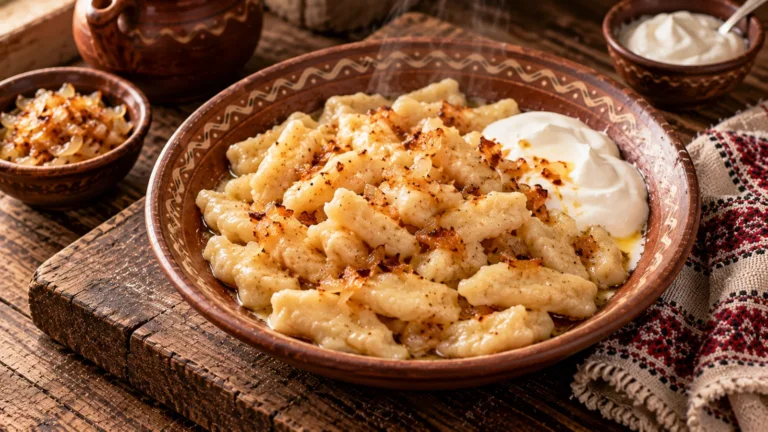
Halushky are also served with onions fried in vegetable oil.2 For a version with onion, cook one finely diced onion in the olive oil until soft and golden before adding the mushrooms.
Nutritional Comparison
Per serving (1 of 4 servings)

| Nutrient | Traditional halushky | This version |
|---|---|---|
| Calories | ~430–530 kcal | ~395–480 kcal |
| Protein | ~10–13g | ~14–17g |
| Total fat | ~20–24g | ~16–19g |
| Carbohydrates | ~52–64g | ~52–64g |
| Dietary fiber | ~2g | ~5–6g |
The comparison shows where the changes land. Calories drop modestly, because the amount of fat is smaller and the mushrooms add volume for very few calories. Protein rises by about 4 grams, from the buckwheat flour and the yogurt. Fiber more than doubles. Carbohydrates barely move, since this is still a flour-based dumpling, and the portion of dumplings is the same size as in the traditional recipe.
Nutritional values are estimates based on standard ingredient databases (USDA FoodData Central). The traditional column refers to the compiled traditional recipe in our traditional halushky article. Values will vary with the exact fat content of the yogurt, the ratio of buckwheat to all-purpose flour, and portion size.
Storage and Reheating
Cooked dumplings keep in an airtight container in the refrigerator for up to 3 days.12 Store the mushroom topping separately, because dumplings stored with the mushrooms turn soggy faster. Add the yogurt fresh rather than storing it mixed in.
Reheat the dumplings in a skillet with a little olive oil over medium heat until warmed through, and warm the mushrooms in their own pan so they re-crisp rather than steam.
To freeze, spread the raw dumplings on a parchment-lined tray, freeze until firm, then transfer to a freezer bag, where they keep for up to 3 months.12 Boil straight from frozen, adding a minute or two to the cooking time (this adjustment is Heritage Healthy Kitchen’s own estimate). Freeze the dumplings only: mushrooms are 80–90% water and turn mushy when defrosted.8
Healthy Halushky

Ingredients
For the dough (serves 4)
- 150g (about 1¼ cups) buckwheat flour
- 150g (about 1¼ cups) all-purpose flour
- 2 large eggs
- 110ml (a scant ½ cup) water
- 28g (2 tbsp) olive oil
- ½ tsp salt
For the mushroom topping
- 300g (about 4 cups) white or cremini mushrooms, sliced
- 21g (1½ tbsp) olive oil
- Salt and pepper, to taste
- Fresh dill, chopped (optional)
For serving
- 60g (about ¼ cup) plain whole-milk Greek yogurt
Instructions
- Make the dough: In a large bowl, whisk the eggs with the water, 2 tablespoons of olive oil, and the salt. Stir the buckwheat and all-purpose flours together in a separate bowl, then gradually stir them into the egg mixture until a soft, slightly sticky dough comes together. Knead briefly, just until smooth, about 2 minutes. Cover and let it rest for 20 minutes.
- Shape the dumplings: Divide the dough into four pieces. On a lightly floured surface, roll each piece into a rope about 1.3 cm (½ inch) thick, or into a flat band of the same thickness. Cut it with a knife into pieces about 2 cm (¾ inch) long, or pinch off small pieces by hand. Handle the dough gently: with half the flour gluten-free, it tears more easily than an all-wheat dough.
- Boil: Bring a large pot of generously salted water to a rolling boil. Drop the dumplings in a few at a time, stirring gently so they don’t stick to each other or to the bottom of the pot.
- Cook until they float: Halushky are done about 3 minutes after they rise to the surface. Scoop them out with a slotted spoon rather than draining the whole pot at once.
- Sauté the mushrooms: While the dumplings cook, heat 1½ tablespoons of olive oil in a wide pan over medium-high heat. Add the mushrooms in a single layer and let them sit undisturbed for 1–2 minutes before stirring, so they brown rather than steam. Cook for 5–6 minutes in total, stirring occasionally, until browned and any released liquid has cooked off. Season with salt and pepper.
- Serve: Toss the drained dumplings with the mushrooms. Serve immediately, with a spoonful of Greek yogurt on top and a scattering of fresh dill, if using.
Frequently Asked Questions
Can I use all buckwheat flour instead of a blend?
It is possible, but the dough will be more fragile and harder to shape, because buckwheat contains no gluten to hold it together.4 The 50/50 blend used here keeps enough structure for rolling and cutting while still adding fiber. Pure buckwheat dough is better pinched into small pieces by hand than rolled.
Will the buckwheat flavor be noticeable?
Yes, mildly. Buckwheat has an earthy, nutty flavor, and raw and toasted buckwheat taste different from each other.4 In this dough the egg and the savory mushrooms soften it. For a milder result, use a third buckwheat and two thirds all-purpose flour; you will gain somewhat less fiber.
Is this version gluten-free?
No. Buckwheat itself contains no gluten,4 but this recipe blends it with wheat flour, so the finished dough contains gluten and it is not suitable for anyone who must avoid gluten.
Which mushrooms work best?
White button and cremini mushrooms are the easy choice: they are mild, brown well, and are sold everywhere. Shiitake or oyster mushrooms also work and add a stronger flavor. Stick to mushrooms bought at a market; Harvard’s Nutrition Source advises against picking wild mushrooms unless you are trained to identify them.8
Can I use low-fat Greek yogurt instead of whole-milk?
Yes. Low-fat Greek yogurt has about 2 grams of fat and 10 grams of protein per 100 grams,5 so it trims the fat further while keeping the protein, though the topping will be a little less rich.
Is this version lower in calories than the traditional one?
Somewhat. The estimates are roughly 395–480 kcal per serving against 430–530 kcal for the traditional recipe, and the ranges overlap. The clearer differences are in fiber, which more than doubles, and protein, which rises by about 4 grams.
Is this version vegetarian?
Yes, as written: the dough contains egg, and the topping is olive oil, mushrooms, and dairy yogurt, with no meat. It is not vegan, since it contains both egg and dairy.
The Traditional Version
This article covers only the lighter adaptation. For the dish’s name and history, the Poltava monument, and the classic recipe finished with butter and sour cream, see our traditional halushky recipe.
Further Reading & Sources
The following sources were consulted for the base recipe, the ingredient swaps, and the nutrition figures. The recipe is a compilation based on the published recipes listed here, adapted with the swaps the other sources support; these links are provided for readers who want to explore further.
- “Poltava halushky.” Authentic Ukraine, supported by the Ministry of Culture of Ukraine (no author or date printed). authenticukraine.com.ua — Poltava halushky — the historical buckwheat-and-wheat flour blend used for the dough, and the “pinched” versus “torn” shaping distinction.
- Tiazhka, Lilia. “Cheese Dumplings Halushky Traditional Recipe.” Etnocook, December 13, 2017 (last modified May 8, 2021). etnocook.com — Cheese Dumplings Halushky Traditional Recipe — halushky served as a main course with butter, vegetable oil, sour cream, or mushroom gravy, and onions fried in vegetable oil as an accompaniment.
- Podolyak, Lilia. “Dishes and Drinks From ‘Eneida’: Museum Workers and Philanthropists Presented Ancient Ukrainian Recipes.” UNN, July 23, 2025. unn.ua — Dishes and Drinks From “Eneida” — halushky with mushroom gravy among the dishes of Kotliarevsky’s time presented in a National Museum of Folk Architecture and Life of Ukraine project.
- “Buckwheat: Nutrition and Health Benefits” (page headline “5 Health Benefits of Buckwheat”). Cleveland Clinic Health Essentials, October 31, 2025; registered dietitian Natalie Crtalic-Lowther, RD, LD. health.clevelandclinic.org/buckwheat-benefits — buckwheat is gluten-free, contains soluble and insoluble fiber, has a low glycemic index compared with millet, bulgur wheat, and couscous, can replace all-purpose flour in certain baked goods, and rarely causes allergy.
- U.S. Department of Agriculture. FoodData Central, SR Legacy and Foundation data. fdc.nal.usda.gov — per-100-g composition of buckwheat flour, all-purpose flour, eggs, butter, sour cream, olive oil, white mushrooms, and plain whole-milk Greek yogurt (entries 170687, 169761, 748967, 173430, 171257, 171413, 169251, 171304).
- Solan, Matthew. “Substituting plant oils for butter can lead to better health.” Harvard Health Publishing, June 1, 2025; reviewed by Howard E. LeWine, MD. health.harvard.edu — Substituting plant oils for butter — summary of a study of about 221,000 people followed for 30 years (JAMA Internal Medicine, March 6, 2025): higher plant-oil intake, including olive oil, was associated with lower risk of death from cancer and cardiovascular disease, and higher butter intake with higher risk.
- “Fats and Cholesterol.” The Nutrition Source, Harvard T.H. Chan School of Public Health. nutritionsource.hsph.harvard.edu — Fats and Cholesterol — olive oil among the vegetable oils high in unsaturated fats; butter named among foods high in saturated fat to be eaten in moderation.
- “Mushrooms.” The Nutrition Source, Harvard T.H. Chan School of Public Health. nutritionsource.hsph.harvard.edu — Mushrooms — mushrooms low in calories and fat, umami from glutamate, sautéing in olive oil, quick high-heat sautéing to keep nutrients, and poor freezing.
- Klopotenko, Yevhen. “Галушки з м’ясом і цибулею: простий рецепт.” klopotenko.com (page modified September 5, 2026). klopotenko.com — Галушки з м’ясом і цибулею — recipe: 160–180 g flour, 1 egg, 50 g butter, 50 ml water; 20–30 minute rest; rolled rope cut into small pieces; 4–5 minutes in boiling salted water. Only the dough and method are used; the meat-and-buckwheat topping is not.
- Orlova, Violetta. “Галушки рецепт – як приготувати галушки рецепт.” UNIAN, May 27, 2020. unian.ua — Галушки рецепт — first recipe on the page: 250 g flour, 1 egg, 40 g butter, 40 ml water; 15-minute rest; rope cut into pieces; about 7 minutes in boiling salted water. The page also gives kefir-dough recipes, which are not used here.
- Stsepeleva, Yuliia. “Galushki (Ukrainian Dumplings).” Recipes From Europe, last updated February 11, 2026. recipesfromeurope.com — Galushki — recipe: ⅔ cup flour, 1 egg, 6 tablespoons milk, ½ teaspoon salt; 20-minute rest; rope about ½ inch thick cut into thin slices; 3 minutes after the dumplings float.
- Drozhzhin, Natalya (recipe contributor). “Halushki Recipe (Traditional Ukrainian Dumplings).” Momsdish, published October 19, 2021, modified November 26, 2021. momsdish.com — Halushki Recipe — recipe: 5 cups flour, 4 eggs, 1 cup water, 150 g butter, 1 teaspoon salt; dough divided, rolled into strings and diced; boiled until they float; refrigerator and freezer storage guidance.
Disclaimer
The information in this article is provided for educational and informational purposes only. Heritage Healthy Kitchen makes no representations or warranties regarding the accuracy or completeness of any content on this site. Nutritional values are estimates only and will vary depending on the specific ingredients, brands, and measurements used. This content is not intended as dietary, medical, or professional nutritional advice. Always consult a qualified healthcare provider regarding any dietary needs or health conditions. Heritage Healthy Kitchen is not responsible for any outcomes resulting from the use of recipes or information published on this site.
You Might Also Like
More heritage recipes from our kitchen


Leave a Reply