
Traditional Ukrainian Deruny Recipe: Crispy Grated Potato Pancakes
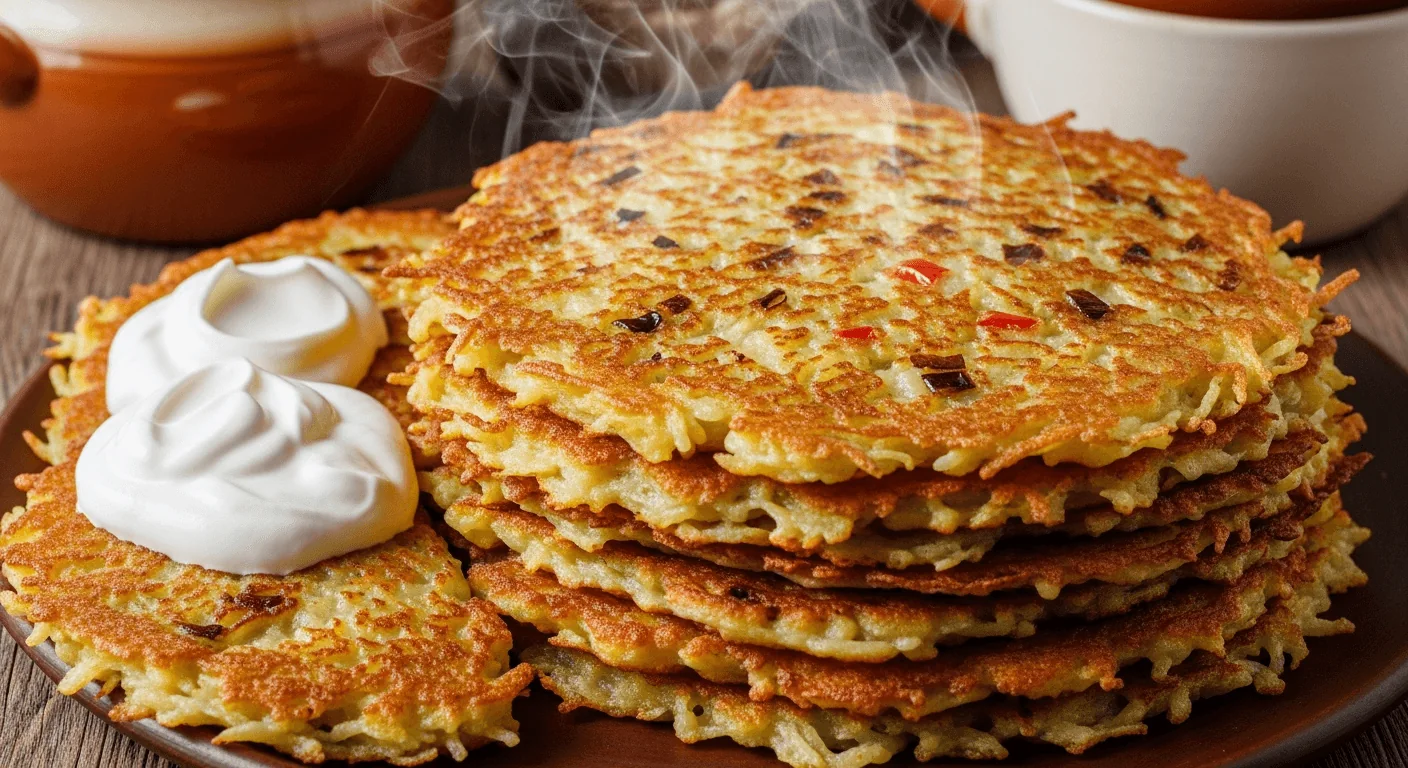
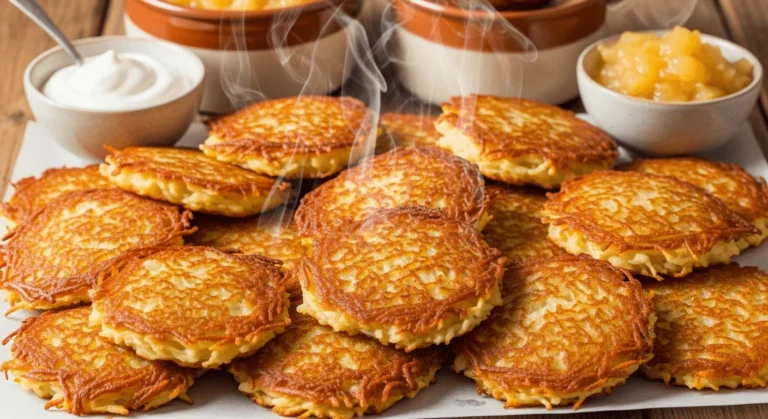
On a Sunday morning in a village kitchen in Polissia, the grater rasps against a bowl long before the rest of the house is awake — potatoes and onion reduced to a wet, starchy shred, the smell of hot oil already drifting from the stove. By the time the family sits down, a stack of deruny is waiting, crisp-edged and glistening, with a bowl of cold sour cream passed from hand to hand. It is, by most accounts, the most everyday dish in the Ukrainian kitchen: five ingredients, no special equipment, and a method nearly every household already knows by heart, documented as a staple of Ukrainian home cooking by the Canadian Institute of Ukrainian Studies’ Internet Encyclopedia of Ukraine.3
Prep Time: 15 min | Cook Time: 25 min | Total Time: 40 min
Serves: 4 (about 14–16 pancakes) | Difficulty: Beginner
Quick Overview
- Grate the potatoes and onion together, alternating handfuls — the onion’s juice keeps the potato from turning gray
- Drain off the excess liquid but leave a little moisture behind; deruny don’t need to be squeezed bone-dry
- Use a hot, well-oiled pan and don’t crowd it, or the pancakes steam instead of crisping
- Flip once the edges turn deep gold and slightly lacy, about 3–4 minutes per side
- Serve immediately, while the edges are still crackling, with a generous spoon of sour cream
What Deruny Is
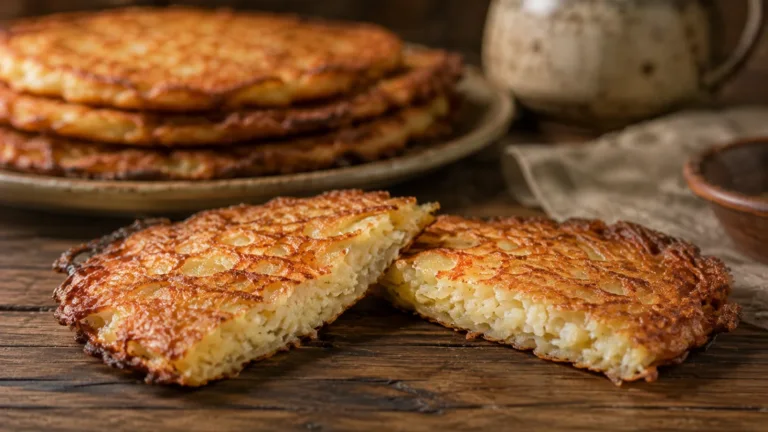
Deruny are Ukraine’s grated potato pancakes: potato, onion, egg, a little flour, fried in oil until the edges go dark gold and crisp while the center stays soft. The name comes straight from the technique — it derives from the Ukrainian verb derty, “to grate.”¹ Depending on the region, the same dish goes by other names too: kremzlyky, tertiukhy, rysylovanyky, terchanyky.² They’re especially associated with the north and east of the country, though home cooks make them everywhere.²
Potato pancakes show up under different names across this part of Europe — draniki, placki ziemniaczane, latkes — and deruny share a family resemblance with all of them.¹ But Ukrainian deruny have their own habits: finer grating, a little moisture left in the batter, and almost always sour cream rather than apple sauce or sugar on top.
Sour cream is the default topping, but it’s not the only one. Depending on the region and the household, deruny might come with crisp pork cracklings, a sharp cheese, a glass of tangy fermented milk called ryazhenka, or a sauce built from sour cream and toasted mushrooms.² In western Ukraine, that mushroom sauce is often made specifically with porcini for a deeper, earthier finish.² None of these are required — the pancakes themselves are the point — but they show how much variation a five-ingredient dish can absorb.
Traditional Deruny Recipe
Recipe developed independently by Heritage Healthy Kitchen, drawing on traditional Ukrainian culinary methods. Sources for further reading are listed at the end of this article.
Ingredients
For the batter (serves 4, about 14–16 pancakes)
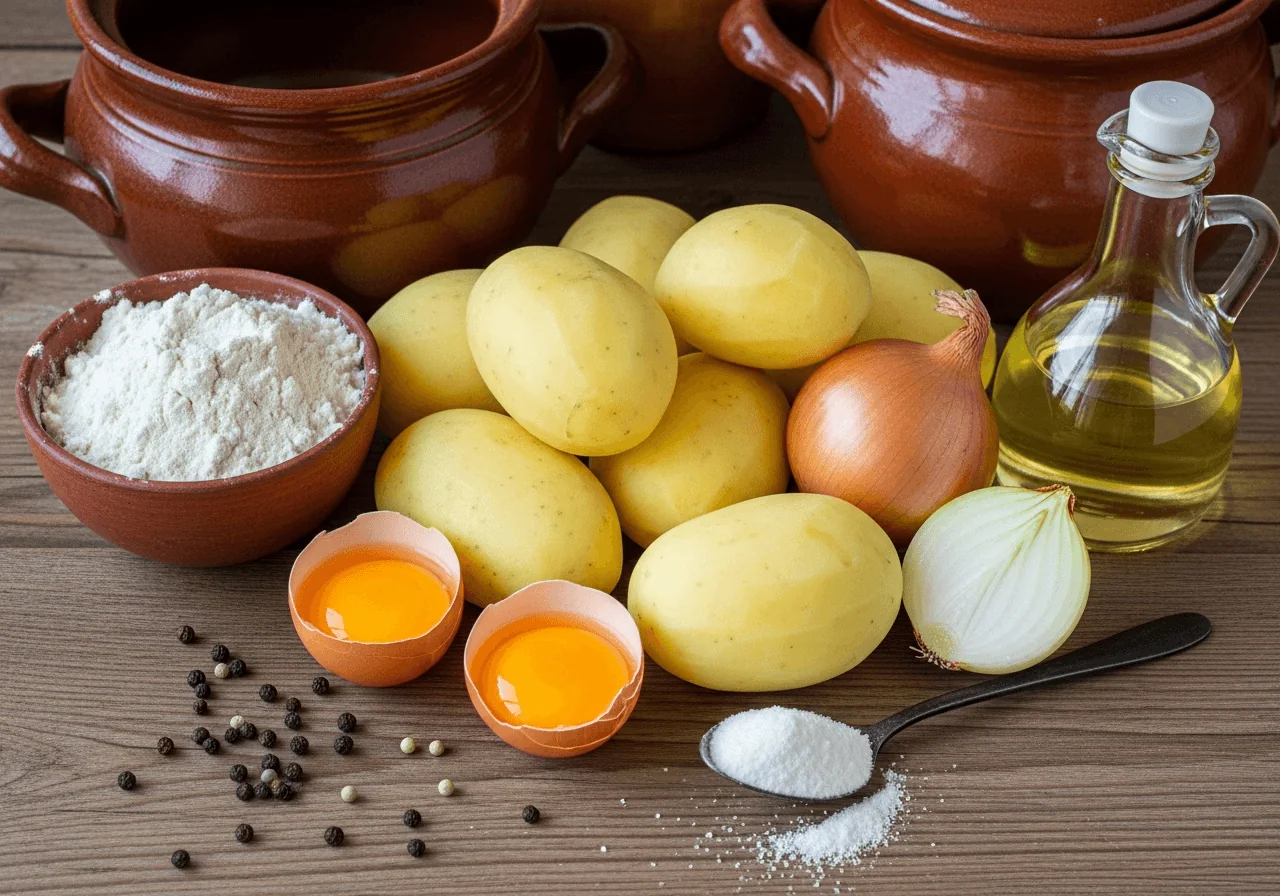
- 1.5 kg (about 3.3 lb) starchy potatoes (russet or similar), peeled
- 1 large onion, peeled
- 2 large eggs
- 3–4 tablespoons all-purpose flour (or potato starch)
- 1 teaspoon salt, plus more to taste
- ½ teaspoon freshly ground black pepper
- Sunflower oil or other neutral oil, for frying
For serving
- Sour cream
- Fresh dill, chopped (optional)
Instructions
Step 1: Grate the Potatoes and Onion
Working over a large bowl, grate the potatoes and onion using the small holes of a box grater or a food processor’s fine grating attachment. Alternate between potato and onion as you go — the onion juice keeps the potato from oxidizing and turning gray while you finish the rest.
Step 2: Drain, But Not Completely
Transfer the grated mixture to a colander or fine sieve and press out the excess liquid with the back of a spoon or your hands. Don’t wring it dry in a kitchen towel the way you might for other potato pancakes — deruny batter should still hold a little moisture, closer to thick sour cream in consistency than a dry mash.
Step 3: Mix the Batter
Add the eggs, flour, salt, and pepper to the potato-onion mixture. Stir gently but thoroughly until everything is evenly combined. The batter should be thick enough to hold its shape on a spoon but loose enough to spread slightly in the pan.
Step 4: Fry
Heat a generous layer of oil in a large skillet over medium-high heat until it shimmers. Drop heaping tablespoons of batter into the pan, leaving space between each, and flatten gently with the back of the spoon to about 5mm (¼ inch) thick. Fry until deep golden and crisp at the edges, 3–4 minutes per side. Work in batches rather than crowding the pan.
Step 5: Drain and Serve
Transfer finished deruny to a plate lined with paper towels to absorb excess oil, then season with a pinch of salt while still hot. Serve immediately, topped with sour cream and a scatter of fresh dill if using.
Expert Tips
Alternate the grating. Going back and forth between potato and onion, rather than grating each separately, keeps the potato in constant contact with onion juice and noticeably slows the gray, oxidized look that plain grated potato develops within minutes.⁶
Resist the urge to squeeze the mixture completely dry. Unlike some other potato pancake traditions, deruny depend on a bit of retained moisture for their texture — bone-dry batter fries up tough rather than tender at the center.⁶
Use the small holes on the grater, not the wide ones. A fine grate gives deruny their characteristic texture; a coarse grate or shredding attachment produces something closer to hash browns, which isn’t wrong exactly, just a different dish.⁶
Test the oil before committing the whole batch. Drop in a small spoonful first — if it doesn’t sizzle immediately, the oil isn’t hot enough yet, and the pancakes will absorb oil rather than crisp up.⁶
Skip any potato with a greenish tinge under the skin. That color signals solanine, a natural plant toxin that can cause digestive upset in larger amounts — not dangerous in the small quantities sometimes present, but worth avoiding when you have the choice.⁵
Give each pancake room in the pan. A large skillet fits about five or six without crowding; pack in more than that and the oil temperature drops, which means longer cooking time and softer edges instead of crisp ones. It’s worth frying in batches and keeping finished deruny warm in a low oven rather than rushing the pan.
Nutritional Information
Per serving (approximately 3–4 pancakes, one of 4 servings)
| Calories | Carbs | Protein | Fat | Fiber | Sodium |
|---|---|---|---|---|---|
| 220–260 kcal | 28–32g | 6g | 10–12g | 3g | 350–450mg |
Potatoes are a meaningful source of potassium — roughly 600mg per medium potato when the skin is included — along with smaller amounts of vitamin C, vitamin B6, and fiber, most of which comes from the peel.⁵
Nutritional values are estimates based on standard ingredient databases. They will vary depending on specific ingredients, oil absorption, and portion size.
Regional Variations
Like most dishes cooked weekly across an entire country, deruny shift in small ways from region to region and household to household.
- Western Ukraine (Carpathian region): some households fold a savory filling — lean ground meat or sautéed wild mushrooms — between two thin layers of batter before frying, turning the pancake into something closer to a stuffed cake.
- Polissia (the Korosten region): the plain version is treated almost ceremonially here, in the area that built an entire annual festival around the dish, and the pancakes are kept simple — just potato, onion, egg, and flour, served with sour cream and nothing else.
- Eastern Ukraine: some cooks replace part of the egg-and-flour binder with a splash of kefir or buttermilk, producing a softer, slightly tangier pancake with a less crisp edge.
Serving & Storage
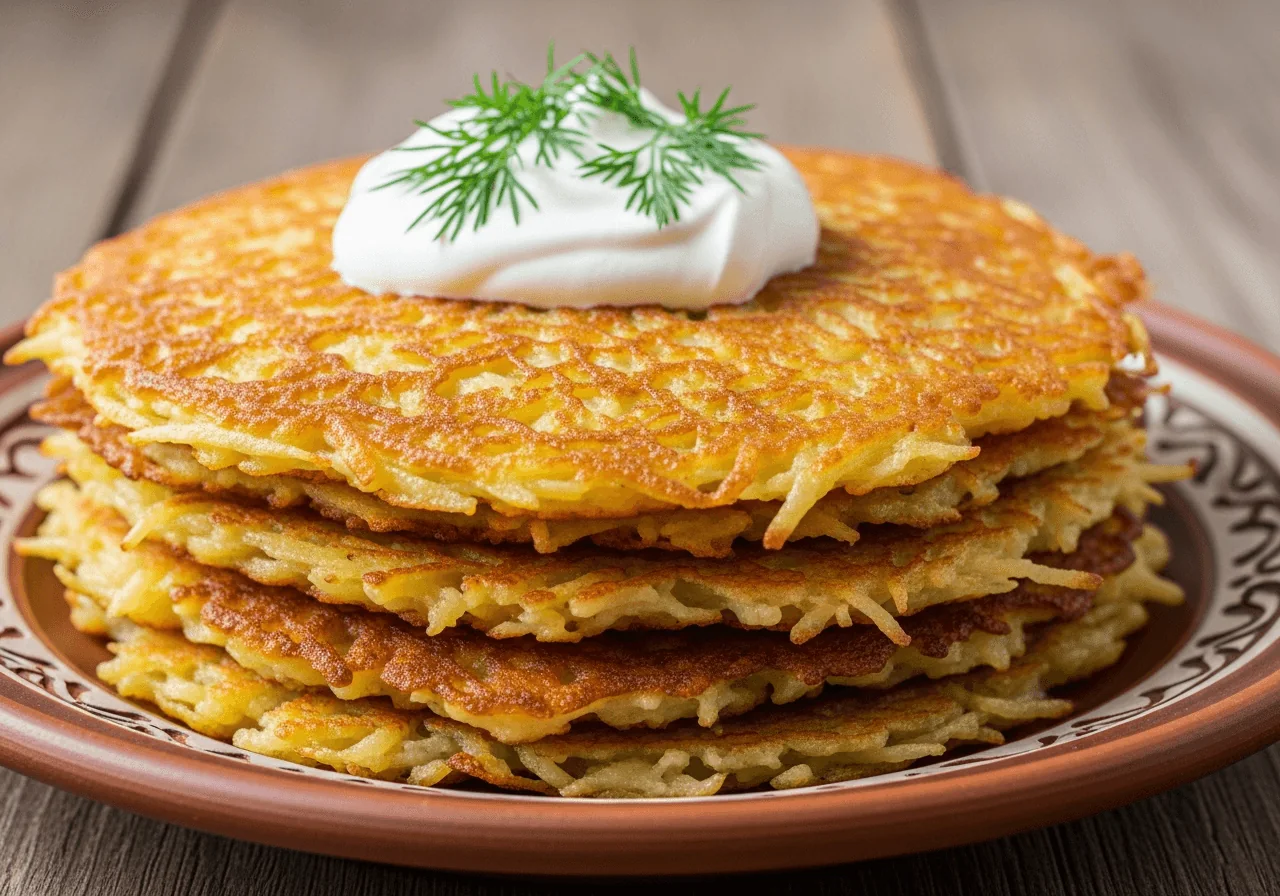
Deruny are eaten hot, straight from the pan, traditionally with a generous spoonful of cold sour cream on top and nothing more elaborate than that. In many households they’re served alongside something else from the same meal rather than as a stand-alone dish — a bowl of borsch, a simple cucumber salad, or just dark bread — so the pancakes themselves stay the center of attention.
Store leftover deruny in an airtight container in the refrigerator for up to 3 days.⁶ Reheat in a skillet over medium heat or in a 350°F (175°C) oven until warmed through and crisp again — both methods work better than a microwave, which leaves the edges soft instead of crackling.
Deruny also freeze well. Layer cooked, cooled pancakes between sheets of parchment or wax paper, then transfer to a freezer-safe container or bag for up to 2 months.⁶ Reheat straight from frozen in a skillet over medium heat, no need to thaw first.
Cultural Significance
History and Cultural Roots
The potato itself is a relative latecomer to Ukrainian cooking. It reached the region from the Americas by way of Europe in the 17th century, well after rye, buckwheat, and millet were already established staples.³ Once it took hold, though, it took hold completely — the potato became the single most-used vegetable in Ukrainian kitchens, essential to borsch, boiled and baked as a side on its own, and the base for dumpling fillings and pancakes alike.³
By the 19th century, deruny had settled into a specific place in rural life. They were a Sunday dish, made for breakfast or dinner, and they were also brought out for the festive table on certain holidays, including the Annunciation.² That rhythm — an everyday dish that could also dress up for a holiday — is part of why the recipe spread so widely and stayed so consistent from household to household: five ingredients, no specialty equipment, a method any cook already knew.
What changed from region to region was rarely the core technique. It was what got added around it — a clove of garlic worked into the batter in one household, a version finished in the oven after the pan for families who wanted something thicker, closer to a casserole.² That kind of variation is typical of dishes that were cooked weekly rather than for special occasions: the basic method gets passed down exactly, and the details get filled in by whatever a particular kitchen had on hand.
That continuity has held for more than a century now. Deruny made it through every upheaval of the 20th century without ever going out of fashion or needing to be rediscovered — they simply stayed on the stove, same five ingredients, same grater, generation after generation.² It’s a genuinely democratic dish, the kind many Ukrainians grew up on and still make without a second thought: no special occasion required, no expensive ingredients, nothing about it tied to a particular decade.⁴
The Korosten Deruny Festival
The town of Korosten in northern Ukraine has held an annual International Deruny Festival since September 2008, and the city has informally adopted the title “capital of deruny” as a result.⁴ The first festival featured a deruny weighing 118 kilograms; by the third festival in 2010, organizers had baked one measuring 2.5 meters long and weighing 136 kilograms, and the city unveiled Ukraine’s first monument to the dish in its Drevliansky Park the same year.⁴
The festival has drawn visitors from Belarus, Poland, France, Norway, Sweden, England, and Scotland, among other countries, and it’s recognized as an international event rather than a purely local one.⁴ It’s a strange, specific bit of civic pride — a city that decided a potato pancake was worth building an identity around — and it’s also a good reminder that this “simple” dish carries real weight in Ukrainian food culture.
Medical Disclaimer
The information in this article is provided for educational and informational purposes only. Heritage Healthy Kitchen makes no representations or warranties regarding the accuracy or completeness of any content on this site. Nutritional values are estimates only and will vary depending on the specific ingredients, brands, and measurements used. This content is not intended as dietary, medical, or professional nutritional advice. Always consult a qualified healthcare provider regarding any dietary needs or health conditions. Heritage Healthy Kitchen is not responsible for any outcomes resulting from the use of recipes or information published on this site.
Further Reading & Sources
The following sources were consulted in researching the history, technique, and cultural background of traditional Ukrainian deruny. Heritage Healthy Kitchen’s recipe was developed independently; these links are provided for readers who want to explore further.
- “Potato pancake.” Wikipedia. en.wikipedia.org/wiki/Potato_pancake — etymology of “deruny” from the Ukrainian verb derty (“to grate”), and overview of regional potato pancake traditions across Europe.
- “Deruny.” Authentic Ukraine (supported by the Ministry of Culture and Information Policy of Ukraine and Google Ukraine). authenticukraine.com.ua/en/food/deruny — regional names, traditional Sunday and holiday serving customs, and authentic technique notes.
- “Traditional foods.” Internet Encyclopedia of Ukraine, Canadian Institute of Ukrainian Studies, University of Toronto. encyclopediaofukraine.com — history of the potato’s arrival in Ukraine and its central role in Ukrainian cooking.
- “History of the International Deruny Festival in Korosten (Part 1).” Korosten City Council official portal. korosten-rada.gov.ua — official municipal history of the annual festival, including dates, records, and the Deruny Monument.
- “Are Potatoes Healthy?” The Nutrition Source, Harvard T.H. Chan School of Public Health. nutritionsource.hsph.harvard.edu/potatoes — nutrient content of potatoes, including potassium, fiber, and guidance on solanine in green-tinged potatoes.
- “Ukrainian Potato Pancakes (Deruny).” Fine Foods Blog. finefoodsblog.com/ukrainian-potato-pancakes-deruny — technique notes on grating, moisture control, and storage.
Traditional Ukrainian Deruny

Ingredients
For the batter (serves 4, about 14–16 pancakes)
- 1.5 kg (about 3.3 lb) starchy potatoes (russet or similar), peeled
- 1 large onion, peeled
- 2 large eggs
- 3–4 tablespoons all-purpose flour (or potato starch)
- 1 teaspoon salt, plus more to taste
- ½ teaspoon freshly ground black pepper
- Sunflower oil or other neutral oil, for frying
For serving
- Sour cream
- Fresh dill, chopped (optional)
Instructions
- Grate the potatoes and onion together, alternating handfuls — the onion’s juice keeps the potato from turning gray
- Drain off the excess liquid but leave a little moisture behind; deruny don’t need to be squeezed bone-dry
- Use a hot, well-oiled pan and don’t crowd it, or the pancakes steam instead of crisping
- Flip once the edges turn deep gold and slightly lacy, about 3–4 minutes per side
- Serve immediately, while the edges are still crackling, with a generous spoon of sour cream
Frequently Asked Questions
What’s the difference between deruny, draniki, and latkes?
They’re close cousins. Draniki is the Belarusian and Russian name for essentially the same grated potato pancake, and the dishes overlap heavily in border regions.¹ Latkes, the Ashkenazi Jewish version most associated with Hanukkah, share the same potato-and-onion base, though many traditional latke recipes skip the flour-and-egg binder common in Ukrainian versions and rely on a coarser grate instead. The cooking method is nearly identical across all three; the names, occasions, and small recipe details are what set them apart.
Do deruny always include egg and flour?
Most modern recipes do, since both help the pancakes hold together in the pan. Some older or more rural versions skip the egg and rely on the potato’s own starch as a binder, which works but produces a slightly more fragile pancake that needs gentler handling when you flip it.
Why do my deruny turn gray or fall apart in the pan?
Gray color usually means the grated potato sat too long before cooking and oxidized — work quickly, and alternate grating with onion as you go to slow that process.⁶ Pancakes that fall apart are typically either under-bound (not enough egg or flour for how wet the batter is) or flipped too early, before a proper crust has formed on the first side.
What’s the best potato for deruny?
Starchy potatoes like russets give the most authentic texture, since their lower water content and higher starch help the pancakes hold together and crisp well. Waxy potatoes work in a pinch but produce a denser, slightly gummier result.
Can deruny be made ahead of time?
The batter itself doesn’t hold well — grated potato continues to release liquid and oxidize the longer it sits, so it’s best mixed and fried within 20–30 minutes of grating. The cooked pancakes, though, reheat well, which makes deruny a reasonable make-ahead option as long as the frying happens close to grating time.
Is deruny vegetarian?
The base recipe is vegetarian, built from potato, onion, egg, and flour. It isn’t vegan as written because of the egg, though some traditional versions are made without one and rely on starch alone to bind, which makes them naturally egg-free.
Is the Korosten Deruny Festival a real, ongoing event?
Yes. It’s been held annually in Korosten since 2008, organized by the city council; the only confirmed interruption on record was in 2014, amid the national crisis of that year.⁴ It includes cooking competitions, a “Deruny from the Mayor” masterclass, and has at times doubled as a fundraising event for local causes.⁴
Can deruny be baked instead of fried?
Traditionally, no — the crisp, lacy edge that defines deruny comes from contact with hot oil, and baking produces a softer, more uniform texture that misses that contrast. That said, a baked version isn’t a bad option for a lighter take; it just isn’t the traditional method, and it changes the dish’s character more than most substitutions do.
Looking for a Lighter Version?
Traditional deruny are fried in a generous amount of oil, which is part of what gives them their crisp edges and rich flavor. A lighter version is possible without losing that character — our Healthy Deruny article covers oven-baked and air-fried methods, lower-sodium adjustments, and ways to boost the protein and fiber content while keeping the texture people actually want.
Cook by Occasion
This recipe is part of our Hanukkah menu.
You Might Also Like
More heritage recipes from our kitchen

Leave a Reply