

Active time: ~30 minutes | Total time: ~3.5–4 hours | Serves: 6 | Difficulty: Moderate
Quick Overview
- Start a whole chicken (or chicken pieces) in cold water and bring it to a bare simmer, skimming off the foam as it rises
- Char an onion directly over a flame, then add it along with carrots, parsnip (or parsley root), celeriac, and leek for color and depth
- Let the pot simmer on the lowest possible heat for 2.5–3 hours — never a rolling boil, or the broth turns cloudy
- Add fresh herbs near the end, strain everything through a fine sieve, and skim off the excess fat
- Serve the clear, golden broth hot over thin egg noodles, with a few pieces of chicken and a scatter of parsley
What Rosół Is
Rosół is Poland’s clear meat broth, most often made with chicken and known in that form as rosół z kury.1 It’s commonly served with thin egg noodles, known in Polish as makaron nitki.1 A vegetarian version exists too, built on oil or butter instead of meat, though it’s the chicken version that shows up at nearly every Polish table on a Sunday.1
The name comes from the Old Polish rozsół or rozsol, describing the process of desalting preserved meat — from sól, the Polish word for salt.1 Before refrigeration, meat was packed in salt to keep it edible, and cooking it in water rinsed out the salt while producing a broth as a side effect.1 Fresh meat eventually replaced salted meat, but the dish stuck around.
What sets rosół apart from an everyday stock is clarity. A proper rosół is golden and completely see-through, with nothing cloudy floating in it — a quality Polish cookbook writers were already fussing over a century ago.2
A Sunday Ritual
Rosół has long been the soup that starts cooking early on a Sunday morning and is ready by the time the family sits down for a relaxed afternoon meal.3 The classic pot holds a free-range hen, carrots, leeks, celeriac, parsnips, and a blackened onion, seasoned with allspice berries, bay leaves, black pepper, and lovage.3 Polish cooks have their own vocabulary for the process: a broth that’s simmering correctly is said to mrugać, or “wink,” and the little droplets of fat that float on the surface are called oka — “eyes.”3
Because making it well takes real time and a steady hand, rosół became something closer to the culinary equivalent of Sunday best — which is exactly why it opens the meal at Polish weddings too.3 There’s a saying for it: “Nie ma wesela bez rosołu” — there’s no wedding without rosół.5 Skipping it at a wedding reception isn’t really an option; the same goes for a proper family Sunday dinner.4
Polish households rarely cook just one bowl’s worth. A big pot is the norm, and the surplus has its own tradition: leftover rosół from Sunday often becomes the stock for Monday’s or Tuesday’s tomato soup, simmered with tomato puree and a dash of cream.3 No two families make it quite the same way.
From the 19th-Century Kitchen
Polish cookbooks from the 1800s and early 1900s treated broth as foundational — not a side dish, but the thing every other dish was built from. Bronisława Leśniewska, in her cookbook Polish Chef, told housewives a prudent kitchen always kept spare broth on hand, since it went into sauces, vegetables, and roasts.2
Some authors of the period, including Maria Ochorowicz-Monatowa, insisted a good broth required a special stone pot reserved only for that purpose. A few decades later, cookbook writer Elżbieta Kiewnarska dismissed that idea flatly as superstition.2
At the start of the 20th century, a broth made from several types of meat together started being called “royal broth,” to set it apart from the plainer, single-meat everyday version.2 Cookbook author Alina Gniewkowska described the everyday method: roughly 400 grams of beef per person, started in cold water, simmered slowly and covered for three to six hours, with the froth skimmed gently rather than boiled off.2 Elżbieta Kiewnarska, in her 1929 book Soups and Sauces, described what good broth should be: fragrant, lightly golden, and absolutely clear.2
Royal Broth, Hunter’s Broth — and Why No Pork
Rosół z kury, the chicken version, is the most common type today, but it’s not the only one.1 Rosół Królewski, or royal rosół, combines three kinds of meat — beef or veal, a white poultry such as hen or turkey, and a dark poultry such as duck or goose — along with a few dried king bolete mushrooms, a single cabbage leaf, and the usual root vegetables.1 It’s meant to simmer for at least six hours, with a lightly charred onion stirred in toward the end.1
Rosół Myśliwski, the hunter’s version, swaps in wild game — pheasant, partridge, grouse, or similar birds — with a small amount of roe deer meat, wild mushrooms, and a few juniper berries.1 Across every version, one rule holds firm: no pork. Pork fat clouds the broth, undoing the clarity that defines a proper rosół, so cooks leave it out entirely and avoid a hard boil for the same reason.1
Rosół as a Remedy
Rosół carries a reputation as Poland’s answer to the common cold, sometimes called “Polish penicillin” — the dish people bring to a sick relative or reach for themselves at the first sniffle.5 Chicken soup turns up as a cold remedy across many cultures, and there’s a real, if modest, body of research behind it.
Mayo Clinic lists warm liquids, including chicken soup, tea, and warm apple juice, as a remedy that may ease congestion by increasing mucus flow, even though nothing actually cures a cold.6 A frequently cited study from researchers at the University of Nebraska Medical Center, built around one of the researchers’ own family chicken soup recipe, found that the soup had a mild anti-inflammatory effect on blood drawn from healthy volunteers, possibly because it slows the movement of neutrophils, a type of white blood cell involved in inflammation.7
The researchers themselves were careful to note that the study wasn’t a clinical trial, and the effect was modest enough that no real conclusions could be drawn about whether it helps a cold in practice.7 One physician summed it up simply: the nutritional benefits of chicken soup for speeding up cold recovery are probably minimal.7
None of that erases what rosół actually does well: it delivers fluids and warmth at a moment when both matter, and breathing in its steam can loosen a stuffy nose for a little while.6,7
Traditional Rosół Recipe
Recipe developed independently by Heritage Healthy Kitchen, drawing on traditional Polish culinary methods. Sources for further reading are listed at the end of this article.
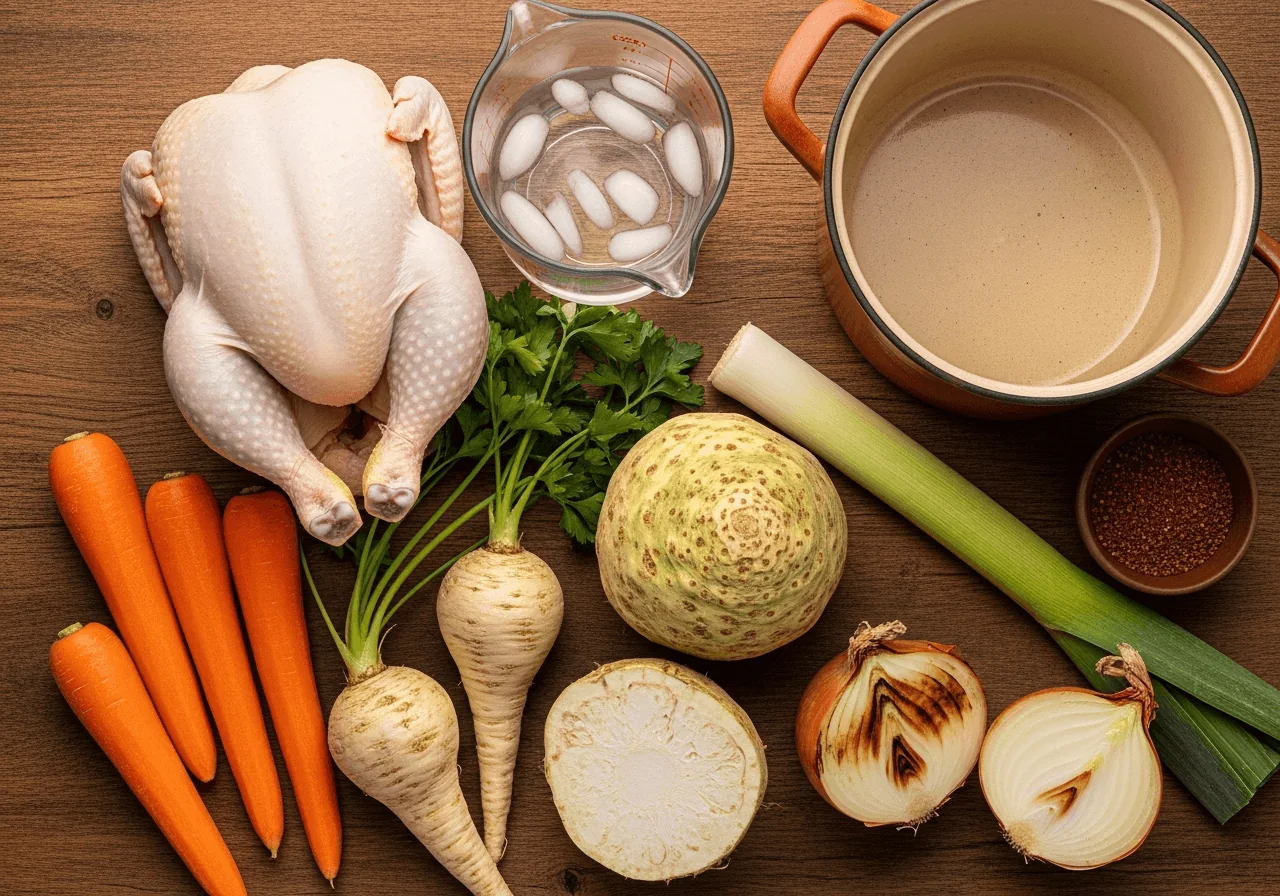
Ingredients
For the broth (serves 6)
- 1 whole chicken (about 1.8–2 kg / 4–4.5 lb), or a mix of chicken legs, thighs, and wings for extra flavor
- 3.5 liters (about 15 cups) cold water
- 3 medium carrots, peeled
- 2 parsley roots (or 2 small parsnips), peeled
- 1 small celeriac (celery root), peeled and halved
- 1 leek, white and light green parts, halved lengthwise and rinsed well
- 1 medium onion, unpeeled, halved
- A small bunch of fresh lovage, or 1–2 teaspoons dried (substitute a few extra celery leaves if unavailable)
- A small bunch of fresh parsley, stems included
- 8–10 black peppercorns
- 4–5 allspice berries
- 2 bay leaves
- Salt, added near the end of cooking
For serving
- Fine egg noodles (makaron nitki) or small egg dumplings (lane kluski)
- Chopped fresh parsley
- Cooked chicken meat and a few pieces of the cooked vegetables, if desired
Instructions
Step 1: Start the broth cold
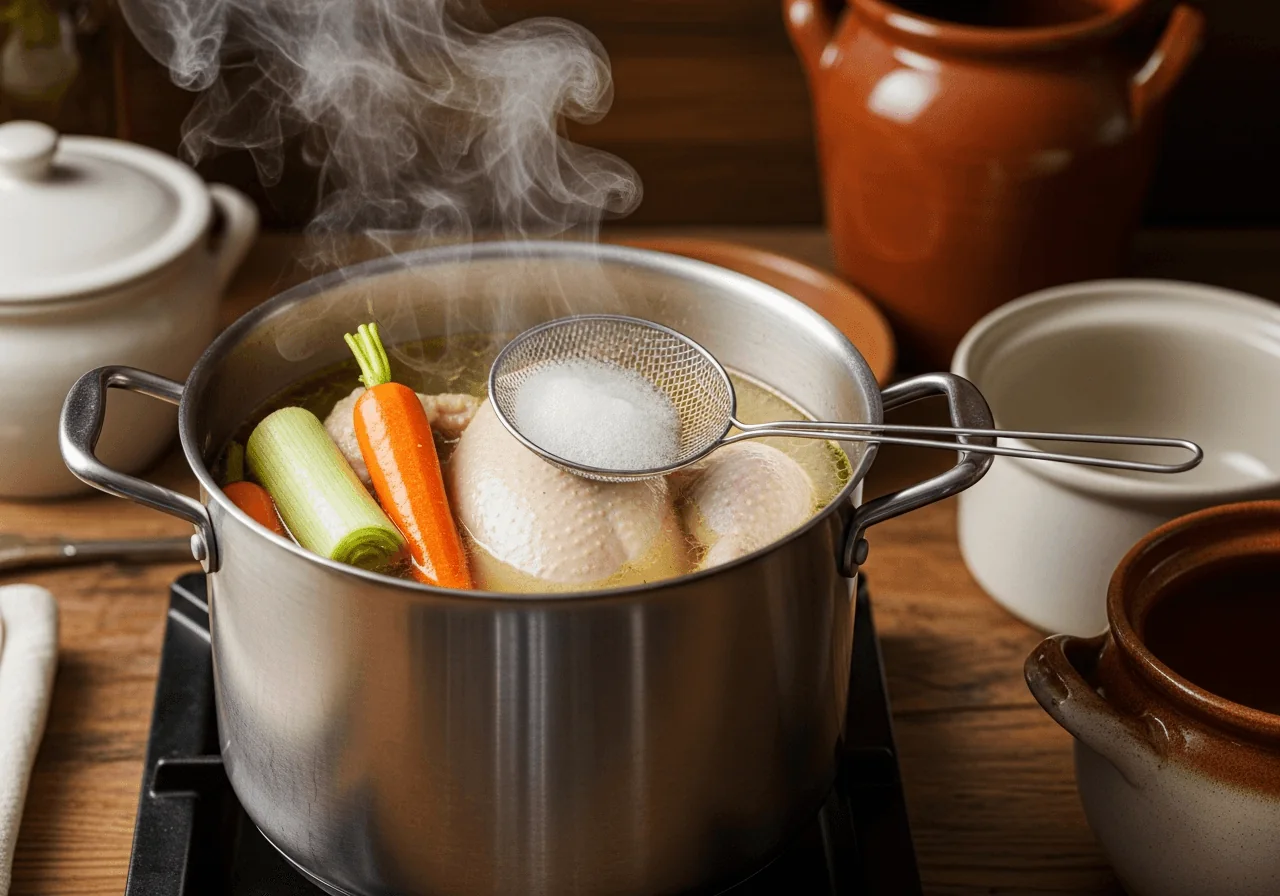
Place the chicken in a large stockpot and cover it with the cold water. Bring it to a bare simmer slowly, over medium-low heat, which should take 15–20 minutes. Starting from cold water draws more flavor into the broth as it heats.
Step 2: Skim the foam
As the water heats, foam and impurities rise to the surface. Skim them off with a ladle or slotted spoon for the first 20–30 minutes. This step does most of the work toward a clear broth, so it’s worth doing patiently rather than rushing past it.
Step 3: Char the onion
While the broth is heating, place the onion halves cut-side down directly on a gas burner or in a dry skillet until the cut surface blackens. This single step is what gives rosół its golden color, so don’t skip it even if it feels unusual.
Step 4: Add the vegetables and simmer
Once most of the foam has been skimmed, add the carrots, parsley roots, celeriac, leek, charred onion, peppercorns, allspice, and bay leaves. Reduce the heat as low as it will go — the surface should barely move, just the occasional bubble. Cover partially and let it simmer for 2.5–3 hours without stirring.
Step 5: Add fresh herbs
About 30 minutes before the end of cooking, add the lovage and parsley. Add salt only at this point, then taste and adjust.
Step 6: Strain and degrease
Lift out the chicken and set it aside to cool. Strain the broth through a fine-mesh sieve, discarding the cooked vegetables, which have given up their flavor by this point. Let the broth sit briefly, then skim off the excess fat from the surface, or refrigerate it overnight and lift off the solidified fat the next day.
Step 7: Serve
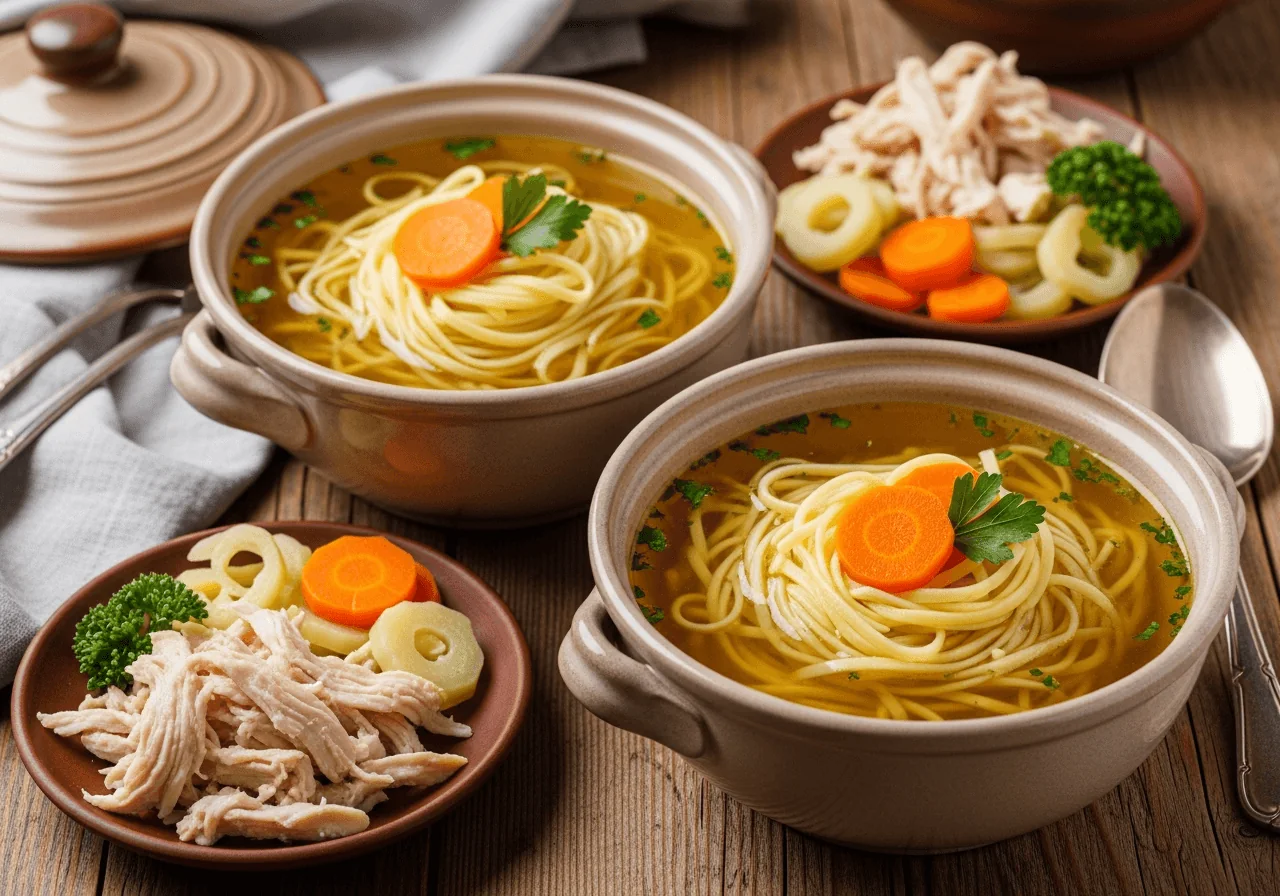
Cook the noodles or kluski separately in salted water, then divide them among bowls. Ladle the hot, clear broth over the top, add a few pieces of chicken if desired, and finish with chopped parsley.
Kitchen Tips
Cloudy broth almost always comes down to one mistake: letting the pot boil hard, or stirring it too much while it cooks. Once the broth hits a rolling boil, the proteins in the meat break apart into tiny particles that cloud the liquid, and there’s no fixing that by simmering it back down.4
If the broth does come out cloudy anyway, there’s a reliable fix. Chill the broth completely, whisk in two egg whites, and reheat it slowly while stirring continuously — the egg whites bind up the cloudy particles as they cook, and straining through cheesecloth afterward leaves a perfectly clear broth.4
Włoszczyzna — the standard Polish soup vegetable mix of carrot, parsnip (or parsley root, a similar root some recipes use instead), celeriac, and leek — comes pre-bundled in most Polish grocery stores, but it’s easy enough to assemble from a regular produce aisle elsewhere.1
Nutritional Information
Per serving (broth, chicken, and noodles, 1 of 6 servings)
- Calories: approximately 280–340 kcal
- Protein: ~24–28g
- Total fat: ~10–14g
- Carbohydrates: ~20–24g
- Sodium: ~450–600mg (varies considerably with added salt)
Nutritional values are estimates based on standard ingredient databases. They will vary depending on the cut of chicken used, how much fat is skimmed, and the amount of salt and noodles added.
Storage and Reheating
Refrigerate rosół in an airtight container for 3–4 days, following the same guidelines that apply to soups, stews, and meat broth generally.8 Cool it to room temperature before refrigerating, and divide a large batch into smaller, shallower containers so it chills quickly and safely.
Rosół freezes well for 2–3 months.8 It’s worth freezing the broth separately from the noodles, since noodles turn soft and waterlogged after thawing — cook a fresh batch each time instead. Reheat the broth thoroughly until it’s steaming hot throughout before serving.
Traditional Rosół

Ingredients
For the broth (serves 6)
- 1 whole chicken (about 1.8–2 kg / 4–4.5 lb), or a mix of chicken legs, thighs, and wings for extra flavor
- 3.5 liters (about 15 cups) cold water
- 3 medium carrots, peeled
- 2 parsley roots (or 2 small parsnips), peeled
- 1 small celeriac (celery root), peeled and halved
- 1 leek, white and light green parts, halved lengthwise and rinsed well
- 1 medium onion, unpeeled, halved
- A small bunch of fresh lovage, or 1–2 teaspoons dried (substitute a few extra celery leaves if unavailable)
- A small bunch of fresh parsley, stems included
- 8–10 black peppercorns
- 4–5 allspice berries
- 2 bay leaves
- Salt, added near the end of cooking
For serving
- Fine egg noodles (makaron nitki) or small egg dumplings (lane kluski)
- Chopped fresh parsley
- Cooked chicken meat and a few pieces of the cooked vegetables, if desired
Instructions
- Start a whole chicken (or chicken pieces) in cold water and bring it to a bare simmer, skimming off the foam as it rises
- Char an onion directly over a flame, then add it along with carrots, parsnip (or parsley root), celeriac, and leek for color and depth
- Let the pot simmer on the lowest possible heat for 2.5–3 hours — never a rolling boil, or the broth turns cloudy
- Add fresh herbs near the end, strain everything through a fine sieve, and skim off the excess fat
- Serve the clear, golden broth hot over thin egg noodles, with a few pieces of chicken and a scatter of parsley
Frequently Asked Questions
Why did my rosół turn out cloudy?
Almost certainly because the broth boiled hard at some point, or got stirred too often while cooking. Keep the heat low enough that the surface barely moves, and resist the urge to check on it constantly.4
What’s the difference between rosół and regular chicken stock?
The main difference is intent and clarity. Rosół is meant to be a finished, seasoned soup in its own right, served as-is with noodles, while a plain stock is usually an unsalted base meant for cooking other things.2
Can rosół be made with beef instead of chicken?
Yes — beef rosół was historically the more common “everyday broth” in Polish households, made with around 400 grams of beef per person and the same root vegetables.2 Chicken rosół became the more familiar version over time, but beef and mixed-meat versions are equally traditional.
Why is pork never used in rosół?
Pork fat clouds the broth and works against the clear, golden result that defines a proper rosół, so it’s left out across every regional and traditional variation.1
What is włoszczyzna, and can it be substituted?
It’s the standard Polish mix of carrot, parsnip, celeriac, and leek used as the vegetable base for most Polish soups.1 Some Polish recipes use parsley root instead of parsnip — a different but visually similar root with a more herbal flavor — and the two are commonly swapped for each other.4
Does rosół actually help with a cold?
The evidence is real but modest. Warm liquids may ease congestion by increasing mucus flow, and one well-known study found a mild anti-inflammatory effect from chicken soup in laboratory conditions — though the researchers themselves stressed it wasn’t a clinical trial.6,7 It’s a comfort food with a bit of science behind it, not a substitute for medical care.
How long does rosół keep, and does it freeze well?
Refrigerated, it keeps for 3–4 days; frozen, for 2–3 months, in line with general guidelines for soups and meat broths.8 Freeze the broth on its own and cook noodles fresh each time, since noodles don’t hold up well after freezing and thawing.
Looking for a Lighter Version?
Traditional rosół already leans toward the lighter end of Polish cooking, but there’s still room to adjust it — skimming the fat more thoroughly, leaning on extra vegetables, or swapping in whole-grain or lower-sodium noodles without losing the dish’s character. A separate Healthy Rosół article on this site will walk through those adjustments in more detail.
Further Reading & Sources
The following sources were consulted in researching the history, technique, and cultural background of traditional rosół. Heritage Healthy Kitchen’s recipe was developed independently; these links are provided for readers who want to explore further.
- “Rosół.” Wikipedia. en.wikipedia.org/wiki/Rosół — etymology, definition, włoszczyzna vegetables, and the types of rosół including Królewski and Myśliwski, with the no-pork rule.
- “The Secrets of Polish Broth.” Culture.pl, Adam Mickiewicz Institute. culture.pl/en/article/the-secrets-of-polish-broth — 19th- and early 20th-century Polish cookbook quotes on broth-making, the origin of the “royal broth” term, and historical technique.
- “All Saints’ Day Soup? The Sunday Soup?: A Soup for Every Occasion.” Culture.pl, Adam Mickiewicz Institute. culture.pl/en/article/all-saints-day-soup — the Sunday-soup and wedding-soup traditions, the terms mrugać and oka, and the leftover-rosół tomato soup custom.
- “This ‘Rosół’ (Polish Chicken Soup) Is Endlessly Nourishing.” The Polonist. polonist.com/polish-chicken-soup-rosol — ingredient guidance, lovage, causes of cloudy broth, and the egg-white clarification technique.
- “Rosół: Poland’s Golden Healing Chicken Soup.” Bay Area Polish Group. bayareapolishgroup.com/en/food/rosol — the “Polish penicillin” nickname and the wedding saying “Nie ma wesela bez rosołu.”
- “Cold remedies: What works, what doesn’t, what can’t hurt.” Mayo Clinic. mayoclinic.org/diseases-conditions/common-cold/in-depth/cold-remedies — warm liquids and chicken soup as a cold remedy that may ease congestion.
- “4 Cold and Flu Old Wives’ Tales That Are Myths.” AARP. aarp.org/health/conditions-treatments/cold-and-flu-wives-tales-myths — the University of Nebraska Medical Center chicken soup study, its findings, and its limitations.
- “Keep Food Safe! Food Safety Basics.” USDA Food Safety and Inspection Service. fsis.usda.gov/food-safety/safe-food-handling-and-preparation/food-safety-basics — refrigerator and freezer storage times for soups, stews, and meat broth.
Disclaimer
The information in this article is provided for educational and informational purposes only. Heritage Healthy Kitchen makes no representations or warranties regarding the accuracy or completeness of any content on this site. Nutritional values are estimates only and will vary depending on the specific ingredients, brands, and measurements used. This content is not intended as dietary, medical, or professional nutritional advice. Always consult a qualified healthcare provider regarding any dietary needs or health conditions. Heritage Healthy Kitchen is not responsible for any outcomes resulting from the use of recipes or information published on this site.
You Might Also Like
More heritage recipes from our kitchen

Leave a Reply