

Active time: ~45 minutes | Total time: ~1 hour | Serves: 6 (about 12 blintzes) | Difficulty: Moderate
Quick Overview
- Whisk a thin, eggy batter and let it rest before cooking
- Cook the batter into delicate crepes in a lightly buttered pan
- Mix farmer’s cheese with egg yolk, sugar, and vanilla for the filling
- Fill, fold, and pan-fry each blintz in butter until golden
- Serve warm with sour cream and fruit preserves
What Blintzes Are
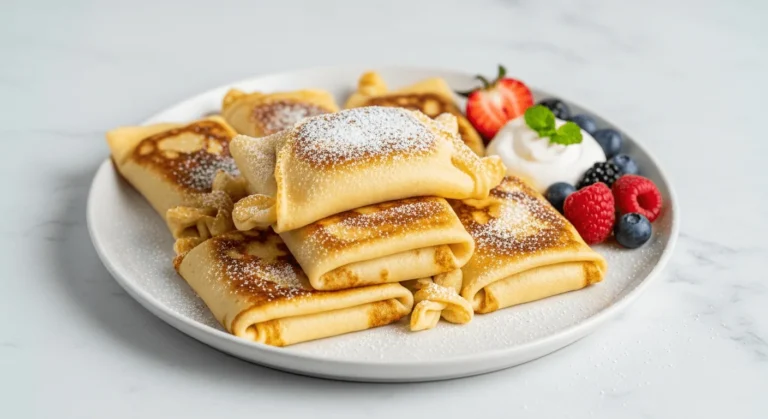
A blintz is a rolled, filled pancake that sits at the center of Ashkenazi Jewish cooking, built on a thin batter closer to a crepe than to a thick American pancake.1 The traditional filling is sweetened farmer’s cheese, sometimes studded with raisins, though fruit preserves show up too.1 Once filled, the pancake is folded into a small parcel and lightly pan-fried a second time.1
Blintzes are best known today as the signature dish of Shavuot, the holiday marking the giving of the Torah, though they turn up at Jewish tables, delis, and brunch spreads throughout the year.1,3 The name itself carries a long journey through language and geography, one that starts well outside the Jewish kitchen.
From Slavic Pancake to Jewish Kitchen
The word blintz comes from the Yiddish blintse, which descends from a Slavic word, blinets, meaning literally “little blin,” or little pancake.1 Food writers trace the dish itself to the same Slavic lands, particularly Russia and Ukraine, where Ashkenazi Jewish communities lived for centuries alongside Slavic neighbors who ate their own versions of thin, filled pancakes.2
Jewish cooks adopted both the pancake and its name, a pattern that runs through much of Ashkenazi cooking: dishes crossed over from non-Jewish neighbors and were reshaped to fit Jewish dietary law and the holiday calendar along the way.1 Blintzes carry that history in their name as plainly as any dish on the Ashkenazi table.
What sets a blintz apart from a plain crepe is the second round of cooking. A crepe is finished the moment it leaves the pan; a blintz is cooked once as a bare pancake, then again after it has been filled and folded, pan-fried in butter until the outside turns golden and slightly crisp.2 A close relative, syrniki — small fried cakes made from farmer’s cheese, egg, and sugar, with no pancake wrapper at all — sits in the same family of dishes.2
The traditional filling itself relies on farmer’s cheese, a pressed, low-moisture cheese with a firmer texture than the cottage cheese found in most American supermarkets.2 Where farmer’s cheese isn’t available, well-drained, pressed cottage cheese is the standard stand-in.2
Why Blintzes Belong to the Shavuot Table
Shavuot marks the giving of the Torah at Mount Sinai, and across Jewish communities it stands out as the one major holiday built around a dairy meal rather than a meat one.3 Cheese in general, and blintzes in particular, are the food most associated with the day in Ashkenazi households.3
No single explanation for the custom has ever settled the matter, and Jewish sources have long offered several explanations side by side. Some trace it to the Torah’s description of Israel as a land flowing with milk and honey; others point to a numerical reading in which the Hebrew word for milk, chalav, adds up to forty — the same number as the days Moses spent on Mount Sinai receiving the Torah.3
A more practical theory holds that once the Israelites received the dietary laws at Sinai, they had no properly kosher meat on hand and no time to prepare any, so the dairy already in camp became the meal.3 In some communities, a dairy meal is still followed by a meat meal after the required waiting period, echoing the two loaves once brought as an offering on the holiday.3
Whichever explanation a family favors, cheese became the ingredient that defines the day, and blintzes joined cheesecake, kreplach, and the Sephardic bourekas as one of its most recognizable dishes.3
From Eastern Europe to the New York Deli
Ashkenazi Jewish immigrants from Ukraine, Russia, and Hungary carried blintzes with them wherever they settled; in Hungary, the same style of filled pancake goes by the name palacsinta.2 Large numbers arrived in the United States in the late nineteenth and early twentieth centuries and settled the Jewish immigrant community of Manhattan’s Lower East Side.7
Among the businesses these immigrants built were kosher dairy restaurants, known in Yiddish as milchig, which served only fish, eggs, and dairy so that meat and milk never had to share a kitchen under Jewish dietary law.6,7 These restaurants descended from earlier European milk pavilions and dairy cafes.7
A few overlapping forces pushed the dairy restaurant’s growth. Kosher meat prices spiked sharply enough in 1902 to touch off boycotts and street protests by Jewish housewives on the Lower East Side; commercial refrigeration made fresh milk and cream safe and affordable for the first time; and a vegetarian movement among some progressive Jewish thinkers gave dairy eating its own momentum.7
One of the most famous was Ratner’s, which opened on the Lower East Side in 1905 and kept cheese blintzes on the menu alongside potato pancakes, onion rolls, and gefilte fish; at its peak, the restaurant served as many as 1,200 people a day.8 Historians describe these dairy restaurants as “third spaces,” not home and not work, somewhere people could sit for the price of a meal and talk.6
Few of these restaurants survive today. B&H Dairy, open continuously in Manhattan’s East Village since 1938, is widely considered the last of its kind, still serving the dishes that once filled hundreds of similar counters across the city.6
On the Holiday Table
Cheese has a second holiday. Blintzes are eaten at Hanukkah too, part of a dairy custom that goes back to Judith, who in the medieval retelling fed an enemy general salty cheese before killing him; that is why they sit on our Hanukkah menu.⁹
Traditional Blintzes Recipe
Recipe developed independently by Heritage Healthy Kitchen, drawing on traditional Ashkenazi Jewish techniques. Sources for further reading are listed at the end of this article.
Ingredients
For the crepes (makes about 12)
- 1 cup (125g) all-purpose flour
- 2 large eggs
- 1¼ cups (300ml) whole milk
- 2 tablespoons unsalted butter, melted, plus more for the pan
- 1 tablespoon granulated sugar
- ¼ teaspoon fine salt

For the filling
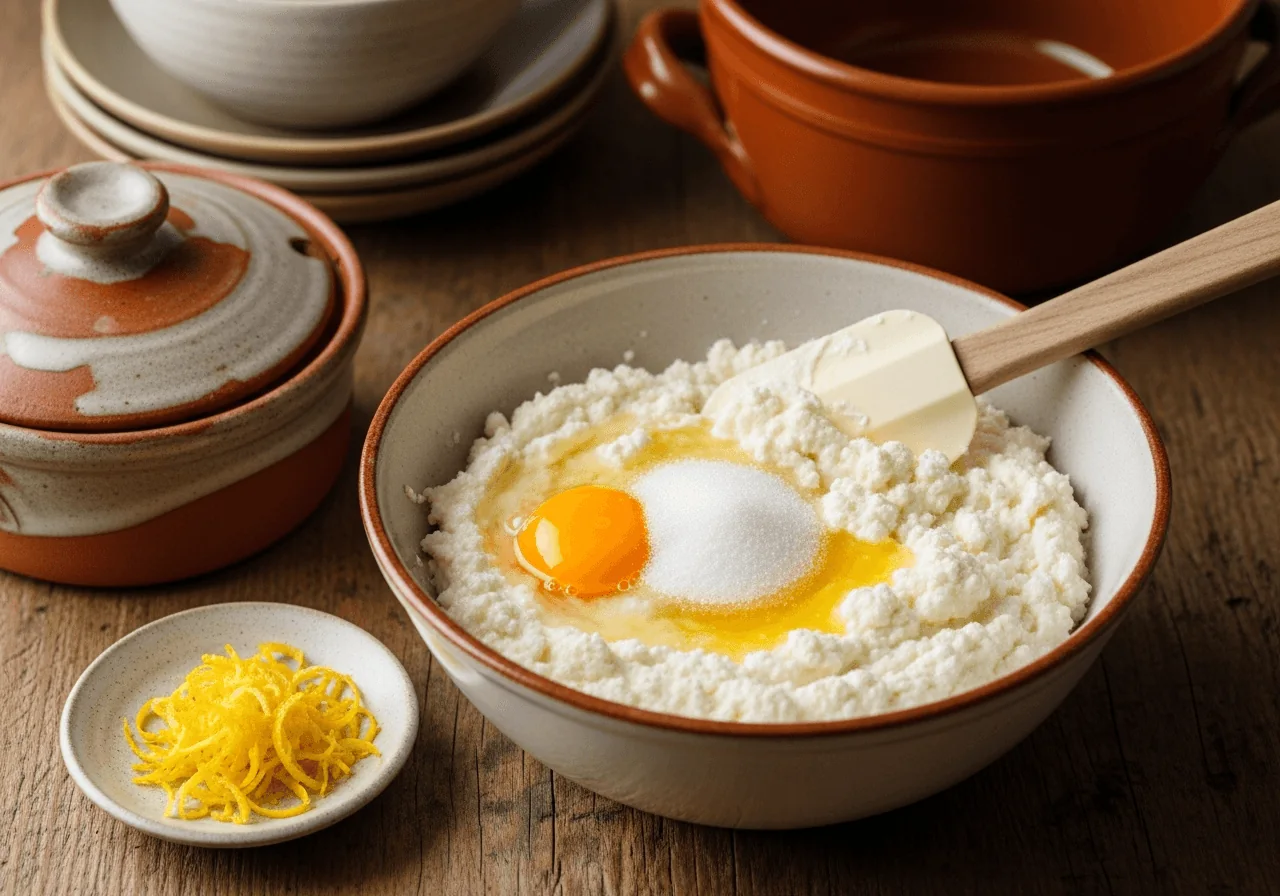
- 2 cups (450g) farmer’s cheese, or well-drained cottage cheese
- 1 large egg yolk
- 3 tablespoons granulated sugar
- 1 teaspoon vanilla extract
- ¼ teaspoon fine salt
- Zest of ½ lemon (optional)
For frying and serving
- 3–4 tablespoons unsalted butter
- Sour cream, for serving
- Fruit preserves or fresh berries, for serving
Instructions

- Make the batter. Whisk the flour, eggs, milk, melted butter, sugar, and salt together until completely smooth. Let the batter rest for 15–20 minutes; this gives the flour time to hydrate fully.
- Cook the crepes. Heat a lightly buttered 8-inch nonstick skillet over medium heat. Pour in a thin layer of batter, swirling to coat the pan, and cook for about 45 seconds until the surface looks dry and the edges lift. Flip and cook the second side for 10–15 seconds, then stack the finished crepes between sheets of parchment paper.
- Make the filling. Stir together the farmer’s cheese, egg yolk, sugar, vanilla, salt, and lemon zest until evenly combined.
- Fill and fold. Lay each crepe browned-side up. Place about 2–3 tablespoons of filling near one edge, fold the sides in over the filling, then roll into a tight rectangular parcel.
- Fry. Melt butter in a skillet over medium heat and cook the filled blintzes seam-side down first, turning once, until golden brown on both sides, about 2–3 minutes per side.
- Serve. Serve warm, topped with sour cream and fruit preserves or fresh berries.
Kitchen Tips
Letting the batter rest before cooking isn’t optional if the goal is a tender crepe rather than a rubbery one; the resting time lets the flour’s starches fully absorb the liquid.
Only one side of each crepe browns much during the first cook, so keep track of which side that is and use it as the outside of the finished blintz once it’s rolled.
If the farmer’s cheese looks watery, press it through a fine sieve or a few layers of cheesecloth for several minutes before mixing the filling. A wet filling is the most common reason blintzes fall apart or turn soggy in the pan.
Nutritional Information
Per serving (2 blintzes, based on 6 servings)

- Calories: approximately 310–350 kcal
- Protein: ~14–16g
- Total fat: ~17–19g
- Carbohydrates: ~27–31g
- Sodium: ~470–560mg
Nutritional values are estimates calculated from raw ingredient quantities using standard nutrient databases; actual values will vary with the specific cheese, milk fat content, and butter used. Cottage cheese, the base for farmer’s cheese, is a good source of protein and calcium, but it is also naturally high in sodium and sits toward the higher end of dairy foods for lactose content compared to firm, aged cheeses.5
Storage and Reheating
Store cooked, filled blintzes in an airtight container in the refrigerator for up to 3 days.
Reheat in a lightly buttered skillet over medium-low heat until warmed through and the outside crisps again. Microwaving works in a pinch but leaves the pancake soft rather than crisp.
Uncooked, unfilled crepes freeze well on their own, stacked with parchment paper between each one, for up to 2 months. Thaw them before filling and frying.
Traditional Blintzes

Ingredients
For the crepes (makes about 12)
- 1 cup (125g) all-purpose flour
- 2 large eggs
- 1¼ cups (300ml) whole milk
- 2 tablespoons unsalted butter, melted, plus more for the pan
- 1 tablespoon granulated sugar
- ¼ teaspoon fine salt
For the filling
- 2 cups (450g) farmer’s cheese, or well-drained cottage cheese
- 1 large egg yolk
- 3 tablespoons granulated sugar
- 1 teaspoon vanilla extract
- ¼ teaspoon fine salt
- Zest of ½ lemon (optional)
For frying and serving
- 3–4 tablespoons unsalted butter
- Sour cream, for serving
- Fruit preserves or fresh berries, for serving
Instructions
- Make the batter. Whisk the flour, eggs, milk, melted butter, sugar, and salt together until completely smooth. Let the batter rest for 15–20 minutes; this gives the flour time to hydrate fully.
- Cook the crepes. Heat a lightly buttered 8-inch nonstick skillet over medium heat. Pour in a thin layer of batter, swirling to coat the pan, and cook for about 45 seconds until the surface looks dry and the edges lift. Flip and cook the second side for 10–15 seconds, then stack the finished crepes between sheets of parchment paper.
- Make the filling. Stir together the farmer’s cheese, egg yolk, sugar, vanilla, salt, and lemon zest until evenly combined.
- Fill and fold. Lay each crepe browned-side up. Place about 2–3 tablespoons of filling near one edge, fold the sides in over the filling, then roll into a tight rectangular parcel.
- Fry. Melt butter in a skillet over medium heat and cook the filled blintzes seam-side down first, turning once, until golden brown on both sides, about 2–3 minutes per side.
- Serve. Serve warm, topped with sour cream and fruit preserves or fresh berries.
Frequently Asked Questions
What’s the difference between a blintz and a crepe?
Both start from a similar thin batter, but a blintz is filled, folded, and pan-fried a second time in butter, while a crepe is typically finished the moment it leaves the pan.2
Why are blintzes associated with Shavuot specifically?
Shavuot is the one Jewish holiday built around a dairy meal, and several explanations exist side by side, from the Torah’s description of a land flowing with milk and honey to a numerical reading tying the word for milk to the number of days Moses spent on Sinai.3
What is farmer’s cheese, and can it be substituted?
Farmer’s cheese is a pressed, low-moisture cottage cheese with a firm texture. Well-drained, pressed cottage cheese is the standard substitute where farmer’s cheese isn’t available.2
Can blintzes be made ahead and frozen?
Yes. The unfilled crepes freeze well on their own, which makes it practical to prepare a large batch of wrappers ahead of time and fill them closer to serving.2
Where does the word “blintz” come from?
It travels from the Yiddish blintse back to a Slavic word for a small pancake, blinets, tracing the dish’s roots to the Slavic lands of Eastern Europe.1
Why do some people find blintzes hard to digest?
Cottage and farmer’s cheese sit toward the higher end of the lactose scale among cheeses,5 which can matter given that an estimated 60 to 80 percent of Ashkenazi Jews experience some degree of lactose intolerance.4
What were Jewish dairy restaurants?
Kosher restaurants, often called milchig, that served only fish, eggs, and dairy and never meat, so that Jewish dietary law’s separation of milk and meat never became a kitchen problem. They were once common across Jewish neighborhoods in New York City.6,7
Is a blintz the same thing as blini or blinchiki?
Not quite. A blintz is built on the same base as Russian blini, but its closer relative is blinchiki, a Russian dish whose name literally means “little blini” and which can be filled with almost anything, while “blintz” in English specifically means the sweetened, cheese-filled, twice-cooked Jewish version.1
Looking for a Lighter Version?
Traditional blintzes lean on full-fat cheese, butter, and sugar by design, and there’s real room to lighten each part without losing the dish’s character: a lower-fat cheese filling, a baked instead of pan-fried finish, a lighter hand with sugar. A separate Healthy Blintzes article on this site works through those swaps in detail.
Further Reading & Sources
The following sources were consulted in researching the history, cultural context, and technique of traditional blintzes. Heritage Healthy Kitchen’s recipe was developed independently; these links are provided for readers who want to explore further.
- “Blintz.” Wikipedia. en.wikipedia.org/wiki/Blintz — definition, traditional filling and preparation, the Shavuot connection, and the Yiddish and Slavic etymology of the name.
- Siva, Micah. “What Are Blintzes and Why Are They Jewish?” Aish. aish.com/what-are-blintzes-and-why-are-they-jewish — Slavic origins, the technical difference between blintzes and crepes, farmer’s cheese and its substitutes, and the syrniki connection.
- Koppelman Ross, Lesli. “Why Dairy on Shavuot?” My Jewish Learning. myjewishlearning.com/article/why-dairy-on-shavuot — the range of traditional explanations for the Shavuot dairy custom.
- Goosenberg, Eric, and Muriam Afzal. “Lactose Intolerance.” StatPearls, NCBI Bookshelf, National Library of Medicine. ncbi.nlm.nih.gov/books/NBK532285 — prevalence of lactose intolerance among Ashkenazi Jewish populations.
- “Cheese.” The Nutrition Source, Harvard T.H. Chan School of Public Health. nutritionsource.hsph.harvard.edu/cheese — nutritional composition of cottage and soft cheeses, and lactose content across cheese types.
- Yadin, Hallel. “The Origins and Evolutions of the Kosher Dairy.” Smithsonian Center for Folklife and Cultural Heritage. folklife.si.edu/magazine/kosher-dairy — the history of kosher dairy restaurants in New York City, their role as community gathering places, and the survival of B&H Dairy.
- “Jewish dairy restaurant.” Wikipedia. en.wikipedia.org/wiki/Jewish_dairy_restaurant — origins of the milchig restaurant in Europe, the forces behind its growth on the Lower East Side, and the 1902 kosher meat boycotts.
- “Ratner’s.” Wikipedia. en.wikipedia.org/wiki/Ratner’s — the founding, menu, and scale of the Lower East Side dairy restaurant Ratner’s.
- “A Hidden Hanukkah Tale of a Woman, an Army and Some Killer Cheese.” NPR. npr.org — the Judith story and the Hanukkah custom of eating cheese and dairy dishes.
Disclaimer
The information in this article is provided for educational and informational purposes only. Heritage Healthy Kitchen makes no representations or warranties regarding the accuracy or completeness of any content on this site. Nutritional values are estimates only and will vary depending on the specific ingredients, brands, and measurements used. This content is not intended as dietary, medical, or professional nutritional advice. Always consult a qualified healthcare provider regarding any dietary needs or health conditions. Heritage Healthy Kitchen is not responsible for any outcomes resulting from the use of recipes or information published on this site.
Cook by Occasion
This recipe is part of our Hanukkah menu.
You Might Also Like
More heritage recipes from our kitchen

Leave a Reply