

Part of our Heritage Kitchen Glossary – short guides to the ingredients and techniques behind Eastern European cooking.
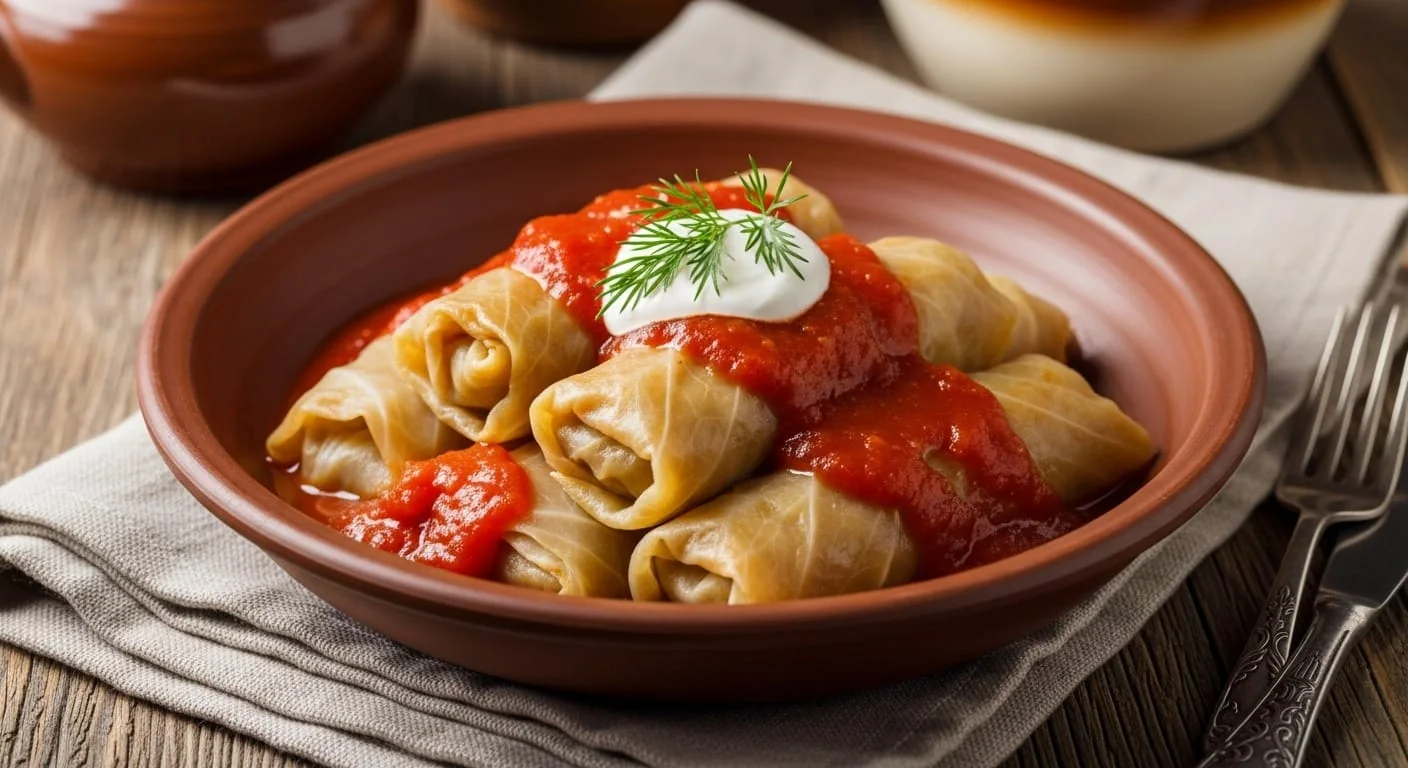
Put a plate of holubtsi next to a plate of gołąbki and almost nobody could tell you which is which. Both are cabbage leaves blanched soft, wrapped around rice and minced pork, braised in tomato sauce for well over an hour. Both names mean the same thing: little doves. The differences are small. They are also real, and a Ukrainian cook would spot the Polish version across a room.
Two names, one bird
Ukrainian holub and Polish gołąb both mean pigeon. The usual explanation is that a rolled leaf with its ends tucked in looks like a small bird sitting on the plate, which is charming and may well be wrong. Polish linguist Marek Stachowski thinks the word is a much older borrowing from Persian or Armenian terms for cabbage, reshaped later by folk etymology into something that happened to sound like a bird. Max Vasmer took the dove story at face value. Nobody has settled it, and the honest answer is that a thousand years of home cooks are not required to explain themselves.
One grammatical note that trips up English speakers: gołąbki is plural. A single roll is a gołąbek. You would never call one roll “a gołąbki.”
Neither one invented it
Stuffed cabbage leaves appear in Apicius, the Roman cookbook dating to the fifth century AD, and versions turn up across the Middle East, Central Asia and the whole of Eastern Europe. Culture.pl, run by Poland’s Adam Mickiewicz Institute, says plainly that it is not clear whether Poland owes gołąbki to Turkish, Armenian or Jewish influence; the dish first appears in 19th-century cookbooks from the Eastern Borderlands. In Ukraine, holubtsi were firmly established by the 18th century, and in 2023 the Ministry of Culture entered their preparation into the national register of intangible cultural heritage. Chasing a single inventor here is a waste of an afternoon. A leaf holds things, grain and fat need holding, and every kitchen in the region worked that out on its own.
Where they part company
The sauce is the clearest divide. Ukrainian holubtsi lean on tomato with sour cream stirred through, while Polish gołąbki usually stay with plain tomato, though the Lublin region keeps an older cream-and-mushroom version that deserves better than its obscurity. Seasoning follows the same split: marjoram is the Polish signature, and skipping it produces something that tastes vaguely off without the cook knowing why. Ukrainian fillings normally carry grated carrot alongside the fried onion.
Then there is the wrapper. White cabbage in both, but Ukrainian practice ranges much wider. Sauerkraut leaves in the Carpathians, where fermentation replaces blanching and the finished roll comes out sour. Beet greens in spring. Grape leaves in the wine-growing south, which lands the result within arm’s reach of dolma.
The grain is rice in the modern version of both. Go back further and the map fragments: corn grits in the Carpathians, buckwheat in Poltava, buckwheat with forest mushrooms in Polissia. Across much of Poland, before pork and rice took over, the filling was buckwheat groats and potato with no meat in it.
Both were meatless first
Meat was a holiday ingredient for ordinary households. The rice-and-pork rolls most people now treat as definitive are recent; on the Ukrainian side the switch happened in the 1920s, when rice became affordable and tomato replaced kvas as the braising liquid. The canonical recipe is younger than the average grandmother it gets attributed to.
The older habit survives at Christmas. The Ukrainian Sviata Vecheria table holds twelve dishes, all meatless, and holubtsi filled with rice and mushrooms are one of them. Polish Wigilia asks for the same abstention, and the buckwheat-and-potato gołąbki fit it without a single adjustment.
The third cousin
Jewish holishkes come from the same towns and the same word: golubtses, holeptshes and holishkes all descend from the Slavic dove. The wrapping is familiar; the sauce is not. Brown sugar and lemon juice make it deliberately sweet and sour, a long way from sour cream. Holishkes belong to autumn and to Sukkot, when cabbage was cheap and in season. Households with roots in Romania, Moldova or southern Ukraine call the same dish prakas, from Turkish yaprak, leaf, which is a second name that arrived by an entirely different road.
Which one to cook
For sour cream in the sauce and dill on top, cook holubtsi; the lighter version uses turkey and brown rice and leaves the braise alone. For marjoram and a cleaner tomato sauce, cook gołąbki, with a turkey or meatless buckwheat version if you want it leaner. Either way, make them the day before. Both taste better on the second day, and a leaf that tears can be patched with a spare one.
Further Reading & Sources
This entry draws on the sources below and on the recipes it links to elsewhere on this site. They are listed for readers who want to go further.
- “Holubtsi in Ukrainian Cuisine: History and Recipes.” The Taste of Ukraine. thetasteofukraine.com — the Ukrainian version and the origin of the name.
- “Polish Food 101 — Gołąbki.” Culture.pl. culture.pl — the Polish version, its fillings and its sauces.
- “The Jews, Stuffed Cabbage and Simchat Torah.” Jewish Telegraphic Agency. jta.org — the sweet-and-sour Ashkenazi branch of the same dish.
- “What’s Yours Is Mine: The Shared Roots of Jewish Cuisine.” Foodish, ANU Museum of the Jewish People. foodish.anumuseum.org.il — how dishes travel between neighbouring kitchens and end up with several names.
Leave a Reply