

Active time: ~40 minutes | Total time: ~2 hours 15 minutes | Serves: 6 | Difficulty: Medium
Quick Overview
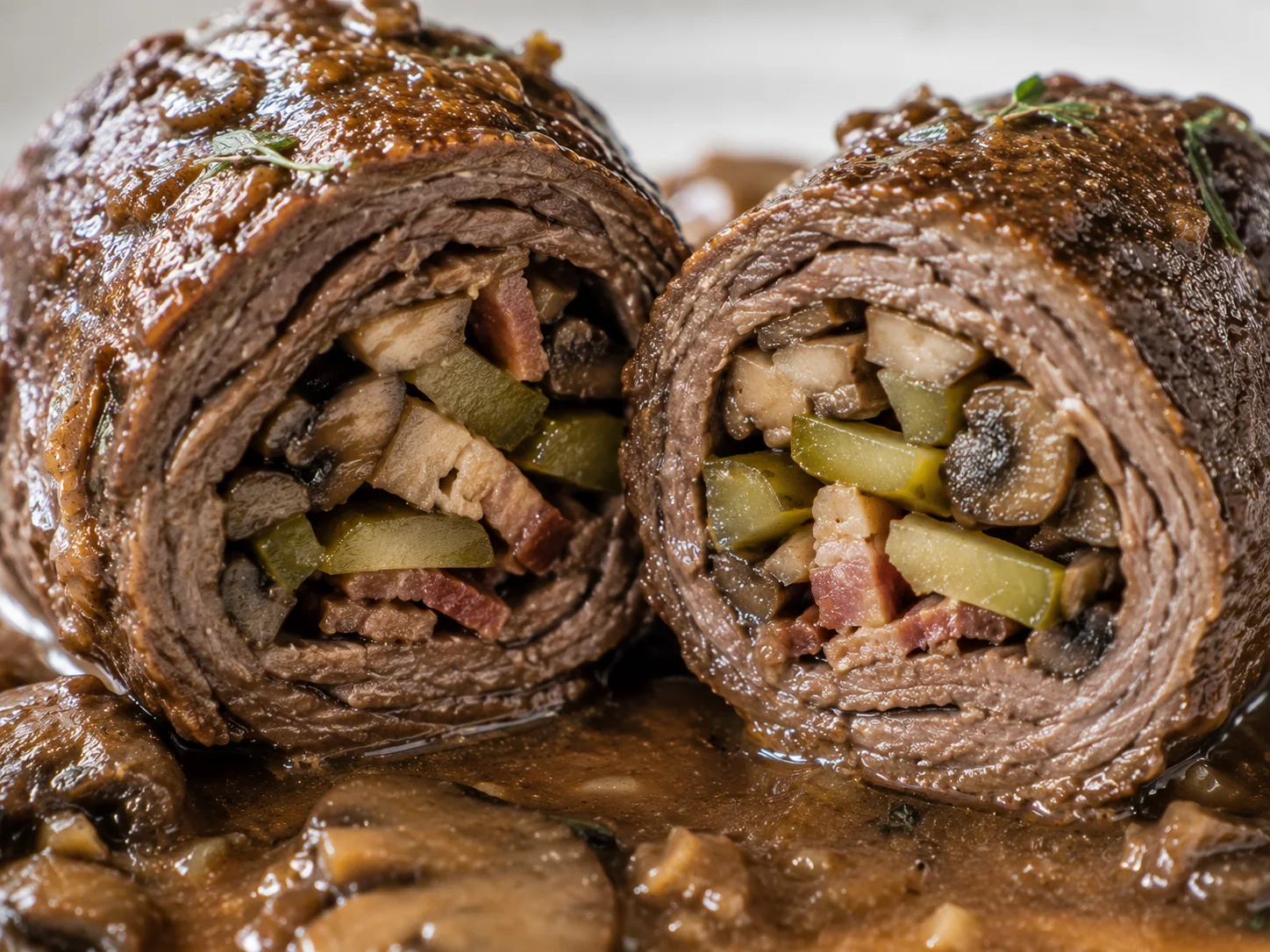
- Pound thin slices of lean beef and spread each one with a thin layer of mustard
- Sauté chopped mushrooms, then fill the rolls with mushrooms plus smaller amounts of bacon and pickle
- Roll, secure, dredge lightly in flour, and brown in a small amount of oil
- Braise in unsalted beef broth with bay leaf and allspice until tender
- Finish the sauce with plain Greek yogurt instead of sour cream
What This Version Changes — and What It Keeps
The roll-and-braise method stays exactly as it is in the traditional recipe, and so does the cut of beef: top round is already lean, so there was nothing to fix there. The mustard-bacon-pickle flavor signature that defines zrazy wołowe stays too, just in smaller, more concentrated amounts rather than disappearing entirely.
What changes is where the sodium and saturated fat were hiding. Half the bacon is replaced with chopped mushrooms, the pickle and mustard are cut back rather than used at full traditional quantity, the braising liquid switches from a low-sodium broth to an unsalted one, and the sour cream finish becomes plain Greek yogurt. None of these swaps touch the technique; they touch what goes into the pot.
Why These Swaps Work
Switching to unsalted beef broth targets the single largest hidden source of sodium in the traditional recipe. Most sodium in the average diet comes from packaged and prepared foods rather than the salt shaker, not from salt added during home cooking.1 Broth is a good example of that pattern: even a “reduced-sodium” version can carry a meaningful amount of sodium per cup, simply because it’s easy to treat as a neutral cooking liquid rather than an ingredient worth checking. The Chronic Disease Risk Reduction intake for sodium, the amount above which health risk starts climbing, is 2,300 milligrams a day for adults, and most people in the U.S. already take in more than that on a typical day.1 Swapping in an unsalted broth removes that contribution almost entirely without changing anything else about how the dish is made.
Replacing half the bacon with chopped mushrooms isn’t a health-food trick invented for this recipe. Mushrooms are naturally low in fat and calories,2 and naturally low in sodium as well,3 while their glutamate content gives them a savory, meaty depth known as umami, strong enough that food scientists recommend replacing a quarter to a half of the meat in a recipe with chopped mushrooms without losing that satisfying flavor.2 A 2025 review in the peer-reviewed journal Foods looked specifically at beef products and found that mushroom substitution let manufacturers cut added salt by 25 to 50 percent, and in some beef burger formulations by more than 50 percent, while the umami compounds in the mushrooms compensated for the reduced saltiness.3 The same principle applies here: the mushrooms fill the gap bacon leaves behind, and the dish doesn’t taste like something is missing.
Trimming back the pickle and mustard matters more than their small serving size suggests. Both are concentrated sources of sodium relative to how little of them go into the dish, so using about half the traditional amount of each keeps their sharp, tangy contribution to the filling while meaningfully lowering what they add to the total.
Swapping sour cream for plain Greek yogurt trades saturated fat for protein without giving up the tang the sauce needs. Cleveland Clinic Health Essentials, quoting registered dietitian Julia Zumpano throughout, recommends swapping Greek yogurt in for sour cream in dips, dressings, and sauces specifically to cut saturated fat while keeping a similar texture.4 The straining process that makes Greek yogurt thick also concentrates its protein well above what regular dairy or sour cream provides for the same volume.5
Healthy Zrazy Wołowe Recipe
Recipe developed independently by Heritage Healthy Kitchen. Sources for the swaps above are listed at the end of this article.
Ingredients (serves 6)
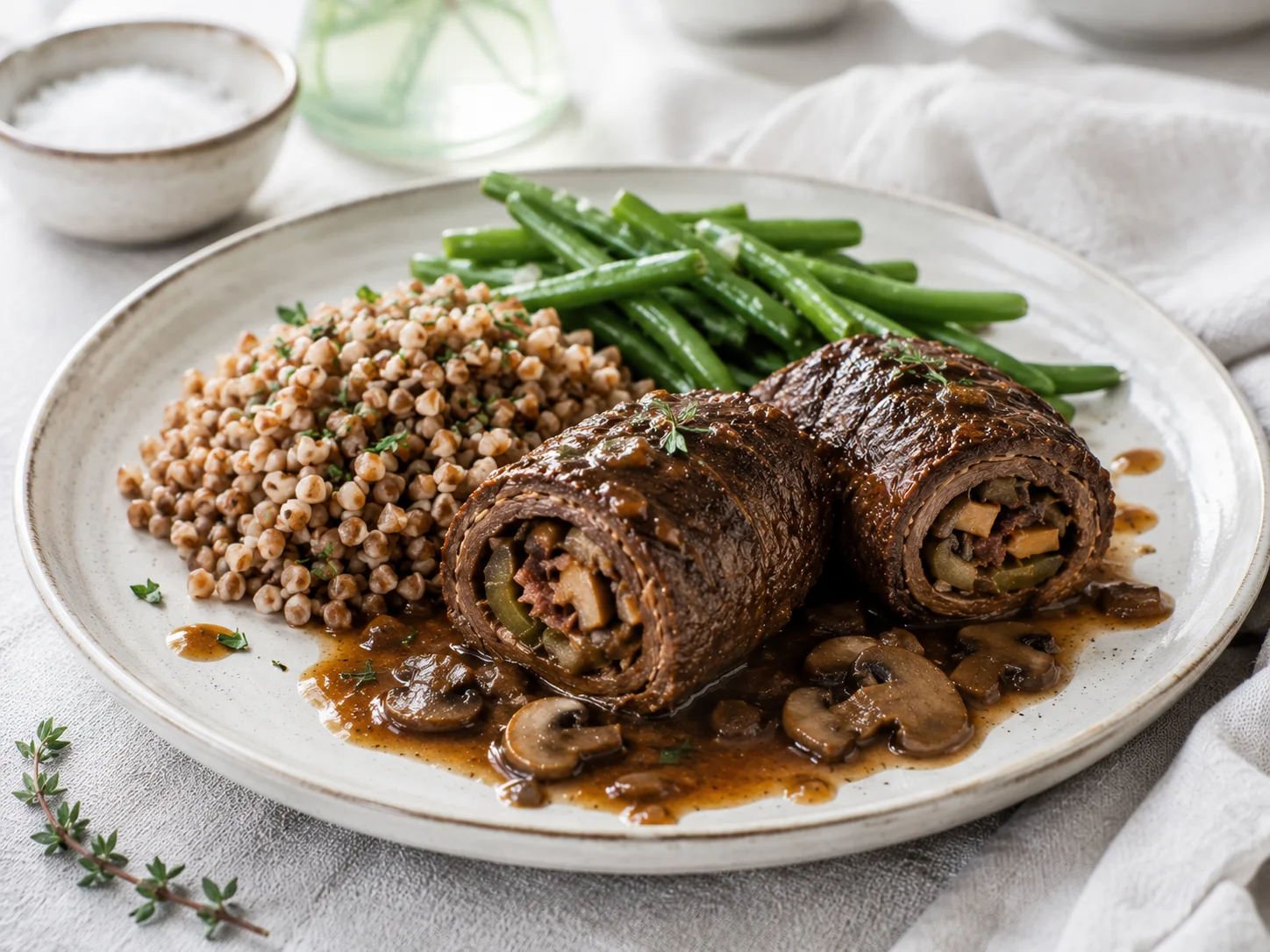
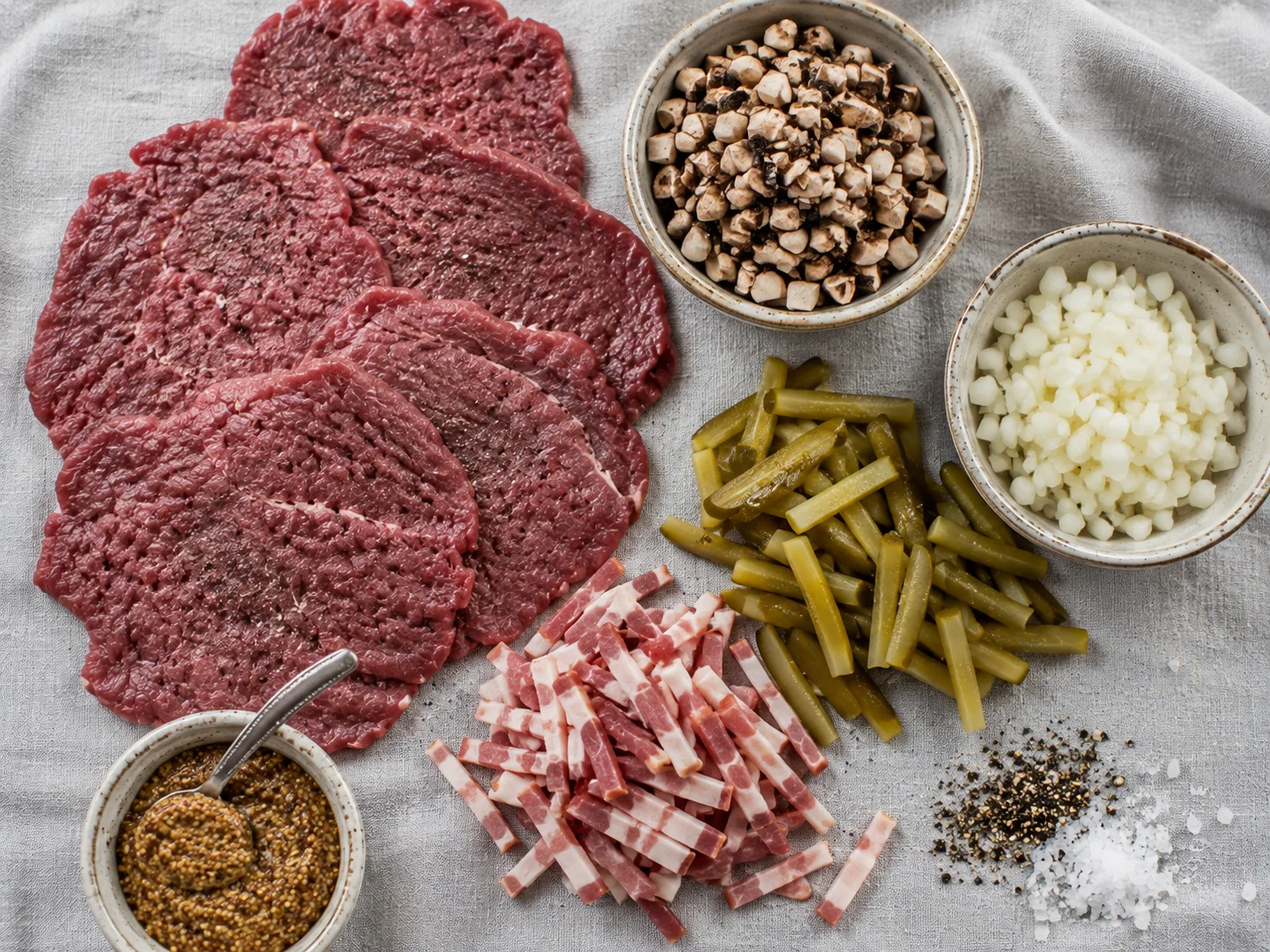
- 900g (2 lbs) beef top round, cut into 6 portions and pounded to about ¼ inch (6mm) thick
- 45g (1.5 oz) smoked bacon, cut into thin strips
- 150g (about 5 oz) button or cremini mushrooms, finely chopped
- 75g (about 2) dill pickles, cut into thin strips
- 1 large onion (about 150g), finely chopped, divided
- 2 tablespoons (30g) Dijon or Polish mustard
- Salt and black pepper, to taste (go easy on the salt; the bacon, pickle, and mustard already contribute some)
- 3 tablespoons (about 25g) all-purpose flour, divided: for dredging and for the sauce
- 1 tablespoon (15ml) neutral oil, for browning
- 500ml (2 cups) unsalted or no-salt-added beef broth
- 2 bay leaves
- 4 allspice berries
- 3 tablespoons (45g) plain nonfat or low-fat Greek yogurt
Instructions
- Pound the beef: Cut the beef into 6 even pieces. Place each piece between two sheets of plastic wrap and pound with a meat mallet until about ¼ inch thick.
- Cook the mushrooms: Sauté the chopped mushrooms in a dry or lightly oiled pan over medium heat until they release their liquid and it evaporates, 5 to 7 minutes. Set aside to cool slightly.
- Season and fill: Season each slice with pepper and a little salt, then spread a thin layer of mustard over the surface. Along one short edge, layer a strip of bacon, a strip of pickle, a spoonful of the cooked mushrooms, and a spoonful of chopped onion.
- Roll and secure: Roll each slice tightly around the filling, tucking in the sides as you go. Secure with kitchen string or toothpicks.
- Dredge and brown: Coat the rolls lightly in 2 tablespoons of the flour, shaking off the excess. Heat the oil in a heavy pot or Dutch oven over medium-high heat and brown the rolls on all sides, about 8 minutes total. Remove and set aside.
- Soften the onion: Add the remaining chopped onion to the same pot and cook until soft, about 5 minutes, scraping up any browned bits from the bottom of the pot.
- Braise: Return the rolls to the pot. Pour in the unsalted broth and add the bay leaves and allspice. Bring to a simmer, cover, and cook on low heat, or in a 160°C (325°F) oven, for 1.5 to 2 hours, until the meat is fork-tender.
- Finish the sauce: Remove the rolls and set aside, covered. Discard the bay leaves and allspice. Whisk the remaining tablespoon of flour into a few tablespoons of cold water, then stir it into the simmering liquid until thickened. Take the pot off the heat before stirring in the Greek yogurt; adding it to liquid that’s still boiling can cause it to separate.
- Serve: Remove the string or toothpicks from the rolls. Slice if desired, and spoon the sauce over the top.
Nutritional Comparison
Per serving (1 of 6)
| Nutrient | Traditional | This Version |
|---|---|---|
| Calories | 305–380 kcal | 265–325 kcal |
| Protein | 39–48g | 38–47g |
| Total fat | 14–17g | 9–11.5g |
| Carbohydrates | 5–6.5g | 5–6.5g |
| Fiber | ~1g | ~1g |
| Sodium | 620–755mg | 285–350mg |
Both sets of values were calculated independently, ingredient by ingredient, using USDA reference data and standard cooking-yield figures. Protein holds essentially steady between the two versions, since it comes mostly from the beef itself, which is unchanged. Fat drops by close to a third, mainly from halving the bacon. Carbohydrates land in almost the same place in both versions, since the mushrooms added in this version bring their own small carbohydrate count that roughly offsets the reduction from less flour and pickle. The biggest shift is sodium, down by more than half, split across four separate swaps rather than one dramatic change; no single ingredient in the traditional recipe was reduced to zero, which is part of why the filling still tastes like zrazy.
Storage and Reheating
Refrigerate leftovers in an airtight container, together with the sauce, for up to 3 days. Reheat gently over low heat on the stovetop or in short bursts in the microwave; a yogurt-based sauce can separate slightly if it’s brought back to a hard boil, so keep the heat low and stir gently.
The rolls freeze well for up to 2 months, though it’s best to freeze them without the sauce and make a fresh batch of sauce after thawing, since yogurt-based sauces don’t always recombine smoothly after freezing.
Healthy Zrazy Wołowe

Ingredients
Ingredients (serves 6)
- 900g (2 lbs) beef top round, cut into 6 portions and pounded to about ¼ inch (6mm) thick
- 45g (1.5 oz) smoked bacon, cut into thin strips
- 150g (about 5 oz) button or cremini mushrooms, finely chopped
- 75g (about 2) dill pickles, cut into thin strips
- 1 large onion (about 150g), finely chopped, divided
- 2 tablespoons (30g) Dijon or Polish mustard
- Salt and black pepper, to taste (go easy on the salt; the bacon, pickle, and mustard already contribute some)
- 3 tablespoons (about 25g) all-purpose flour, divided: for dredging and for the sauce
- 1 tablespoon (15ml) neutral oil, for browning
- 500ml (2 cups) unsalted or no-salt-added beef broth
- 2 bay leaves
- 4 allspice berries
- 3 tablespoons (45g) plain nonfat or low-fat Greek yogurt
Instructions
- Pound the beef: Cut the beef into 6 even pieces. Place each piece between two sheets of plastic wrap and pound with a meat mallet until about ¼ inch thick.
- Cook the mushrooms: Sauté the chopped mushrooms in a dry or lightly oiled pan over medium heat until they release their liquid and it evaporates, 5 to 7 minutes. Set aside to cool slightly.
- Season and fill: Season each slice with pepper and a little salt, then spread a thin layer of mustard over the surface. Along one short edge, layer a strip of bacon, a strip of pickle, a spoonful of the cooked mushrooms, and a spoonful of chopped onion.
- Roll and secure: Roll each slice tightly around the filling, tucking in the sides as you go. Secure with kitchen string or toothpicks.
- Dredge and brown: Coat the rolls lightly in 2 tablespoons of the flour, shaking off the excess. Heat the oil in a heavy pot or Dutch oven over medium-high heat and brown the rolls on all sides, about 8 minutes total. Remove and set aside.
- Soften the onion: Add the remaining chopped onion to the same pot and cook until soft, about 5 minutes, scraping up any browned bits from the bottom of the pot.
- Braise: Return the rolls to the pot. Pour in the unsalted broth and add the bay leaves and allspice. Bring to a simmer, cover, and cook on low heat, or in a 160°C (325°F) oven, for 1.5 to 2 hours, until the meat is fork-tender.
- Finish the sauce: Remove the rolls and set aside, covered. Discard the bay leaves and allspice. Whisk the remaining tablespoon of flour into a few tablespoons of cold water, then stir it into the simmering liquid until thickened. Take the pot off the heat before stirring in the Greek yogurt; adding it to liquid that’s still boiling can cause it to separate.
- Serve: Remove the string or toothpicks from the rolls. Slice if desired, and spoon the sauce over the top.
Frequently Asked Questions
Will I actually notice less bacon and pickle in the filling?
Less than expected. Both are still present, just in smaller amounts, and the chopped mushrooms fill in the savory, meaty character that bacon alone would otherwise provide, so the overall flavor profile stays close to the original.2,3
Why swap in Greek yogurt instead of just leaving the sour cream out?
Leaving it out entirely would thin the sauce and remove its tang. Greek yogurt keeps both while cutting the saturated fat and adding protein, which is why it’s a standard substitution for sour cream in sauces and dips rather than a simple omission.4
What if I can’t find unsalted beef broth?
Homemade stock made without added salt works just as well, and many grocery stores carry a “no salt added” or “unsalted” broth alongside the regular kind. A reduced-sodium broth is a reasonable second choice, though it won’t cut the sodium as much as a truly unsalted one.
Do the mushrooms need to be cooked before they go into the rolls?
Yes. Raw mushrooms release a lot of liquid as they cook, and if they go into the rolls raw, that liquid has nowhere to go during the long braise except into the filling, making it soggy. Sautéing them first drives off that moisture and concentrates their flavor.
Is this version suitable for a low-carb diet?
It’s already fairly low in carbohydrates, at about 5 to 6.5 grams per serving, most of which comes from the onion and the mushrooms. It isn’t a zero-carb dish, but it fits comfortably within most moderate low-carb plans.
Can the sodium be reduced even further?
Yes, with trade-offs. Cutting the pickle and mustard further, or leaving the bacon out entirely in favor of an extra portion of mushrooms, would lower sodium more, but at some point the dish stops tasting like zrazy wołowe and starts tasting like a mushroom-stuffed beef roll with a passing resemblance to it.
Will the Greek yogurt curdle in the hot sauce?
It can, if it’s added while the liquid is still at a hard boil. Taking the pot off the heat first and stirring the yogurt in gently avoids this; the residual heat is enough to warm it through without breaking it.
Looking for the Full History?
This recipe focuses on the swaps and the numbers behind them. The Traditional Zrazy Wołowe recipe on this site covers the dish’s origins in the Polish-Lithuanian Commonwealth, its Silesian regional history, and the full unmodified recipe.
Read the Traditional Zrazy Wołowe recipe
Further Reading & Sources
The following sources support the specific swaps made in this recipe. Heritage Healthy Kitchen’s recipe was developed independently; these links are provided for readers who want to explore the evidence further.
- Harvard T.H. Chan School of Public Health. “Salt and Sodium.” The Nutrition Source. nutritionsource.hsph.harvard.edu/salt-and-sodium — the 2,300mg daily Chronic Disease Risk Reduction sodium guideline, and packaged/prepared foods as the primary source of dietary sodium rather than salt added during home cooking.
- Harvard T.H. Chan School of Public Health. “Mushrooms.” The Nutrition Source. nutritionsource.hsph.harvard.edu/food-features/mushrooms — mushrooms’ low fat and calorie content, their umami flavor, and the recommendation to replace a quarter to a half of the meat in a recipe with chopped mushrooms.
- Fernández-López, J., Viuda-Martos, M., Botella-Martínez, C., Muñoz-Bas, C., Bermúdez-Gómez, P., Lucas-González, R., Pérez-Álvarez, J.Á. “The Potential of Cultivated Mushrooms as Salt Substitutes in Meat Products.” Foods, 2025, 14(6), 977. mdpi.com/2304-8158/14/6/977 — peer-reviewed evidence for 25–50%+ salt reduction in beef products using mushroom substitution.
- “Is Yogurt Good for You?” Cleveland Clinic Health Essentials, quoting registered dietitian Julia Zumpano, RD, LD. health.clevelandclinic.org/is-yogurt-good-for-you — Greek yogurt as a substitute for sour cream in sauces and dips to reduce saturated fat.
- Harvard Health Publishing. “Greek Yogurt: Health Benefits, Protein Content, and How to Choose the Best Option.” Harvard Health. health.harvard.edu/diet-and-nutrition/greek-yogurt-health-benefits-protein-content-and-how-to-choose-the-best-option — the straining process behind Greek yogurt’s higher protein content compared to regular dairy.
Disclaimer
The information in this article is provided for educational and informational purposes only. Heritage Healthy Kitchen makes no representations or warranties regarding the accuracy or completeness of any content on this site. Nutritional values are estimates only and will vary depending on the specific ingredients, brands, and measurements used. This content is not intended as dietary, medical, or professional nutritional advice. Always consult a qualified healthcare provider regarding any dietary needs or health conditions. Heritage Healthy Kitchen is not responsible for any outcomes resulting from the use of recipes or information published on this site.
You Might Also Like
More heritage recipes from our kitchen

Leave a Reply