

Active time: ~35 minutes | Total time: ~2 hours 15 minutes | Serves: 6 | Difficulty: Medium
Quick Overview
- Pound thin slices of beef and spread each one with mustard
- Fill with bacon, dill pickle, and chopped onion, then roll tightly and secure
- Dredge the rolls in flour and brown them on all sides
- Braise slowly in broth with bay leaf and allspice until fork-tender
- Thicken the braising liquid into a sauce and serve hot
What Zrazy Wołowe Is
Zrazy wołowe zawijane, “rolled beef zrazy,” is a traditional Polish beef roulade: thin beef slices spread with mustard, wrapped around bacon, dill pickle, and onion, then browned and braised until tender.3
In Upper Silesia the same dish carries a different name, rolada śląska, and forms one part of the region’s signature Sunday dinner alongside potato dumplings and braised red cabbage.2 Outside Silesia, the filling varies by kitchen, and classic zrazy recipes are just as often stuffed with mushrooms, hard-boiled egg, or other vegetables in place of the bacon-and-pickle combination.1
From Noble Kitchens to a National Dish
Zrazy’s origin traces back to the tables of the Polish-Lithuanian Commonwealth, though exactly who invented it, and where, is still disputed between Poland and Lithuania.1 The dish appears among the recipes attributed to Paul Tremo, court cook to Stanisław August Poniatowski, Poland’s last king, in the 18th century.2
The dish’s rolled shape is thought to have Lithuanian roots, but the name itself is Polish: an 18th-century account of the era’s customs used the word simply to mean a slice of meat or a cut of roast sliced from the whole.1 Exactly when cooks began wrapping that slice around a filling is unclear, but the practice was already established among the nobility by the time it shows up in royal-kitchen records.1,2 From there, zrazy moved down through the social ranks over the following generations, the way many Polish dishes did, keeping its rolled shape and mustard-and-filling formula while trading rarer ingredients for whatever regional kitchens had at hand.
The Silesian Sunday Dinner
This is where the dish took on its best-known regional form. Studies of Silesian towns and villages found beef roulade already well established by the interwar period, though it appeared only at the biggest celebrations, since beef was expensive.2 One such study, from the village of Dąbrówka Wielka in the 1960s, recorded weddings where families used as much as 300 kilograms of beef over two days of celebration, all going toward roulades and the minced-meat patties called karminadle.2
As the region’s mining industry brought more money into Silesian households, beef roulade spread from weddings alone to christenings, communions, and holiday dinners. After the Second World War it became a fixture of Sunday dinner, served with kluski śląskie, potato dumplings pressed into a ball with a thumbprint well to hold the sauce, and modro kapusta, red cabbage braised with onion.2 One local legend dates the dumplings back to 1241, claiming women in the town of Racibórz hurled them at invading Mongol forces rather than serving them as food, though this is folklore rather than documented history.2
A similar tradition of rolled, stuffed meat runs through the old Commonwealth’s eastern reaches. In Ukraine, kruchenyky wraps thin slices of meat, most often pork, around fillings like mushrooms, onion, or dried fruit, then bakes them with a sour-cream topping rather than braising them in the beef broth used in Poland.4
Traditional Zrazy Wołowe Recipe
Recipe developed independently by Heritage Healthy Kitchen, drawing on traditional Polish culinary methods. Sources for further reading are listed at the end of this article.
Ingredients (serves 6)
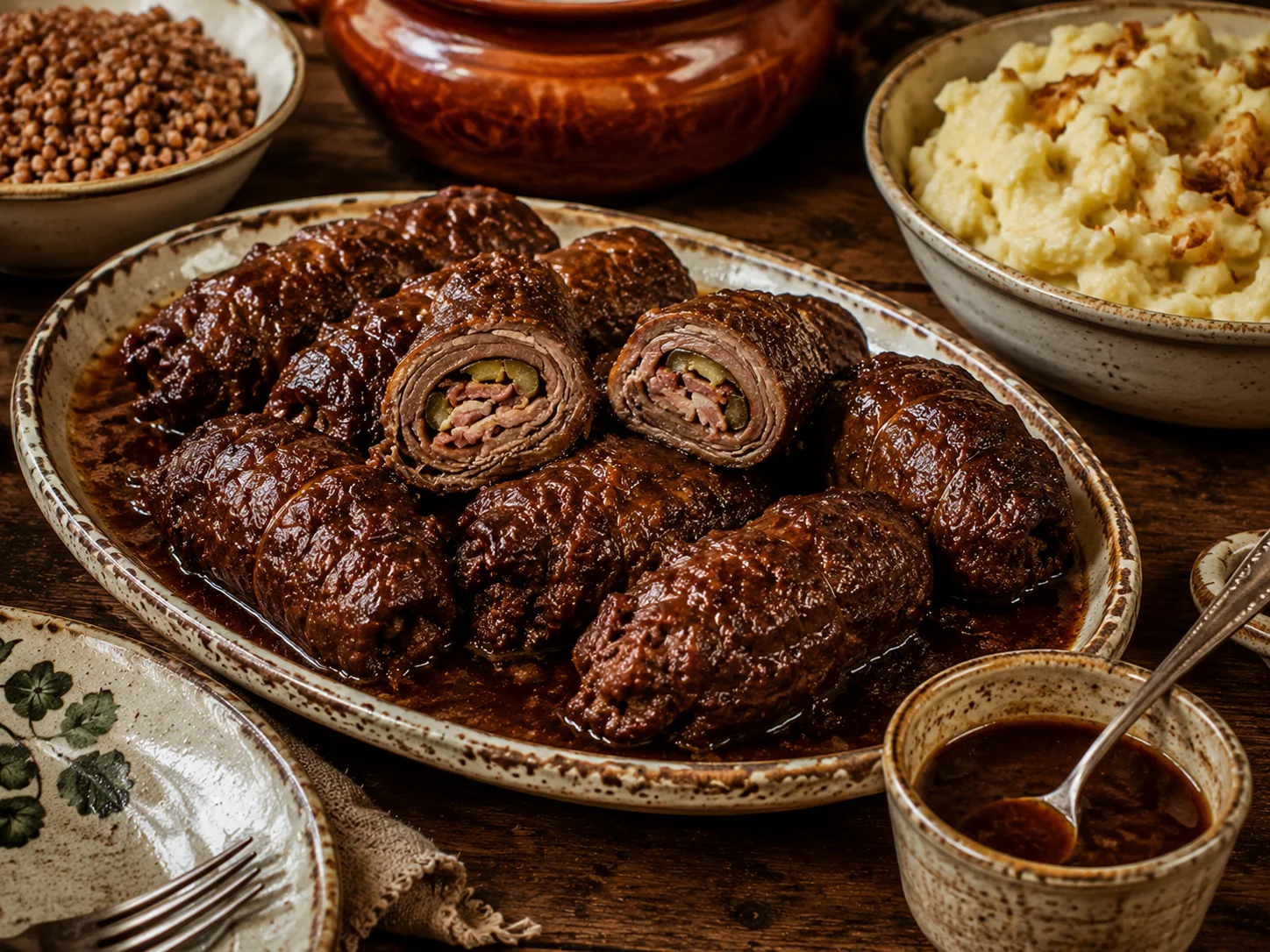
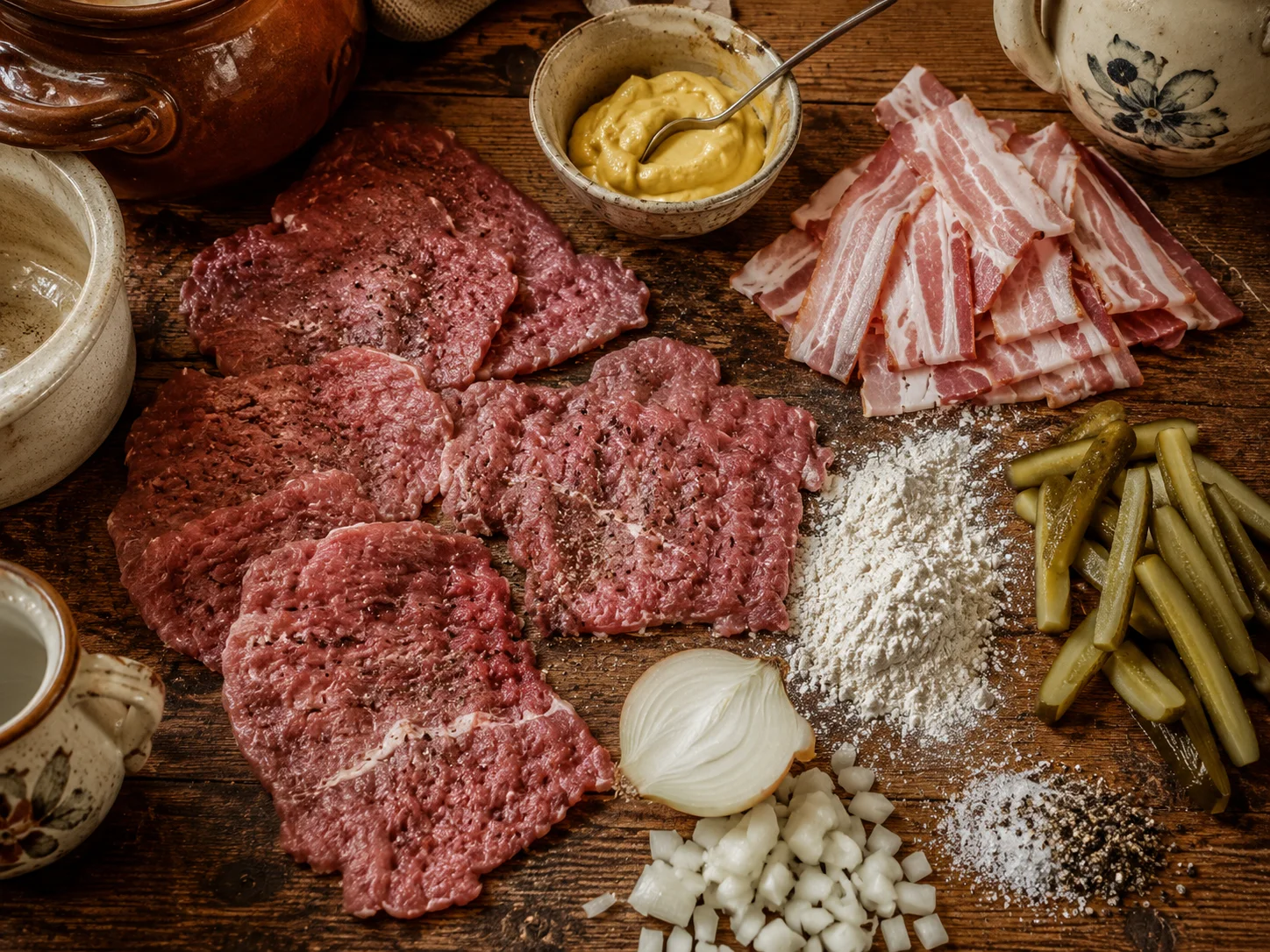
- 900g (2 lbs) beef top round or flank steak, cut into 6 portions and pounded to about ¼ inch (6mm) thick
- 90g (3 oz) smoked bacon, cut into thin strips
- 3–4 dill pickles (about 150g), cut into thin strips
- 1 large onion (about 150g), finely chopped, divided
- 3 tablespoons (45g) Polish or Dijon mustard
- Salt and black pepper, to taste
- 3 tablespoons (about 25g) all-purpose flour, for dredging, plus 1 tablespoon more for the sauce
- 2 tablespoons (30ml) neutral oil or lard, for browning
- 500ml (2 cups) low-sodium beef broth
- 2 bay leaves
- 4 allspice berries
- 2 tablespoons (30g) sour cream, optional
Instructions
- Pound the beef: Cut the beef into 6 even pieces. Place each piece between two sheets of plastic wrap and pound with a meat mallet until about ¼ inch thick.
- Season and fill: Season each slice with salt and pepper, then spread a thin layer of mustard over the surface. Lay a strip of bacon, a strip of pickle, and a spoonful of chopped onion along one short edge.
- Roll and secure: Roll each slice tightly around the filling, tucking in the sides as you go. Secure with kitchen string or toothpicks.
- Dredge and brown: Coat the rolls lightly in flour, shaking off the excess. Heat the oil in a heavy pot or Dutch oven over medium-high heat and brown the rolls on all sides, about 8 minutes total. Remove and set aside.
- Soften the onion: Add the remaining chopped onion to the same pot and cook until soft, about 5 minutes, scraping up any browned bits from the bottom of the pot.
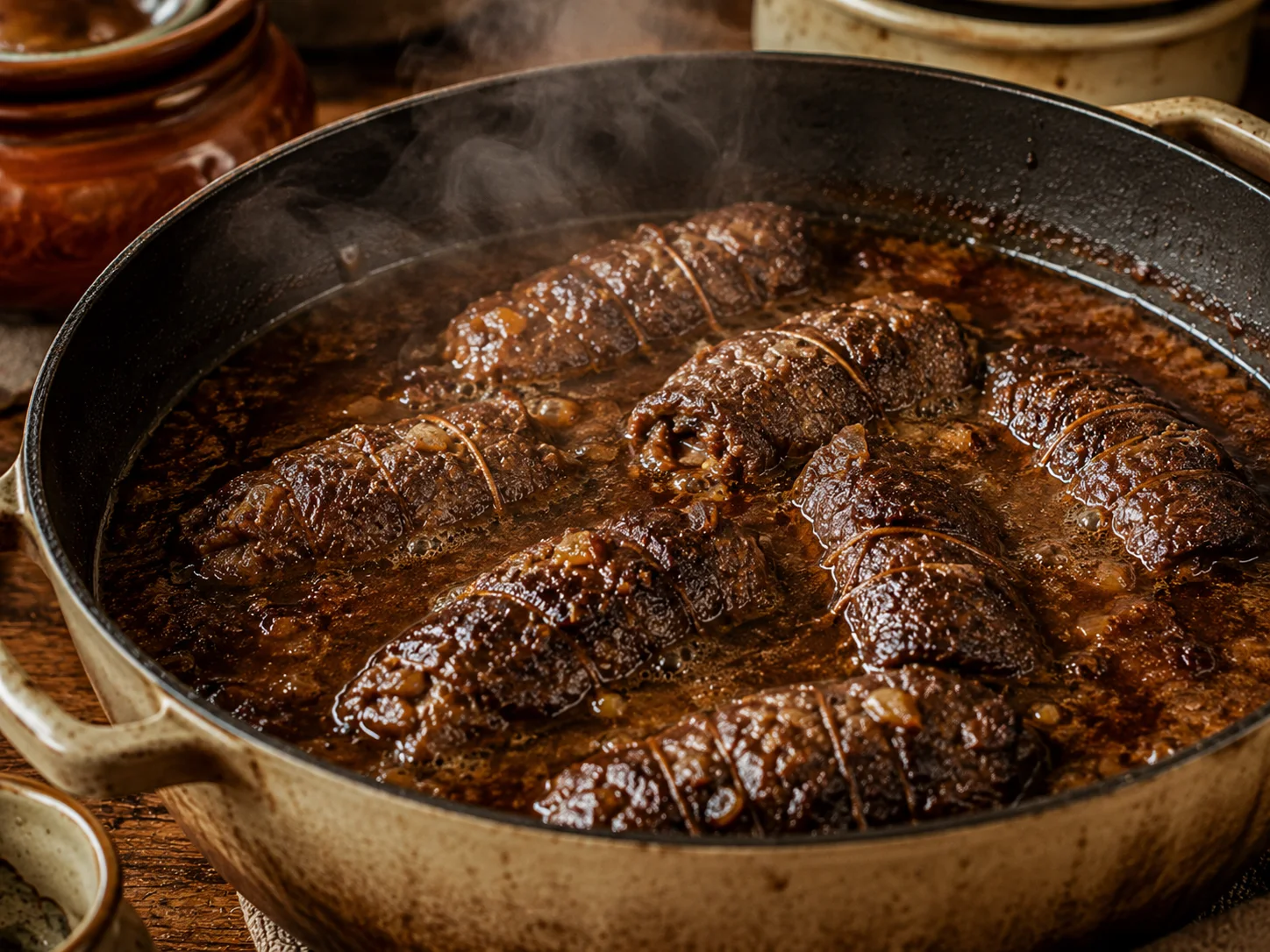
- Braise: Return the rolls to the pot. Pour in the broth and add the bay leaves and allspice. Bring to a simmer, cover, and cook on low heat, or in a 160°C (325°F) oven, for 1.5 to 2 hours, until the meat is fork-tender.
- Finish the sauce: Remove the rolls and set aside, covered. Discard the bay leaves and allspice. Whisk the remaining tablespoon of flour into a few tablespoons of cold water, then stir it into the simmering liquid until thickened. Stir in the sour cream, if using, off the heat.
- Serve: Remove the string or toothpicks from the rolls. Slice if desired, and spoon the sauce over the top.
Kitchen Tips
Choose a cut with little sinew, such as top round or flank steak. Sinew doesn’t break down evenly during pounding and can tear through when the roll is sliced.
Some Silesian cooks soak the beef in soured milk overnight before pounding, which is said to leave it more tender by the time it reaches the pot.2
For a more traditional two-day approach, brown the rolls one day and braise them the next. Supposedly this rules out any raw taste in the finished dish, since the meat gets a full day to rest before its final cook.2
Don’t skip the flour dredge before browning. It helps the rolls develop a light crust and gives the braising liquid a head start on thickening into a proper sauce.
Nutritional Information
Per serving (1 of 6)
- Calories: approximately 305–380 kcal
- Protein: ~39–48g
- Total fat: ~14–17g
- Carbohydrates: ~5–6.5g
- Fiber: ~1g
- Sodium: ~620–755mg
Values are estimates, calculated ingredient-by-ingredient using USDA reference data and standard cooking-yield figures, and will vary with the exact cut of beef, the bacon and pickles used, and how much salt is added at the table. Because the bacon is rolled inside the beef rather than pan-fried on its own, and the browning oil stays in the pot as part of the braising liquid rather than being drained off, less fat escapes the dish than a quick glance at the ingredient list might suggest. A four-ounce serving of lean beef alone provides roughly 33 grams of protein, which is most of what a single serving of this dish delivers.5 Most major health guidance recommends treating red meat as an occasional part of the diet rather than a daily staple, largely because of the saturated fat that comes packaged alongside its protein.5
Storage and Reheating
Refrigerate leftover zrazy in an airtight container, together with the sauce, for up to 3 days. Reheat gently on the stovetop over low heat or in the microwave, adding a splash of broth or water if the sauce has thickened too much.
The rolls freeze well for up to 2 months. Thaw overnight in the refrigerator before reheating slowly; a quick reheat straight from frozen tends to dry out the meat.
Traditional Zrazy Wołowe

Ingredients
Ingredients (serves 6)
- 900g (2 lbs) beef top round or flank steak, cut into 6 portions and pounded to about ¼ inch (6mm) thick
- 90g (3 oz) smoked bacon, cut into thin strips
- 3–4 dill pickles (about 150g), cut into thin strips
- 1 large onion (about 150g), finely chopped, divided
- 3 tablespoons (45g) Polish or Dijon mustard
- Salt and black pepper, to taste
- 3 tablespoons (about 25g) all-purpose flour, for dredging, plus 1 tablespoon more for the sauce
- 2 tablespoons (30ml) neutral oil or lard, for browning
- 500ml (2 cups) low-sodium beef broth
- 2 bay leaves
- 4 allspice berries
- 2 tablespoons (30g) sour cream, optional
Instructions
- Pound the beef: Cut the beef into 6 even pieces. Place each piece between two sheets of plastic wrap and pound with a meat mallet until about ¼ inch thick.
- Season and fill: Season each slice with salt and pepper, then spread a thin layer of mustard over the surface. Lay a strip of bacon, a strip of pickle, and a spoonful of chopped onion along one short edge.
- Roll and secure: Roll each slice tightly around the filling, tucking in the sides as you go. Secure with kitchen string or toothpicks.
- Dredge and brown: Coat the rolls lightly in flour, shaking off the excess. Heat the oil in a heavy pot or Dutch oven over medium-high heat and brown the rolls on all sides, about 8 minutes total. Remove and set aside.
- Soften the onion: Add the remaining chopped onion to the same pot and cook until soft, about 5 minutes, scraping up any browned bits from the bottom of the pot.
- Braise: Return the rolls to the pot. Pour in the broth and add the bay leaves and allspice. Bring to a simmer, cover, and cook on low heat, or in a 160°C (325°F) oven, for 1.5 to 2 hours, until the meat is fork-tender.
- Finish the sauce: Remove the rolls and set aside, covered. Discard the bay leaves and allspice. Whisk the remaining tablespoon of flour into a few tablespoons of cold water, then stir it into the simmering liquid until thickened. Stir in the sour cream, if using, off the heat.
- Serve: Remove the string or toothpicks from the rolls. Slice if desired, and spoon the sauce over the top.
Frequently Asked Questions
What’s the difference between zrazy and rolada śląska?
They’re close enough to be considered the same dish under two names. Rolada is what Silesians call their regional beef roulade, while zrazy wołowe zawijane is the name used across the rest of Poland for a very similar rolled, stuffed, and braised beef dish.2,3
Can zrazy be made with pork instead of beef?
Not traditionally. Zrazy wołowe specifically refers to the beef version, and beef is what the historical sources and regional traditions describe.1,2 Pork rolls of a similar style aren’t unheard of in the wider region, though; Ukraine’s kruchenyky is usually made with pork.4
Why is the meat pounded so thin?
Pounding tenderizes the beef and makes it pliable enough to roll tightly around the filling without tearing. It also increases the surface area, so the meat cooks evenly and picks up more flavor from the braising liquid during the long simmer.
What can I use instead of dill pickles?
Cornichons or another firm, tangy pickled cucumber work as a direct swap. Some regional versions use mushrooms, egg, or other vegetables instead, which changes the flavor but keeps the same rolled structure.1
Is zrazy the same dish as Ukrainian kruchenyky?
Closely related, but not identical. Both wrap thin slices of meat around a filling, but kruchenyky is usually pork, topped with sour cream and baked, while Polish zrazy wołowe is beef, braised in a beef-broth sauce thickened at the end.4
Can zrazy be made ahead of time?
Yes. The traditional two-day browning method described above exists partly for this reason, and once fully cooked, the dish keeps and reheats well for several days, so there’s no harm in making it a day or two before serving.
What sides traditionally accompany zrazy wołowe?
In Silesia, the classic pairing is kluski śląskie, potato dumplings with a thumbprint well for the sauce, and modro kapusta, braised red cabbage; together they make up the region’s signature Sunday dinner.2 Outside Silesia, mashed potatoes, rice, or buckwheat groats are common instead.
Do the rolls need to be tied with string, or will toothpicks work?
Some kind of fastener is necessary, since the filling spills out during braising otherwise. Kitchen string gives the neatest presentation, but toothpicks are easier for home cooks and work just as well; remove them before serving.
Looking for a Lighter Version?
Zrazy wołowe leans on bacon, cured pickles, and a broth-based sauce thickened with flour, all of which add saturated fat and sodium on top of what the beef itself provides. The Healthy Zrazy Wołowe recipe on this site works through leaner cuts, a lighter filling, and a reduced-sodium sauce while keeping the roll-and-braise method intact.
Read the Healthy Zrazy Wołowe recipe
Further Reading & Sources
The following sources were consulted in researching the history and background of traditional zrazy wołowe. Heritage Healthy Kitchen’s recipe was developed independently; these links are provided for readers who want to explore further.
- “Zrazy.” Wikipedia. en.wikipedia.org/wiki/Zrazy — origin in the Polish–Lithuanian Commonwealth, the disputed Polish/Lithuanian origin of the dish, and the etymology of the name as a slice of meat cut from the whole.
- “The Silesian Roulade: History & Recipe.” Culture.pl. culture.pl/en/article/the-silesian-roulade-history-recipe — Paul Tremo’s 18th-century court recipes, the interwar and postwar history of Silesian roulade, the Dąbrówka Wielka wedding research, and the kluski śląskie and modro kapusta pairing.
- “Zrazy Wołowe Zawijane.” TasteAtlas. tasteatlas.com/zrazy-woowe-zawijane — the standard mustard, bacon, pickle, and onion filling, and the browning-and-braising method.
- “Kruchenyky.” TasteAtlas. tasteatlas.com/kruchenyky — the Ukrainian counterpart dish, its typical pork base, and its sour-cream preparation.
- Harvard T.H. Chan School of Public Health. “Protein.” The Nutrition Source. nutritionsource.hsph.harvard.edu/what-should-you-eat/protein — the protein and saturated fat profile of a red meat serving, and guidance on red meat’s role in the overall diet.
Disclaimer
The information in this article is provided for educational and informational purposes only. Heritage Healthy Kitchen makes no representations or warranties regarding the accuracy or completeness of any content on this site. Nutritional values are estimates only and will vary depending on the specific ingredients, brands, and measurements used. This content is not intended as dietary, medical, or professional nutritional advice. Always consult a qualified healthcare provider regarding any dietary needs or health conditions. Heritage Healthy Kitchen is not responsible for any outcomes resulting from the use of recipes or information published on this site.
You Might Also Like
More heritage recipes from our kitchen

Leave a Reply