
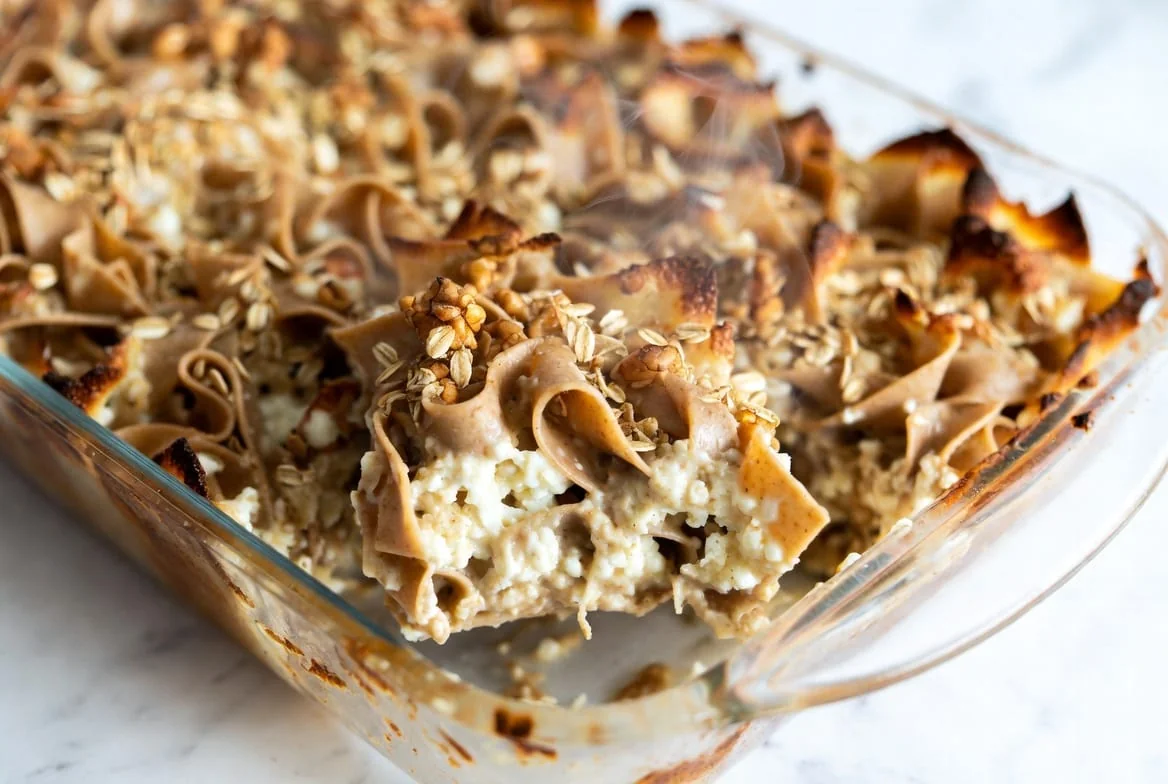
Active time: ~30 minutes | Total time: ~1¾ hours | Serves: 10 | Difficulty: Easy
Quick Overview
- Boil whole wheat egg noodles until just tender
- Blend half the cottage cheese and mix it with the rest, Greek yogurt, eggs, egg whites and sugar
- Fold in the noodles and raisins
- Pour into a lightly buttered dish and top with oats and walnuts
- Bake until golden and set, then rest before cutting
What This Version Changes — and What It Keeps
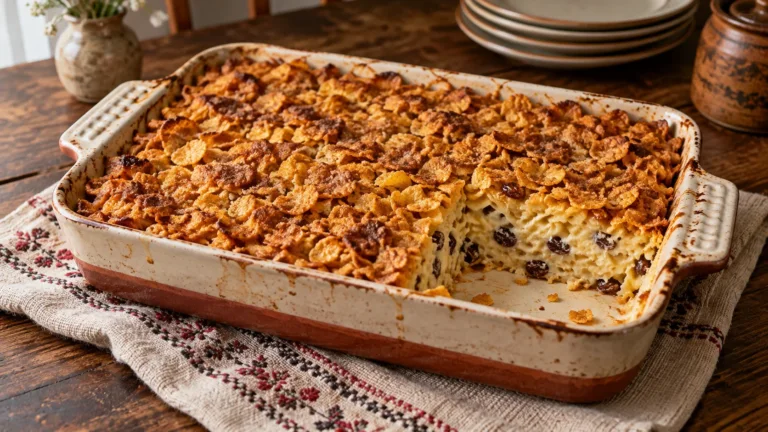
The method stays the same as in the traditional noodle kugel: boil the noodles, whisk a custard, fold the two together and bake until golden and set. So do the raisins, cinnamon and vanilla, and the dairy character of the dish, which keeps it a kugel for Shavuot.
What changes is where the fat and sugar sat. Whole wheat noodles replace regular ones, three of the six whole eggs become egg whites, cottage cheese and Greek yogurt take the place of the cream cheese and sour cream, the sugar and butter are cut sharply, and an oat and walnut topping replaces the cornflake one.
Why These Swaps Work
The noodles are whole wheat. Refining wheat strips away more than half of its B vitamins, 90 percent of its vitamin E and virtually all of its fiber, according to Harvard’s Nutrition Source.1 USDA data put dry whole-wheat pasta at 9.2g of fiber per 100g, against 3.3g for egg noodles.14 We found no published kugel recipe that uses whole wheat noodles, so this swap is Heritage Healthy Kitchen’s choice.
Three of the six whole eggs are replaced with six egg whites. Cleveland Clinic notes that egg whites are “almost pure protein and don’t contain any saturated fat.”2 Three whole eggs stay for richness and color; that split is Heritage Healthy Kitchen’s choice.
Cottage cheese and plain Greek yogurt replace the cream cheese and sour cream. Per 100g, USDA lists cream cheese at 350 calories and 34.4g of fat, sour cream at 198 calories and 19.4g, and plain lowfat Greek yogurt at 73 calories and 1.9g.14 Cleveland Clinic suggests both cottage cheese and Greek yogurt as substitutes for sour cream;2,3 2% cottage cheese has 84 calories and 2.3g of fat per 100g.3
The sugar drops from ¾ cup plus 3 tablespoons to ⅓ cup plus 1 tablespoon. Harvard’s Nutrition Source suggests cutting the added sugar in baking by ¼–⅓ cup;4 this cuts about ½ cup, and the raisins and cinnamon supply the sweetness. Published recipes leave room for it: one uses ⅓ cup of sugar for 12 ounces of noodles.7
The butter drops from ½ cup plus 3 tablespoons to 3 tablespoons in the custard and 1 tablespoon in the topping. About 60 percent of the fat in butter is saturated, and butter and other dairy foods are among the biggest sources of saturated fat in the diet. The Dietary Guidelines for Americans recommend less than 10 percent of calories from saturated fat, and the American Heart Association no more than 7 percent.5
Rolled oats and chopped walnuts replace the cornflake topping. Oats are among the whole grains Harvard lists,1 and cohort studies find a 30 to 50 percent lower risk of heart attack, sudden cardiac death or cardiovascular disease associated with eating nuts several times a week; the unsaturated fats in nuts help lower LDL and raise HDL cholesterol.6 One published recipe puts a walnut, sugar and butter topping on its kugel;9 the oat version is Heritage Healthy Kitchen’s own.
Healthy Noodle Kugel Recipe
This recipe was compiled by Heritage Healthy Kitchen from published recipes and the sources for the swaps, all listed at the end of this article. Figures that are Heritage Healthy Kitchen’s own estimates rather than taken from a published source are marked as such.
The base follows the traditional kugel, whose proportions sit inside the ranges of the published recipes: 4–6 eggs per 450g (1 lb) of noodles, a 23×33cm (9×13-inch) dish at 175–190°C (350–375°F).7,8,9,10,11 The amounts of the substitutes, the oat and walnut topping, the 50–60 minute bake and the number of servings are Heritage Healthy Kitchen’s estimates.
Ingredients (serves 10)
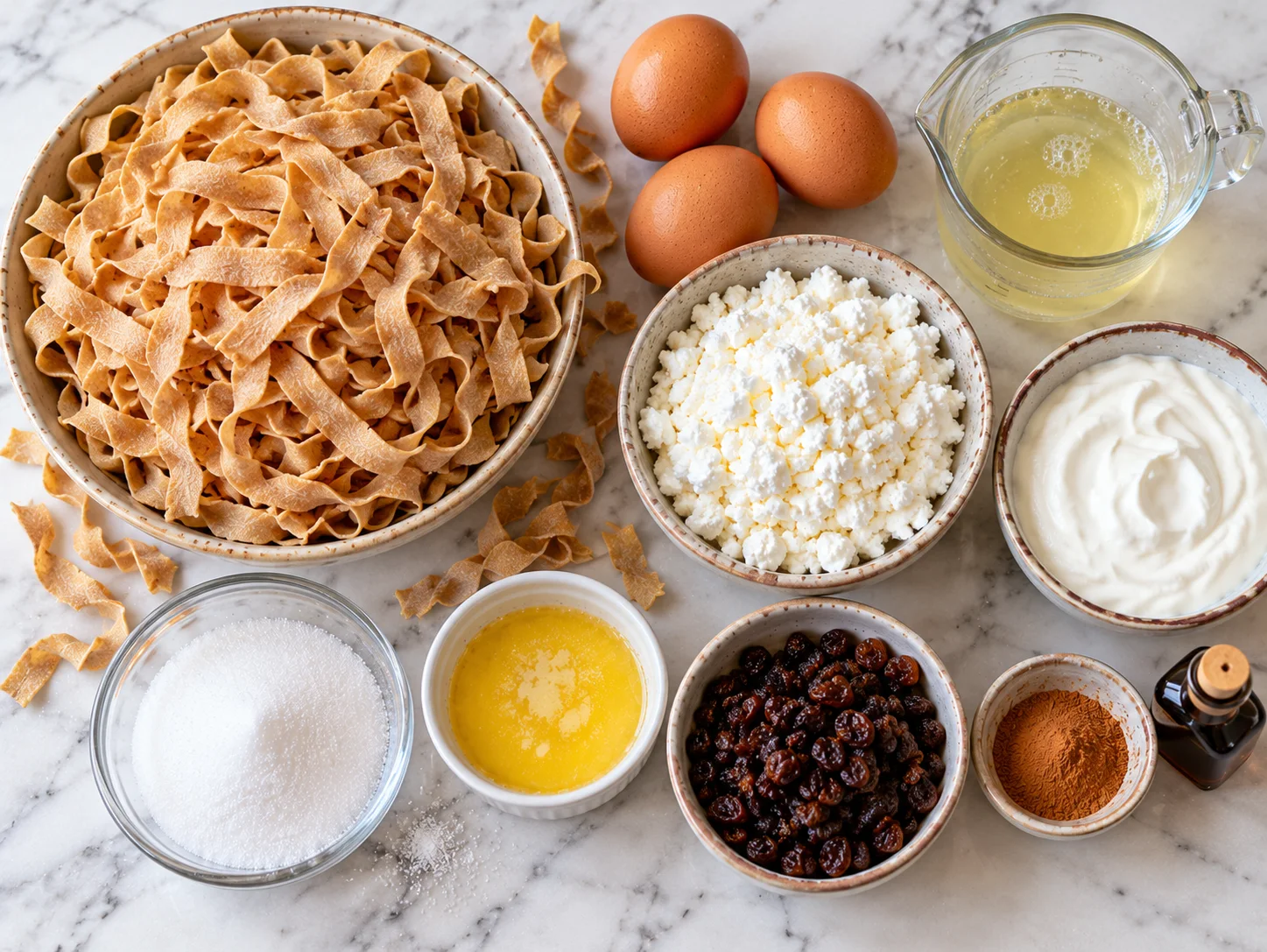
For the kugel
- 450g (1 lb) whole wheat egg noodles
- 3 large eggs
- 6 large egg whites (or ¾ cup egg whites from a carton)
- 450g (2 cups) low-fat (2%) cottage cheese
- 225g (1 cup) plain Greek yogurt (2%)
- 67g (⅓ cup) granulated sugar
- 42g (3 tablespoons) unsalted butter, melted, plus a little for the dish
- 1 teaspoon vanilla extract
- 1 teaspoon ground cinnamon
- ¼ teaspoon fine salt
- 110g (¾ cup) raisins
For the topping
- 90g (1 cup) old-fashioned rolled oats
- 40g (⅓ cup) walnuts, chopped
- 1 tablespoon (12.5g) granulated sugar
- 1 teaspoon ground cinnamon
- 1 tablespoon (14g) unsalted butter, melted
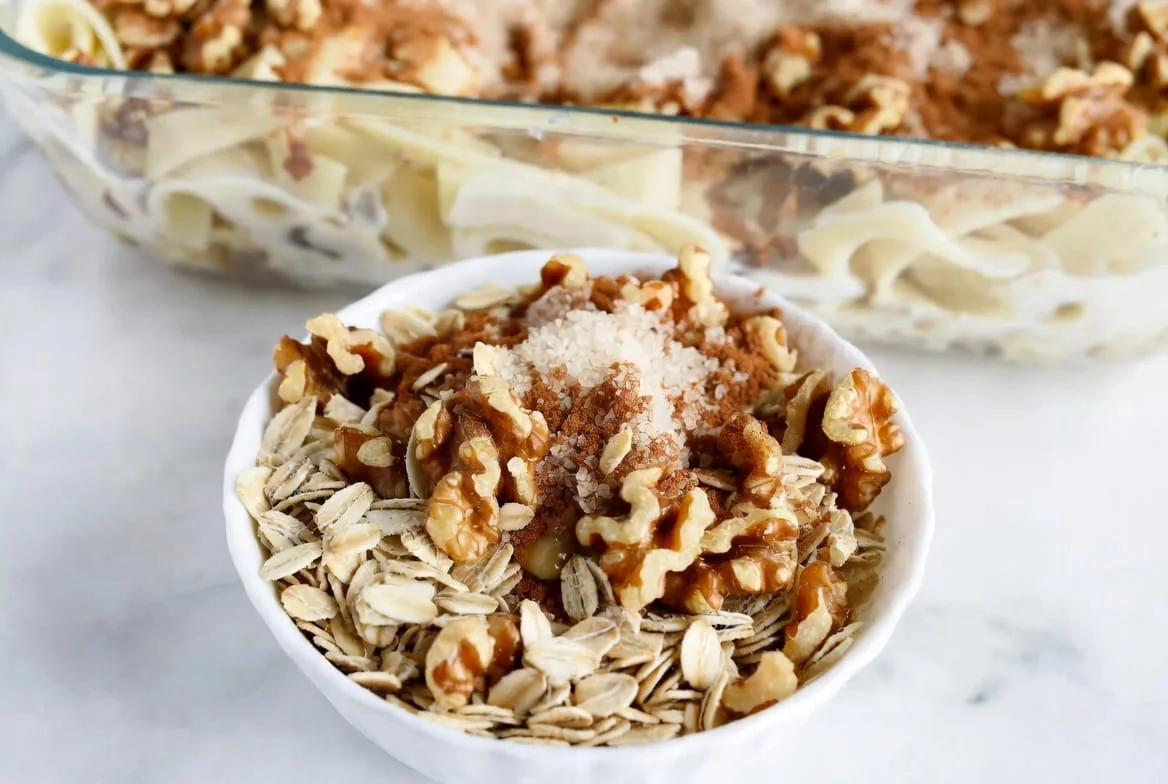
Instructions
- Boil the noodles. Cook the whole wheat egg noodles in salted boiling water until just tender, following the package time and pulling them a little early, since they finish cooking in the oven. Drain well.7
- Blend the base. Blend or process about half the cottage cheese until smooth, then stir it back in with the remaining cottage cheese and the Greek yogurt.
- Make the custard. In a large bowl, beat the whole eggs and egg whites together, then whisk in the cottage cheese mixture, sugar, melted butter, vanilla, cinnamon and salt until fairly smooth.7,10,11
- Combine. Fold the drained noodles and the raisins into the custard until evenly coated.
- Assemble. Heat the oven to 175°C (350°F). Pour the mixture into a lightly buttered 23×33cm (9×13-inch) baking dish.7,11
- Top. Mix the oats, walnuts, sugar, cinnamon and melted butter, and scatter evenly over the kugel.
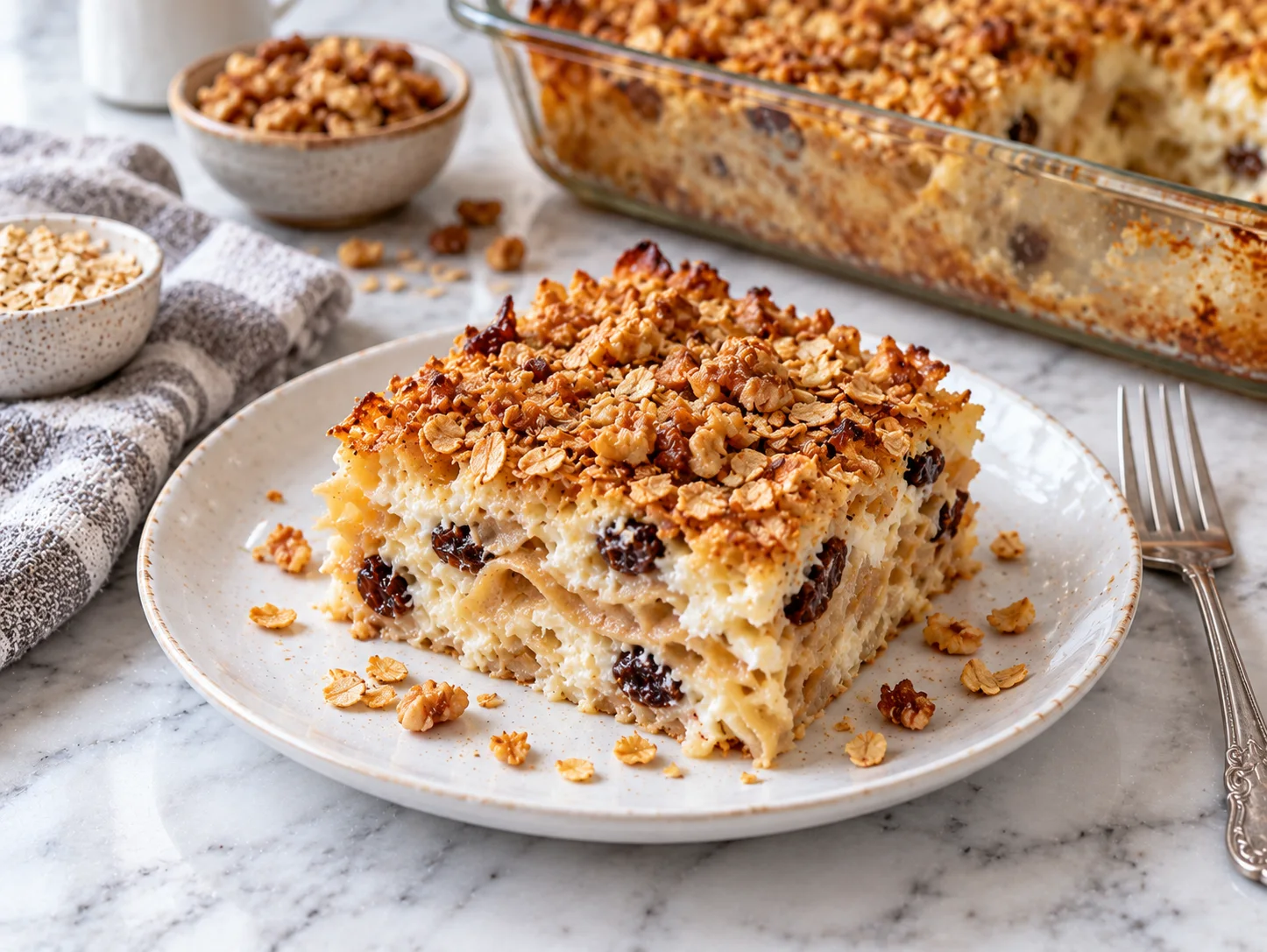
- Bake. Bake for 50–60 minutes, until the top is golden and a knife inserted in the center comes out clean.7,8,11
- Rest and serve. Let the kugel rest for 10–15 minutes before cutting. Serve warm, at room temperature or cold.
Kitchen Tips
Blending only half the cottage cheese keeps some of the soft curd of the traditional dish while smoothing out the rest. Blend all of it for a completely smooth, custard-like kugel.
Whole wheat noodles are taken from the water a little early, as in the traditional recipe, because they finish cooking in the oven.7
For a deeper, roasted flavor, toast the walnuts in a dry skillet for a few minutes before mixing the topping.
Nutritional Comparison
Per serving (one of 10 servings):
| Nutrient | Traditional Noodle Kugel | This Version |
|---|---|---|
| Calories | ~570–695 kcal | ~370–455 kcal |
| Protein | ~16–20g | ~18–22g |
| Total fat | ~29–36g | ~11–14g |
| Saturated fat | ~16–19g | ~4–5g |
| Carbohydrates | ~62–75g | ~54–65g |
| Dietary fiber | ~2g | ~5–6g |
| Sodium | ~380–465mg | ~240–290mg |
Nutritional values are estimates based on standard ingredient databases (USDA FoodData Central)14 and vary with the brands of dairy and noodles. Whole wheat egg noodles are not in the database, so whole-wheat pasta stands in for them. Choosing a low-sodium cottage cheese brings the sodium down further in either version.
Storage and Reheating
Refrigerate leftover kugel within 2 hours of baking. It keeps in the refrigerator for 3 to 4 days, or in the freezer for 3 to 4 months, after which it can lose moisture and flavor.12 Wrap it tightly for the freezer and thaw it in the refrigerator before reheating.
Reheat portions until they reach 74°C (165°F) in the center.12 In a 165°C (325°F) oven this takes about 15–20 minutes for a thawed portion; that time is Heritage Healthy Kitchen’s estimate. A microwave works too, with less crisping on top.
Healthy Noodle Kugel

Ingredients
For the kugel
- 450g (1 lb) whole wheat egg noodles
- 3 large eggs
- 6 large egg whites (or ¾ cup egg whites from a carton)
- 450g (2 cups) low-fat (2%) cottage cheese
- 225g (1 cup) plain Greek yogurt (2%)
- 67g (⅓ cup) granulated sugar
- 42g (3 tablespoons) unsalted butter, melted, plus a little for the dish
- 1 teaspoon vanilla extract
- 1 teaspoon ground cinnamon
- ¼ teaspoon fine salt
- 110g (¾ cup) raisins
For the topping
- 90g (1 cup) old-fashioned rolled oats
- 40g (⅓ cup) walnuts, chopped
- 1 tablespoon (12.5g) granulated sugar
- 1 teaspoon ground cinnamon
- 1 tablespoon (14g) unsalted butter, melted
Instructions
- Noodles: Boil whole wheat noodles until just tender, a little early; drain.
- Blend: Blend half the cottage cheese smooth; stir it back in with the rest and the yogurt.
- Custard: Beat the eggs and whites; whisk in the cheese mixture, sugar, butter, vanilla, cinnamon, salt.
- Combine: Fold in the noodles and raisins.
- Assemble: Oven at 175°C (350°F). Pour into a lightly buttered 23×33cm (9×13-inch) dish.
- Top: Scatter over the oats, walnuts, sugar, cinnamon and butter.
- Bake: 50–60 minutes, until golden and a knife comes out clean.
- Rest: 10–15 minutes before cutting; serve warm, at room temperature or cold.
Frequently Asked Questions
Will the texture be noticeably different with less fat and sugar?
It is less rich, since the cream cheese, the sour cream and half the yolks are gone. Blending half the cottage cheese smooth gives a creamier custard; that technique is Heritage Healthy Kitchen’s own, not taken from a published recipe.
Can I use whole eggs instead of eggs and whites?
Yes. Use 6 whole eggs in place of the 3 whole eggs and 6 whites. That brings back the yolk fat this version trims.
Do whole wheat noodles cook differently?
Follow the package time for the noodles you buy, and drain them while they are still slightly firm, since they finish cooking in the oven.7
Is this still a Shavuot dish?
Yes. It is a dairy kugel, made with cottage cheese and Greek yogurt, and kugel is a dish for Shavuot.13
Can this version be made dairy-free?
Not easily. Cottage cheese and Greek yogurt make up the custard, so a dairy-free version would be a different recipe.
Can it be made ahead or frozen?
Yes. One published recipe assembles the kugel and refrigerates it overnight before baking.9 Baked kugel keeps in the refrigerator for 3 to 4 days, or in the freezer for 3 to 4 months.12
Further Reading & Sources
The recipe is a compilation based on the published recipes and the sources for the swaps listed here; these links are provided for readers who want to explore further.
- The Nutrition Source. Whole Grains. Harvard T.H. Chan School of Public Health.
- Cleveland Clinic Health Essentials. Try These 21 High-Protein Foods (no date given).
- Cleveland Clinic Health Essentials. 7 Reasons Why Cottage Cheese Is Good for You (no date given).
- The Nutrition Source. Added Sugar. Harvard T.H. Chan School of Public Health.
- The Nutrition Source. Types of Fat. Harvard T.H. Chan School of Public Health.
- The Nutrition Source. Nuts for the Heart. Harvard T.H. Chan School of Public Health.
- Abbe Odenwalder. Sweet Noodle Kugel. Aish (no date given; reposted by PBS Food, 26 June 2023).
- Shannon Sarna. (28 January 2016). Sweet Noodle Kugel. The Nosher, My Jewish Learning.
- Tina Wasserman. Deluxe Noodle Kugel. ReformJudaism.org (no date given).
- Amy Ettinger. This Amazing Kugel Was the Only Thing My Jewish Mom Could Cook. Kveller (no date given).
- Temple Covenant of Peace Sisterhood, Easton, PA. Aunt Mildred’s Crunchy Noodle Kugel. ReformJudaism.org (no date given).
- U.S. Department of Agriculture, Food Safety and Inspection Service. (updated 31 July 2020). Leftovers and Food Safety.
- Chaim Harrison. 11 Delicious Kugel Recipes for Shavuot and Beyond. ReformJudaism.org (no date given).
- U.S. Department of Agriculture. FoodData Central, SR Legacy: egg noodles, dry, enriched (FDC 169731); whole-wheat pasta, dry (169738); cream cheese (173418); cottage cheese, creamed (172179) and low fat 2% (172182); sour cream (171257); Greek yogurt, plain, lowfat (170903); eggs (171287); oats (169705); walnuts (170187).
Disclaimer
The information in this article is provided for educational and informational purposes only. Heritage Healthy Kitchen makes no representations or warranties regarding the accuracy or completeness of any content on this site. Nutritional values are estimates only and will vary depending on the specific ingredients, brands, and measurements used. This content is not intended as dietary, medical, or professional nutritional advice. Always consult a qualified healthcare provider regarding any dietary needs or health conditions. Heritage Healthy Kitchen is not responsible for any outcomes resulting from the use of recipes or information published on this site.
Cook by Occasion
This recipe is part of our Shavuot menu.
You Might Also Like
More heritage recipes from our kitchen
Leave a Reply