

Part of our Heritage Kitchen Glossary – short guides to the ingredients and techniques behind Eastern European cooking.
The short answer
Zakwas is a Polish fermented sour starter – grain or vegetable left to sour naturally in water over several days until lactic fermentation gives it a clean, tangy acidity. It is the soul of Poland’s two most distinctive sour soups: rye zakwas turns into żurek, and beet zakwas turns into barszcz czerwony. Neither soup can be faked with vinegar. The starter is not a seasoning added at the end; it is the base the whole dish is built on.
How a zakwas is made
The principle is always the same: a jar, water, something to ferment, and patience. For the rye version behind żurek, that means whole grain dark rye flour stirred into cooled, non-chlorinated water (chlorine slows the fermentation), with a few crushed garlic cloves, bay leaves and allspice berries added for flavor, and sometimes a piece of rye bread crust to help the fermentation along. The jar sits loosely covered at room temperature for five to seven days, until it turns cloudy and smells distinctly sour. Nothing is rushed – the timeline is the recipe.
The beet version follows the same logic with a different raw ingredient: grated or sliced beets left to sour in water for the same five to seven days, producing a deep red, tangy liquid known specifically as zakwas buraczany. Both starters rely on the same wild lactic fermentation that also sours sauerkraut and traditional pickles – no commercial starter culture, no vinegar, just time and the right conditions.
Two zakwas, two soups
It is easy to assume “zakwas” always means the same thing, but Polish cooks are precise about which one they mean. Zakwas żytni (rye zakwas) is what goes into Traditional Polish Żurek – poured in gradually near the end of cooking, tasted as it goes in, because the right level of sourness is a matter of personal taste. Zakwas buraczany (beet zakwas) is what gives Traditional Polish Barszcz Czerwony its jewel-red color and its restrained sourness, combined with a separately simmered vegetable broth in a ratio of roughly three parts broth to two parts zakwas, then finished with a touch of sugar and a splash of vinegar or lemon juice to balance it further.
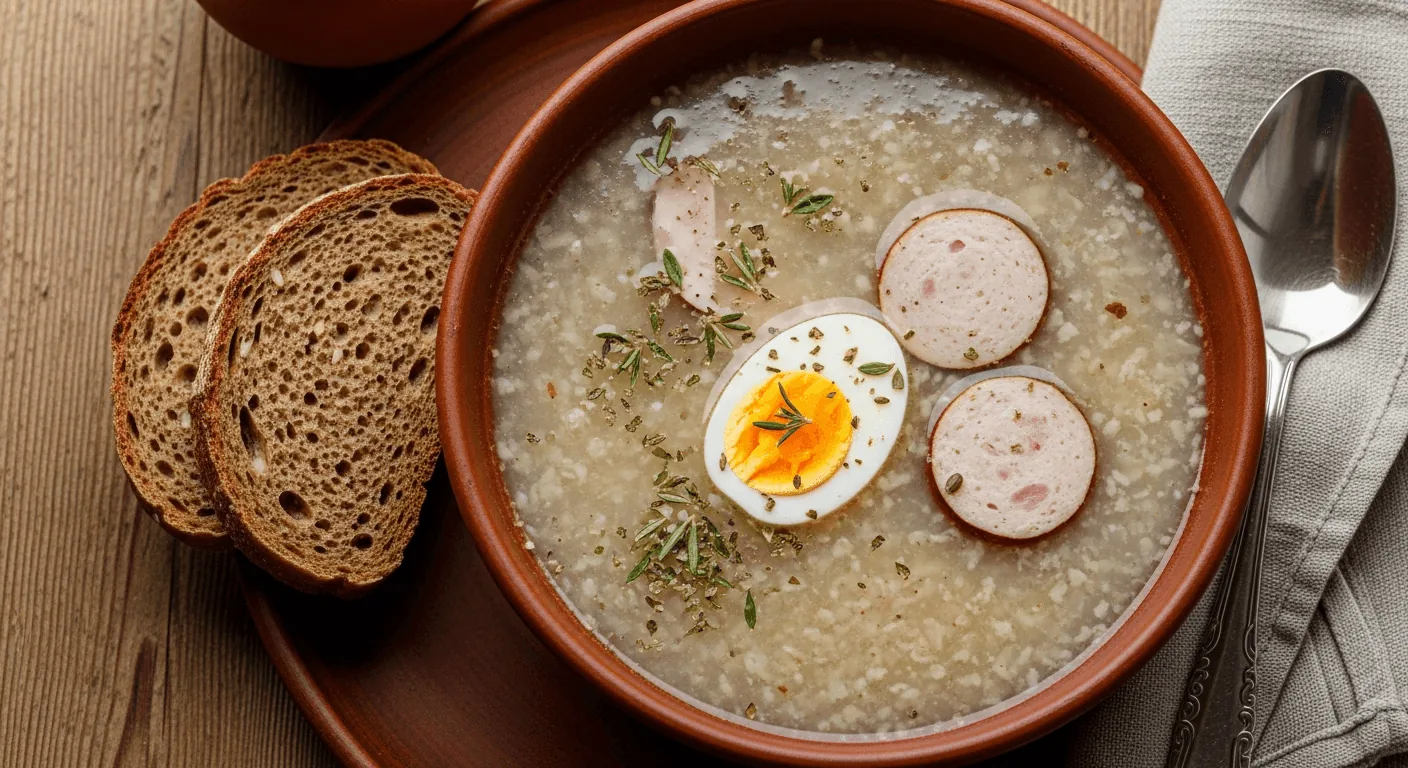
The two soups could not look more different on the table – żurek is thick, pale and cloudy, ladled over sausage and boiled egg; barszcz czerwony is strained clear and ruby-red, often served as a formal broth on its own or with mushroom-filled uszka on Christmas Eve. What they share is the same technique underneath: a raw ingredient, water, and days of unhurried fermentation before either soup is even started.
Why fermentation, not vinegar
A splash of vinegar can make a soup taste sour in seconds, but it cannot reproduce what lactic fermentation does over five to seven days – a rounder, less sharp acidity with its own depth of flavor, plus the faint effervescence and cloudiness that mark a real zakwas. Before refrigeration, souring grain or vegetables in water was also simply practical: it preserved food and produced something worth eating out of ingredients that would otherwise spoil. That practical origin is still visible in how unfussy the method is – a jar, tap water left to stand, and whatever aromatics were on hand.
Where you will meet it on this site
Rye zakwas is the base of our Traditional Polish Żurek, and it carries through in a lighter form in our Healthy Żurek, which keeps the same fermented starter while trimming sodium and leaning out the protein. Beet zakwas anchors Traditional Polish Barszcz Czerwony and its lighter companion piece, Healthy Polish Barszcz Czerwony and Uszka. If you are curious about the dumplings that traditionally float in that clear red broth on Christmas Eve, see Traditional Polish Uszka. Start the zakwas five to seven days before you plan to cook – it is the one step in either soup that cannot be hurried, and it is what makes both of them taste like nothing else on the table.
Further Reading & Sources
This entry draws on the sources below and on the recipes it links to elsewhere on this site. They are listed for readers who want to go further.
- “Polish Żurek Soup.” Polonist. polonist.com — the rye starter and how the soup is built on it.
- “Polish Food 101 — Barszcz.” Culture.pl. culture.pl — the beet version of the same souring method.
Leave a Reply