
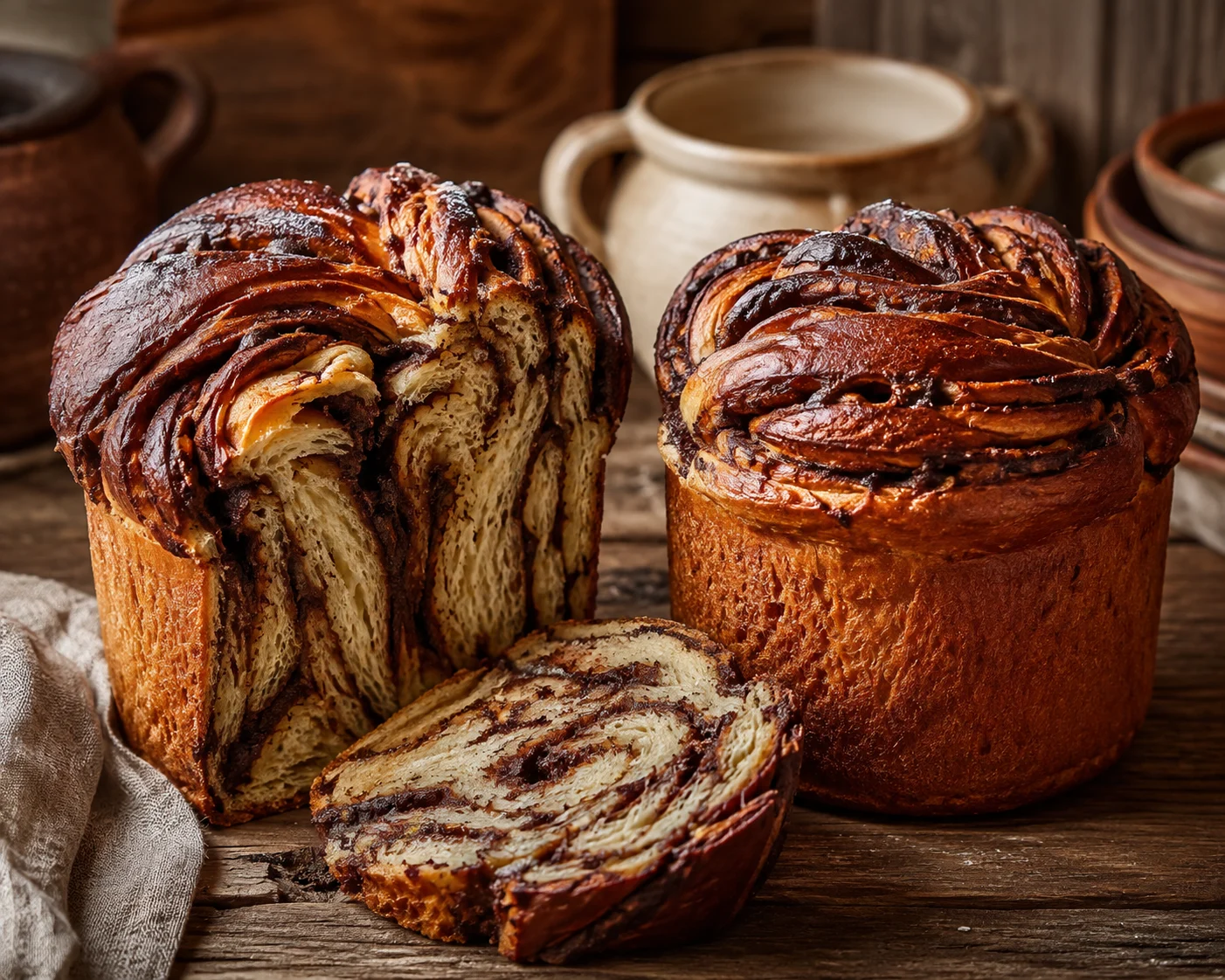
Active time: ~40 minutes | Total time: ~4 hours (including rising) | Serves: 20 (2 loaves, 10 slices each) | Difficulty: Moderate
Quick Overview
- Bloom yeast in warm water, then whisk it into an oil-enriched dough with eggs and sugar
- Let the dough rise until doubled, about 1½–2 hours
- Divide the dough and spread one half with chocolate filling, the other with cinnamon-sugar
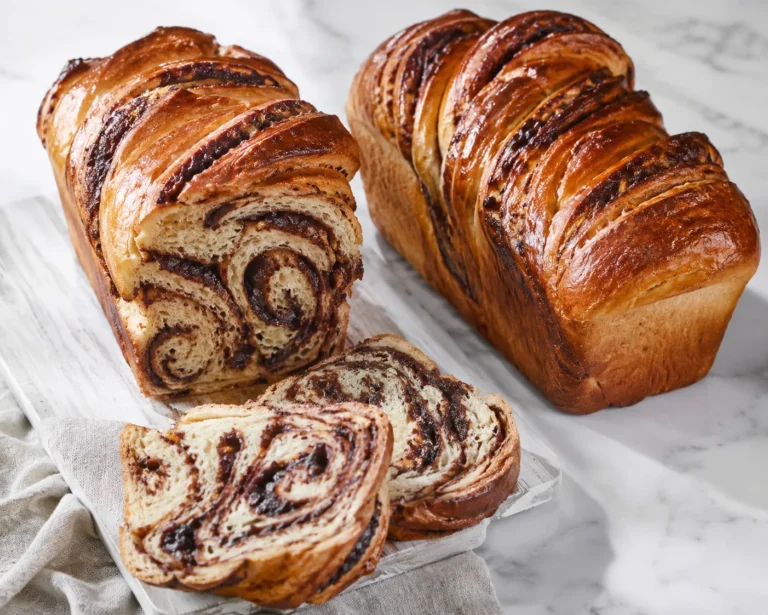
- Roll each half into a tight log, slice it lengthwise, and twist the two strands together
- Top with a light streusel and let the shaped loaves rise again before baking
- Cool completely before slicing, so the swirled layers hold their shape
What Babka Is
Babka is a sweet, twisted yeast bread filled with a swirl of chocolate, cinnamon, or another sweet filling, usually finished with a streusel topping or a brush of sugar syrup.1 It belongs to the Ashkenazi Jewish baking tradition of Poland and neighboring parts of Ukraine, and its name comes from the Slavic word for grandmother.1,2
The dough is enriched with eggs and, in its traditional form, oil rather than butter, a distinction rooted in Jewish dietary law that shows up repeatedly in babka’s history.2,4,5 Depending on the baker, that dough can be a soft, challah-like bread dough or, in more modern versions, a laminated dough closer to a croissant.1
From Leftover Dough to a Named Tradition
The most widely repeated account of babka’s origin starts in the kitchen, not the bakery. In early 19th-century Poland, Jewish housewives preparing dough for Friday’s challah would set aside the extra, spread it with jam, cinnamon, or raisins, and bake it alongside the Shabbat loaves as a small bonus treat.2,4 Culinary historians generally credit Polish Jewish cooks with the idea, and from Poland it spread through the Jewish communities of Central and Eastern Europe.1,3
Not every historian tells the story the same way. Cookery writer Lesley Chamberlain, who specializes in Eastern European cuisine, has floated an alternate theory: that babka’s bread-like texture and taste echo Italian panettone, possibly introduced to Poland by Queen Bona Sforza in the 1500s and adapted by local bakers over the centuries that followed.4
The name itself is easier to pin down. “Babka” is a diminutive of “baba,” the word for grandmother in Polish, Yiddish, and related languages.1,4 Two explanations for the connection circulate: that the fluted sides of the traditional baking pan resembled the pleats of a grandmother’s skirt, or, more simply, that grandmothers were the ones doing the baking.2
Oil, Not Butter: Why It Mattered
Non-Jewish Polish and Ukrainian households have long baked their own babka in tall, fluted, panettone-style pans, a cake related by name but visibly different from the one that became a Jewish tradition.1,4 The Jewish version was baked in smaller loaf pans instead.4
Non-Jewish bakers typically enriched their babka with butter and milk, closer to a French brioche.4 Jewish bakers used oil instead, so the finished loaf would be pareve, or free of dairy, and could still be served after a meat-based Shabbat meal without breaking the dietary laws that keep meat and dairy separate.2,4,5 A streusel topping of sugar, flour, and oil or margarine finished the loaf, and the standard filling was cinnamon, not chocolate.2,4
Crossing the Atlantic: A Seinfeld Cameo
Jewish emigrants carried babka with them during the wave of emigration from Poland and neighboring countries to the United States in the late 19th century, and it became a fixture of Jewish bakeries there.3 Chocolate entered the picture later: Wikipedia describes the chocolate-filled version as a mid-20th-century American development,1 arriving only once the ingredient became affordable to immigrant Jewish households.4 Other holiday variations took shape as well: a syrup-soaked “shikkera babka,” or “drunken grandma,” for Purim, a loaf served to break the Yom Kippur fast, and dairy-enriched “milchig” versions for the cheese-friendly holiday of Shavuot.4
Babka stayed largely confined to Polish Jewish neighborhoods until the 1950s, when it began appearing more widely in Jewish bakeries and community cookbooks.2 Then, in 1994, it got an unlikely boost from television: a Seinfeld episode, “The Dinner Party,” in which Jerry and Elaine wait in a bakery line for a chocolate babka, only to lose the last one to another couple.3,4 Settling for a cinnamon loaf, Elaine calls it “the lesser babka,” while Jerry insists, “Cinnamon takes a backseat to no babka.”1
The episode gave babka national name recognition,2 but it didn’t immediately transform its reputation. For nearly two decades afterward, babka remained something of an afterthought at the Jewish dessert table: reliably good, but rarely the star, more a “plus-one on the shiva table” than a headline dessert.5
The Babka Renaissance
That changed in 2012, when Israeli chef Yotam Ottolenghi and Palestinian chef Sami Tamimi published Jerusalem: A Cookbook, featuring a butter-rich, syrup-glazed babka they called a “krantz cake.”5 Instead of a streusel top, the loaf was left bare and glossy, its ropes of dough sliced open to expose the chocolate rather than twisted shut.5
A few months later, in early 2013, Israeli baker Uri Scheft opened Breads Bakery near Union Square in New York, serving a similar loaf made with laminated, croissant-style dough and a Nutella-and-chocolate filling.5 Scheft had originally called his version a krantz cake too, but renamed it chocolate babka because the term translated more easily for local customers. Within three months, the bakery’s babka was named the best in the city by New York Magazine.5
The trend never really slowed down. Breads Bakery now operates six locations and reportedly sells more than 1,000 babkas a day during the winter holidays, and its chocolate babka made the New York Times’ 2025 list of the city’s essential pastries.6 Chef and Milk Bar founder Christina Tosi credited Scheft with defying “the odds of how much chocolate one could put in babka.”6
Much of the older, streusel-topped babka sold across New York for decades actually came from a single wholesaler: Green’s Bakery, founded by Chana Green, a Holocaust survivor who immigrated from Hungary in 1948.5 Green’s bakes around 24,000 babkas a week and supplies stores including Zabar’s and Fairway, each repackaging the same babka under its own label. Family lore even holds that the very first cakes Green sold were actually kokosh, a related Hungarian pastry, not babka at all.5
Traditional Babka Recipe
Recipe developed independently by Heritage Healthy Kitchen, drawing on traditional Ashkenazi baking methods. Sources for further reading are listed at the end of this article.
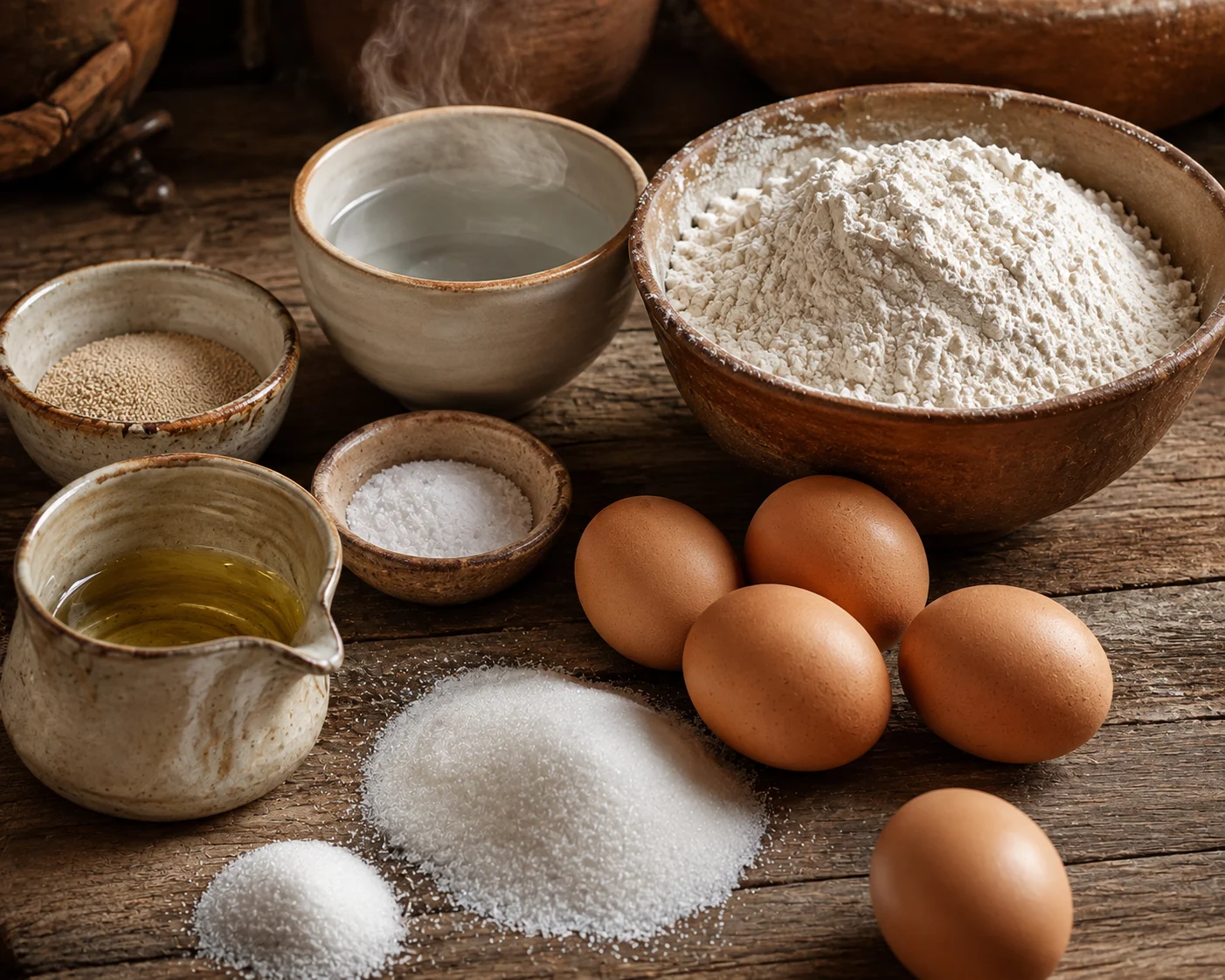
Ingredients
For the dough (makes 2 loaves)
- 1 packet (2¼ teaspoons / 7g) active dry yeast
- ¼ cup (60ml) warm water (about 110°F)
- ¾ cup (150g) granulated sugar, divided
- 4 large eggs, plus 1 extra for egg wash
- 1 cup (240ml) neutral vegetable oil (canola or sunflower), plus extra for the bowl
- 1 teaspoon fine salt
- 4½ cups (560g) all-purpose flour, plus more for kneading
For the chocolate filling (1 loaf)
- 1 cup (170g) semisweet chocolate, finely chopped
- ⅓ cup (67g) granulated sugar
- ¼ cup (21g) unsweetened cocoa powder
- 3 tablespoons neutral oil or melted margarine
For the cinnamon filling (1 loaf)
- ½ cup (110g) packed brown sugar
- 1 tablespoon ground cinnamon
- 3 tablespoons neutral oil or melted margarine
For the streusel (optional, both loaves)
- ½ cup (60g) all-purpose flour
- ¼ cup (50g) granulated sugar
- 3 tablespoons neutral oil or melted margarine
Instructions
- Bloom the yeast: Dissolve the yeast in warm water with 1 teaspoon of the sugar. Let stand until foamy, about 10 minutes.
- Mix the dough: In a large bowl, whisk the eggs, remaining sugar, oil, and salt. Stir in the yeast mixture, then gradually add the flour, mixing until a soft, slightly tacky dough forms. Knead 6–8 minutes until smooth.
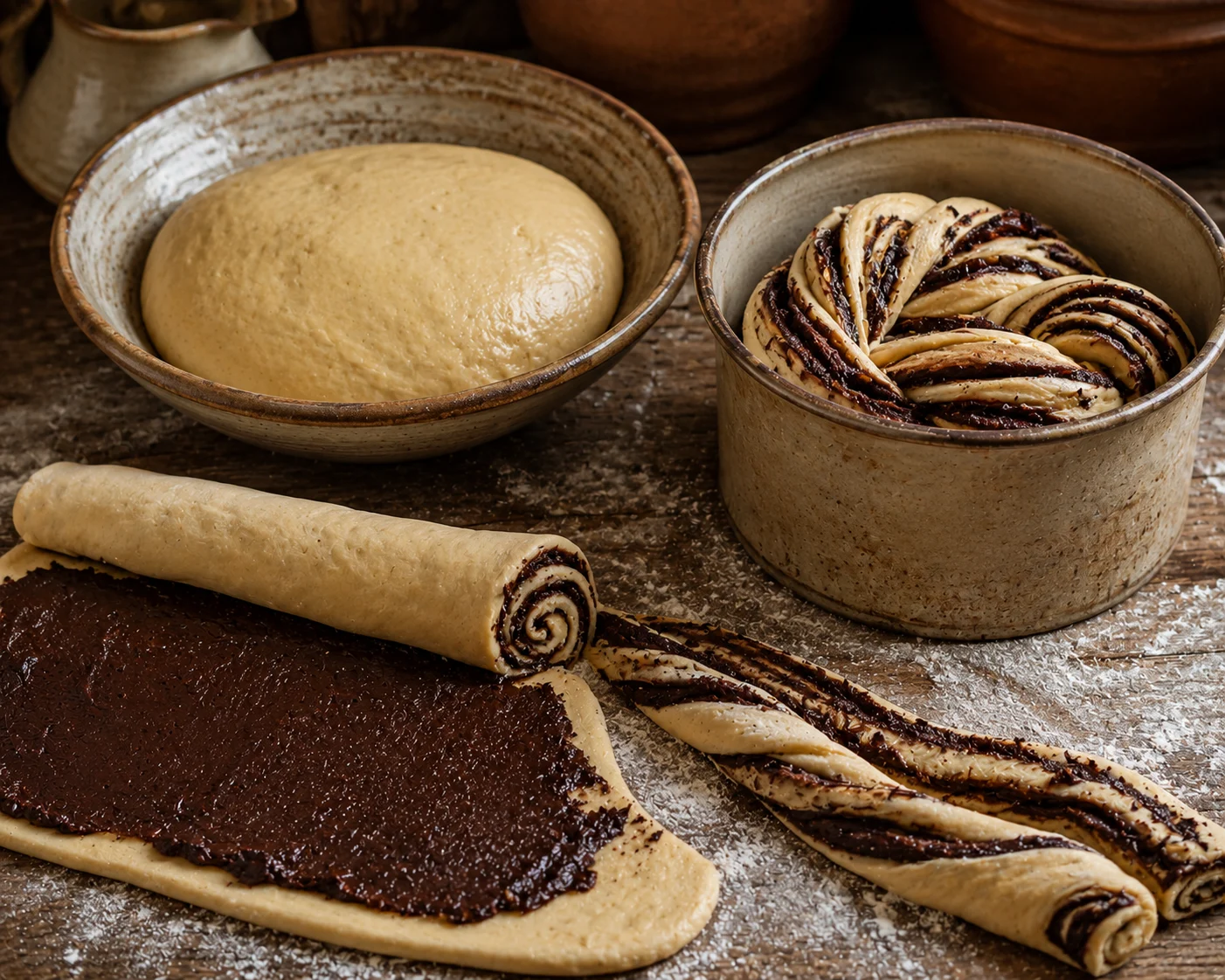
- First rise: Place the dough in an oiled bowl, cover, and let rise in a warm spot until doubled, about 1½–2 hours.
- Make the fillings: Stir together the chocolate filling ingredients in one bowl and the cinnamon filling ingredients in another.
- Shape the loaves: Punch down the dough and divide it in half. Roll each half into a 12×16-inch rectangle. Spread one with the chocolate filling and the other with the cinnamon filling, leaving a small border.
- Roll and twist: Roll each rectangle tightly into a log from the long side. Slice each log in half lengthwise with a sharp knife, exposing the swirled layers, then twist the two strands together, cut sides up, and settle each into a greased 9×5-inch loaf pan.
- Second rise: Cover the loaves and let rise until puffy, 45–60 minutes. Preheat the oven to 350°F (175°C) and mix the streusel into coarse crumbs.
- Top and bake: Brush each loaf with beaten egg, sprinkle with streusel, and bake 35–45 minutes, until deeply golden and a skewer inserted in the center comes out clean.
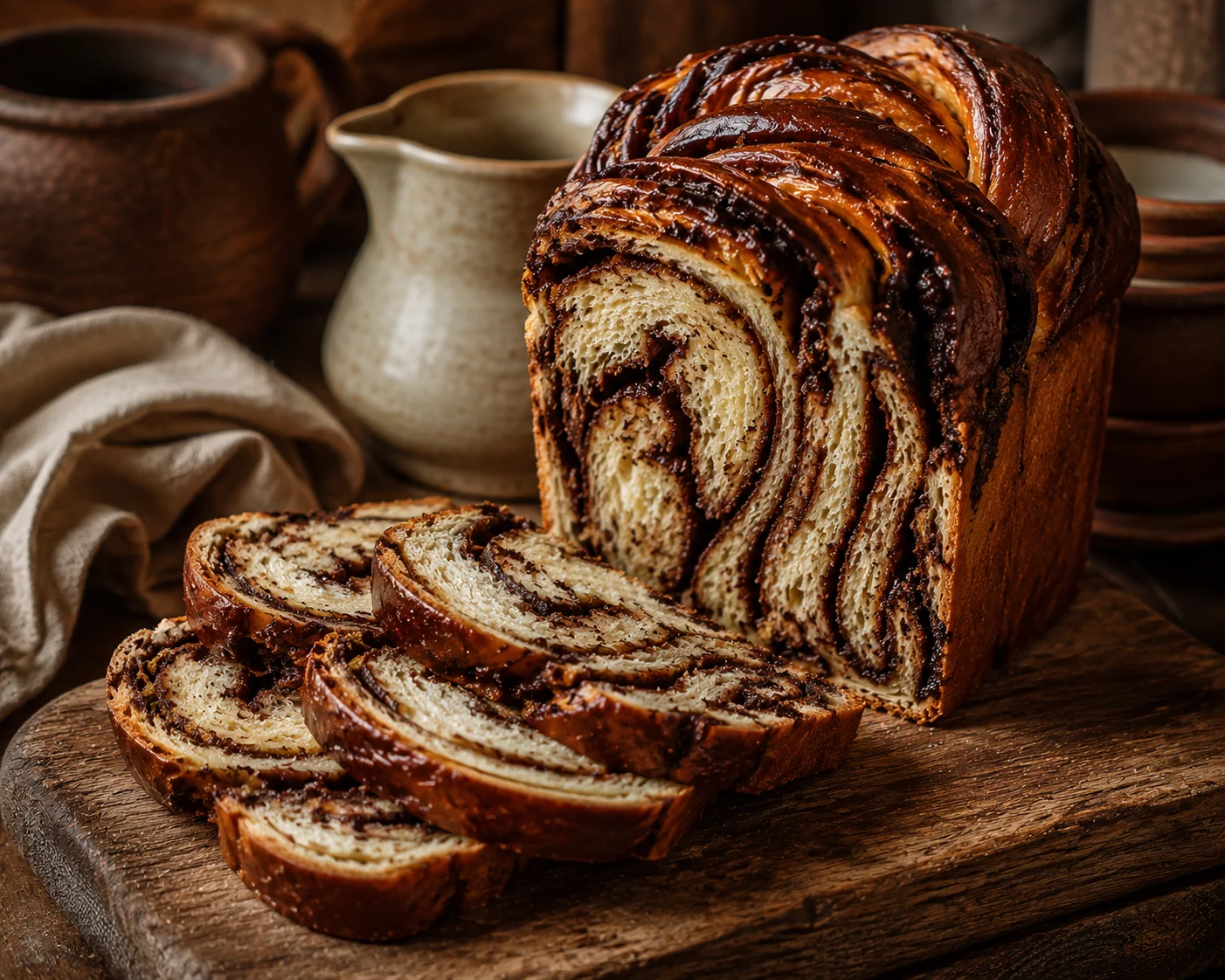
- Cool: Rest the loaves in their pans for 15 minutes, then turn out onto a rack and cool completely before slicing.
Kitchen Tips
Roll the dough as tightly as possible before twisting. A snug log produces the fine, many-layered swirl babka is known for; a loosely rolled one bakes into just a few thick bands.
Let the loaf cool completely before slicing. A warm babka is tempting, but the filling is still soft and will smear rather than hold a clean swirl.
The shaped, unbaked loaves freeze well: thaw overnight in the refrigerator, then let the loaf finish its second rise at room temperature before baking as directed.
Nutritional Information
Per serving (1 of 10 slices), chocolate babka
- Calories: approximately 390–480 kcal
- Protein: ~5–7g
- Total fat: ~22–26g
- Carbohydrates: ~48–58g
- Sodium: ~125–150mg
The cinnamon version runs somewhat lighter, at approximately 330–400 kcal per slice, since it skips the chocolate and cocoa powder. Values are estimates calculated ingredient-by-ingredient using standard reference data and will vary with the exact brands and slice size used. Eggs contribute a meaningful share of the dough’s fat and protein, most of it unsaturated, along with choline and several vitamins.8
Storage and Reheating
Store cooled babka at room temperature, wrapped tightly or in an airtight container, for up to 3–4 days. The oil and egg in the dough keep it noticeably moister for longer than a plain, lean bread.
For longer storage, wrap a fully cooled loaf tightly in plastic and then foil and freeze for up to 2 months. Thaw at room temperature, and refresh a slightly stale loaf with a few minutes in a 300°F oven or a short burst in the microwave.
Traditional Babka

Ingredients
For the dough (makes 2 loaves)
- 1 packet (2¼ teaspoons / 7g) active dry yeast
- ¼ cup (60ml) warm water (about 110°F)
- ¾ cup (150g) granulated sugar, divided
- 4 large eggs, plus 1 extra for egg wash
- 1 cup (240ml) neutral vegetable oil (canola or sunflower), plus extra for the bowl
- 1 teaspoon fine salt
- 4½ cups (560g) all-purpose flour, plus more for kneading
For the chocolate filling (1 loaf)
- 1 cup (170g) semisweet chocolate, finely chopped
- ⅓ cup (67g) granulated sugar
- ¼ cup (21g) unsweetened cocoa powder
- 3 tablespoons neutral oil or melted margarine
For the cinnamon filling (1 loaf)
- ½ cup (110g) packed brown sugar
- 1 tablespoon ground cinnamon
- 3 tablespoons neutral oil or melted margarine
For the streusel (optional, both loaves)
- ½ cup (60g) all-purpose flour
- ¼ cup (50g) granulated sugar
- 3 tablespoons neutral oil or melted margarine
Instructions
- Bloom the yeast: Dissolve the yeast in warm water with 1 teaspoon of the sugar. Let stand until foamy, about 10 minutes.
- Mix the dough: In a large bowl, whisk the eggs, remaining sugar, oil, and salt. Stir in the yeast mixture, then gradually add the flour, mixing until a soft, slightly tacky dough forms. Knead 6–8 minutes until smooth.
- First rise: Place the dough in an oiled bowl, cover, and let rise in a warm spot until doubled, about 1½–2 hours.
- Make the fillings: Stir together the chocolate filling ingredients in one bowl and the cinnamon filling ingredients in another.
- Shape the loaves: Punch down the dough and divide it in half. Roll each half into a 12×16-inch rectangle. Spread one with the chocolate filling and the other with the cinnamon filling, leaving a small border.
- Roll and twist: Roll each rectangle tightly into a log from the long side. Slice each log in half lengthwise with a sharp knife, exposing the swirled layers, then twist the two strands together, cut sides up, and settle each into a greased 9×5-inch loaf pan.
- Second rise: Cover the loaves and let rise until puffy, 45–60 minutes. Preheat the oven to 350°F (175°C) and mix the streusel into coarse crumbs.
- Top and bake: Brush each loaf with beaten egg, sprinkle with streusel, and bake 35–45 minutes, until deeply golden and a skewer inserted in the center comes out clean.
- Cool: Rest the loaves in their pans for 15 minutes, then turn out onto a rack and cool completely before slicing.
Frequently Asked Questions
Why is traditional babka made with oil instead of butter?
Jewish babka was traditionally kept pareve, or free of dairy, so it could be eaten after a meat-based Shabbat meal without violating the dietary laws that separate meat and dairy. Oil made that possible where butter would not.2,4,5
Where does the name “babka” come from?
It’s a diminutive of “baba,” the word for grandmother in Polish, Yiddish, and related languages,1,4 either because the traditional fluted pan resembled a grandmother’s pleated skirt or simply because grandmothers were the ones baking it.2
Is Jewish babka the same as the Polish or Ukrainian babka that shares its name?
They’re related but visibly different: the non-Jewish version is typically a taller, rounder cake baked in a fluted, panettone-style pan, while the Jewish version became a smaller, twisted loaf baked in a standard bread pan.1,4
Why wasn’t the original babka filled with chocolate?
Chocolate wasn’t widely available or affordable to Eastern European Jewish households when babka first developed; jam, cinnamon, and raisins filled it instead, until chocolate became accessible to immigrant families in North America.1,4
What’s the difference between babka and krantz cake?
Krantz cake is a closely related Ashkenazi pastry popular in Israel.7 The modern butter-enriched, syrup-glazed babka style was modeled on it and originally named after it (krantz is German for wreath), before bakeries such as Breads rebranded their version “chocolate babka” because the word translated more easily for customers.5
Did Seinfeld really make babka famous?
It gave babka a major boost in name recognition after a 1994 episode built around Jerry and Elaine’s hunt for a chocolate loaf, but babka’s reputation as a must-have dessert didn’t fully take off until nearly two decades later.1,2,5
Why did chocolate babka suddenly become so trendy in the 2010s?
Two butter-laminated, syrup-glazed versions, one from the 2012 cookbook Jerusalem and one from New York’s Breads Bakery, which opened in 2013, reintroduced babka with a richer dough and more visible filling, and the style spread quickly through bakeries and, later, social media.5
Looking for a Lighter Version?
Traditional babka is a sugar- and oil-enriched dough wrapped around a rich chocolate or cinnamon filling, and there’s genuine room to lighten it: a partial swap to whole wheat flour, a reduced-sugar filling, or dark chocolate in place of semisweet. A separate Healthy Babka article on this site walks through those adjustments in detail.
Further Reading & Sources
The following sources were consulted in researching the history and background of traditional babka. Heritage Healthy Kitchen’s recipe was developed independently; these links are provided for readers who want to explore further.
- “Babka.” Wikipedia. en.wikipedia.org/wiki/Babka — dough types and fillings, the origin region, the baba/grandmother etymology, the non-Jewish vs. Jewish pan styles, the mid-20th-century arrival of chocolate, and the Seinfeld “Dinner Party” scene and quotes.
- Romanow, Katherine. “Eating Jewish: Babka.” Jewish Women’s Archive. jwa.org/blog/eating-jewish-babka — the grandmother/babcia etymology and pan-shape theory, the pareve rationale for oil, the leftover-challah-dough origin story, and babka’s 1950s spread beyond Polish Jewish neighborhoods.
- O’Leary, Joanna. “A Short History of Babka.” The Nosher, My Jewish Learning. myjewishlearning.com/the-nosher/a-short-history-of-babka — Polish origins credited by culinary historians, the late-19th-century emigration wave, and details of the 1994 Seinfeld episode’s real-life bakery basis.
- Alt Miller, Yvette. “Let Them Eat Babka.” Aish. aish.com/let-them-eat-babka — the baba/grandmother etymology, the Lesley Chamberlain panettone theory, the oil-versus-butter and streusel details, and holiday variations including shikkera babka, Yom Kippur, and Shavuot versions.
- Koenig, Leah. “Searching for Babka’s Soul.” Tablet Magazine. tabletmag.com/sections/food/articles/searching-for-babkas-soul — babka’s pre-2012 reputation, the 2012 Jerusalem cookbook, the 2013 opening of Breads Bakery, and the history of Green’s Bakery and Chana Green.
- Hajdenberg, Jackie. “These Jewish Baked Goods Made the New York Times’ List of ’25 Essential Pastries’ in NYC.” Jewish Telegraphic Agency. jta.org — babka essential pastries — Breads Bakery’s current scale and its 2025 New York Times recognition.
- “Krantz Cake.” Wikipedia. en.wikipedia.org/wiki/Krantz_cake — background on the related Israeli pastry, described as the most popular cake on Jerusalem’s west side.
- Harvard T.H. Chan School of Public Health. “Eggs.” The Nutrition Source. nutritionsource.hsph.harvard.edu/food-features/eggs — the fat, protein, and nutrient composition of eggs, a key ingredient in the dough.
Disclaimer
The information in this article is provided for educational and informational purposes only. Heritage Healthy Kitchen makes no representations or warranties regarding the accuracy or completeness of any content on this site. Nutritional values are estimates only and will vary depending on the specific ingredients, brands, and measurements used. This content is not intended as dietary, medical, or professional nutritional advice. Always consult a qualified healthcare provider regarding any dietary needs or health conditions. Heritage Healthy Kitchen is not responsible for any outcomes resulting from the use of recipes or information published on this site.
Cook by Occasion
This recipe is part of our Shabbat table.
You Might Also Like
More heritage recipes from our kitchen


Leave a Reply