

Active time: ~40 minutes | Total time: ~4 hours (including rising and cooling) | Serves: 20 (2 loaves, 10 slices each) | Difficulty: Moderate
Quick Overview
- Bloom yeast in warm water, then whisk it into an oil-enriched dough with eggs and sugar
- Let the dough rise until doubled, about 1½–2 hours
- Divide the dough and spread one half with chocolate filling and the other with cinnamon-sugar
- Roll each half into a tight log, slice it lengthwise and twist the two strands together
- Top with a light streusel, let the loaves rise again and bake
- Cool completely before slicing, so the swirled layers hold their shape
What Babka Is
Babka is a sweet, twisted yeast bread rolled around a filling such as nuts and cinnamon, marzipan, jam or chocolate, and usually topped with streusel.1 Its name comes from baba, the word for grandmother in several Eastern European languages including Yiddish; babka is a diminutive, “little grandma.”1 The Jewish loaf is made with oil rather than butter, so it is pareve, without milk or meat, and can be eaten after a meat meal.2
History and Cultural Roots
Historians are not entirely sure where babka began.1 The story told most often starts in the kitchen: in early nineteenth-century Poland, Jewish housewives spread the extra dough from the egg challah they made for Shabbat with jam, cinnamon or raisins.2 Culinary historians credit Polish cooks with babka, and emigrants from Poland and other Central European countries brought it to the United States, where it became common in Jewish bakeries.3 One cookery writer, cited by Aish, has another idea: that babka’s bread-like texture recalls the Italian festive pastry panettone, brought to Eastern Europe by Queen Bona Sforza of Poland in the 1500s.1
The Jewish loaf differed from its neighbors’. Non-Jewish housewives typically made babka with butter and milk, much like brioche, and baked it in high, wide round pans. Jewish babkas were small and loaf-like, made with oil instead of butter, and finished with a streusel of sugar, flour and oil or margarine.1 Chocolate arrived once it was affordable: after Jewish families emigrated to North America in the late 1800s, many housewives began adding it to their babkas.1
For a long time babka was, as one writer puts it, a plus-one on the shiva table, the food set out for visitors during the Jewish week of mourning. That changed with the butter-rich, syrup-glazed babka in the 2012 cookbook Jerusalem and with Breads Bakery, which opened in New York in early 2013 and made its chocolate babka with laminated, croissant-style dough.4 Those are butter doughs, not pareve ones; the recipe below follows the older oil tradition.
On the Holiday Table
Babka began with the extra dough of the Shabbat challah,2 and because an oil loaf is pareve it can follow a meat meal,2 which is why it is on our Shabbat table.
For Purim, a food historian cited by Aish notes a special version, shikkera babka, “drunken grandma,” drizzled with a syrup containing whiskey or rum. The optional syrup in the recipe below is that finish.1 Babka appears on other holiday tables too: Polish Jews would break the Yom Kippur fast with it, and dairy, or milchig, versions were sometimes baked for Shavuot, when dairy foods are customary.1 The loaves below are pareve.
Traditional Babka Recipe
This recipe was compiled by Heritage Healthy Kitchen from a comparison of published recipes; the sources are listed at the end of this article. Figures that are Heritage Healthy Kitchen’s own estimates rather than taken from a published source are marked as such.
Published recipes use 225–345g of flour for each loaf, with ½–1 cup (120–250ml) of water, soy milk or milk for 250–480g of flour.5,6,7,8 The dough is enriched with anything from a single egg yolk to 2 eggs and a yolk, about 5 tablespoons of margarine or butter or ⅓ cup (80ml) of oil, and ¼–½ cup (50–100g) of sugar.5,6,7,8 The chocolate filling uses about 4 oz (113g) of chopped chocolate per loaf, with sugar and cocoa.5,8 The loaves rise for about 1½ hours, then for 45 minutes to 1½ hours in the pan, and bake at 175°C (350°F) in a 23×13cm (9×5-inch) loaf pan for 30–50 minutes.5,6,7,8 The syrup is ¼ cup (50g) of sugar to ¼ cup (60ml) of water, spooned over as the loaves come out of the oven.6,7 The amounts below sit inside those ranges. The cinnamon filling, the streusel, the rum, the kneading time and the number of slices are Heritage Healthy Kitchen’s estimates.
Ingredients (makes 2 loaves, serves 20)
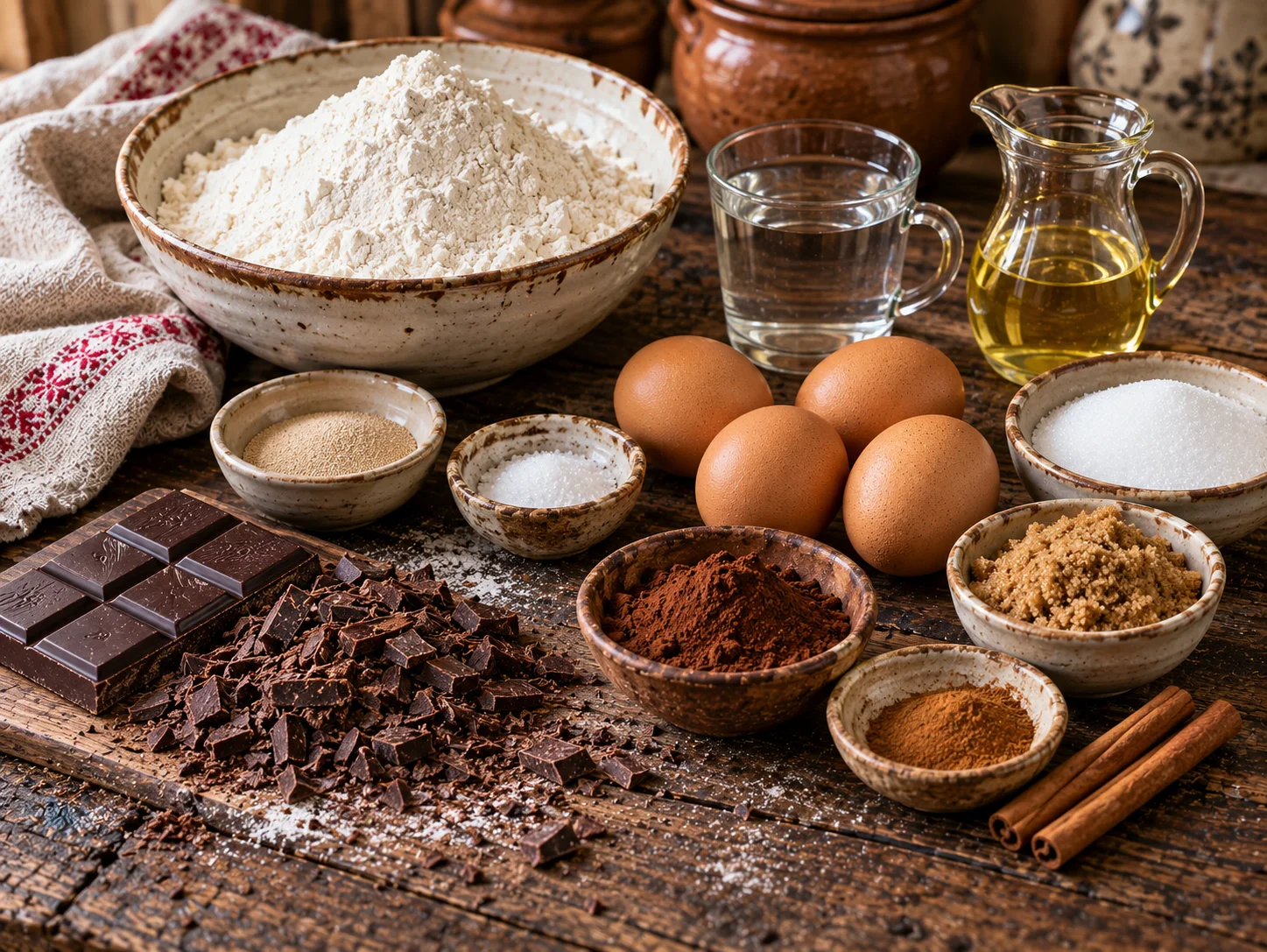
For the dough (makes 2 loaves)
- 1 packet (7g / 2¼ teaspoons) active dry yeast
- 180ml (¾ cup) warm water (about 43°C / 110°F)
- 100g (½ cup) granulated sugar, divided
- 3 large eggs, plus 1 for the egg wash
- 100ml (scant ½ cup) neutral vegetable oil, such as canola or sunflower, plus a little for the bowl and pans
- 1 teaspoon fine salt
- 480g (4 cups) all-purpose flour, plus more for kneading
For the chocolate filling (1 loaf)
- 113g (4 oz) semisweet chocolate, finely chopped
- 67g (⅓ cup) granulated sugar
- 21g (¼ cup) unsweetened cocoa powder
- 4 tablespoons (60ml) neutral oil or melted margarine
For the cinnamon filling (1 loaf)
- 110g (½ cup, packed) brown sugar
- 2 teaspoons ground cinnamon
- 4 tablespoons (60ml) neutral oil or melted margarine
For the streusel (optional, both loaves)
- 40g (⅓ cup) all-purpose flour
- 38g (3 tablespoons) granulated sugar
- 2 tablespoons (30ml) neutral oil or melted margarine
For the syrup (optional, both loaves)
- 50g (¼ cup) granulated sugar
- 60ml (¼ cup) water
- 2 tablespoons (30ml) rum or whiskey, for the shikkera version
Instructions
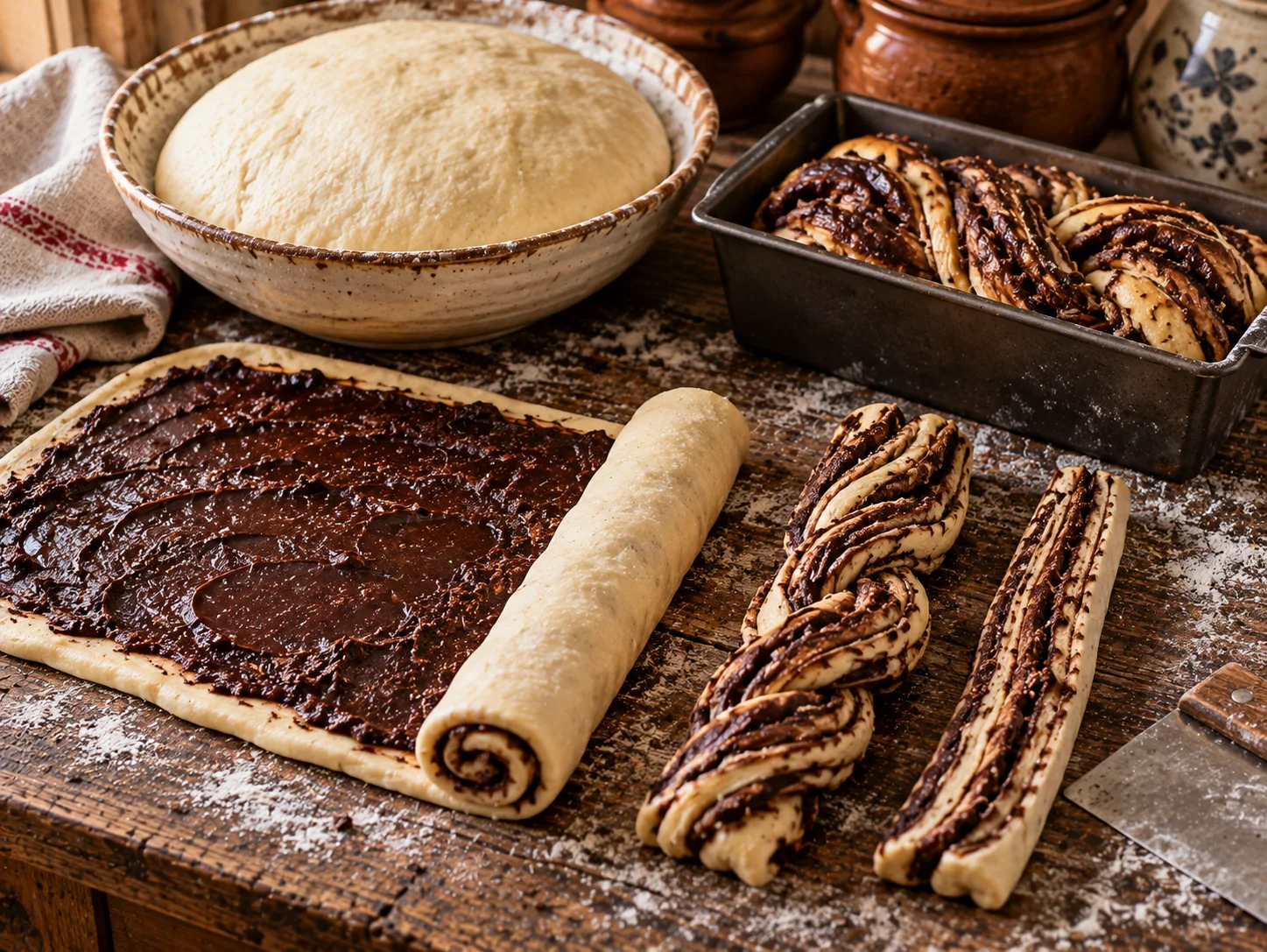
- Bloom the yeast. Stir the yeast and 1 teaspoon of the sugar into the warm water and leave it for about 10 minutes, until foamy.5,6
- Mix the dough. In a large bowl, whisk the eggs with the rest of the sugar, the oil and the salt. Stir in the yeast mixture, then add the flour gradually until a soft, slightly tacky dough forms. Knead for about 8 minutes, until smooth.
- First rise. Put the dough in an oiled bowl, cover and leave it in a warm place for 1½–2 hours, until doubled.5,6,8
- Make the fillings. Stir the chocolate filling ingredients together in one bowl and the cinnamon filling ingredients in another.
- Shape the loaves. Punch the dough down and divide it in half. Roll each half into a rectangle about 30×40cm (12×16 inches). Spread one with the chocolate filling and the other with the cinnamon filling, leaving a small border.
- Roll and twist. Roll each rectangle tightly into a log from the long side. Slice each log in half lengthwise, then twist the two strands together with the cut sides up and settle each loaf into a greased 23×13cm (9×5-inch) loaf pan.5,7
- Second rise. Cover the loaves and leave them for 45–60 minutes, until puffy. Heat the oven to 175°C (350°F) and rub the streusel ingredients together into coarse crumbs.5
- Top and bake. Brush each loaf with beaten egg and scatter over the streusel. Bake for 35–40 minutes, until deep golden and a skewer in the center comes out clean.5,6,8
- Make the syrup (optional). While the loaves bake, simmer the sugar and water until the sugar dissolves, then take the pan off the heat. For shikkera babka, stir in the rum or whiskey. Spoon the syrup over the loaves as soon as they come out of the oven.1,6,7
- Cool. Leave the loaves in their pans for 15 minutes, then turn them out onto a rack and cool completely before slicing.7
Kitchen Tips
Roll the log as tightly as you can before slicing and twisting. A snug roll gives many fine layers; a loose one bakes into a few thick bands.
Spoon the syrup over the loaves while they are still hot from the oven, as the published recipes do.6,7
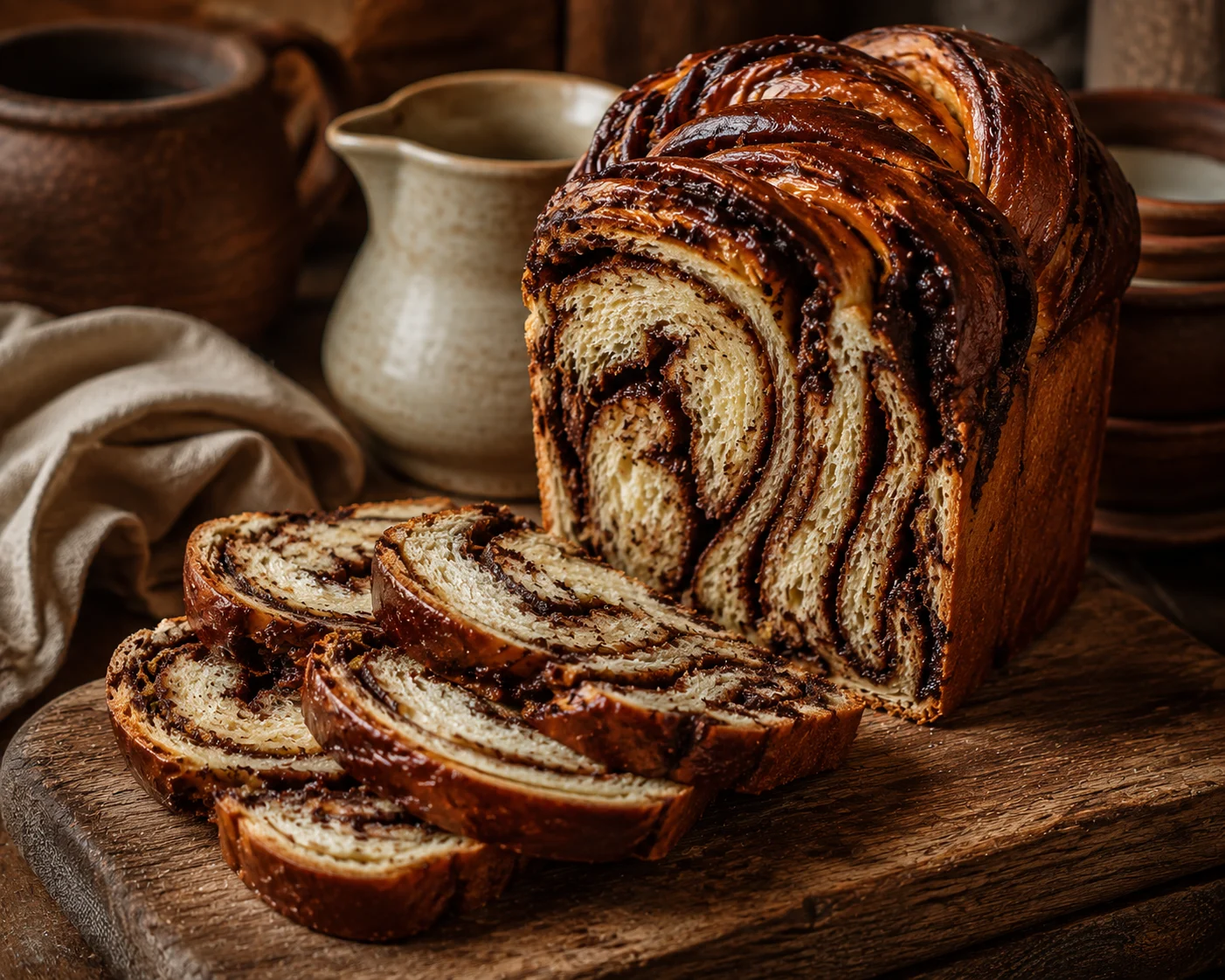
Let the loaves cool completely before slicing. The filling is still soft when warm and smears instead of holding a clean swirl.7
Looking for a Lighter Version?
Our Healthy Babka recipe keeps the twist and the streusel but uses half white whole wheat flour, about a quarter less sugar, unsweetened applesauce in place of part of the oil and 70% dark chocolate.
Nutritional Information
Per serving (1 slice, one-tenth of a loaf), chocolate babka, without the optional syrup:
- Calories: approximately 300–365 kcal
- Protein: 4.5–5.5g
- Total fat: 15–18g, of which saturated 3–4g
- Carbohydrates: 38–46g, of which sugars 17–21g
- Fiber: 2–2.6g
- Sodium: 120–150mg
The cinnamon babka comes to approximately 250–310 kcal per slice. The optional syrup adds up to about 10 kcal a slice if it is all absorbed.
Nutritional values are estimates based on standard ingredient databases (USDA FoodData Central).9 They vary with the chocolate, the brand of flour and how thickly the loaves are sliced; semisweet chocolate is represented by the USDA entry for dark chocolate with 45–59% cacao solids.
Storage and Reheating
Wrap the cooled loaf tightly and keep it at room temperature for 3–4 days, or wrap it in plastic and then foil and freeze it for up to 2 months. Thaw it at room temperature, and refresh a slightly stale slice with a few minutes in a 150°C (300°F) oven. These times are Heritage Healthy Kitchen’s estimates.
Traditional Babka

Ingredients
For the dough (makes 2 loaves)
- 1 packet (7g / 2¼ teaspoons) active dry yeast
- 180ml (¾ cup) warm water (about 43°C / 110°F)
- 100g (½ cup) granulated sugar, divided
- 3 large eggs, plus 1 for the egg wash
- 100ml (scant ½ cup) neutral vegetable oil, such as canola or sunflower, plus a little for the bowl and pans
- 1 teaspoon fine salt
- 480g (4 cups) all-purpose flour, plus more for kneading
For the chocolate filling (1 loaf)
- 113g (4 oz) semisweet chocolate, finely chopped
- 67g (⅓ cup) granulated sugar
- 21g (¼ cup) unsweetened cocoa powder
- 4 tablespoons (60ml) neutral oil or melted margarine
For the cinnamon filling (1 loaf)
- 110g (½ cup, packed) brown sugar
- 2 teaspoons ground cinnamon
- 4 tablespoons (60ml) neutral oil or melted margarine
For the streusel (optional, both loaves)
- 40g (⅓ cup) all-purpose flour
- 38g (3 tablespoons) granulated sugar
- 2 tablespoons (30ml) neutral oil or melted margarine
For the syrup (optional, both loaves)
- 50g (¼ cup) granulated sugar
- 60ml (¼ cup) water
- 2 tablespoons (30ml) rum or whiskey, for the shikkera version
Instructions
- Yeast: Stir yeast and 1 tsp sugar into warm water; foamy in about 10 min.
- Dough: Whisk eggs, sugar, oil, salt; add yeast, then flour; knead about 8 min.
- First rise: Oiled bowl, warm spot, 1½–2 hours, until doubled.
- Fillings: Stir the chocolate and cinnamon fillings separately.
- Shape: Halve the dough; roll each to about 30×40cm (12×16 in); spread with a filling.
- Twist: Roll tightly, slice lengthwise, twist cut sides up, into greased 9×5-inch pans.
- Second rise: 45–60 min, until puffy; oven to 175°C (350°F).
- Bake: Egg wash and streusel; 35–40 min, until deep golden.
- Syrup: Optional: simmer sugar and water, add rum or whiskey for shikkera babka, spoon over the hot loaves.
- Cool: 15 min in the pans, then a rack; cool completely before slicing.
Frequently Asked Questions
Why is traditional babka made with oil instead of butter?
Jewish babka was made with oil so that it would be pareve, without milk or meat, and could be eaten after meat meals.2 Non-Jewish housewives typically made theirs with butter and milk.1
Where does the name “babka” come from?
It comes from baba, the word for grandmother in several Eastern European languages including Yiddish, and means “little grandma.”1 One explanation offered is that the fluted sides of the pan looked like an old woman’s skirt.2
Is Jewish babka the same as the babka non-Jewish households made?
Not quite. Non-Jewish housewives baked a butter-and-milk babka, much like brioche, in high, wide round pans like panettone. Jewish babkas were small and loaf-like.1
Why wasn’t the original babka filled with chocolate?
Popular fillings were nuts and cinnamon, marzipan and jam. Chocolate came later: after Jewish families emigrated to North America in the late 1800s, many housewives began adding it to their babkas, now that it was affordable.1
What is shikkera babka?
Shikkera babka, literally “drunken grandma,” is a version drizzled with a syrup containing whiskey or rum, served on Purim, according to a food historian cited by Aish.1 The optional syrup in the recipe above follows that idea.
What is the difference between babka and krantz cake?
Krantz cake is a babka-adjacent confection that came from Germany; krantz is German for “wreath.” The chocolate babka in the cookbook Jerusalem was called a krantz cake, and Breads Bakery in New York first called its version krantz before choosing the name chocolate babka.4
Further Reading & Sources
The recipe is a compilation based on the published recipes listed here; these links are provided for readers who want to explore further.
- Yvette Alt Miller. (1 April 2025). Let Them Eat Babka. Aish. Historians are not sure where babka began; baba and the diminutive “little grandma”; Lesley Chamberlain’s panettone theory and Queen Bona Sforza in the 1500s; butter and milk in non-Jewish babka, like brioche, in high, wide round pans; small, loaf-like Jewish babkas, pareve, made with oil and topped with a streusel of sugar, flour and oil or margarine; fillings of nuts and cinnamon, marzipan, jam and chocolate; chocolate added once it was affordable, after emigration in the late 1800s; shikkera babka for Purim, after Gil Marks; Polish Jews breaking the Yom Kippur fast with babka; milchig versions for Shavuot.
- Katherine Romanow. (28 October 2010). Eating Jewish: Babka. Jewish Women’s Archive. Babka from babcia, “grandmother,” a form of endearment; the fluted sides of the pan like an old woman’s skirt; oil rather than butter, so that babka was pareve and could be eaten after meat meals; in early nineteenth-century Poland, the extra dough from the egg challah made for Shabbat spread with jam, cinnamon or raisins.
- Joanna O’Leary. (4 May 2020). A Short History of Babka. The Nosher, My Jewish Learning. Culinary historians credit Polish cooks with babka; emigrants from Poland and other Central European countries brought it to the United States, where it became common in Jewish bakeries.
- Leah Koenig. (8 July 2020). Searching for Babka’s Soul. Tablet Magazine. Babka as “a plus-one on the shiva table”; the babka in the 2012 cookbook Jerusalem, called a krantz cake, butter-rich and glossy with simple syrup; Breads Bakery, which opened near Union Square in early 2013, and its laminated dough with Nutella, first called krantz and then chocolate babka; krantz as a babka-adjacent confection from Germany, German for “wreath.”
- Jamie Geller. Pareve Chocolate Babka. jamiegeller.com (no date given). Published pareve recipe, one loaf: 1 cup all-purpose and 1 cup bread flour, 1 egg yolk, 5 tablespoons margarine, 6 tablespoons sugar, ¾ cup warm soy milk, 1 package yeast; rises 1½ hours and 45 minutes; filling of ½ cup sugar, 3 tablespoons cocoa, ½ teaspoon cinnamon and 4 oz chopped chocolate; 9×5-inch pan, 350°F for 40 minutes.
- ElissaBeth. Chocolate Babka. The Taste of Kosher (no date given). Published oil recipe, two loaves: 4 cups (480g) flour, 2 eggs, ⅓ cup (80ml) oil, ½ cup (100g) sugar, ¾ cup (180ml) lukewarm water, 1 tablespoon instant yeast; first rise about 1½–2 hours; two standard loaf pans, 350°F (175°C) for 30–40 minutes; a syrup of ¼ cup sugar and ¼ cup water spooned over after baking.
- Jennifer Segal. Chocolate Babka. Once Upon a Chef (no date given). Published recipe, one loaf, butter dough: 2¾ cups flour, 2 eggs and 1 yolk, ½ cup butter, ¼ cup sugar, ½ cup warm water, 1 teaspoon yeast; 9×5-inch pan, 350°F for 45–50 minutes; a syrup of ¼ cup water and 6 tablespoons sugar brushed on right after baking; cooled in the pan for 15 minutes, then turned out to cool completely. (Its fat is butter; cited for amounts, baking, syrup and cooling only.)
- Jonathan Katz. (11 December 2022). Chocolate Babka. Flavors of Diaspora. Published recipe, two loaves, butter and milk dough (not pareve): about 450g flour, 2 eggs, 5 tablespoons butter, 1 cup milk, ⅓ cup sugar in the dough, 8 tablespoons butter in the filling; first rise about 1½ hours; 350°F (175°C) for 30–40 minutes. (Cited for amounts and baking only.)
- U.S. Department of Agriculture. FoodData Central, SR Legacy: all-purpose flour (FDC 169761), whole wheat flour (FDC 168893), canola oil (FDC 172336), eggs (FDC 171287), sugar (FDC 169655), brown sugar (FDC 168833), cocoa powder (FDC 169593), dark chocolate 45–59% cacao solids (FDC 170271), dark chocolate 70–85% (FDC 170273), cinnamon (FDC 171320), unsweetened applesauce (FDC 171695). The per-100g values behind the nutrition estimates.
Disclaimer
The information in this article is provided for educational and informational purposes only. Heritage Healthy Kitchen makes no representations or warranties regarding the accuracy or completeness of any content on this site. Nutritional values are estimates only and will vary depending on the specific ingredients, brands, and measurements used. This content is not intended as dietary, medical, or professional nutritional advice. Always consult a qualified healthcare provider regarding any dietary needs or health conditions. Heritage Healthy Kitchen is not responsible for any outcomes resulting from the use of recipes or information published on this site.
Cook by Occasion
This recipe is part of our Shabbat table.
You Might Also Like
More heritage recipes from our kitchen

Leave a Reply