
Active time: ~55 minutes | Total time: ~2.5 hours (including dough rising) | Serves: 9 (about 18 doughnuts, 2 per serving) | Difficulty: Moderate
Quick Overview

- Bloom yeast in warm milk, then build a soft, slightly sweet dough enriched with egg and butter
- Let the dough rise until doubled, then divide and shape it into 18 small rounds
- Let the shaped rounds rise a second time until puffy
- Deep-fry in batches until deep golden on both sides
- Cool briefly, then pipe jam into the center of each doughnut
- Dust generously with powdered sugar just before serving
What Sufganiyot Are
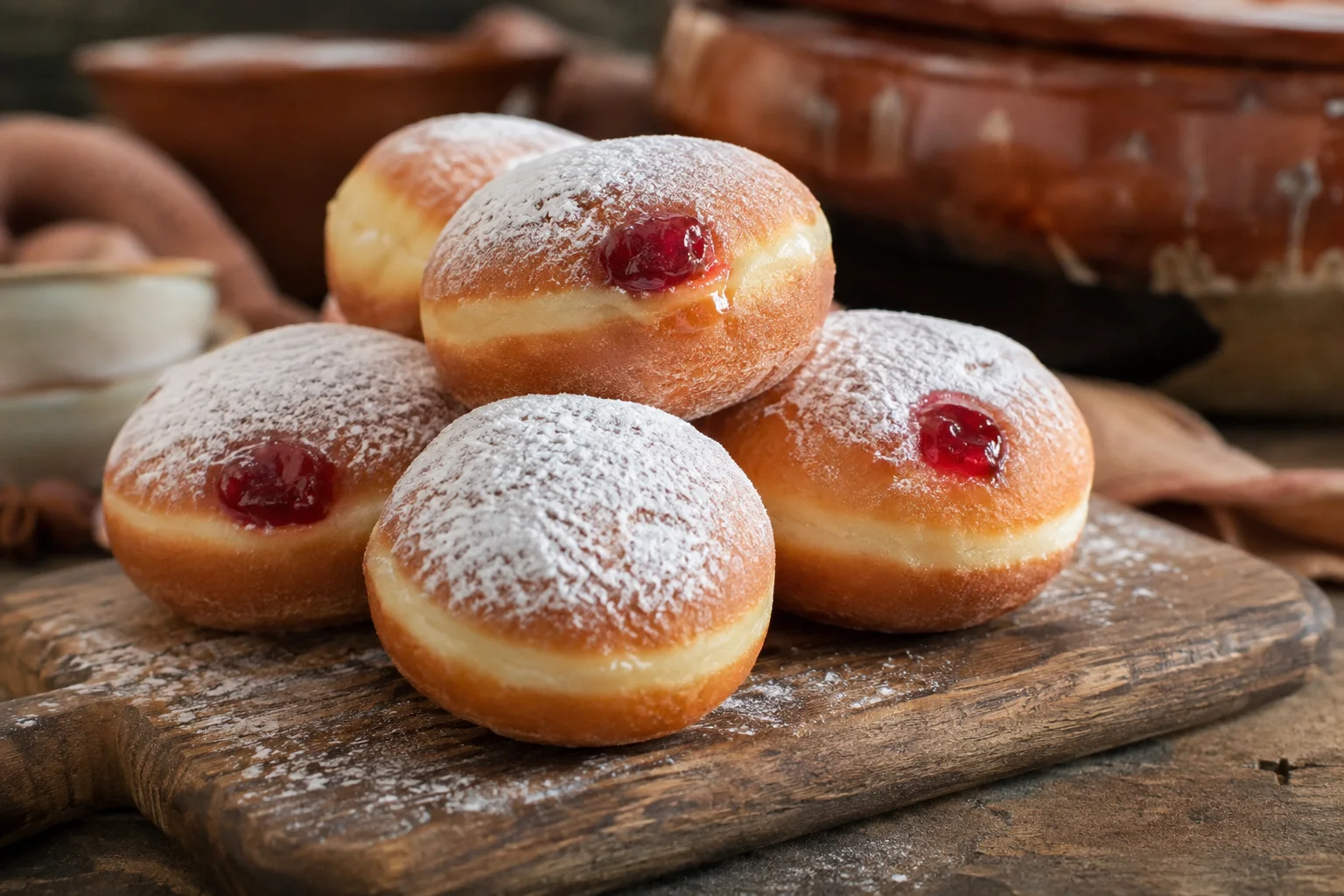
Sufganiyot (singular: sufganiyah) are round, deep-fried yeast doughnuts, injected with jam or another sweet filling and finished with a heavy dusting of powdered sugar.3 They are the signature food of Hanukkah in Israel, sold across Israeli bakeries for weeks before and throughout the eight-day holiday.2,3
The dough itself is close to an enriched bread dough: flour, egg, a little sugar, and butter or oil, leavened with yeast and left to rise before frying. The frying is the point. Like latkes, the other classic Hanukkah food, sufganiyot are cooked in oil to recall the holiday’s central story, a single flask of oil in the Jerusalem Temple that was meant to last one day and instead burned for eight.2,4
History and the Making of an Israeli Tradition
The custom of eating fried dough on Hanukkah is older than the jelly doughnut itself. The earliest written trace of it comes from Rabbi Maimon ben Yosef, the father of the medieval scholar Maimonides, who wrote in the 12th century that Jews should not treat the custom of eating fried Hanukkah fritters lightly, describing it as already an old tradition in his own day.2,4 Those early fritters were most likely syrup-soaked, closer to what’s known today as zalabiya or bimuelos than to the modern jelly doughnut.2,3
The word sufganiyah itself is a modern Hebrew coinage, but its root goes back to the Talmudic terms sofgan and sfogga, both referring to a “spongy dough.”1,2,3 That root, sfog, is also the modern Hebrew word for sponge, and traces further back to the ancient Greek spóngos.3
The doughnut most people picture today, a jam-filled round fried in fat, is a later, European addition. Food historian Gil Marks traces the first known written recipe for a filled jelly doughnut to 1485, in a cookbook called Kuchenmeisterei (“Mastery of the Kitchen”) printed in Nuremberg, one of the earliest cookbooks to appear in print not long after Gutenberg’s invention of movable type.1,2,3 That original recipe, called gefüllte krapfen, sandwiched jam between two rounds of yeast dough and fried the whole thing in lard.2,3 Cheap, slave-produced sugar arriving from Caribbean plantations around the same time made jam itself more widely affordable, which helped the sweet, filled version spread across northern Europe over the following century.1,3 By the 19th century, the same basic pastry was known in Germany as a Berliner.3
Jewish bakers in Poland adapted the recipe to keep it kosher, frying in schmaltz or goose fat instead of lard, and called the result ponchik or ponczki.1,2,3,5 A separate tradition existed too. Jewish communities in North Africa had their own fried Hanukkah dough, still eaten today as sfenj, without the European jam filling.5 The two traditions met when Polish Jewish immigrants brought their ponchiks to Mandatory Palestine in the early 20th century. There, the pastry picked up a new Hebrew name, sufganiyah.1,3,5
What turned the sufganiyah into Israel’s dominant Hanukkah food, ahead of the latke, was less about taste than about labor economics. The Histadrut, Israel’s national labor federation founded in 1920 during the British Mandate, began promoting the doughnut over the potato pancake in the late 1920s specifically because it created work.1,2,3,5 Anyone with a grater and a frying pan could make latkes at home, but a properly filled and fried sufganiyah took far more manpower to prepare, transport, and sell.1,2,3,5 Commercial bakeries began selling the doughnuts weeks ahead of the holiday to stretch out that employment, a pattern that continues in Israel today.3
The campaign succeeded well beyond its original goal. A Teleseker survey found that roughly 80 percent of Israelis eat at least one sufganiyah during Hanukkah, more than the share who fast on Yom Kippur.2 Israel’s Ministry of Defense alone buys upwards of 400,000 sufganiyot for soldiers each Hanukkah, and Angel Bakeries, the country’s largest bakery, reportedly fries more than 25,000 a day during the holiday from batches of 100 kilograms of dough at a time.3 In the United States, by contrast, latkes remained the dominant Hanukkah food for most of the 20th century, and sufganiyot only became widely available commercially from the 1970s onward.3
Traditional Sufganiyot Recipe
Recipe developed independently by Heritage Healthy Kitchen, drawing on the Central European and Israeli methods that shaped the modern sufganiyah. Sources for further reading are listed at the end of this article.
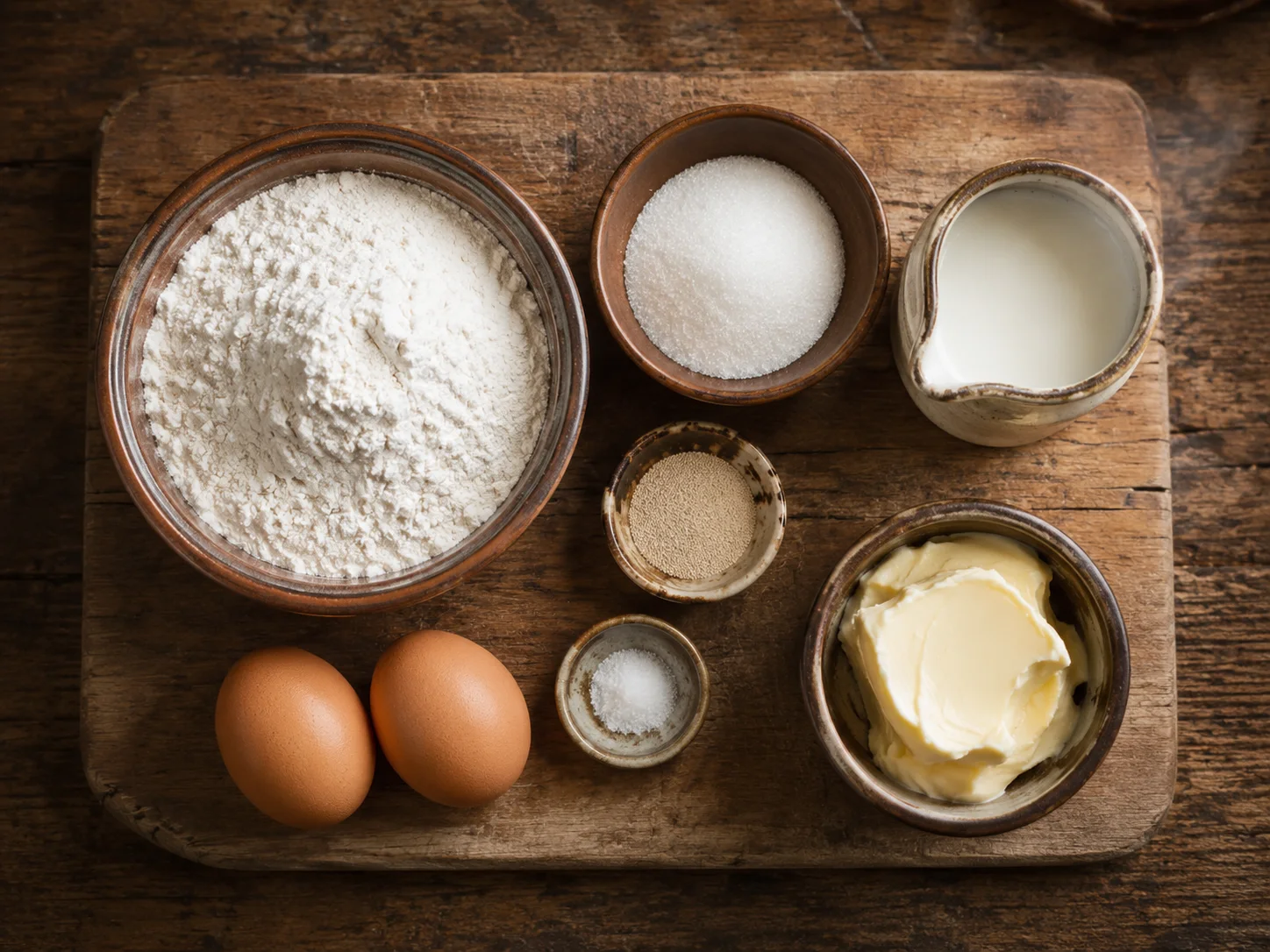
Ingredients (makes about 18 doughnuts, serves 9)

For the dough
- 4 cups (500g) all-purpose flour, plus more for kneading
- ⅓ cup (65g) granulated sugar, divided
- 2¼ teaspoons (7g) active dry yeast
- ¾ teaspoon (4g) fine salt
- ¾ cup (180ml) whole milk, warmed to about 110°F (43°C)
- 2 large eggs, at room temperature
- ¼ cup (55g) unsalted butter, softened
- Zest of 1 lemon (optional)
For frying and finishing
- Neutral oil (such as sunflower or canola), about 6 cups (1.4 liters), for deep-frying
- 1 cup (320g) strawberry jam, for filling
- ½ cup (60g) powdered sugar, for dusting
Instructions
- Bloom the yeast: Stir the warm milk with the yeast and 1 tablespoon of the sugar. Let stand until foamy, about 10 minutes.
- Mix the dough: In a large bowl, whisk the eggs with the remaining sugar, salt, and lemon zest. Stir in the yeast mixture and softened butter, then add the flour gradually, mixing until a soft dough forms. Knead 8–10 minutes, by hand or with a dough hook, until smooth and elastic; the dough should stay soft and slightly tacky rather than stiff.
- First rise: Place the dough in a greased bowl, cover, and let rise in a warm spot until doubled, about 1–1½ hours.
- Shape: Punch down the dough and divide it into 18 equal pieces (about 50g each). Roll each piece into a smooth, tight ball and set on a floured tray, spaced well apart.
- Second rise: Cover loosely and let rise until visibly puffy, 30–45 minutes.
- Fry: Heat the oil in a deep, heavy pot to 340–350°F (170–175°C). Fry the dough balls in small batches, without crowding the pot, for 2–3 minutes per side, until deep golden brown and cooked through. Lift out with a slotted spoon and drain on a wire rack or paper towels.
- Fill: Let the doughnuts cool for about 10 minutes. Fit a piping bag or squeeze bottle with a narrow, long tip, fill with the jam, and insert it into the side of each doughnut, piping in about 1–1½ tablespoons of jam.
- Finish: Dust generously with powdered sugar just before serving.
Kitchen Tips
Keep an eye on oil temperature with a thermometer rather than guessing. Oil that’s too hot browns the outside before the center finishes cooking; oil that’s too cool leaves the doughnuts greasy and heavy instead of light.
Don’t crowd the pot. Adding too many dough balls at once drops the oil temperature sharply and leads to uneven, pale frying.
Let the doughnuts cool before filling. Piping jam into a doughnut that’s still hot can turn the filling watery and cause it to leak back out through the hole.
Dust with powdered sugar as close to serving as possible. Sugar dusted too early tends to dissolve into the oily surface and disappear rather than staying visibly powdery.
Nutritional Information
Per serving (2 doughnuts, one of 9 servings)
- Calories: approximately 560–625 kcal
- Protein: ~7.5–9g
- Total fat: ~22–30g
- Saturated fat: ~5–6g
- Carbohydrates: ~75–88g
- Dietary fiber: ~1.5–2.5g
- Sodium: ~185–225mg
Most of that carbohydrate load comes from added sugar rather than the flour itself. Between the sugar in the dough, the jam filling, and the powdered sugar dusting, a two-doughnut serving supplies roughly 35–40g of added sugar on its own, close to the American Heart Association’s full daily recommended limit of about 24g for women or 36g for men.6 This is a once-a-year holiday food, not something to build a weekly habit around.
Values are estimates, calculated ingredient-by-ingredient using standard reference data, including an estimated 15–22% oil absorption during frying, and will vary with jam brand, doughnut size, and exact frying time.
Storage and Reheating
Sufganiyot are best eaten the day they’re fried, while the crust is still faintly crisp and the dough soft. Once filled and dusted, they don’t hold well; the jam softens the crust from the inside within a few hours, and the powdered sugar dissolves into the surface.
For make-ahead planning, fry and cool the doughnuts but hold off on filling and dusting. Store them airtight at room temperature for up to a day, or freeze for up to 2 months. Thaw and warm briefly in a 300°F (150°C) oven, then fill and dust just before serving so the finish still looks fresh.
Traditional Sufganiyot

Ingredients
Ingredients (makes about 18 doughnuts, serves 9)
- 4 cups (500g) all-purpose flour, plus more for kneading
- ⅓ cup (65g) granulated sugar, divided
- 2¼ teaspoons (7g) active dry yeast
- ¾ teaspoon (4g) fine salt
- ¾ cup (180ml) whole milk, warmed to about 110°F (43°C)
- 2 large eggs, at room temperature
- ¼ cup (55g) unsalted butter, softened
- Zest of 1 lemon (optional)
For frying and finishing
- Neutral oil (such as sunflower or canola), about 6 cups (1.4 liters), for deep-frying
- 1 cup (320g) strawberry jam, for filling
- ½ cup (60g) powdered sugar, for dusting
Instructions
- Bloom the yeast: Stir the warm milk with the yeast and 1 tablespoon of the sugar. Let stand until foamy, about 10 minutes.
- Mix the dough: In a large bowl, whisk the eggs with the remaining sugar, salt, and lemon zest. Stir in the yeast mixture and softened butter, then add the flour gradually, mixing until a soft dough forms. Knead 8–10 minutes, by hand or with a dough hook, until smooth and elastic; the dough should stay soft and slightly tacky rather than stiff.
- First rise: Place the dough in a greased bowl, cover, and let rise in a warm spot until doubled, about 1–1½ hours.
- Shape: Punch down the dough and divide it into 18 equal pieces (about 50g each). Roll each piece into a smooth, tight ball and set on a floured tray, spaced well apart.
- Second rise: Cover loosely and let rise until visibly puffy, 30–45 minutes.
- Fry: Heat the oil in a deep, heavy pot to 340–350°F (170–175°C). Fry the dough balls in small batches, without crowding the pot, for 2–3 minutes per side, until deep golden brown and cooked through. Lift out with a slotted spoon and drain on a wire rack or paper towels.
- Fill: Let the doughnuts cool for about 10 minutes. Fit a piping bag or squeeze bottle with a narrow, long tip, fill with the jam, and insert it into the side of each doughnut, piping in about 1–1½ tablespoons of jam.
- Finish: Dust generously with powdered sugar just before serving.
Frequently Asked Questions
What’s the difference between sufganiyot and latkes?
Both are Hanukkah foods fried in oil to recall the Temple oil miracle, but they’re otherwise unrelated dishes. Latkes are savory, grated-potato pancakes; sufganiyot are sweet, jam-filled yeast doughnuts.3,4 Historically, sufganiyot became Israel’s dominant Hanukkah food while latkes stayed dominant in the United States, though that gap has narrowed in recent years.3
Why are sufganiyot associated so strongly with Israel specifically?
The Histadrut’s labor campaign in the late 1920s deliberately pushed sufganiyot over homemade latkes to create commercial baking jobs, and the campaign worked well enough that the doughnut became Israel’s default Hanukkah food rather than a Jewish food generally.1,2,3
Can sufganiyot be filled with something other than strawberry jam?
Yes. Strawberry remains the classic filling, but modern Israeli bakeries fill sufganiyot with everything from chocolate cream and vanilla cream to dulce de leche and halva.3
Do sufganiyot really need two separate rises?
Both rises matter for texture. The first builds the dough’s structure and flavor; the second, after shaping, keeps the finished doughnuts light rather than dense once they hit the hot oil.
Why do Israeli bakeries sell sufganiyot for weeks before Hanukkah actually begins?
That head start traces directly back to the Histadrut campaign, which encouraged bakeries to sell for longer stretches precisely to extend the period of paid work the doughnuts generated.3 Today sufganiyot commonly appear in Israeli bakeries as early as September.3
What does the word “sufganiyah” actually mean?
It comes from Talmudic words for a “spongy dough,” referring to how the fried dough soaks up oil the way a sponge soaks up liquid, not to any particular shape or filling.1,2,3
Is there a way to make sufganiyot without deep-frying?
There are baked and air-fried approaches that trade some of the classic texture for less oil. The Healthy Sufganiyot article on this site works through those methods in detail.
Looking for a Lighter Version?
Traditional sufganiyot are deep-fried in oil and filled with sweetened jam, which is a real part of what gives them their glossy crust and rich, tender crumb. A lighter version is possible without losing too much of that character. The Healthy Sufganiyot article on this site covers baked and air-fried methods, reduced-sugar filling options, and portion adjustments while keeping the flavor people actually want.
Read the Healthy Sufganiyot recipe
Further Reading & Sources
The following sources were consulted in researching the history and cultural background of traditional sufganiyot. Heritage Healthy Kitchen’s recipe was developed independently; these links are provided for readers who want to explore further.
- “Why Do We Eat Jelly Donuts on Hanukkah?” The Nosher, My Jewish Learning. myjewishlearning.com — the 1485 Nuremberg cookbook, the spread of the jelly doughnut across Poland, and the Histadrut’s 1920s Hanukkah campaign, drawing on food historian Gil Marks.
- Ungar, Carol Green. “The ‘Hole’ Truth About Sufganiyot.” Jewish Action, Orthodox Union. jewishaction.com — the 12th-century Maimon ben Yosef reference, the Teleseker consumption survey, and the doughnut’s journey from Poland to Israel.
- “Sufganiyah.” Wikipedia. en.wikipedia.org/wiki/Sufganiyah — etymology, the Berliner connection, the Histadrut campaign, modern consumption statistics, and the doughnut’s history in the United States.
- Shurpin, Yehudah. “Why Eat Latkes and Sufganiyot (Doughnuts) on Chanukah?” Chabad.org. chabad.org — the primary-source quote from Rabbi Maimon ben Yosef on the custom of eating oil-fried food on Hanukkah.
- Rude, Emelyn. “Why Jelly Doughnuts Are Eaten During Hanukkah.” Time. time.com — the parallel North African fried-dough tradition (sfenj) and its merging with the European jelly doughnut in Mandatory Palestine.
- “Added Sugar.” The Nutrition Source, Harvard T.H. Chan School of Public Health. nutritionsource.hsph.harvard.edu — American Heart Association recommended daily limits on added sugar intake.
Disclaimer
The information in this article is provided for educational and informational purposes only. Heritage Healthy Kitchen makes no representations or warranties regarding the accuracy or completeness of any content on this site. Nutritional values are estimates only and will vary depending on the specific ingredients, brands, and measurements used. This content is not intended as dietary, medical, or professional nutritional advice. Always consult a qualified healthcare provider regarding any dietary needs or health conditions. Heritage Healthy Kitchen is not responsible for any outcomes resulting from the use of recipes or information published on this site.
Cook by Occasion
This recipe is part of our Hanukkah menu.
You Might Also Like
More heritage recipes from our kitchen


Leave a Reply