

Part of our Heritage Kitchen Glossary – short guides to the ingredients and techniques behind Eastern European cooking.
What a sufganiyah is
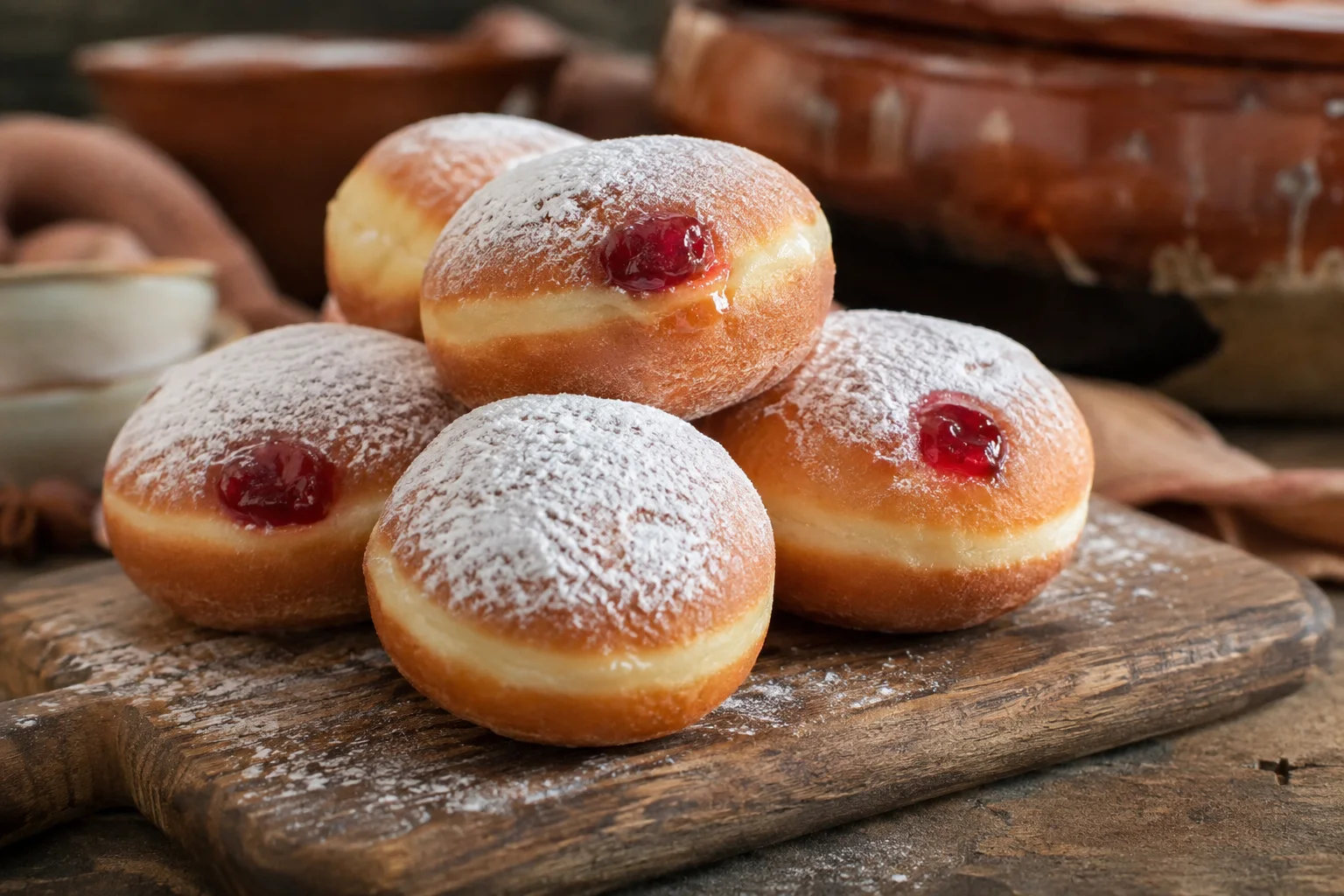
A sufganiyah (plural sufganiyot) is a round yeast doughnut, fried, filled with jam and dusted with powdered sugar. The best-known kind is filled with strawberry jam. In Israel it is the Hanukkah food, more than latkes, and bakeries sell it for weeks before the holiday. It is made from a yeast dough of flour, milk, eggs, sugar and butter (some recipes use oil), left to rise twice before frying.
Where the name comes from
Sufganiyah is a modern Hebrew coinage with old roots. Its root, sfog, means “sponge” in ancient and modern Hebrew alike, and the Talmud mentions a “spongy dough” called sofgan or sfogga. The sponge is the dough, which soaks up oil as it fries.
Why Hanukkah calls for frying
Hanukkah remembers the single flask of pure oil the Maccabees found in the Temple, enough for one day, which kept the menorah lit for eight. Food fried in oil recalls that miracle, which is why sufganiyot and latkes belong to the same holiday. Fried dough at Hanukkah is older than the jelly doughnut. The earliest mention comes from Rabbi Maimon ben Yosef, the father of Maimonides, born around 1110, who called eating “sufganin” an ancient custom, “because they are fried in oil.” Those fritters were most likely sweet pancakes coated in syrup, the kind known in Ladino as bimuelos and in much of the Middle East as zalabia.
From Germany to Poland
The jam came from Central Europe. The first known recipe for a jelly doughnut dates to 1485, in a German cookbook called Kuchenmeisterei (“Mastery of the Kitchen”): jam was sandwiched between two rounds of dough and the whole thing fried in lard. By 1600 jelly doughnuts were popular all over Poland, at Christmas, Hanukkah and other special occasions. Polish Jews called them ponchiks and fried them in schmaltz, goose fat or oil instead of lard, which is not kosher. Jews in Morocco and Algeria had their own fried dough for Hanukkah, sfenj, without any jam.
How Israel made it the holiday’s food
Nobody knows for certain who brought the doughnut to the Land of Israel. Time credits immigrants from Europe in the early 20th century; Jewish Action reports a theory that German Jews brought it in the 1930s. Either way, the ponchik took the Hebrew name sufganiyah. In the late 1920s the Histadrut, the labor federation, promoted the doughnut in place of the latke to create jobs: anyone with a grater and a frying pan could make latkes at home, but sufganiyot needed people to make them, transport them and sell them. It worked. A Teleseker survey found that 80 percent of Israelis eat at least one sufganiyah during the eight days of Hanukkah, more than the share who fast on Yom Kippur. In the United States latkes still come first, though many kosher bakeries now sell sufganiyot.
Making them at home
Our Traditional Sufganiyot makes about 18 doughnuts, fried a few at a time and filled with jam. Healthy Sufganiyot air-fries the dough or bakes it, uses half whole wheat flour, less sugar in the dough and about a teaspoon of jam per doughnut. The crust won’t match a deep-fried one exactly, and the recipe says so. For the potato side of the holiday, see Traditional Latkes and Healthy Latkes, or browse the full Hanukkah recipe collection.
Frequently Asked Questions
What does sufganiyah mean?
It is a modern Hebrew word built on the root sfog, “sponge.” The Talmud mentions a spongy dough called sofgan or sfogga. The sponge is the dough soaking up oil as it fries.
Why are sufganiyot eaten on Hanukkah?
Hanukkah remembers a single flask of Temple oil that lasted eight days instead of one. Food fried in oil, latkes and doughnuts alike, recalls that miracle, and fried dough at Hanukkah was already called an ancient custom in the 12th century.
Is a sufganiyah the same as a ponchik?
Yes, it is the same jelly doughnut. Polish Jews called it ponchik and fried it in schmaltz, goose fat or oil. In the Land of Israel the ponchik took the Hebrew name sufganiyah.
Can sufganiyot be baked or air-fried?
Yes. Our healthy version air-fries the doughnuts with about a tablespoon of oil for the whole batch, or bakes them in the oven. An air fryer browns the outside and keeps the inside soft, but it won’t perfectly copy the texture of deep-fried dough.
Which is more traditional on Hanukkah, sufganiyot or latkes?
Both belong to the holiday. Sufganiyot dominate in Israel, where a late-1920s labor campaign promoted them, while in the United States latkes still come first.
Further Reading & Sources
This entry draws on the sources below and on the recipes it links to elsewhere on this site. They are listed for readers who want to go further.
- Carol Ungar. “The ‘Hole’ Truth About Sufganiyot.” Jewish Action, Orthodox Union, Winter 2012. jewishaction.com
- Yehuda Shurpin. “Why Eat Latkes and Sufganiyot (Doughnuts) on Chanukah?” Chabad.org. chabad.org
- Aly Miller. “Why Do We Eat Jelly Donuts on Hanukkah?” The Nosher, My Jewish Learning, 9 December 2016. myjewishlearning.com
- Emelyn Rude. “Why Jelly Doughnuts Are Eaten During Hanukkah.” Time, 7 December 2015. time.com
Leave a Reply