
Active time: ~45 minutes | Total time: ~3 hours | Serves: 16 doughnuts | Difficulty: Medium
Quick Overview
- Make the classic rich yeast dough, with half the flour whole wheat
- Use oil instead of butter in the dough and halve the sugar
- Shape, rise and bake instead of deep-frying
- Brush with a little butter and fill with a teaspoon of jam
- Dust lightly with powdered sugar instead of glazing
What This Version Changes — and What It Keeps
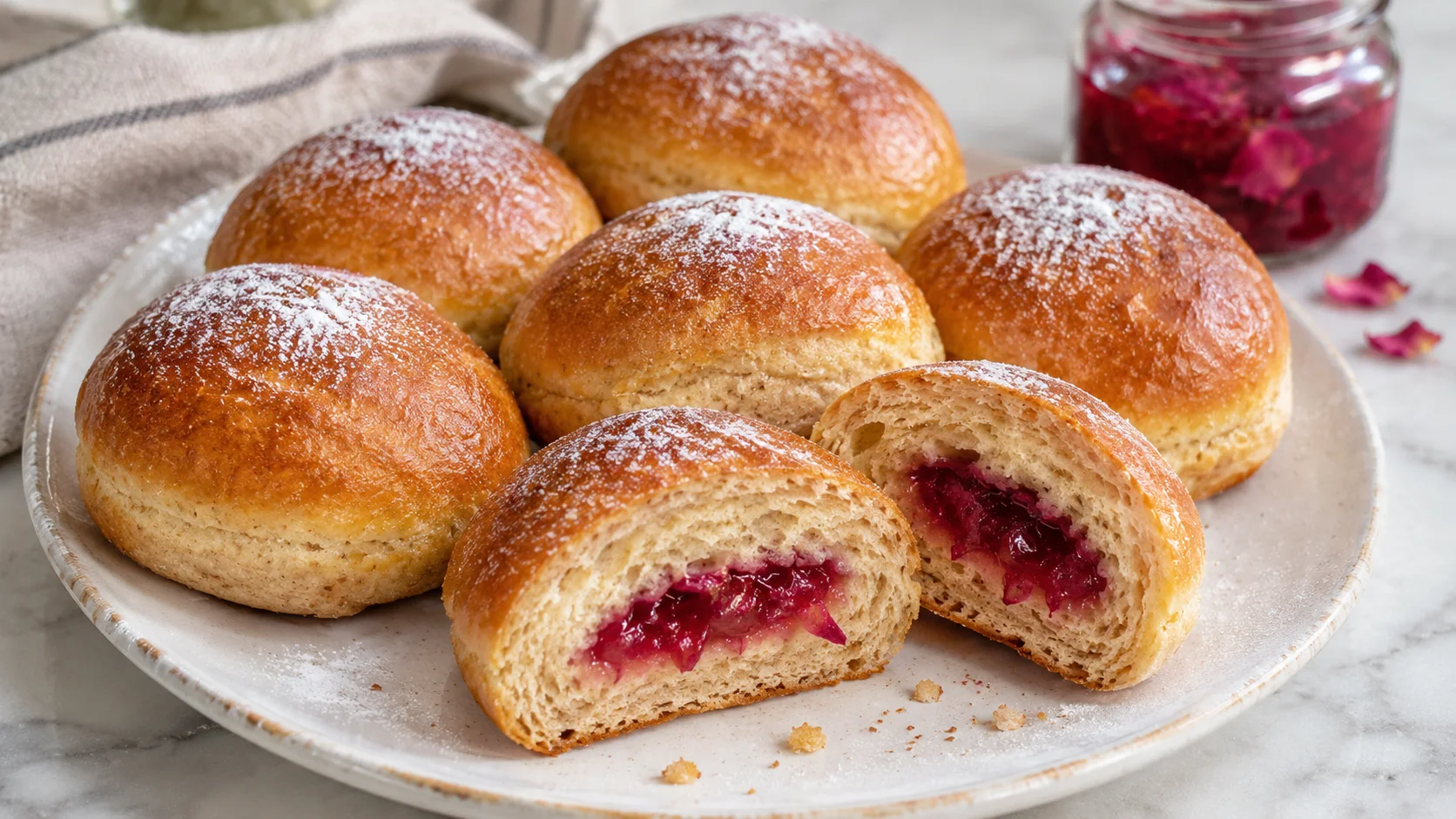
This is a lighter take on our Traditional Pączki. The dough is the same rich yeast dough with egg yolks, milk, lemon zest and vanilla, shaped into the same 60g balls, and the classic fillings stay: rose petal jam or plum butter. What changes is the cooking. The doughnuts bake in the oven instead of frying in oil or lard, half the white flour becomes whole wheat, oil replaces the butter in the dough, and the sugar comes down in the dough, the filling and the finish.
Because it never goes into hot fat, a baked pączek does not get the fried crust of the original and is closer to a soft filled bun. It keeps the dough and the filling, and by our estimates it saves about 110 kcal and 6.5g of fat per doughnut.
Why These Swaps Work
Baking instead of deep-frying. A fried doughnut takes up fat from the pot, and that fat accounts for much of the difference in the numbers below. Published recipes already bake the same kind of yeast dough, at 190°C (375°F).¹ There is a reason to fry less often, too. A large analysis summarized by Harvard Health found that people who ate the most fried food each week were 28% more likely to have heart problems than people who ate the least, and noted that fried foods are often high in saturated fat and sodium.² The vodka from the fried recipe goes, as well: bakers add it so frying doughnuts absorb less fat, and the baked recipe has no frying fat to absorb.¹˒³
Half whole wheat flour. Refining wheat makes light flour for pastries but strips away more than half of its B vitamins, 90 percent of the vitamin E and virtually all of the fiber. The bran and fiber in whole grains also slow the breakdown of starch into glucose.⁴ Per 100g, whole wheat flour has about 10.7g of fiber against 2.7g for all-purpose flour.⁵ This version replaces only half of the white flour.
Oil instead of butter in the dough. The published baked recipe already uses vegetable oil in the dough.¹ Butter is about 50g saturated fat per 100g, sunflower oil about 10g.⁵ The American Heart Association recommends limiting saturated fat, and cutting back on it can help when it is replaced with unsaturated fats such as these oils, though not when it is replaced with refined carbohydrates.⁶ The only butter left is a tablespoon brushed over the baked doughnuts, as in the published recipe.¹
Less sugar. The dough uses 2½ tablespoons of sugar, close to the lowest amount in the published traditional recipes.³ Each doughnut gets a teaspoon of jam instead of two, and a light dusting of powdered sugar replaces the glaze. Together that brings added sugar down from about 17g to about 6g per doughnut. For scale, the American Heart Association suggests no more than about 24g of added sugar a day for most women and 36g for most men.⁷
Healthy Baked Pączki Recipe
This recipe was compiled by Heritage Healthy Kitchen from published recipes and the sources for the swaps, all listed at the end of this article. Figures that are Heritage Healthy Kitchen’s own estimates rather than taken from a published source are marked as such.
The dough follows the traditional recipe, with the swaps above; the oven temperature and the butter brushing follow a published baked pączki recipe.¹ The baking time for 60g balls and the amount of jam and powdered sugar are Heritage Healthy Kitchen estimates.
Ingredients
Makes 16 doughnuts
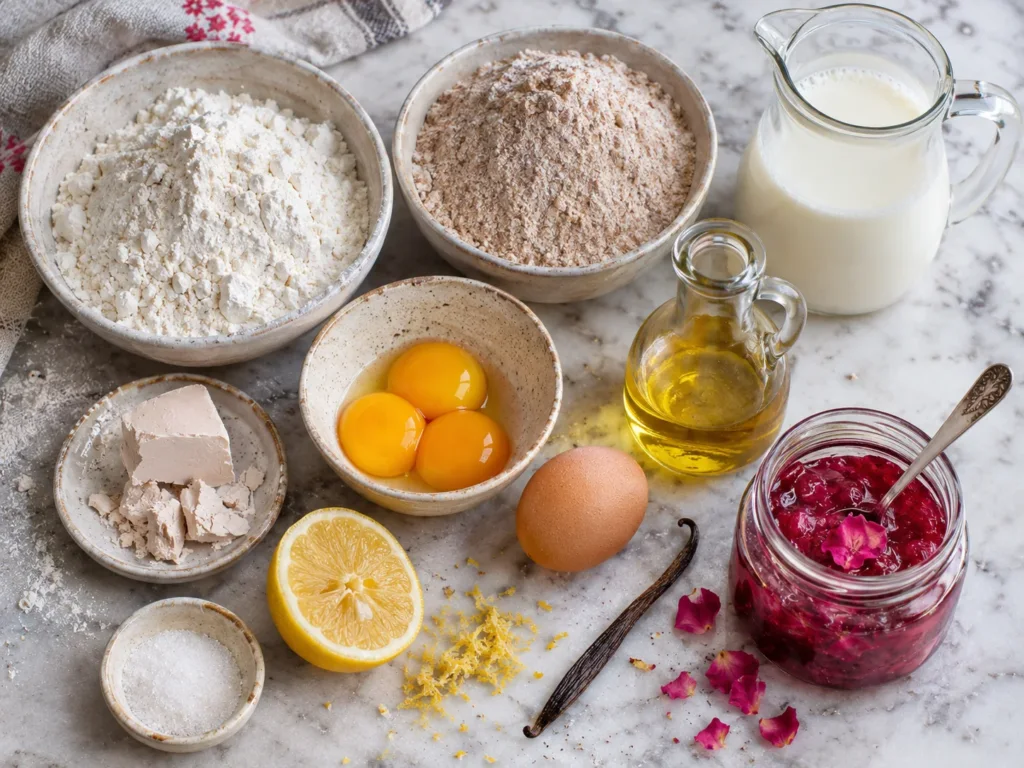
- 250g (2 cups) all-purpose flour⁸˒⁹
- 250g (2 cups) whole wheat flour, plus a little all-purpose flour for dusting⁴
- 25g fresh yeast, or 10g (about 1 tablespoon) dried yeast⁸˒⁹
- 250ml (1 cup) whole milk, lukewarm⁸˒⁹
- 30g (2½ tablespoons) sugar³
- 3 egg yolks and 1 whole egg, at room temperature⁸˒⁹
- 40g (3 tablespoons) sunflower or rapeseed oil¹˒⁶
- Finely grated zest of ½ lemon⁸˒⁹
- Seeds of ½ vanilla pod, or 1 teaspoon vanilla extract⁸˒⁹
- A pinch of salt⁸˒⁹
Filling
- About 110g (⅓ cup) rose petal jam or thick plum butter, about 1 teaspoon per doughnut⁸˒⁹
To finish
- 1 tablespoon butter, melted, for brushing¹
- 1 tablespoon powdered sugar, for dusting
Instructions
- Start the yeast. Mix the fresh yeast with a little of the lukewarm milk, sugar and flour, and leave it until it bubbles. If you use dried yeast, mix it straight into the flour.⁸˒⁹
- Make the dough. Mix the yolks and the whole egg with the rest of the sugar. Add both flours, the rest of the milk, the yeast, lemon zest, vanilla and salt, and knead until smooth. Work in the oil last and knead until the dough is soft and comes away from the bowl.¹˒⁸˒⁹
- First rise. Cover and leave in a warm place until doubled, about 1 to 1½ hours.⁸˒⁹
- Shape. Divide the dough into 16 pieces of about 60g, roll each into a smooth ball and flatten it slightly. Set them well apart on a baking sheet lined with parchment.¹˒⁸˒⁹
- Second rise. Cover with a towel and let them rise until puffy, about 45 minutes. Heat the oven to 190°C (375°F) while they rise.¹
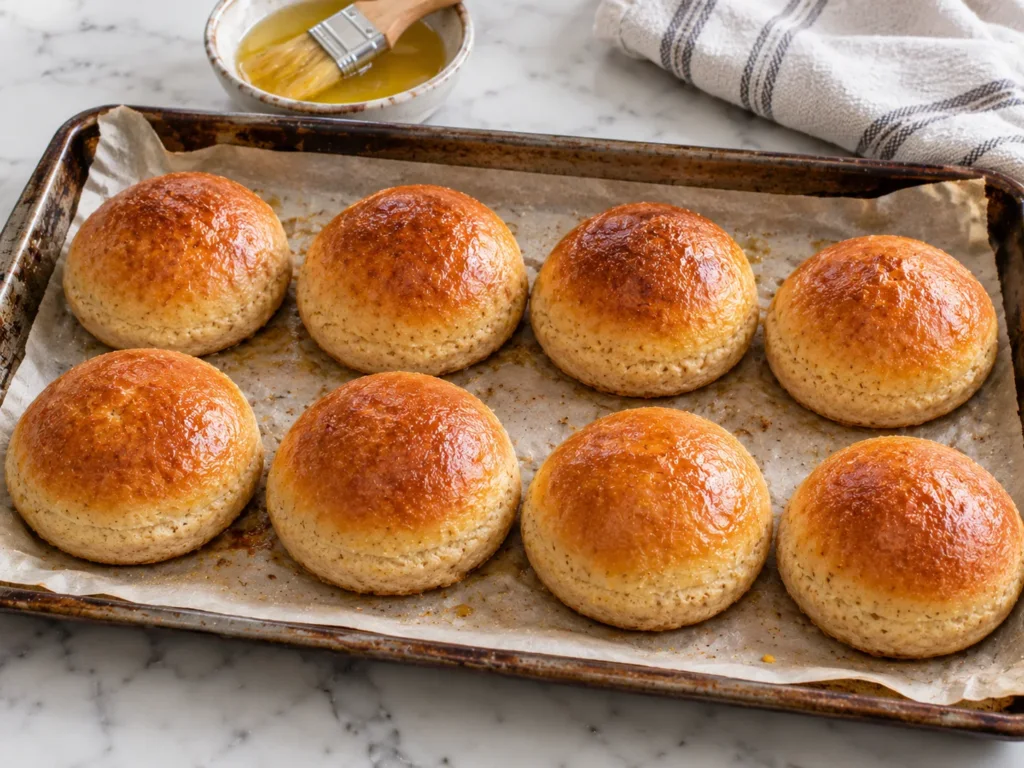
- Bake. Bake until golden brown. The published oven recipe bakes smaller rounds for 10 minutes; for 60g balls, Heritage Healthy Kitchen estimates 12 to 15 minutes.¹
- Brush. As soon as they come out of the oven, brush the tops and sides with the melted butter.¹
- Fill. Fill a piping bag with a long nozzle with the jam, push it into the side of each doughnut and squeeze in about 1 teaspoon.¹˒⁸
- Dust. Just before serving, dust lightly with the powdered sugar.
Kitchen Tips
Let them rise until puffy. The published baked recipe puts the doughnuts in the oven when they are puffy but not necessarily doubled.¹
Brush them straight away. The butter goes on while the doughnuts are still warm from the oven.¹
Mind the size. The baking time depends on the size of the doughnuts. Smaller rounds, like those in the published recipe, need about 10 minutes; the 60g balls here need longer.¹
Fill them warm or cool. Jam can go in while the doughnuts are still warm or once they have cooled.¹

Nutritional Information
Per doughnut (1 of 16), filled and dusted
- Calories: approximately 175–215 kcal
- Protein: approximately 5–6g
- Total fat: approximately 5–6g
- Saturated fat: approximately 1.5g
- Carbohydrates: approximately 28–35g
- Sugars: approximately 6–7g
- Dietary fiber: approximately 2–2.5g
- Sodium: approximately 40mg
Traditional and this version, per doughnut
| Nutrient | Traditional (fried, glazed) | This version (baked) |
|---|---|---|
| Calories | about 305 kcal | about 195 kcal |
| Total fat | about 12g | about 5.5g |
| Saturated fat | about 3g (oil); about 5g (lard) | about 1.5g |
| Sugars | about 18g | about 7g |
| Dietary fiber | about 1g | about 2.3g |
Nutritional values are estimates based on standard ingredient databases (USDA FoodData Central). They vary with the size of each doughnut, the filling and, for fried pączki, how much fat they take up.
Storage and Reheating
Like fried pączki, these are best on the day they are made.¹˒⁸ By Heritage Healthy Kitchen’s estimate, they keep in an airtight container at room temperature for 1 to 2 days; dust them with sugar just before serving.
Healthy Baked Pączki

Ingredients
For the dough
- 250g (2 cups) all-purpose flour
- 250g (2 cups) whole wheat flour, plus a little all-purpose flour for dusting
- 25g fresh yeast, or 10g (about 1 tablespoon) dried yeast
- 250ml (1 cup) whole milk, lukewarm
- 30g (2½ tablespoons) sugar
- 3 egg yolks and 1 whole egg, at room temperature
- 40g (3 tablespoons) sunflower or rapeseed oil
- Finely grated zest of ½ lemon
- Seeds of ½ vanilla pod, or 1 teaspoon vanilla extract
- A pinch of salt
Filling
- About 110g (⅓ cup) rose petal jam or thick plum butter, about 1 teaspoon per doughnut
To finish
- 1 tablespoon butter, melted, for brushing
- 1 tablespoon powdered sugar, for dusting
Instructions
- Mix the fresh yeast with a little lukewarm milk, sugar and flour and leave until bubbly (dried yeast goes straight into the flour).
- Mix the yolks and egg with the sugar, add both flours, the milk, yeast, lemon zest, vanilla and salt, knead until smooth, then work in the oil.
- Cover and leave in a warm place until doubled, about 1 to 1½ hours.
- Divide into 16 pieces of about 60g, roll into balls, flatten slightly and set well apart on a parchment-lined baking sheet.
- Cover and let rise until puffy, about 45 minutes; heat the oven to 190°C (375°F).
- Bake until golden brown, about 12 to 15 minutes (Heritage Healthy Kitchen estimate for 60g balls).
- Brush with the melted butter straight from the oven, then pipe about 1 teaspoon of jam into the side of each doughnut.
- Dust lightly with powdered sugar just before serving.
Frequently Asked Questions
Do baked pączki taste like fried ones?
Not exactly. They have the same soft, rich dough and the same filling, but because they are not fried, they do not get the fried crust of the original.
Why is there no vodka in this version?
In fried pączki, bakers add it so the doughnuts absorb less fat. Baked doughnuts are not cooked in fat, and the published baked recipe leaves it out.¹˒³
Can I use only whole wheat flour?
This version replaces only half of the white flour. A dough made entirely with whole wheat flour is not covered by the published pączki recipes this version is based on, so it is not included here.
Can I make them in an air fryer?
This recipe is written for the oven, following a published baked pączki recipe.¹ An air fryer is not covered by the sources used here.
How much lighter is this version?
About 195 kcal per doughnut against about 305 for the fried and glazed traditional pączek, with about 5.5g of fat against 12g and about 7g of sugar against 18g, according to our estimates.
Further Reading & Sources
The recipe is a compilation based on the published recipes and the sources for the swaps listed here; these links are provided for readers who want to explore further.
Traditional base and published recipes
- Jones, Jenny. “Pączki – Polish Doughnuts.” Jenny Can Cook (no date given). jennycancook.com
- Dorota (blog Dorota Smakuje). “Pączki czy faworki – co jest waszym ulubieńcem w Karnawale?” Dorota Smakuje, January 31, 2024. dorotasmakuje.com
- Dorota, Moje Wypieki. “Pączki – Polish doughnuts.” Moje Wypieki, August 30, 2021 (updated March 25, 2026). mojewypieki.com
- Polonist Test Kitchen (no individual author named). “Pączki: Polish Doughnuts.” Polonist, September 27, 2018 (updated June 5, 2023). polonist.com
Sources for the swaps
- Harvard Health Publishing (no author named). “How much will fried foods harm your heart?” Harvard Health, April 1, 2021. health.harvard.edu
- The Nutrition Source. “Whole Grains.” Harvard T.H. Chan School of Public Health. nutritionsource.hsph.harvard.edu
- U.S. Department of Agriculture. FoodData Central, SR Legacy: whole wheat flour (FDC 168893), all-purpose flour (FDC 169761), unsalted butter (FDC 173430), sunflower oil (FDC 171025). fdc.nal.usda.gov
- The Nutrition Source. “Types of Fat.” Harvard T.H. Chan School of Public Health. nutritionsource.hsph.harvard.edu
- The Nutrition Source. “Added Sugar.” Harvard T.H. Chan School of Public Health. nutritionsource.hsph.harvard.edu
Disclaimer
The information in this article is provided for educational and informational purposes only. Heritage Healthy Kitchen makes no representations or warranties regarding the accuracy or completeness of any content on this site. Nutritional values are estimates only and will vary depending on the specific ingredients, brands, and measurements used. This content is not intended as dietary, medical, or professional nutritional advice. Always consult a qualified healthcare provider regarding any dietary needs or health conditions. Heritage Healthy Kitchen is not responsible for any outcomes resulting from the use of recipes or information published on this site.
You Might Also Like
More heritage recipes from our kitchen


Leave a Reply