
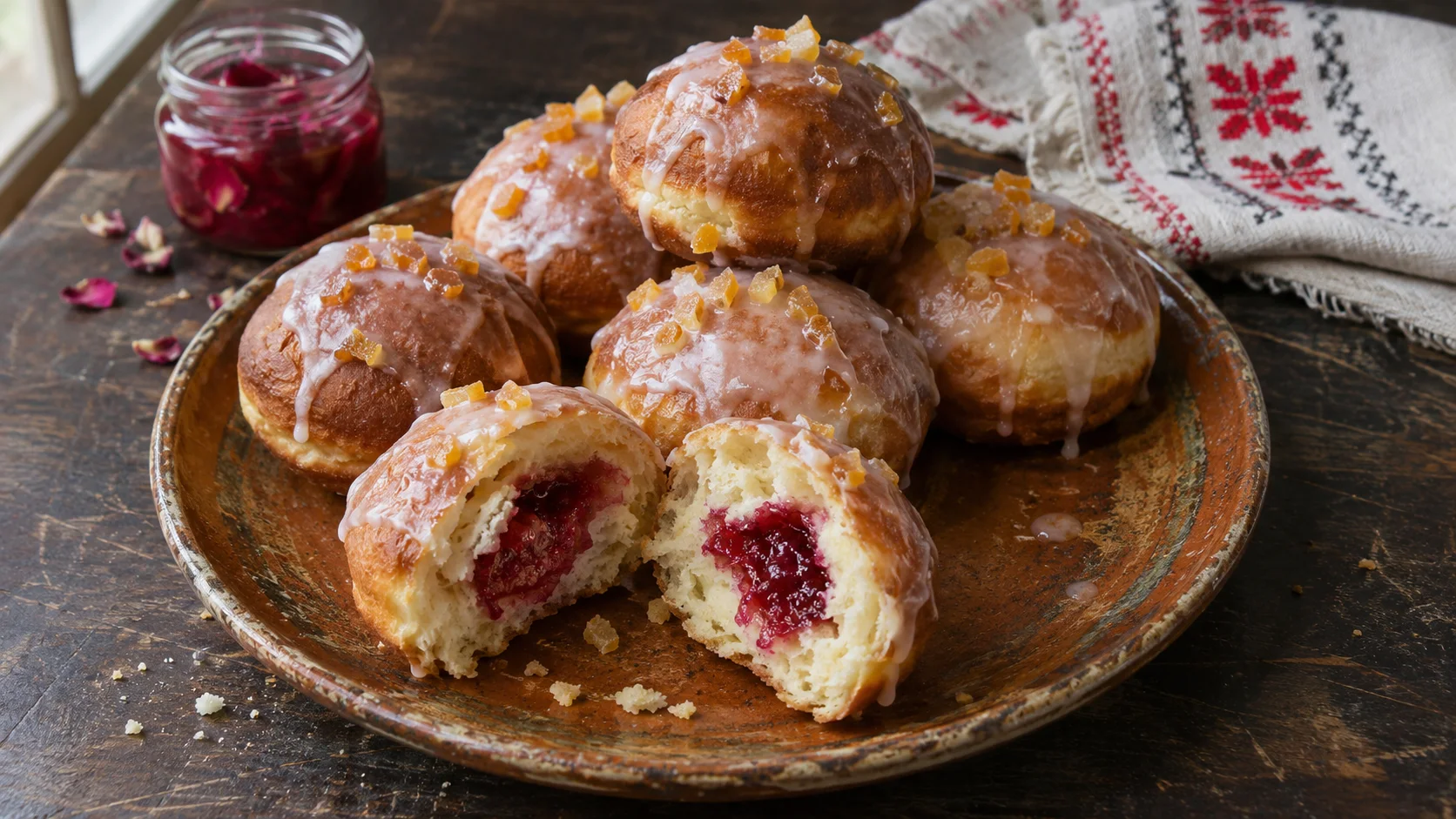
Active time: ~1 hour | Total time: ~3 hours | Serves: 16 doughnuts | Difficulty: Medium
Quick Overview
- Make a soft yeast dough rich with egg yolks, milk and butter, plus a splash of vodka
- Let it rise, shape it into balls and let them rise again
- Fry in oil or lard until deep golden on both sides
- Pipe rose petal jam or plum butter into the side
- Finish with a lemon glaze and candied orange peel, or powdered sugar
What Pączki Are
Pączki are Polish yeast doughnuts. The dough is richer than an ordinary bread dough, with egg yolks, milk, butter and sugar, and the doughnuts are fried, filled with jam and glazed or dusted with sugar.¹˒² The classic fillings are rose petal jam and plum.¹˒³ Most Polish recipes also add a little vodka, rum or spirytus to the dough, which bakers say keeps the doughnuts from soaking up too much fat.⁴˒⁵ Unlike ring doughnuts, pączki have no hole, and they hold a generous amount of filling.²
In Poland they are the food of Tłusty Czwartek, or Fat Thursday, the last Thursday before Lent.³˒⁶ In 2027 it falls on February 4.
History and Cultural Roots
Fried pastries have a long history in Polish carnival feasting. The historian Jarosław Dumanowski, speaking to the Polish Press Agency, describes old pączki as fried in lard or butter with plenty of eggs, and notes that recipes become numerous from the 17th century. In the cookbook Compendium ferculorum of 1682 they appear as “pierożki,” little pastries with fruit fillings.⁷
Tłusty Czwartek falls in the last, most festive days of the carnival before the Lenten fast.⁶˒⁷ Ethnographers of the Pracownia Etnograficzna list racuchy (yeast pancakes), bliny, pampuchy, pączki and chrusty, also called faworki, among the sweets eaten on those days.⁶ Eating pączki on Fat Thursday was a symbolic farewell to the carnival.⁷ Today bakeries in Poland have long queues for pączki and faworki from early morning.⁶
Pączki Day in North America
Polish communities abroad kept the custom but often moved it. In the United States, Pączki Day has merged with Fat Tuesday, the day before Ash Wednesday, in cities with large Polish populations such as Chicago.³ In 2027 that is February 9. The doughnut is the same; only the day of the week changes.
Traditional Pączki Recipe
This recipe was compiled by Heritage Healthy Kitchen from a comparison of published recipes; the sources are listed at the end of this article. Figures that are Heritage Healthy Kitchen’s own estimates rather than taken from a published source are marked as such.
For 500g of flour, the published recipes use 2 to 4 egg yolks with one whole egg, 50 to 60g of butter, about 250ml of milk and between 2 tablespoons and 75g of sugar. The alcohol ranges from about 20 to 50ml. Doughnuts are shaped at 40 to 60g of dough and fried at 175 to 180°C.¹˒²˒⁴˒⁵ This version sits in the middle of those ranges. The amount of jam per doughnut is a Heritage Healthy Kitchen estimate.
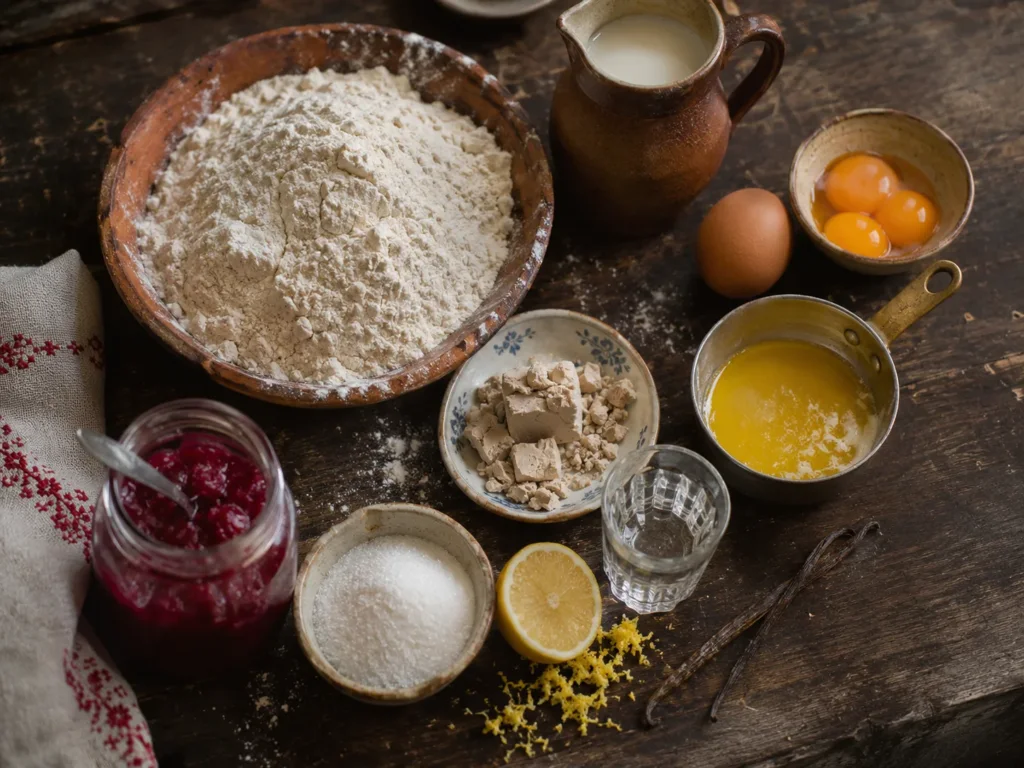
Ingredients
Makes 16 doughnuts
- 500g (about 4 cups) all-purpose flour, plus extra for dusting¹˒²
- 25g fresh yeast, or 10g (about 1 tablespoon) dried yeast¹˒²
- 250ml (1 cup) whole milk, lukewarm¹˒²
- 60g (about ⅓ cup) sugar¹˒²˒⁵
- 3 egg yolks and 1 whole egg, at room temperature¹˒²
- 50g (3½ tablespoons) butter, melted and cooled¹˒²
- 25ml (5 teaspoons) vodka, rum or Polish spirytus¹˒²˒⁴
- Finely grated zest of ½ lemon¹˒²
- Seeds of ½ vanilla pod, or 1 teaspoon vanilla extract¹˒²
- A pinch of salt¹˒²
- About 1 litre (1 quart) neutral oil, or 1kg (2.2 lb) lard, for frying¹˒²
Filling
- About 200g (⅔ cup) rose petal jam (konfitura z róży), or thick plum butter (powidła) or another firm fruit preserve¹˒²˒³
Glaze
- 125g (1 cup) powdered sugar²
- 2 tablespoons warm water²
- 2 teaspoons lemon juice²
- Chopped candied orange peel, optional¹˒²
Instructions
- Start the yeast. Mix the fresh yeast with a little of the lukewarm milk, sugar and flour, and leave it until it bubbles. If you use dried yeast, mix it straight into the flour.¹˒²
- Make the dough. Mix the yolks and the whole egg with the rest of the sugar. Add the flour, the rest of the milk, the yeast, the vodka, lemon zest, vanilla and salt, and knead until smooth. Work in the melted butter last and knead until the dough is glossy, soft and comes away from the bowl.¹˒²
- First rise. Cover the bowl and leave the dough in a warm place until it doubles in size, about 1 to 1½ hours.¹˒²˒⁵
- Shape. Turn the dough onto a floured board and divide it into 16 pieces of about 60g. Roll each into a smooth ball, flatten it slightly and set the balls well apart on a floured board or tray.¹˒²
- Second rise. Cover with a cloth and let them rise until puffy and nearly doubled, about 25 to 45 minutes.¹˒²˒⁵
- Fry. Heat the oil or lard in a wide, deep pot to 175–180°C (350–356°F). Lower in a few doughnuts at a time, leaving them room to swell, and fry for about 1½ to 3 minutes per side, until deep golden brown. Keep checking the temperature between batches.¹˒²˒⁴˒⁵
- Drain. Lift the doughnuts onto paper towels and let them cool a little.¹˒⁴
- Fill. Fill a piping bag with a long nozzle with the jam, push it into the side of each doughnut and squeeze in about 2 teaspoons.¹˒⁴
- Glaze. Stir the powdered sugar with the warm water and lemon juice into a thick glaze. Spread it over the tops once the doughnuts have cooled a little and scatter with candied orange peel. A dusting of powdered sugar works instead.¹˒²˒⁴

Kitchen Tips
Let the dough rise fully. Both rises matter: the dough should double in the bowl, and the shaped balls should be puffy and close to doubled before they go into the fat.¹˒⁵
Watch the oil temperature. All the recipes fry at 175 to 180°C and keep an eye on the temperature throughout. Without a thermometer, drop in a small piece of dough first: it should start to brown straight away.¹˒²˒⁴
Keep the alcohol. Bakers add the vodka or rum so the doughnuts absorb less fat while frying.⁴˒⁵ Some recipes leave it out for simplicity.⁵
Don’t crowd the pot. The doughnuts swell as they fry, so give them room and fry only a few at a time.⁴

Nutritional Information
Per doughnut (1 of 16), filled and glazed
- Calories: approximately 275–340 kcal
- Protein: approximately 4.5–5.5g
- Total fat: approximately 11–14g
- Saturated fat: approximately 3g fried in oil; about 5g fried in lard
- Carbohydrates: approximately 40–49g
- Sugars: approximately 16–20g
- Dietary fiber: approximately 1g
- Sodium: approximately 40mg
Dusting with powdered sugar instead of glazing saves about 20 kcal and 6g of sugar per doughnut.
For a baked version with half whole wheat flour and less sugar, see our Healthy Baked Pączki.
Nutritional values are estimates based on standard ingredient databases (USDA FoodData Central). They vary with how much fat the doughnuts take up, the size of each doughnut and the filling.
Storage and Reheating
Pączki are best on the day they are fried.¹˒⁵ They keep in an airtight container at room temperature for up to 2 days.¹ Freezing is not recommended.⁵
Traditional Pączki

Ingredients
For the dough
- 500g (about 4 cups) all-purpose flour, plus extra for dusting
- 25g fresh yeast, or 10g (about 1 tablespoon) dried yeast
- 250ml (1 cup) whole milk, lukewarm
- 60g (about ⅓ cup) sugar
- 3 egg yolks and 1 whole egg, at room temperature
- 50g (3½ tablespoons) butter, melted and cooled
- 25ml (5 teaspoons) vodka, rum or Polish spirytus
- Finely grated zest of ½ lemon
- Seeds of ½ vanilla pod, or 1 teaspoon vanilla extract
- A pinch of salt
- About 1 litre (1 quart) neutral oil, or 1kg (2.2 lb) lard, for frying
Filling
- About 200g (⅔ cup) rose petal jam (konfitura z róży), or thick plum butter (powidła) or another firm fruit preserve
Glaze
- 125g (1 cup) powdered sugar
- 2 tablespoons warm water
- 2 teaspoons lemon juice
- Chopped candied orange peel, optional
Instructions
- Mix the fresh yeast with a little lukewarm milk, sugar and flour and leave until bubbly (dried yeast goes straight into the flour).
- Mix the yolks and egg with the sugar, add the flour, milk, yeast, vodka, lemon zest, vanilla and salt, knead until smooth, then work in the melted butter.
- Cover and leave in a warm place until doubled, about 1 to 1½ hours.
- Divide into 16 pieces of about 60g, roll into balls, flatten slightly and set well apart on a floured board.
- Cover and let rise until puffy and nearly doubled, 25 to 45 minutes.
- Fry a few at a time in oil or lard at 175–180°C (350–356°F) for 1½ to 3 minutes per side, until deep golden brown.
- Drain on paper towels, then pipe about 2 teaspoons of jam into the side of each doughnut.
- Mix the powdered sugar, warm water and lemon juice, spread over the tops and scatter with candied orange peel, or dust with powdered sugar.
Frequently Asked Questions
What is the difference between pączki and ordinary jelly doughnuts?
Pączki are made from a richer dough with more egg yolks and butter, they have no hole, and they hold a generous amount of filling. Most Polish recipes also add a little alcohol to the dough.¹˒²˒⁴
Why is there vodka in pączki dough?
Bakers add a small amount of vodka, rum or spirytus because it helps the doughnuts absorb less fat while they fry.⁴˒⁵
What is the traditional filling?
Rose petal jam is the classic. Plum filling, such as thick plum butter, is the other traditional choice, and many bakeries now offer other jams and custard as well.¹˒²˒³
When is Fat Thursday, and when is Pączki Day?
Fat Thursday (Tłusty Czwartek) is the last Thursday before Ash Wednesday; in 2027 it is February 4. In the United States, Pączki Day is usually celebrated on Fat Tuesday, the day before Ash Wednesday, which in 2027 is February 9.³˒⁶
Can I make the dough the day before?
The published recipes all rise the dough at room temperature on the day of frying, so this recipe does the same. Pączki are best eaten the day they are made.¹˒²˒⁵
Further Reading & Sources
The recipe is a compilation based on the published recipes listed here; these links are provided for readers who want to explore further.
- Dorota, Moje Wypieki. “Pączki – Polish doughnuts.” Moje Wypieki, August 30, 2021 (updated March 25, 2026). mojewypieki.com
- Polonist Test Kitchen (no individual author named). “Pączki: Polish Doughnuts.” Polonist, September 27, 2018 (updated June 5, 2023). polonist.com
- Coffman, Rebekah. “Happy Pączki Day!” Chicago History Museum, February 12, 2024. chicagohistory.org
- Dorota (blog Dorota Smakuje). “Pączki czy faworki – co jest waszym ulubieńcem w Karnawale?” [Pączki or faworki: which is your carnival favorite?]. Dorota Smakuje, January 31, 2024. dorotasmakuje.com
- Marzalek-Kelly, Molly. “Pączki (Polish Doughnuts).” King Arthur Baking (no date given). kingarthurbaking.com
- Stowarzyszenie „Pracownia Etnograficzna” im. Witolda Dynowskiego (Witold Dynowski Ethnographic Workshop Association). “Tłusty Czwartek” [Fat Thursday], educational worksheet, series Cztery pory roku (no author named). etnograficzna.pl
- Suchodolska, Mira (PAP), interview with historian Prof. Jarosław Dumanowski. “Prof. Jarosław Dumanowski: tłusty czwartek był dawniej częścią tygodniowego szaleństwa” [Fat Thursday used to be part of a week of revelry]. Dzieje.pl, February 12, 2026. dzieje.pl
Disclaimer
The information in this article is provided for educational and informational purposes only. Heritage Healthy Kitchen makes no representations or warranties regarding the accuracy or completeness of any content on this site. Nutritional values are estimates only and will vary depending on the specific ingredients, brands, and measurements used. This content is not intended as dietary, medical, or professional nutritional advice. Always consult a qualified healthcare provider regarding any dietary needs or health conditions. Heritage Healthy Kitchen is not responsible for any outcomes resulting from the use of recipes or information published on this site.
You Might Also Like
More heritage recipes from our kitchen


Leave a Reply