
Active time: ~1 hour | Total time: ~1½ hours | Serves: about 40 pieces | Difficulty: Medium
Quick Overview
- Knead a stiff dough of flour, egg yolks, sour cream and a spoonful of vodka or vinegar
- Beat it with a rolling pin to work in air
- Roll it paper-thin, cut it into strips and pull one end through a slit in the middle
- Fry the twists for seconds in hot lard or oil
- Dust with powdered sugar while still warm
What Chruściki Are
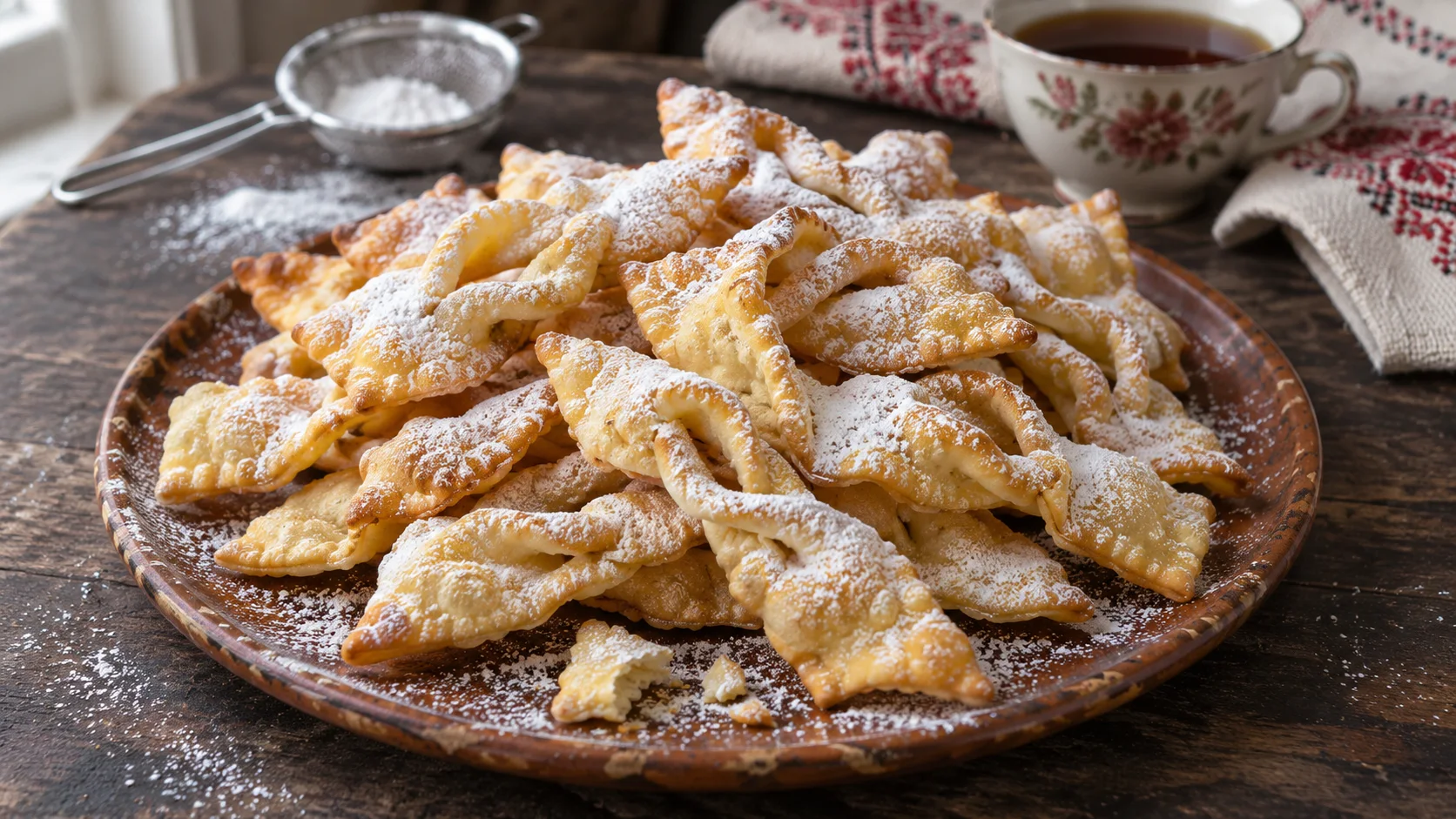
Chruściki, also called faworki or chrust, are thin ribbons of fried pastry. The dough is made with egg yolks and sour cream, rolled very thin, cut into strips and twisted through a slit in the middle, then fried for a few seconds and dusted with powdered sugar.¹˒² They fry up crisp and light, with small blisters on the surface.³ In English they are often called angel wings.¹˒⁴
In Poland they belong to Tłusty Czwartek, or Fat Thursday, the last Thursday before Lent, when they are eaten alongside pączki.²˒⁵
History and Cultural Roots
Faworki comes from the French faveur, a ribbon, after the shape of the pastry.⁶ Chrust is the ordinary Polish word for dry branches, and the standard Polish dictionary lists faworki as another meaning of the same word; chruścik is its diminutive.⁵˒⁷ The names are regional to some degree: dialect studies link chrust to parts of Silesia, Lesser Poland and the Subcarpathian region, and chruściki to Greater Poland, Kuyavia and Pomerania. In the villages around Konin, in central Poland, people use faworki and chruściki side by side.⁵
The historian Jarosław Dumanowski, speaking to the Polish Press Agency, says faworki appear later than pączki but quickly became a symbol of the carnival. In the 18th and 19th centuries, hosts would invite guests “for faworki,” the way people were invited for kutia on Christmas Eve, and the phrase meant the whole party.⁶
On the Fat Thursday Table
Fat Thursday falls in ostatki, the last week of the carnival, which ends when Lent begins on Ash Wednesday.²˒⁶ Ethnographers of the Pracownia Etnograficzna list chrusty, “also called faworki,” among the sweets eaten in those days, together with racuchy (yeast pancakes), bliny and pączki. Today bakeries in Poland have long queues for pączki and chruściki from early morning.² People interviewed by a dialectologist around Konin also name faworki and chruściki among the foods of Fat Thursday.⁵ The recipe also uses up the eggs and fat that were traditionally given up during Lent.⁴
Polish communities abroad also make chruściki for Christmas and Easter.¹
Traditional Chruściki Recipe
This recipe was compiled by Heritage Healthy Kitchen from a comparison of published recipes; the sources are listed at the end of this article. Figures that are Heritage Healthy Kitchen’s own estimates rather than taken from a published source are marked as such.
For every 100g of flour, the published recipes use about 1⅓ to 2 egg yolks and 22 to 42g of sour cream, with between 2 teaspoons and 3 tablespoons of vodka, spirit or vinegar per batch. Most roll the dough 1 to 2mm thin and fry at 170 to 180°C for 15 to 60 seconds per side.¹˒²˒³˒⁴˒⁸˒⁹ This version sits within those ranges and makes about 40 pieces.¹˒⁴

Ingredients
Makes about 40 pieces
- 250g (about 2 cups) all-purpose or pastry flour, plus extra for rolling¹˒⁴˒⁹
- 4 egg yolks¹˒⁴˒⁹
- 75g (5 tablespoons) full-fat sour cream¹˒²˒⁹
- 1 tablespoon vodka or Polish spirytus, or 1 tablespoon 6% white vinegar¹˒²˒⁹
- ½ teaspoon sugar¹
- A pinch of salt¹˒⁹
- About 600g (1⅓ lb) lard, or 500–700ml (2–3 cups) neutral oil such as sunflower or canola, for frying¹˒²
- 25g (¼ cup) powdered sugar, for dusting¹
Instructions
- Mix the dough. Sift the flour with the sugar and salt. Add the egg yolks, sour cream and vodka and knead until the dough is smooth and no longer sticks to your hands. If it feels too dry, add a little more sour cream; if it is too sticky, a little more flour.¹˒⁸˒⁹
- Beat the dough. Fold the dough over itself, beat it flat with a rolling pin, fold it again and keep going, turning it as you work. Published recipes call for anywhere from 10 to 20 minutes of this. The beating works air into the dough. Passing it two or three times through a meat grinder on the largest plate, or through a pasta machine, does a similar job.¹˒³˒⁸
- Rest the dough (optional). Wrap the dough and chill it for 30 to 60 minutes. Some recipes skip the rest and report little difference.¹˒³˒⁴˒⁸
- Roll it thin. Cut the dough into two or three pieces and keep the ones you aren’t using covered. Roll each piece on a lightly floured board to 1–2mm, thin enough that you can almost see through it.¹˒²˒³
- Cut and shape. Cut the sheet into strips 3–4cm (about 1½ inches) wide, then into pieces 9–10cm (about 4 inches) long, with straight or slanted ends. Make a 2cm (¾ inch) slit down the middle of each piece, pull one end through it and gently straighten the twist.¹˒³˒⁸
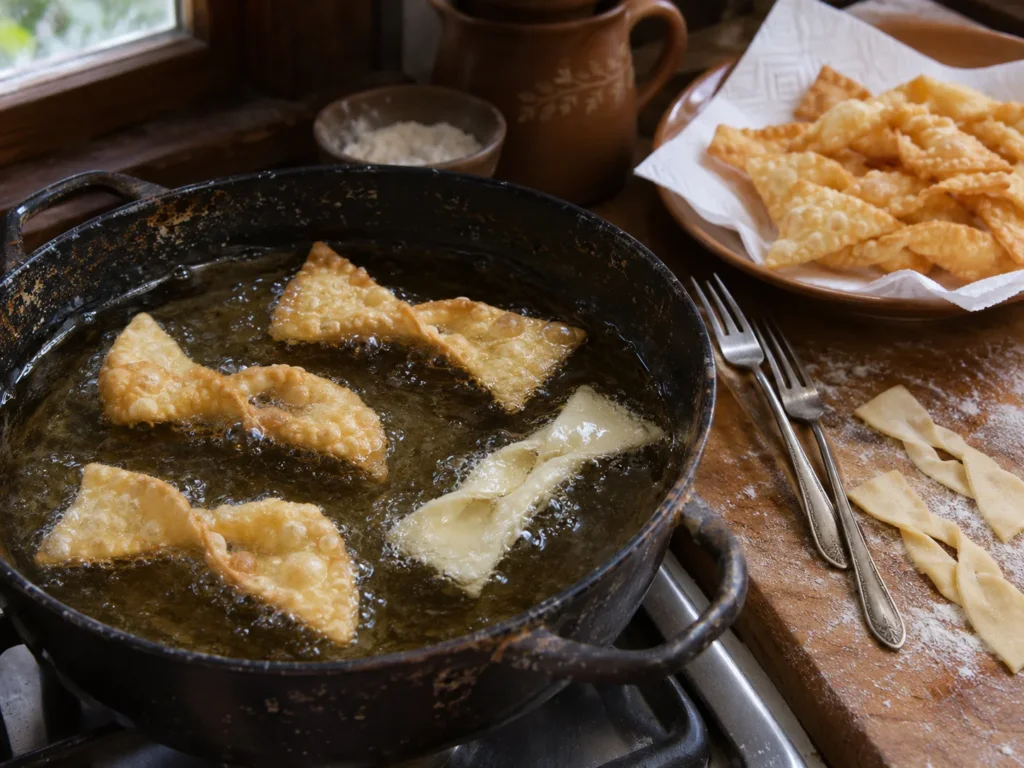
- Heat the fat. Heat the lard or oil in a wide, deep pan to 175–180°C (350–356°F). Without a thermometer, drop in a scrap of dough: it should rise to the surface and sizzle straight away.¹˒³˒⁴˒⁹
- Fry. Fry a few pieces at a time, without crowding the pan, for about 15 to 60 seconds per side, until pale golden and covered in small blisters. Turn them with two forks. They cook very fast, so stay at the stove.¹˒²˒³˒⁴
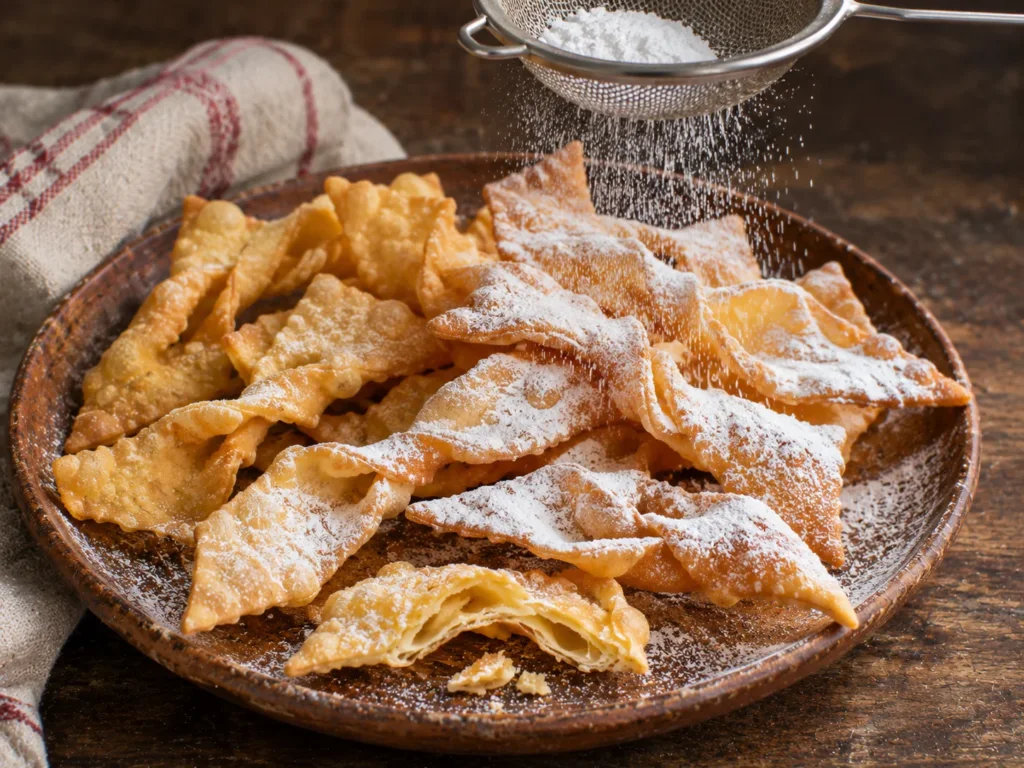
- Drain and dust. Lift them onto paper towels to drain and dust generously with powdered sugar while they are still warm.¹˒²˒³
Kitchen Tips
Don’t skimp on the beating. Beating the folded dough with a rolling pin works in the air that later shows up as small bubbles on the surface, and a well-aerated dough gives crisper chruściki.³˒⁸˒¹⁰
Roll thinner than seems right. The recipes agree on 1 to 2mm, thin enough to see light through the dough.²˒³
Keep the vodka or vinegar. Recipe writers add it so the pastry absorbs less fat in the pan and stays crisp.¹˒³˒⁹
Fry in small batches. Too many pieces at once cool the oil, and the pastry then soaks up more fat.³ At the right temperature they take less than a minute per side, so have the forks and paper towels ready before the first batch goes in.¹˒⁴
Dust at the right time. Powdered sugar sticks best to warm pastry. If you are making them ahead, dust them just before serving instead.¹˒³˒⁹
A Lighter Way to Make It
By our estimate, fried chruściki get about a third of their calories from the fat the thin dough takes up in the pan, so baking them is the obvious way to lighten them. Some recipes give an oven method: lay the shaped pieces on a sheet lined with baking paper and bake at 180–190°C (356–375°F) for about 8 to 10 minutes, until lightly golden. In an air fryer, cook them at 190°C (375°F) for 8 to 10 minutes. Let them cool on a rack, where any soft ones crisp up, and dust with powdered sugar.¹˒⁹
Be ready for a different pastry. The recipe writers who offer these methods say the texture changes quite a bit, that baked chruściki come out a little dry and taste slightly different, and one Polish baker finds them less good than fried, though much lower in calories.¹˒⁹˒¹⁰ By our calculation the baked version has about a third fewer calories and roughly a third of the fat of the fried one (see below).
If you fry, use fresh fat. A Harvard study of more than 100,000 adults linked eating fried food often with a higher risk of type 2 diabetes and heart disease, a risk that rose the more often people ate it. The researchers also noted that oil breaks down each time it is reused, so that more of it is absorbed into the food.¹¹
Nutritional Information
Per serving of 5 pieces (1 of 8), dusted with sugar
Fried
- Calories: approximately 240–290 kcal
- Protein: approximately 4.5–5.5g
- Total fat: approximately 12–17g
- Saturated fat: approximately 3g fried in oil; about 5–7g fried in lard
- Carbohydrates: approximately 25–31g
- Sugars: approximately 4g
- Dietary fiber: under 1g
- Sodium: approximately 60mg
Baked or air-fried
- Calories: approximately 160–190 kcal
- Total fat: approximately 4–5g
- Saturated fat: approximately 2g
- Protein, carbohydrates, sugars, fiber and sodium: as for the fried version
How much fat fried chruściki absorb is a Heritage Healthy Kitchen estimate (60 to 100g per batch); no published recipe gives a figure.
Nutritional values are estimates based on standard ingredient databases (USDA FoodData Central). They vary with how thin the dough is rolled, how much fat the pastry takes up and how much sugar goes on top.
Storage and Reheating
Kept dry at room temperature in an airtight container, chruściki stay crisp for up to 5 days, and some recipes say up to a week. Don’t refrigerate them, and don’t freeze fried ones, which turn soggy. The raw dough can be wrapped and frozen for 2 to 3 months.¹˒³˒⁹
Traditional Chruściki (Faworki)

Ingredients
For the dough
- 250g (about 2 cups) all-purpose or pastry flour, plus extra for rolling
- 4 egg yolks
- 75g (5 tablespoons) full-fat sour cream
- 1 tablespoon vodka or Polish spirytus, or 1 tablespoon 6% white vinegar
- ½ teaspoon sugar
- A pinch of salt
- About 600g (1⅓ lb) lard, or 500–700ml (2–3 cups) neutral oil such as sunflower or canola, for frying
- 25g (¼ cup) powdered sugar, for dusting
Instructions
- Sift the flour with the sugar and salt, add the yolks, sour cream and vodka, and knead until smooth and no longer sticky.
- Fold and beat the dough with a rolling pin for 10 to 20 minutes, turning it as you go.
- Wrap and chill the dough for 30 to 60 minutes.
- Roll the dough in batches on a floured board to 1–2mm, almost see-through.
- Cut strips 3–4cm wide and 9–10cm long, slit each in the middle and pull one end through the slit.
- Heat lard or oil to 175–180°C (350–356°F); a scrap of dough should rise and sizzle at once.
- Fry a few at a time for 15 to 60 seconds per side, until pale golden and blistered; turn with two forks.
- Drain on paper towels and dust generously with powdered sugar while still warm.
Frequently Asked Questions
Are faworki, chruściki and chrust different pastries?
No, they are the same pastry under different names. Which one people use depends partly on the region of Poland they come from, and in some places two names are used side by side.⁴˒⁵
Why is there vodka or vinegar in the dough?
Recipe writers add a spoonful of vodka, spirit or vinegar so the pastry absorbs less fat while frying and stays crisp. It is also said to make the dough lighter. The small amount of alcohol evaporates quickly in the hot fat.¹˒³˒⁹
Do I really have to beat the dough?
Beating is the traditional way to work air into the dough, which gives the bubbled, crisp surface. Passing the dough through a meat grinder or a pasta machine is a shortcut some recipes suggest.¹˒³˒⁸
Lard or oil?
Lard is the traditional frying fat and gives a richer flavor. A neutral oil such as sunflower or canola works too and keeps the pastry vegetarian.¹˒²
Can I make the dough ahead?
Yes. The dough keeps in a sealed bag in the refrigerator for up to 2 days and in the freezer for up to 3 months. Let chilled dough sit out for about 30 minutes before rolling.¹˒³
Can I bake chruściki instead of frying them?
Yes, in the oven or an air fryer at 180–190°C (356–375°F) for 8 to 10 minutes. They come out lighter and lower in fat, but drier and different in texture from fried ones; see A Lighter Way to Make It above.¹˒⁹
Further Reading & Sources
The recipe is a compilation based on the published recipes listed here; these links are provided for readers who want to explore further.
- Polonist Test Kitchen (no individual author named). “Chruściki, Faworki, Chrusty: Polish Angel Wings.” Polonist, February 12, 2022 (updated June 5, 2023). polonist.com
- Stowarzyszenie „Pracownia Etnograficzna” im. Witolda Dynowskiego (Witold Dynowski Ethnographic Workshop Association). “Tłusty Czwartek” [Fat Thursday], educational worksheet with a chruściki recipe, series Cztery pory roku (no author named; project funded in 2025). etnograficzna.pl
- Allison, Jo. “Polish Faworki (Chrusty, Chruściki).” Jo’s Kitchen Larder, February 2, 2024 (updated June 12, 2026). joskitchenlarder.com
- Behan, Ren. “Angel Wings (Faworki).” Food52, March 1, 2022. food52.com
- Osowski, Błażej. “Zwyczaje kulinarne w okresie od tłustego czwartku do Wielkiej Soboty w języku i kulturze mieszkańców Konina i okolic” [Culinary customs from Fat Thursday to Holy Saturday in the language and culture of the inhabitants of Konin and the surrounding area]. Rozprawy Komisji Językowej ŁTN, vol. 73, 2025. DOI 10.26485/RKJ/2025/73/21. czasopisma.ltn.lodz.pl
- Suchodolska, Mira (PAP), interview with historian Prof. Jarosław Dumanowski. “Prof. Jarosław Dumanowski: tłusty czwartek był dawniej częścią tygodniowego szaleństwa” [Fat Thursday used to be part of a week of revelry]. Dzieje.pl, February 12, 2026. dzieje.pl
- Słownik języka polskiego PWN. “Chrust.” Wydawnictwo Naukowe PWN, online dictionary (no date given). sjp.pwn.pl
- Margot (author named by first name only). “Faworki / Chruściki (Angel Wings) – Polish Fat Thursday’s Treats.” Coffee & Vanilla, February 5, 2013. coffeeandvanilla.com
- Klesta, Karolina. “Polish Angel Wing Cookies Recipe (Chrusciki).” Polish Foodies, February 4, 2022 (updated January 7, 2025). polishfoodies.com
- Beata (blog Wypieki Beaty). “Best faworki recipes.” Wypieki Beaty, updated August 24, 2026. wypiekibeaty.com.pl
- Harvard T.H. Chan School of Public Health (staff writer). “Eating fried foods tied to increased risk of diabetes, heart disease.” Harvard T.H. Chan School of Public Health News, July 25, 2014. hsph.harvard.edu
Disclaimer
The information in this article is provided for educational and informational purposes only. Heritage Healthy Kitchen makes no representations or warranties regarding the accuracy or completeness of any content on this site. Nutritional values are estimates only and will vary depending on the specific ingredients, brands, and measurements used. This content is not intended as dietary, medical, or professional nutritional advice. Always consult a qualified healthcare provider regarding any dietary needs or health conditions. Heritage Healthy Kitchen is not responsible for any outcomes resulting from the use of recipes or information published on this site.
You Might Also Like
More heritage recipes from our kitchen


Leave a Reply