
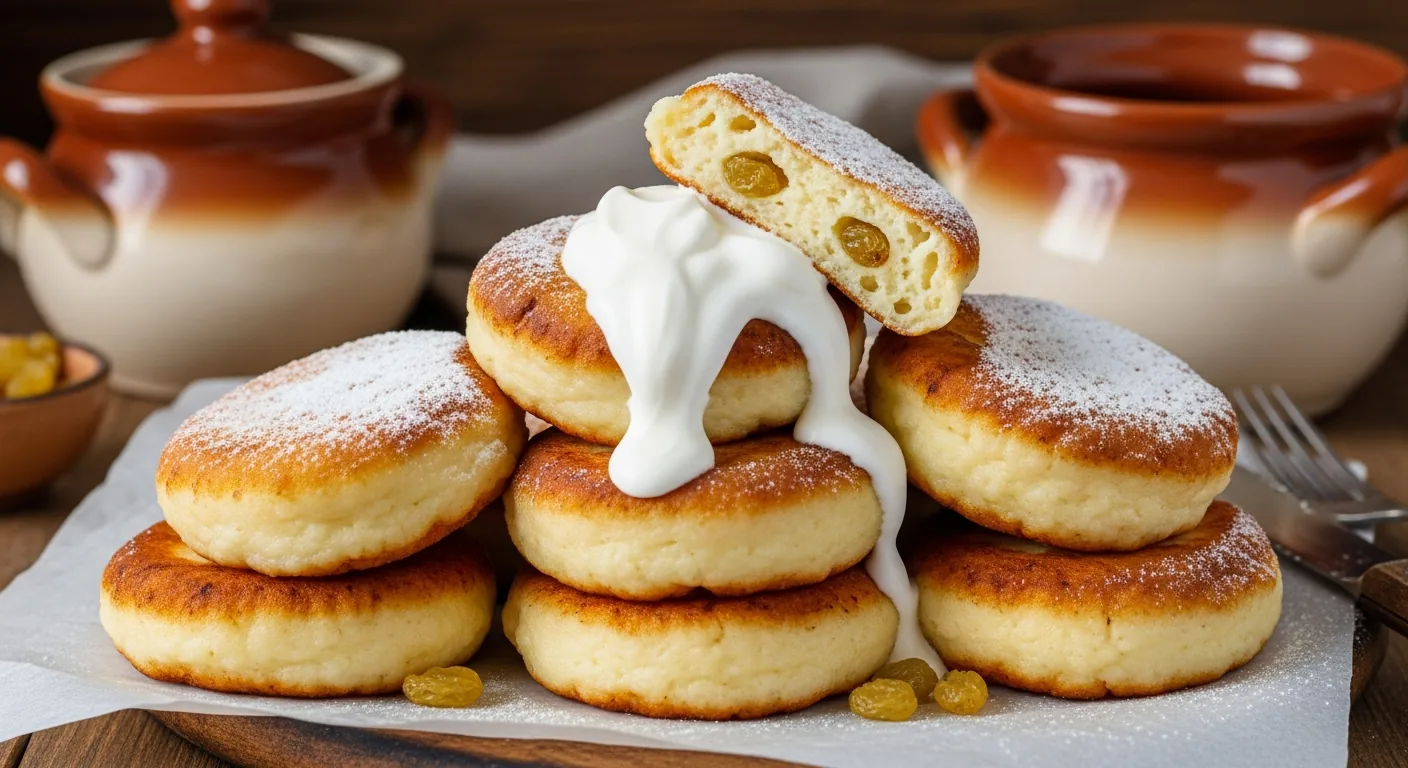
Active time: ~25 minutes | Total time: ~35 minutes | Serves: 4 (about 12–14 pancakes) | Difficulty: Easy
Quick Overview
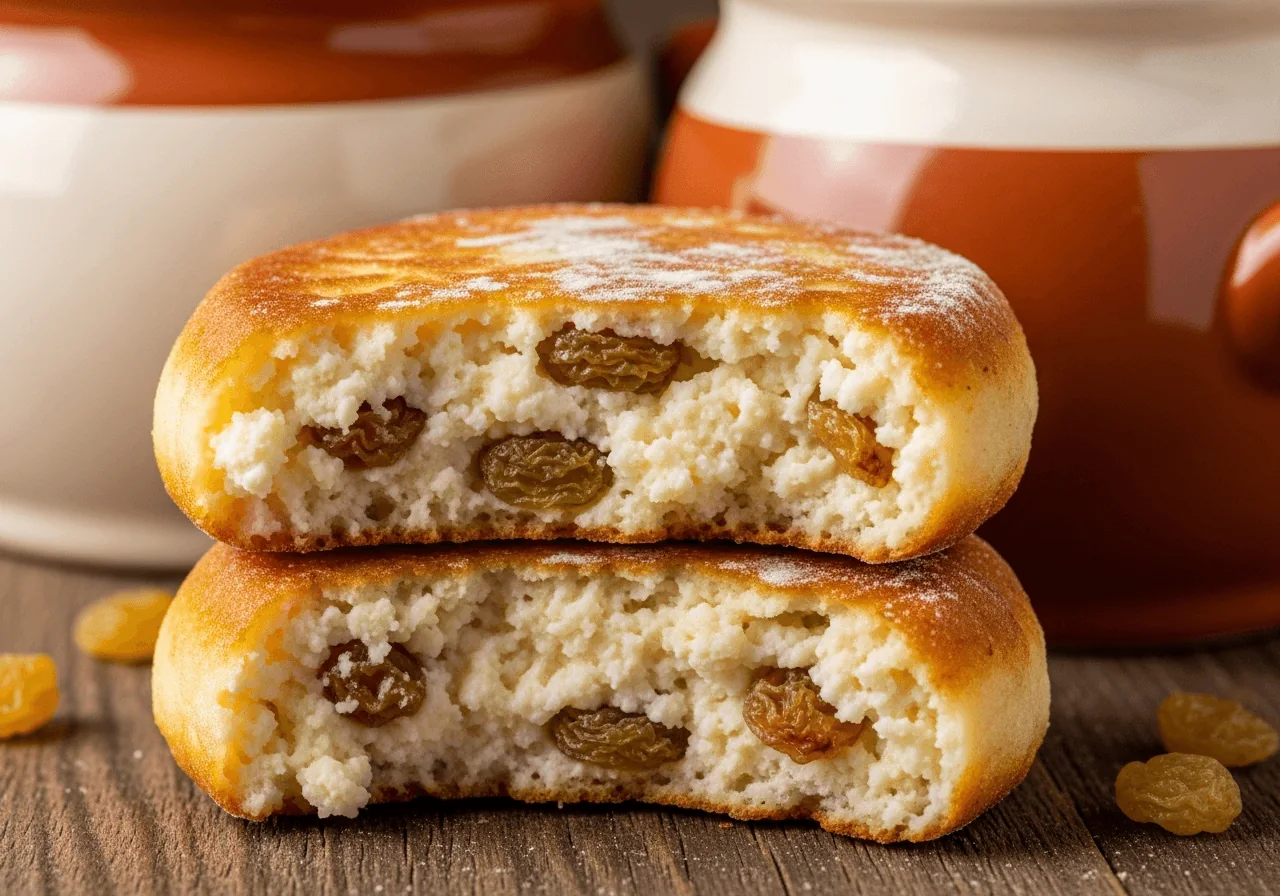
- Drain fresh farmer’s cheese or cottage cheese thoroughly — this is what keeps the pancakes from falling apart in the pan
- Mix the cheese with egg, a little flour, sugar, and salt into a soft, workable dough
- Shape the dough into small rounds and dredge lightly in flour
- Pan-fry in butter or oil over medium heat until golden on both sides
- Serve warm with sour cream, jam, or honey
What Syrnyky Is
Syrnyky are pan-fried Ukrainian pancakes made from farmer’s cheese, egg, a little flour, and sugar, sometimes with a touch of vanilla.¹
Golden on the outside and soft in the middle, syrnyky sit somewhere between a pancake and a small cheesecake. Ukrainian cottage cheese is the same base ingredient used to fill nalysnyky, varenyky, and hand pies, so shaping it into its own pancake is a natural extension of how the cheese is already used in the kitchen.⁵
History and Cultural Roots
Cottage cheese has held a steady place in Ukrainian cooking for a long time, eaten plain with sour cream, mixed into noodles, dumplings, potatoes, and kasha, or used as a filling for varenyky and pyrizhky.² The Encyclopedia of Ukraine traces a broader refinement of Ukrainian culinary arts to the 19th and early 20th century, when techniques that started in wealthier or clerical households gradually spread into ordinary village kitchens.² Turning cottage cheese into a fried pancake fits the same pattern: a way to stretch a farmhouse staple into something more substantial without needing anything beyond what was already on hand.
Exactly where syrnyky were first cooked isn’t settled. Food writers who have researched the dish describe its origins as inconclusive, and versions of the same fried cheese pancake appear across Belarus, Russia, Ukraine, Latvia, and Lithuania under different regional names.¹³ The name is clearer than the origin. Syrnyky comes from syr, an old Slavic word for soft curd cheese, and Ukrainian kept that original meaning. Russian shifted to a different word, tvorog, for the same ingredient, and that small linguistic difference has become part of a larger, ongoing conversation about which dishes belong to which culinary tradition in the region.¹³
That conversation has sharpened since Russia’s full-scale invasion of Ukraine in 2022. Ukrainian chefs and food writers, including cookbook author Anna Voloshyna and chef Ievgen Klopotenko — the activist behind Ukraine’s successful 2022 UNESCO bid recognizing borscht as Ukrainian cultural heritage — have pushed to have syrnyky recognized the same way, as a dish with clear Ukrainian roots rather than a generic “Soviet” one.³⁶ In an interview shortly after the UNESCO decision, Klopotenko named sirniki among the Ukrainian dishes he expects to gain wider international recognition next, alongside cabbage rolls and buckwheat dishes.⁶ Restaurants built around Ukrainian identity in the United States, including Anelya in Chicago and Leleka in San Francisco, now serve syrnyky as a deliberate statement about heritage as much as a menu item.³
A Breakfast and a Dessert, Equally
Syrnyky work as an easy breakfast and as a simple dessert, and Ukrainian households treat both uses as equally traditional rather than favoring one over the other.¹ Sweet versions take raisins, vanilla, chopped dried apricot, or a little more sugar in the dough. A plainer version with less sugar sits closer to a savory side dish, though the shaping and frying method barely changes between the two — sugar and add-ins are the main variable.¹
Syrnyky have also found an audience far beyond Ukraine’s borders, appearing on more restaurant menus in the United States as part of a wider interest in Ukrainian cooking since 2022.³ The pancake itself hasn’t changed much wherever it lands: farmer’s cheese, egg, a little flour, fried until golden.
On the Holiday Table
Syrnyky have a season as well as a time of day. Maslyana, the week before Great Lent, is the last stretch when the Orthodox calendar still allows cheese and eggs but no longer meat, which is why farmer’s cheese fills the table that week; the recipe sits on our Maslyana table for that reason.⁸
Traditional Syrnyky Recipe
Recipe developed independently by Heritage Healthy Kitchen, drawing on traditional Ukrainian culinary methods. Sources for further reading are listed at the end of this article.
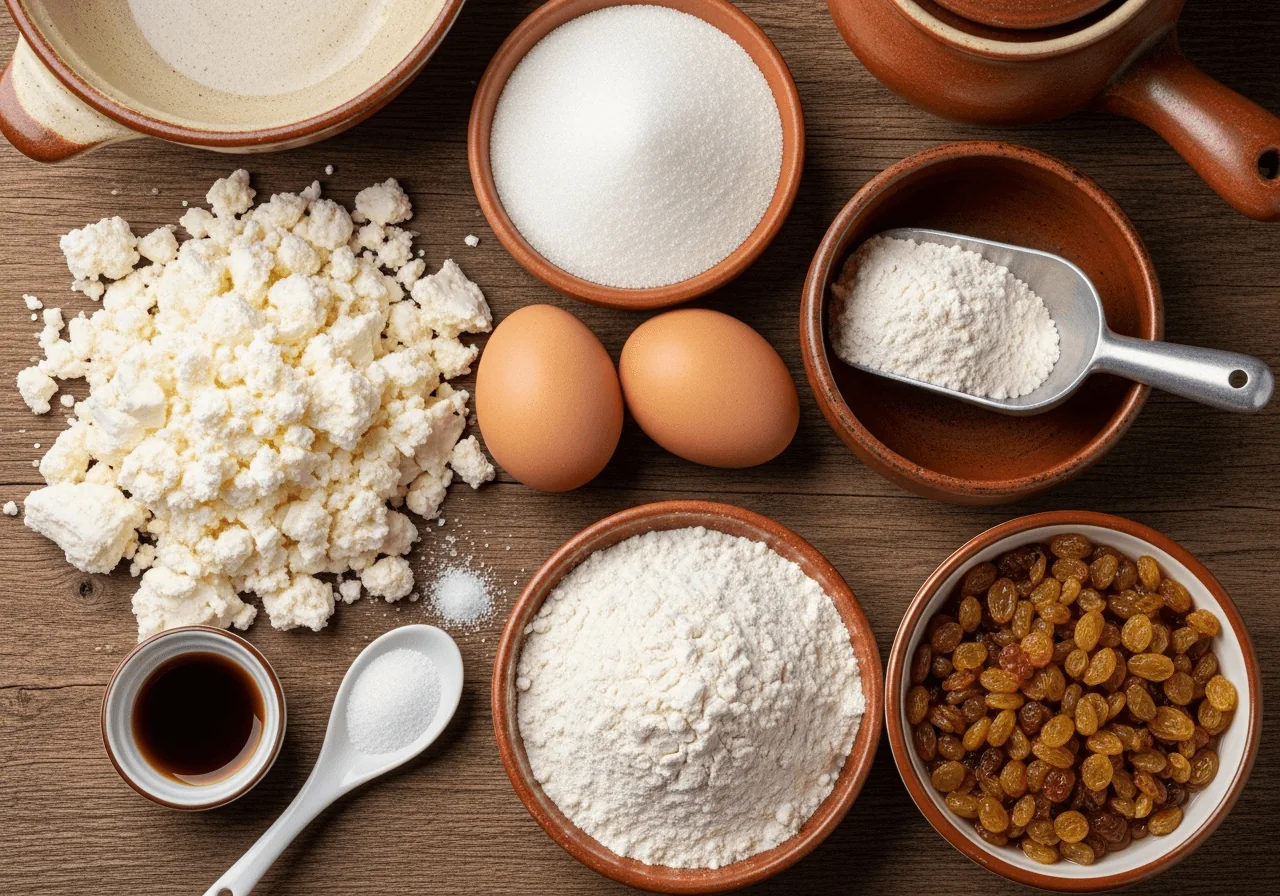
Ingredients
Serves 4, about 12–14 pancakes
- 500 g (about 2 cups) dry farmer’s cheese, or well-drained cottage cheese
- 2 large eggs
- 60 g (about ½ cup) all-purpose flour, plus more for dredging
- 3 tablespoons sugar
- ¼ teaspoon salt
- ½ teaspoon vanilla extract (optional)
- 2 tablespoons raisins, soaked and patted dry (optional)
- 2–3 tablespoons butter or neutral oil, for frying
- Sour cream, jam, or honey, to serve
Instructions
Prepare the cheese
If using cottage cheese instead of dry farmer’s cheese, drain it in a cheesecloth-lined sieve for at least an hour, pressing out as much liquid as possible.
Mix the dough
Mash the cheese in a bowl with a fork until mostly smooth. Add the egg, sugar, salt, and vanilla, and mix well. Fold in the flour just until combined, into a soft, slightly sticky dough rather than a stiff one. Stir in raisins if using.
Shape
With floured hands, portion the dough into small balls, about 2 tablespoons each, and flatten gently into rounds roughly 1.5 cm (½ inch) thick. Dredge each one lightly in flour, shaking off the excess.
Fry
Heat butter or oil in a nonstick skillet over medium-low heat. Fry the pancakes in batches, 2–3 minutes per side, until deep golden and cooked through. Lower the heat if the outside is browning faster than the center is cooking.
Serve
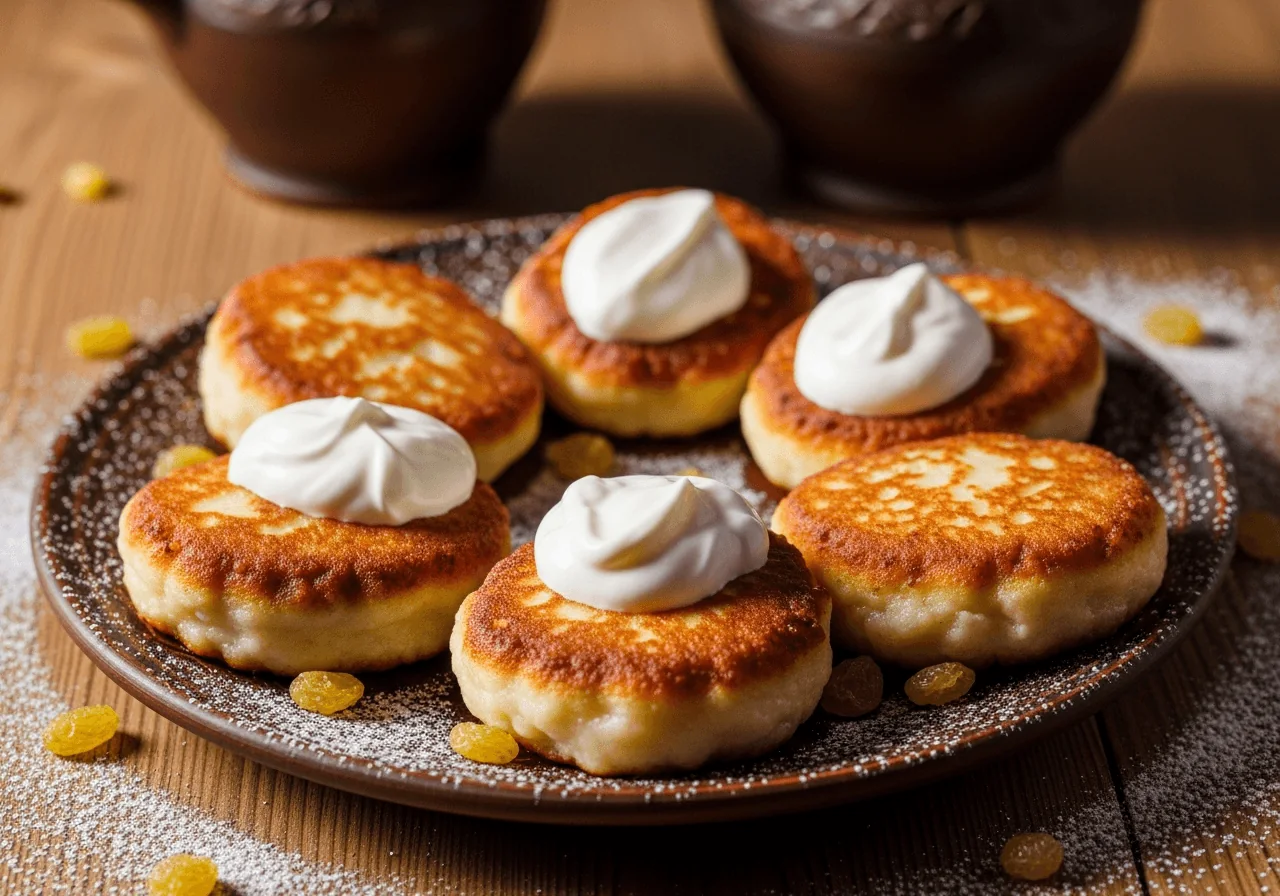
Serve warm, with sour cream, jam, or honey spooned over the top.
Kitchen Tips
Cheese matters more than technique. Wet, watery cottage cheese is the single biggest reason syrnyky spread out and fall apart instead of holding their shape. Dry farmer’s cheese, pressed and firm, gives the best result with the least amount of added flour.
Resist the urge to add extra flour. Traditional syrnyky use just enough flour to bind the dough. Adding more to compensate for wet cheese makes them dense and gummy instead of soft and light.
Keep the heat moderate. A hot pan browns the outside before the center has a chance to cook through, leaving a raw middle. Medium-low heat and a slightly longer cook time give a more even result.
Chilling or briefly freezing the shaped, uncooked pancakes before frying helps them hold their shape better in the pan, particularly if the cheese used was on the wetter side.
Nutritional Information
All values below are calculated from USDA FoodData Central figures for each ingredient in this recipe, scaled to the amounts used and divided across 4 servings.⁷ Actual values will still vary with the specific products used.
Per serving (about 3–4 pancakes)
- Calories: approx. 350–370 kcal
- Protein: approx. 18–19 g
- Carbohydrates: approx. 26–30 g
- Total fat: approx. 16–20 g
- Saturated fat: approx. 9–12 g
- Dietary fiber: less than 1 g
- Sodium: approx. 210–600 mg
Most of the protein and fat comes from the cheese, and so does most of the sodium range above. A salted, creamed-style farmer’s cheese runs close to regular cottage cheese in sodium; a dry, unsalted farmer’s cheese runs much lower. Harvard T.H. Chan School of Public Health flags cottage cheese specifically as a food that can carry more sodium and fat than people expect, and recommends checking labels and choosing lower-sodium, lower-fat versions where that’s a concern.⁴ The quarter teaspoon of added salt in the dough itself also accounts for a meaningful share of the sodium total, regardless of which cheese is used.
Storage and Reheating
Cooked syrnyky keep in the refrigerator for up to 3 days in a sealed container. Reheat in a dry skillet over medium-low heat for 2–3 minutes per side, or in a 160°C / 325°F oven for about 10 minutes, until warmed through and the outside re-crisps slightly.
The uncooked, shaped dough also freezes well. Arrange the flattened rounds on a baking sheet, freeze until firm, then transfer to a freezer bag for up to 2 months. Fry directly from frozen, adding a minute or two per side.
Microwaving works in a pinch but softens the crust and can leave the center a little rubbery. A skillet or oven gets closer to the fresh-fried texture.
Traditional Ukrainian Syrnyky

Ingredients
Ingredients
- 500 g (about 2 cups) dry farmer’s cheese, or well-drained cottage cheese
- 2 large eggs
- 60 g (about ½ cup) all-purpose flour, plus more for dredging
- 3 tablespoons sugar
- ¼ teaspoon salt
- ½ teaspoon vanilla extract (optional)
- 2 tablespoons raisins, soaked and patted dry (optional)
- 2–3 tablespoons butter or neutral oil, for frying
- Sour cream, jam, or honey, to serve
Instructions
- Drain fresh farmer’s cheese or cottage cheese thoroughly — this is what keeps the pancakes from falling apart in the pan
- Mix the cheese with egg, a little flour, sugar, and salt into a soft, workable dough
- Shape the dough into small rounds and dredge lightly in flour
- Pan-fry in butter or oil over medium heat until golden on both sides
- Serve warm with sour cream, jam, or honey
Frequently Asked Questions
What’s the difference between syrnyky and cheese blintzes?
Blintzes wrap a filling inside a separate crepe that’s cooked first, then rolled or folded around the cheese. Syrnyky are a single dough of cheese, egg, and flour, shaped directly into small rounds and fried without a crepe involved. Both belong to the same broad family of Eastern European cheese pancakes, but the construction is completely different.
Why do syrnyky fall apart when frying?
Usually one of three things: the cheese was too wet, too much flour was added to compensate, or the pan was too hot and browned the outside before the center set. Well-drained farmer’s cheese, a light hand with the flour, and moderate heat solve most of it.
Is syrnyky a Ukrainian or a Russian dish?
The dish’s exact origins aren’t documented with certainty, and near-identical versions exist across several Eastern Slavic and Baltic cuisines, as explained above. What isn’t in dispute is the name itself, which is Ukrainian rather than Russian, and since 2022 Ukrainian chefs and cultural advocates — including Klopotenko, who led the successful campaign to have borscht recognized by UNESCO as Ukrainian heritage — have pushed to have syrnyky recognized the same way.³⁶
What’s the difference between farmer’s cheese and cottage cheese for this recipe?
Farmer’s cheese is drier and firmer, closer in texture to a dense, crumbly block than to the moist curds found in most cottage cheese. It holds its shape with less added flour. Cottage cheese works as a substitute if it’s drained thoroughly first, but skipping that step is the most common reason a batch turns out too soft to shape.
Can syrnyky be made without sugar?
Yes. A savory version with just a pinch of sugar or none at all, served with sour cream rather than jam, is just as traditional as the sweet version and works well as a light lunch or side dish.
What is the traditional way to serve syrnyky?
Sour cream is the most common topping, spooned over the top just before eating. Jam, honey, and fresh berries are also traditional, and a light dusting of powdered sugar sometimes finishes the sweet version.
Looking for a Lighter Version?
Traditional syrnyky use full-fat farmer’s cheese, added sugar, and a fry in butter or oil. A lighter version keeps the basic method intact while adjusting the cheese, the sweetener, and the cooking approach. Heritage Healthy Kitchen covers those swaps, their nutritional trade-offs, and the adapted method in a separate dedicated article.
Further Reading & Sources
The following sources were consulted in researching the history, technique, and cultural background of traditional Ukrainian syrnyky. Heritage Healthy Kitchen’s recipe was developed independently; these links are provided for readers who want to explore further.
- “Syrniki.” Wikipedia. en.wikipedia.org — etymology of “syrniki” from the Slavic word syr; Ukrainian retention of the original meaning versus the Russian term tvorog; regional variations across Belarusian, Russian, Ukrainian, Latvian, and Lithuanian cuisines; traditional use as both a breakfast and dessert dish, with common add-ins.
- “Traditional foods.” Internet Encyclopedia of Ukraine, Canadian Institute of Ukrainian Studies, University of Toronto. encyclopediaofukraine.com — cottage cheese’s role in Ukrainian flour-based and everyday cooking; development of Ukrainian culinary arts in the 19th and early 20th century.
- Flora Tsapovsky. “These Light Ukrainian Cheese Pancakes Carry a Heavy Load.” TASTE. tastecooking.com — inconclusive documented origins of syrniki; the post-2022 movement among Ukrainian chefs to reclaim the dish as Ukrainian heritage; Klopotenko, Voloshyna, and Ukrainian-identity restaurants in the United States.
- “Is cottage cheese healthy?” Harvard T.H. Chan School of Public Health. hsph.harvard.edu — guidance on sodium and fat content in cottage cheese, and recommendation to choose lower-sodium, lower-fat varieties.
- “A Guide to the Essential Ingredients in Ukrainian Cuisine.” Matusya’s Kitchen. matusyaskitchen.com — cottage cheese as a central Ukrainian dairy ingredient, used for syrnyky as well as fillings for nalysnyky, varenyky, and hand pies.
- Masha Zhartovska. Interview with Yevhen Klopotenko. Babel. babel.ua — Klopotenko’s prediction, shortly after borscht’s UNESCO listing, that Ukrainian cheese pancakes would be among the next dishes to gain wider international recognition.
- “Cottage cheese, farmer’s” and related dairy, egg, and grain entries. USDA FoodData Central, U.S. Department of Agriculture. fdc.nal.usda.gov — per-ingredient nutrient data used to calculate the nutritional estimates in this article.
- “Fasting & Fast-Free Seasons of the Church.” Orthodox Church in America. oca.org — Cheesefare Week: meat set aside after Meatfare Sunday, dairy and eggs still permitted until Great Lent begins.
Disclaimer
The information in this article is provided for educational and informational purposes only. Heritage Healthy Kitchen makes no representations or warranties regarding the accuracy or completeness of any content on this site. Nutritional values are estimates only and will vary depending on the specific ingredients, brands, and measurements used. This content is not intended as dietary, medical, or professional nutritional advice. Always consult a qualified healthcare provider regarding any dietary needs or health conditions. Heritage Healthy Kitchen is not responsible for any outcomes resulting from the use of recipes or information published on this site.
Cook by Occasion
This recipe is part of our Maslyana table.
You Might Also Like
More heritage recipes from our kitchen
Leave a Reply