

Part of our Heritage Kitchen Glossary – short guides to the ingredients and techniques behind Eastern European cooking.
The short answer
Farmer’s cheese is a pressed cottage cheese, with less moisture and a firmer texture than ordinary cottage cheese. In Ukrainian it is syr. It is the classic filling of blintzes and nalysnyky, goes into varenyky, and is the base of syrnyky.
What to look for
Ukrainian recipes call farmer’s cheese of 5 to 9 percent fat the most versatile. It should be neither too dry nor too wet: dry cheese will not hold together, and cheese full of whey makes the dough spread. If it is wet, drain it in a cheesecloth-lined sieve and press out the liquid; if it is grainy, press it through a sieve. Draining works better than adding flour, which makes syrnyky less tender. In a crepe, a wet filling soaks the dough and leaks in the oven.
Outside Ukraine the same cheese can be hard to find. Look for cheese sold as farmer’s cheese; where there is none, drained cottage cheese is the usual substitute. Give it 1½ to 2 hours in a sieve before it goes into a filling.
In the Ukrainian kitchen
Syr is eaten with sour cream and goes into varenyky, nalysnyky and pyrizhky. It also has a week of its own. Masnytsia, the week before Great Lent, is also called Cheese Week: meat is set aside by then, but dairy is still eaten. Ukrainska Pravda’s account of the old Masnytsia table puts varenyky with cheese in every house, and an ethnographer quoted in the same article lists nalysnyky with cheese and syrnyky among the dishes of that week: “everything except meat.”
In the Ashkenazi kitchen
Shavuot marks the giving of the Torah at Mount Sinai, and cheese is the food of the holiday. In Ashkenazi homes that most often means blintzes, thin crepes folded around a sweet cheese filling, and cheesecake is popular too. Many families serve the same dairy dishes at Hanukkah.
Where you will meet it on this site
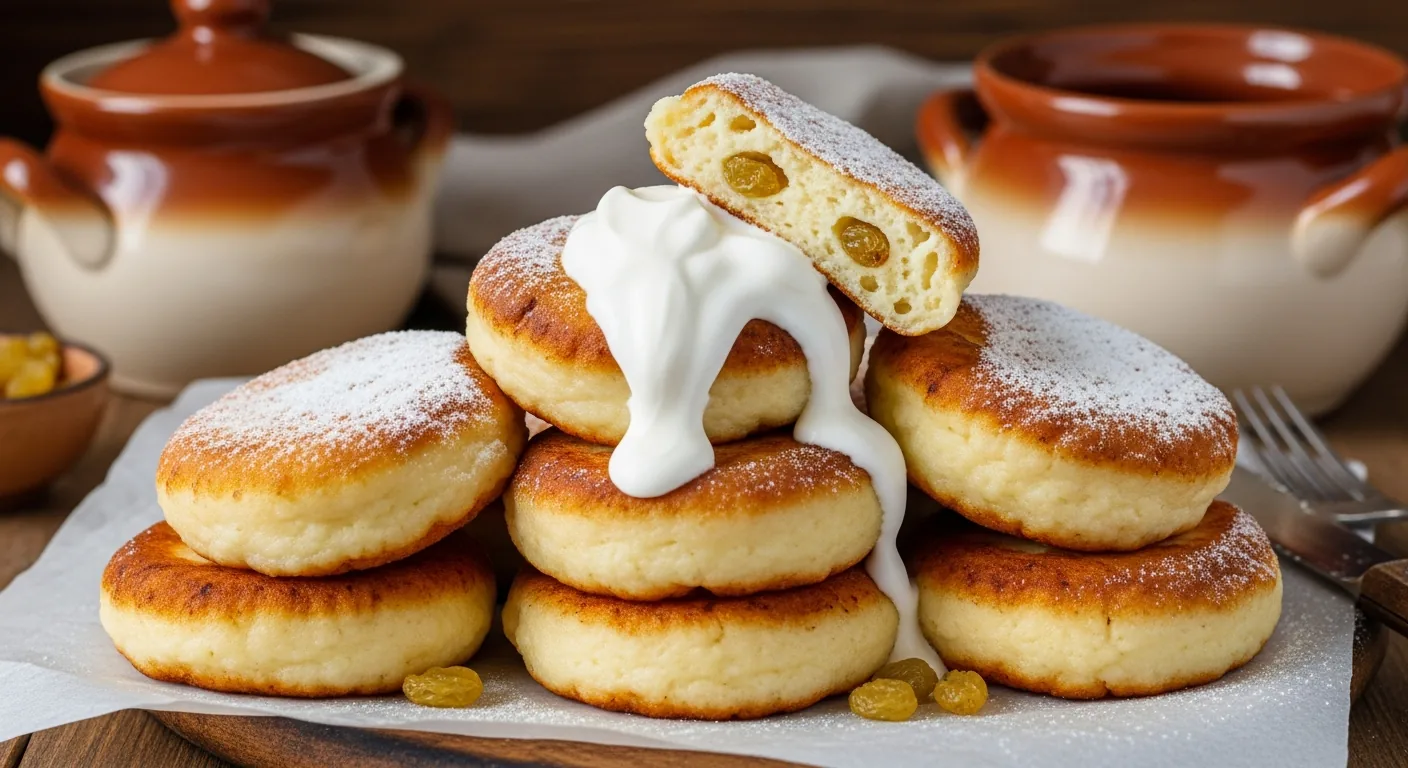
Farmer’s cheese is the filling in our Traditional Blintzes; the Healthy Blintzes use well-drained 2 percent cottage cheese instead. It is rolled inside Traditional Nalysnyky, sweet with sugar, vanilla sugar and raisins, or savory with dill in a Ukrainian-Canadian version, and inside the buckwheat and whole wheat crepes of Healthy Nalysnyky. It fills the cheese varenyky in our Traditional Varenyky. Mashed with an egg, a little sugar and flour and fried, it becomes Traditional Syrnyky; Healthy Syrnyky bake the same rounds in the oven.
Substitutes and the lighter view
Our lighter recipes use cheese of 2 to 5 percent fat. Cleveland Clinic gives the numbers for 2 percent cottage cheese: 84 calories, 2.3 grams of fat and 11 grams of protein per 100 grams, with full-fat cottage cheese carrying about 1.5 grams more saturated fat. Fat-free cheese is not a better choice, since it also has less protein. Packaged cottage cheese can be high in sodium, so check the label. At the table, plain Greek yogurt, with about twice the protein of regular yogurt, takes the place of sour cream in our lighter versions.
Frequently Asked Questions
What is farmer’s cheese?
A pressed cottage cheese, with less moisture and a firmer texture than ordinary cottage cheese. In Ukrainian it is syr, the cheese of syrnyky, nalysnyky and cheese varenyky.
Can I use cottage cheese instead of farmer’s cheese?
Yes, once it is well drained. Leave it in a sieve for 1½ to 2 hours, so fillings for blintzes, nalysnyky or varenyky and the dough for syrnyky do not turn wet.
What fat content should farmer’s cheese have?
Ukrainian recipes call 5 to 9 percent fat the most versatile. Lighter versions use 2 to 5 percent; fat-free cheese is best avoided, since it has less protein as well as less fat.
Is farmer’s cheese healthy?
It is a good source of protein, and the fat depends on the kind you buy. Per 100 grams, 2 percent cottage cheese has 84 calories, 2.3 grams of fat and 11 grams of protein. Cottage cheese can be high in sodium, so check the label.
Which holidays is it eaten on?
In Ukraine, Masnytsia, the Cheese Week before Lent, when dairy is eaten but meat is not. In Ashkenazi homes, Shavuot, when cheese is the food of the holiday and blintzes the most typical dish; many families serve them at Hanukkah as well.
Further Reading & Sources
This entry draws on the sources below and on the recipes it links to elsewhere on this site. They are listed for readers who want to go further.
- Yevhen Klopotenko. “Zapecheni syrnyky u makitri” [Syrnyky baked in a clay pot]. klopotenko.com, 13 December 2024 (in Ukrainian). klopotenko.com
- Yevhen Klopotenko. “Retsept syrnykiv” [Syrnyky recipe]. klopotenko.com, 26 April 2023, updated 9 September 2026 (in Ukrainian). klopotenko.com
- Yevhen Klopotenko. “Syrnyky (Farmer Cheese Pancakes),” from The Authentic Ukrainian Kitchen (Voracious, 2024). The Splendid Table, 13 September 2024. splendidtable.org
- Micah Siva. “What Are Blintzes and Why Are They Jewish?” Aish, 30 May 2022. aish.com
- PJ Hamel. “Cheese Blintzes.” King Arthur Baking, updated 10 July 2024. kingarthurbaking.com
- S. Stechishin. “Traditional foods.” Internet Encyclopedia of Ukraine, Canadian Institute of Ukrainian Studies. encyclopediaofukraine.com
- Liudmyla Panasiuk. “Masnytsia, a ne ‘Masliana’, i varenyky zamist blyniv” [Masnytsia, not “Masliana”, and varenyky instead of blini]. Ukrainska Pravda. Zhyttia, 3 March 2019 (in Ukrainian). life.pravda.com.ua
- Lesli Koppelman Ross. “Why Dairy on Shavuot?” My Jewish Learning, no date given. myjewishlearning.com
- Sarah Zielinski. “A Hidden Hanukkah Tale of a Woman, an Army and Some Killer Cheese.” NPR, The Salt, 4 December 2012. npr.org
- Cleveland Clinic Health Essentials. “Why Cottage Cheese Is Good for You.” 23 August 2023. health.clevelandclinic.org
- Cleveland Clinic Health Essentials. “Is Yogurt Good for You?” 9 November 2020. health.clevelandclinic.org
- Harvard T.H. Chan School of Public Health. “Is cottage cheese healthy?” 7 July 2023. hsph.harvard.edu
Leave a Reply