
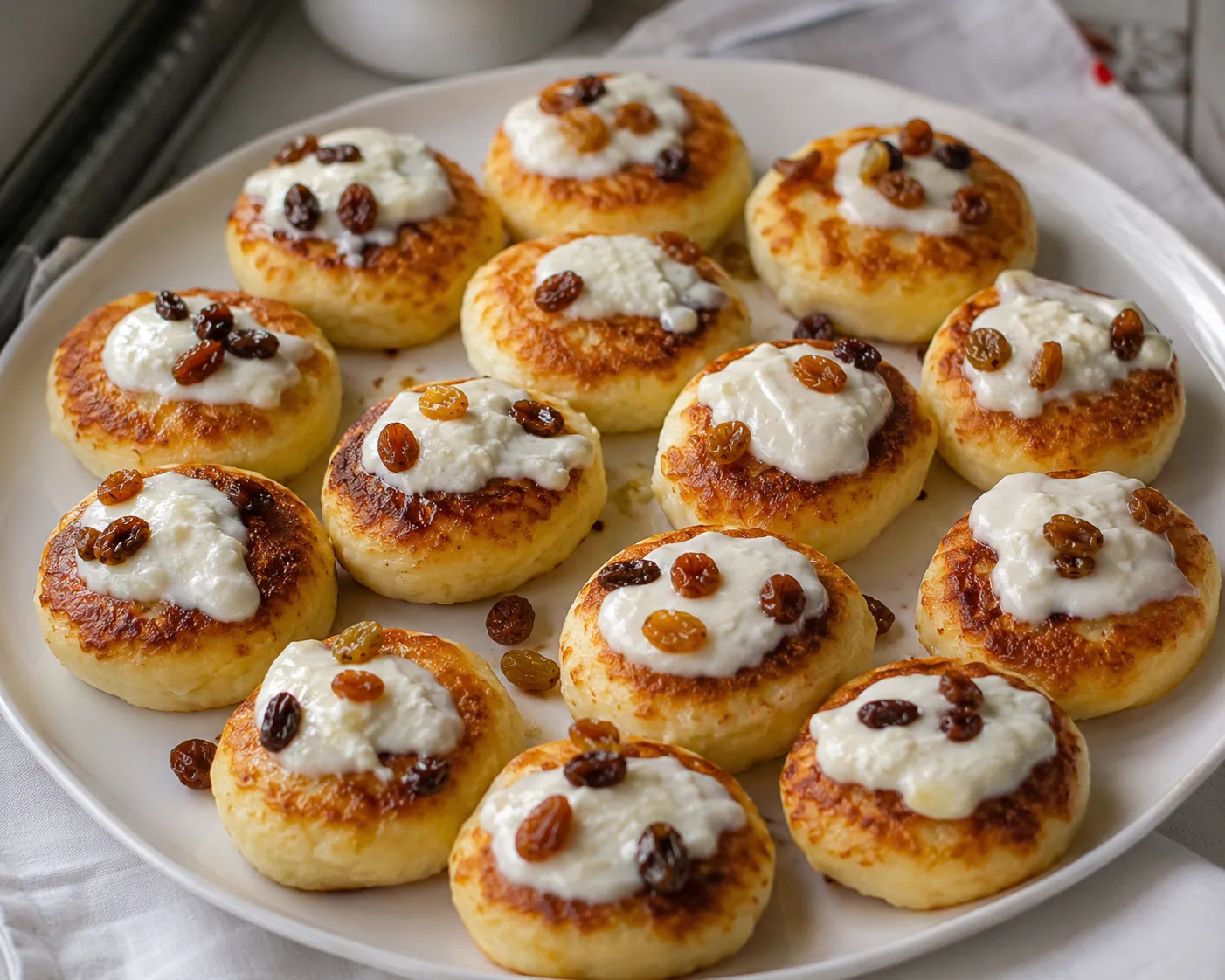
Active time: ~25 minutes | Total time: ~45 minutes | Serves: 4 (about 12–14 pancakes) | Difficulty: Easy
Quick Overview
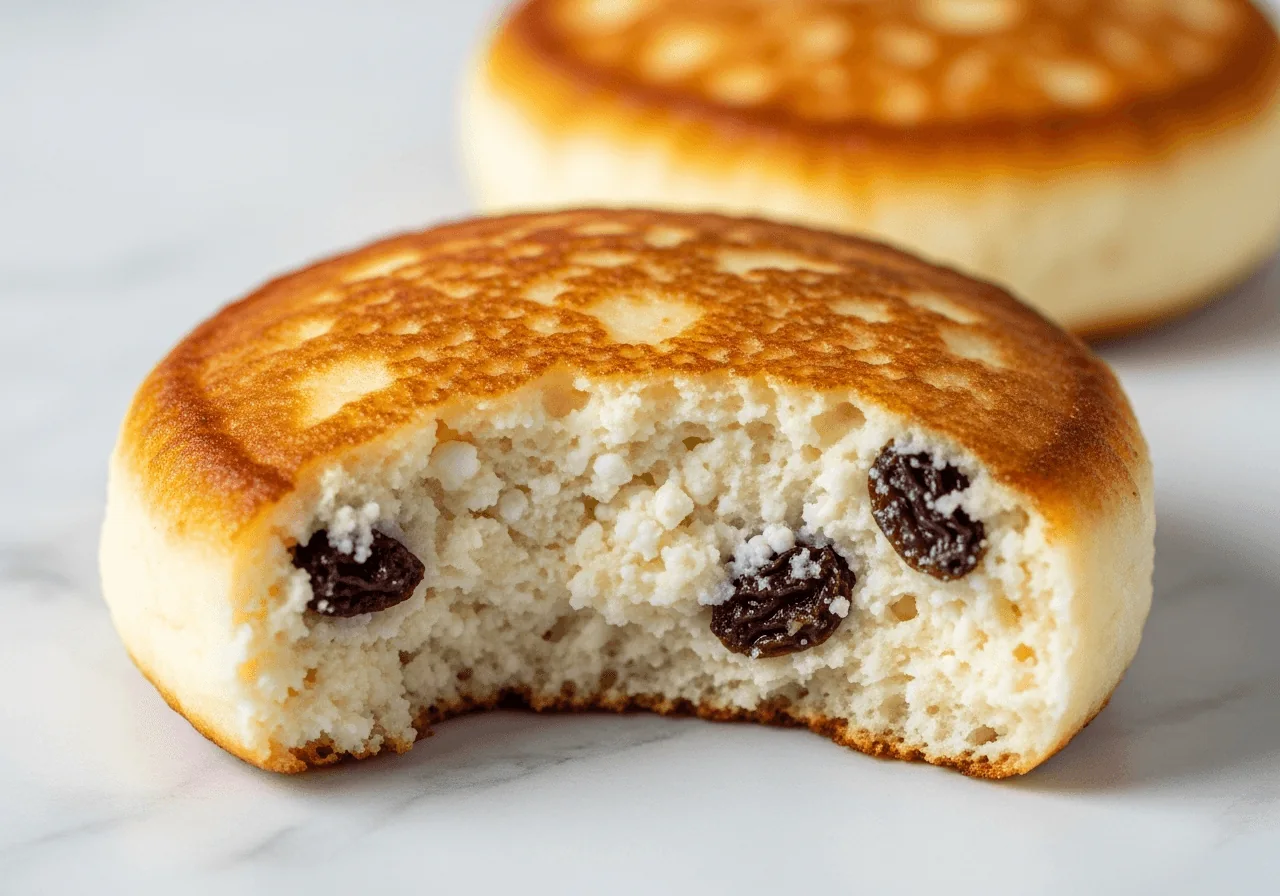
- Bake or air-fry instead of pan-frying — the same golden crust, a fraction of the added fat
- Low-fat (2%) cottage cheese replaces full-fat farmer’s cheese — protein stays high, saturated fat drops sharply
- Whole wheat flour replaces all-purpose flour — more fiber, a steadier blood sugar response
- Sugar is cut roughly in half, with a little extra vanilla carrying more of the sweetness
- Greek yogurt and fresh berries replace sour cream and jam at the table
What This Version Changes — and What It Keeps
The basic method doesn’t change: cheese mashed with egg, bound with a little flour and sugar, shaped into small rounds, and cooked until golden. Anyone who has made the traditional version already knows how to make this one — the mixing, shaping, and dredging steps are identical.
What changes is where the fat, sugar, and refined flour concentrate. Full-fat farmer’s cheese becomes low-fat cottage cheese, some of the sugar disappears, all-purpose flour becomes whole wheat, the pan of butter becomes a sheet pan and a light brush of oil, and sour cream or jam at the table becomes Greek yogurt and fresh fruit. None of this touches the shaping technique or the basic proportions of the dough.
Why These Swaps Work
Baking instead of pan-frying is the single biggest change here. Cleveland Clinic registered dietitian Julia Zumpano notes that a low-oil method such as air-frying can cut the calories a food would otherwise absorb from deep frying by up to 80%, since fat absorption during frying is what drives up calories in the first place.¹ Traditional syrnyky are pan-fried rather than deep-fried, so the realistic reduction from baking falls short of that 80% figure. But two to three tablespoons of butter in a skillet is still far more than the light brush of oil a sheet pan needs, and the pancakes absorb correspondingly less.
The cheese swaps full-fat, often salted farmer’s cheese for low-fat (2%) cottage cheese. Cleveland Clinic’s nutrition team puts a number on the difference: a 100-gram serving of 2% cottage cheese provides 84 calories, 2.3 grams of fat, and 11 grams of protein.² Zumpano specifically suggests cottage cheese as a stand-in for sour cream and as an addition to pancake batter, which is close to what this swap does.² Sodium is the exception to the good news here, and it’s worth its own explanation in the FAQ below.²
All-purpose flour becomes whole wheat. Milling strips away the bran and germ, the parts of the wheat kernel that carry most of the fiber, and Harvard T.H. Chan School of Public Health explains that this bran and fiber are what slow the breakdown of starch into glucose, keeping blood sugar steadier rather than causing sharp spikes.³ Whole wheat flour behaves a little differently in the dough than all-purpose. It’s thirstier and needs a short rest to hydrate, but the swap doesn’t touch the shaping or baking method at all.
Sugar drops from 3 tablespoons to 1½, roughly half. Harvard’s Nutrition Source gives specific guidance for baking: reduce a recipe’s added sugar by a quarter to a third of a cup, or replace part of it with mashed fruit.⁴ A slightly larger dose of vanilla extract picks up more of the sweetness once less sugar is competing for attention, and the toppings, Greek yogurt and fresh berries rather than jam, do most of the remaining flavor work.
Sour cream and jam at the table become plain Greek yogurt and fresh berries. Cleveland Clinic recommends this swap directly for cutting saturated fat: Greek yogurt has roughly twice the protein of regular yogurt, and using it in place of sour cream is one of the specific substitutions the dietetics team suggests.⁵ Full-fat or 2% Greek yogurt holds up best in texture against a warm pancake; nonfat versions taste noticeably thinner.
Healthy Syrnyky Recipe
Recipe developed independently by Heritage Healthy Kitchen. Sources for further reading are listed at the end of this article.
Ingredients
Serves 4, about 12–14 pancakes
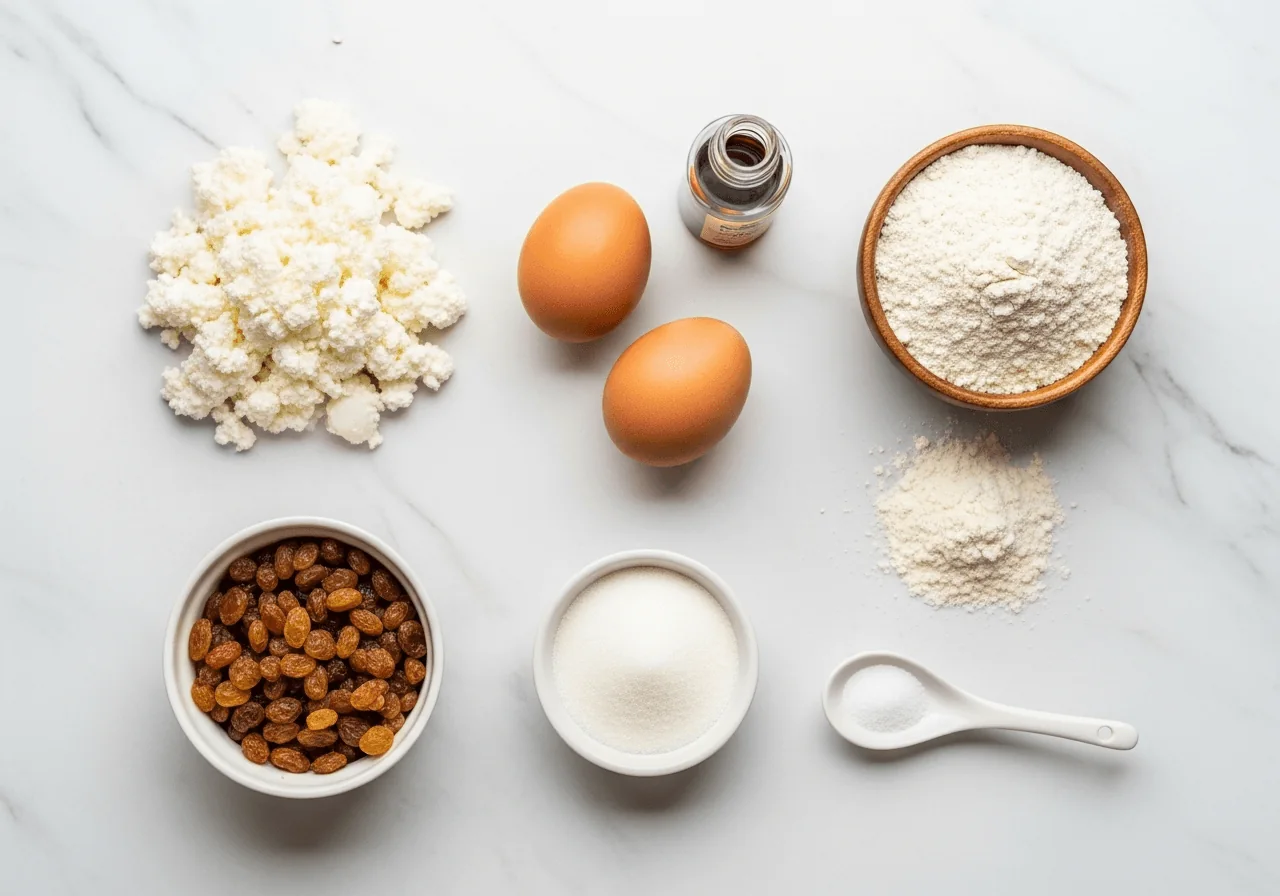
- 500 g (about 2 cups) low-fat (2%) cottage cheese, well-drained (a lower-sodium variety if available)
- 2 large eggs
- 60 g (about ½ cup) whole wheat flour, plus more for dredging
- 1½ tablespoons sugar
- ⅛ teaspoon salt
- ¾ teaspoon vanilla extract
- 2 tablespoons raisins, soaked and patted dry (optional)
- Neutral oil spray, or 1½ teaspoons oil for brushing
- Plain Greek yogurt (2% or full-fat) and fresh berries, to serve
Instructions
- Prepare the cheese. Drain the cottage cheese in a cheesecloth-lined sieve for at least an hour, pressing out as much liquid as possible. Whole wheat flour is thirstier than all-purpose, so a dry base matters even more here.
- Mix the dough. Mash the cheese in a bowl with a fork until mostly smooth. Add the egg, sugar, salt, and vanilla, and mix well. Fold in the flour just until combined. Let the dough rest for 10 minutes so the whole wheat flour has time to hydrate, then stir in raisins if using.
- Shape. With floured hands, portion the dough into small balls, about 2 tablespoons each, and flatten gently into rounds roughly 1.5 cm (½ inch) thick. Dredge each one lightly in flour, shaking off the excess.
- Bake. Preheat the oven to 400°F (200°C). Arrange the rounds on a parchment-lined baking sheet, spaced apart, and lightly spray or brush the tops with oil. Bake for 10 minutes, flip carefully, brush the second side, and bake for another 8–10 minutes, until golden and set. To air-fry instead, cook at 375°F (190°C) for about 12–14 minutes in a single layer, flipping halfway.
- Serve. Serve warm, topped with Greek yogurt and fresh berries.
Kitchen Tips
Whole wheat flour absorbs more liquid than all-purpose, so the dough can look slightly drier right after mixing. The rest period fixes this; adding more flour to compensate does not.
Baked syrnyky don’t develop quite as deep a crust as pan-fried ones. A light brush of oil right before baking, rather than just a spray, closes most of that gap.
Reduced-sodium cottage cheese is worth seeking out by name, rather than reaching for whatever happens to be labeled low-fat. The two label claims track different things, and most supermarkets carry at least one reduced-sodium option.
Nutritional Comparison
Per serving (about 3–4 pancakes)

| Nutrient | Traditional | This Version |
|---|---|---|
| Calories | ~350–370 kcal | ~210–230 kcal |
| Protein | ~18–19 g | ~18–19 g |
| Carbohydrates | ~26–30 g | ~20–22 g |
| Total fat | ~16–20 g | ~7–8 g |
| Saturated fat | ~9–12 g | ~3 g |
| Dietary fiber | less than 1 g | ~1.5–2 g |
| Sodium | ~210–600 mg | ~330–510 mg |
Values are calculated from USDA FoodData Central figures for each ingredient, scaled to the amounts used and divided across 4 servings.⁶ Actual values will vary with the specific products used.
The biggest shift is fat: total fat drops by more than half and saturated fat by roughly two-thirds, almost entirely from baking instead of pan-frying and from swapping in 2% cottage cheese. Protein holds essentially steady. Fiber more than doubles thanks to the whole wheat flour, though it’s still a modest amount for a dish this size. Sodium is the one number that doesn’t necessarily move in the expected direction — see the FAQ below for why.
Storage and Reheating
Cooked syrnyky keep in the refrigerator for up to 3 days in a sealed container. Reheat in a 350°F (175°C) oven for about 8 minutes, or in a dry skillet over medium-low heat until warmed through. A microwave works in a pinch but softens the crust.
The shaped, unbaked dough also freezes well. Arrange the flattened rounds on a baking sheet, freeze until firm, then transfer to a freezer bag for up to 2 months. Bake directly from frozen, adding about 5 minutes to the baking time.
Healthy Syrnyky

Ingredients
Ingredients
- 500 g (about 2 cups) low-fat (2%) cottage cheese, well-drained (a lower-sodium variety if available)
- 2 large eggs
- 60 g (about ½ cup) whole wheat flour, plus more for dredging
- 1½ tablespoons sugar
- ⅛ teaspoon salt
- ¾ teaspoon vanilla extract
- 2 tablespoons raisins, soaked and patted dry (optional)
- Neutral oil spray, or 1½ teaspoons oil for brushing
- Plain Greek yogurt (2% or full-fat) and fresh berries, to serve
Instructions
- Prepare the cheese. Drain the cottage cheese in a cheesecloth-lined sieve for at least an hour, pressing out as much liquid as possible. Whole wheat flour is thirstier than all-purpose, so a dry base matters even more here.
- Mix the dough. Mash the cheese in a bowl with a fork until mostly smooth. Add the egg, sugar, salt, and vanilla, and mix well. Fold in the flour just until combined. Let the dough rest for 10 minutes so the whole wheat flour has time to hydrate, then stir in raisins if using.
- Shape. With floured hands, portion the dough into small balls, about 2 tablespoons each, and flatten gently into rounds roughly 1.5 cm (½ inch) thick. Dredge each one lightly in flour, shaking off the excess.
- Bake. Preheat the oven to 400°F (200°C). Arrange the rounds on a parchment-lined baking sheet, spaced apart, and lightly spray or brush the tops with oil. Bake for 10 minutes, flip carefully, brush the second side, and bake for another 8–10 minutes, until golden and set. To air-fry instead, cook at 375°F (190°C) for about 12–14 minutes in a single layer, flipping halfway.
- Serve. Serve warm, topped with Greek yogurt and fresh berries.
Frequently Asked Questions
Does 2% cottage cheese work as well as farmer’s cheese in this dough?
Reasonably well, once it’s thoroughly drained. Cottage cheese has a looser curd than farmer’s cheese even after draining, so the dough will feel a little softer going into the oven; the whole wheat flour and the short rest both help it hold together.
Why bake instead of pan-fry?
Baking removes most of the added fat that pan-frying in butter contributes, and it means not standing over a skillet cooking several batches. The tradeoff is texture: baking browns the pancakes evenly but doesn’t produce quite the same deep, crisp edge a few minutes in butter does (see the Kitchen Tips above for a way to narrow that gap).
Is this version actually lower in sodium?
Not by much, and that’s worth being upfront about. The main sodium source in both versions is the cheese itself, and standard 2% cottage cheese runs close to the same sodium level as a salted, creamed-style farmer’s cheese.² The meaningful reduction comes specifically from choosing a low-sodium or no-salt-added cottage cheese, which most supermarkets carry as a separate product from the regular version, since “low-fat” and “low-sodium” are different label claims. The added salt in the dough is also cut here, from a quarter teaspoon to an eighth, which trims a little more off the total regardless of which cheese is used.
Can I use oat flour or all-purpose flour instead of whole wheat?
All-purpose works and produces a slightly softer pancake, but it loses the fiber benefit that’s one of the main points of this version.³ Oat flour is a reasonable swap for anyone avoiding wheat, though the dough will be a little more delicate and benefits from a longer rest before shaping.
Is this version suitable for managing blood sugar?
The combination of more fiber, meaningfully less added sugar, and a large cut to saturated fat moves the dish in a more favorable direction on paper.³⁴ Individual needs vary by health status, medications, and overall diet, so anyone managing diabetes, prediabetes, or heart disease should check with a doctor or registered dietitian rather than relying on recipe changes alone.
Can these be made ahead for the week?
Yes. Bake a full batch, cool completely, and refrigerate in a sealed container for up to 3 days, or freeze the unbaked shaped dough as described above. Reheating in the oven rather than the microwave keeps the texture closer to fresh.
Will Greek yogurt curdle on a warm pancake?
It can, if it sits on food that’s still very hot. Adding it just before serving, rather than while the pancakes are still steaming, avoids this. Full-fat or 2% Greek yogurt is more stable than nonfat, which separates more easily.
The Traditional Version
If you want the full version with pan-frying in butter, full-fat farmer’s cheese, and classic sour cream and jam, the Traditional Syrnyky article covers that in detail, including the dish’s history and cultural background.
Further Reading & Sources
The following sources were consulted for the nutritional information and health context in this article. Heritage Healthy Kitchen’s recipe was developed independently; these links are provided for readers who want to explore further.
- “Are Air Fryers Healthy?” Cleveland Clinic Health Essentials. health.clevelandclinic.org — registered dietitian commentary on calorie and fat reduction from low-oil cooking methods versus deep frying.
- “7 Reasons Why Cottage Cheese Is Good for You.” Cleveland Clinic Health Essentials. health.clevelandclinic.org — nutritional profile of 2% cottage cheese; dietitian guidance on sodium content and using cottage cheese as a sour cream and pancake-batter substitute.
- “Whole Grains.” The Nutrition Source, Harvard T.H. Chan School of Public Health. nutritionsource.hsph.harvard.edu — nutrients lost when wheat is refined into white flour; fiber’s role in blood sugar stability.
- “Added Sugar.” The Nutrition Source, Harvard T.H. Chan School of Public Health. nutritionsource.hsph.harvard.edu — specific guidance on reducing added sugar in baking recipes.
- “Is Yogurt Good for You?” Cleveland Clinic Health Essentials. health.clevelandclinic.org — Greek yogurt’s protein content relative to regular yogurt and its use as a sour cream substitute.
- “Cottage cheese, farmer’s” and related dairy, egg, and grain entries. USDA FoodData Central, U.S. Department of Agriculture. fdc.nal.usda.gov — per-ingredient nutrient data used to calculate the nutritional comparison in this article.
Disclaimer
The information in this article is provided for educational and informational purposes only. Heritage Healthy Kitchen makes no representations or warranties regarding the accuracy or completeness of any content on this site. Nutritional values are estimates only and will vary depending on the specific ingredients, brands, and measurements used. This content is not intended as dietary, medical, or professional nutritional advice. Always consult a qualified healthcare provider regarding any dietary needs or health conditions. Heritage Healthy Kitchen is not responsible for any outcomes resulting from the use of recipes or information published on this site.
Cook by Occasion
This recipe is part of our Maslyana table.
You Might Also Like
More heritage recipes from our kitchen



Leave a Reply