

Active time: ~25 minutes | Total time: ~3 days, mostly soaking and marinating | Serves: 6 | Difficulty: Easy
Quick Overview
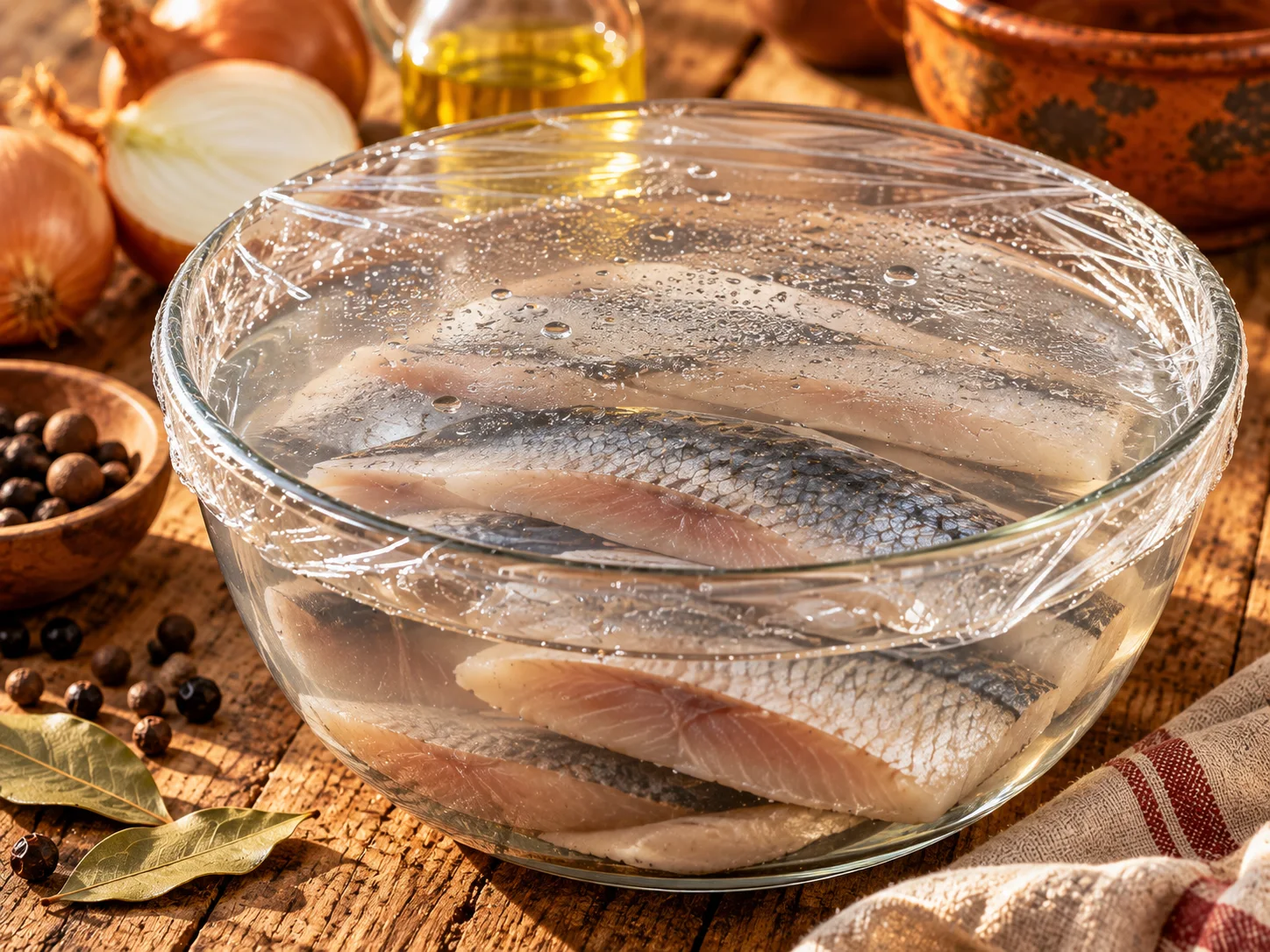
- Soak salted herring fillets in cold water for 12 to 24 hours, changing the water, until they taste pleasantly salty
- Drain, pat dry, and cut each fillet into 4 or 5 pieces
- Slice the onions into thin rings
- Layer herring, onion, bay leaf, allspice, and peppercorns in a glass jar
- Pour rapeseed oil over the top until everything is submerged
- Refrigerate for 2 to 3 days, then serve cold with sourdough bread or boiled potatoes
What Śledzie w Oleju Is
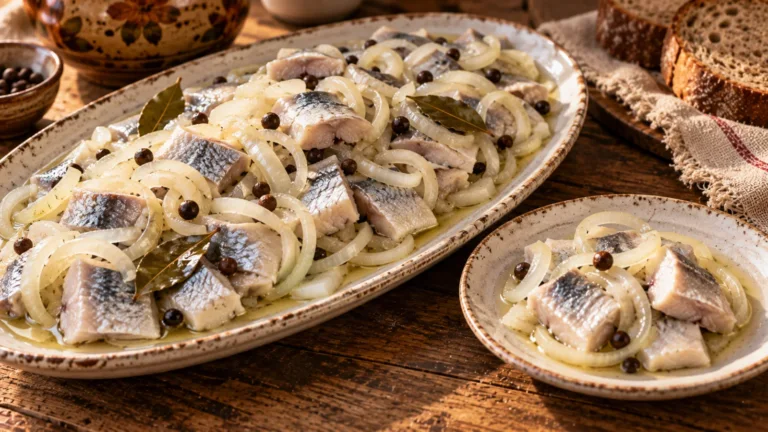
Śledzie w oleju, “herring in oil,” is salted herring cut into pieces, layered in a jar with sliced onion, bay leaf, and allspice, covered with oil, and left in the refrigerator for a couple of days (śledź is the Polish word for herring). It’s served cold, usually as an appetizer, with sourdough bread or boiled potatoes.³
It is one of the fish dishes of Wigilia, the Polish Christmas Eve supper, which traditionally includes twelve dishes and no meat.¹ Herring is eaten in Poland all year, and on Christmas Eve the most common preparations are soused fillets in oil and fillets dressed with cream, sour apples, and chopped onions.¹
The jar is made days ahead, so on Christmas Eve itself there is nothing to cook: it comes out of the refrigerator and goes on the table.
History and Cultural Roots
Herring has been eaten in Poland for a very long time. Culture.pl notes that the 12th-century chronicler known as Gallus Anonymus already mentions it, and that better transport in the 13th and 14th centuries made it easier to bring the fish inland.² The catch was salted straight away. Herring schools were easy and cheap to fish, so even Kraków, some 600 km from the Baltic shore, could afford it: almost everyone there could buy herring, and it stayed within reach in times of famine.²
Distance still shaped how it was eaten. For centuries, saltwater fish were eaten only in limited amounts in central and southern Poland because they were hard to transport and store, and herring traveled inland matured in barrels of brine.³ Fish that hard and that salty needed a great deal of preparation, including soaking, rinsing, and tenderizing.³ That is the reason for the long soak at the start of this recipe. Polish cooks once had their own tricks for drawing out the salt, soaking herring in milk, buttermilk, water, beer, or even wine.²
Cheap and easy to keep, salted or smoked herring became an iconic food of Catholic fast days.³ In homes of every social class it was on the menu during the long, strict fasts when meat, vegetable fats, and dairy products were all banned.² During Lent, the less affluent ate herring and żur, the sour rye soup, every day, which is why an old Polish custom gives herring a ritual funeral at the end of the fast.²
Herring fits the Wigilia table, where meat is not allowed.¹ For many families it was also a matter of necessity. Culture.pl’s article on Polish fish cookery says that in the past it was the only fish poor households had for Christmas Eve, and that before the Second World War newspaper columnists wrote about meatless Christmas Eve dishes for readers who ate no meat all year round because of poverty.⁴
Traditional Śledzie w Oleju Recipe
This recipe was compiled by Heritage Healthy Kitchen from a comparison of published recipes; the sources are listed at the end of this article. Figures that are Heritage Healthy Kitchen’s own estimates rather than taken from a published source are marked as such.
Ingredients (Serves 6, as one dish among several)
- 500g (about 1.1 lb) salted herring fillets, about 5 fillets
- 250g (about 9 oz) onions, about 2 medium, cut into thin rings
- 250ml (about 1 cup) rapeseed (canola) oil, enough to cover the fish
- 4 bay leaves
- 6 allspice berries
- 6 whole black peppercorns
- Sourdough bread or boiled potatoes, to serve
Instructions
- Soak the herring. Put the fillets in a large bowl and cover them with cold water. Refrigerate for 12 to 24 hours, changing the water two or three times. Taste a small piece at the end: it should taste pleasantly salty, not sharp.⁵ If it is still too salty, soak for a few more hours in fresh water.
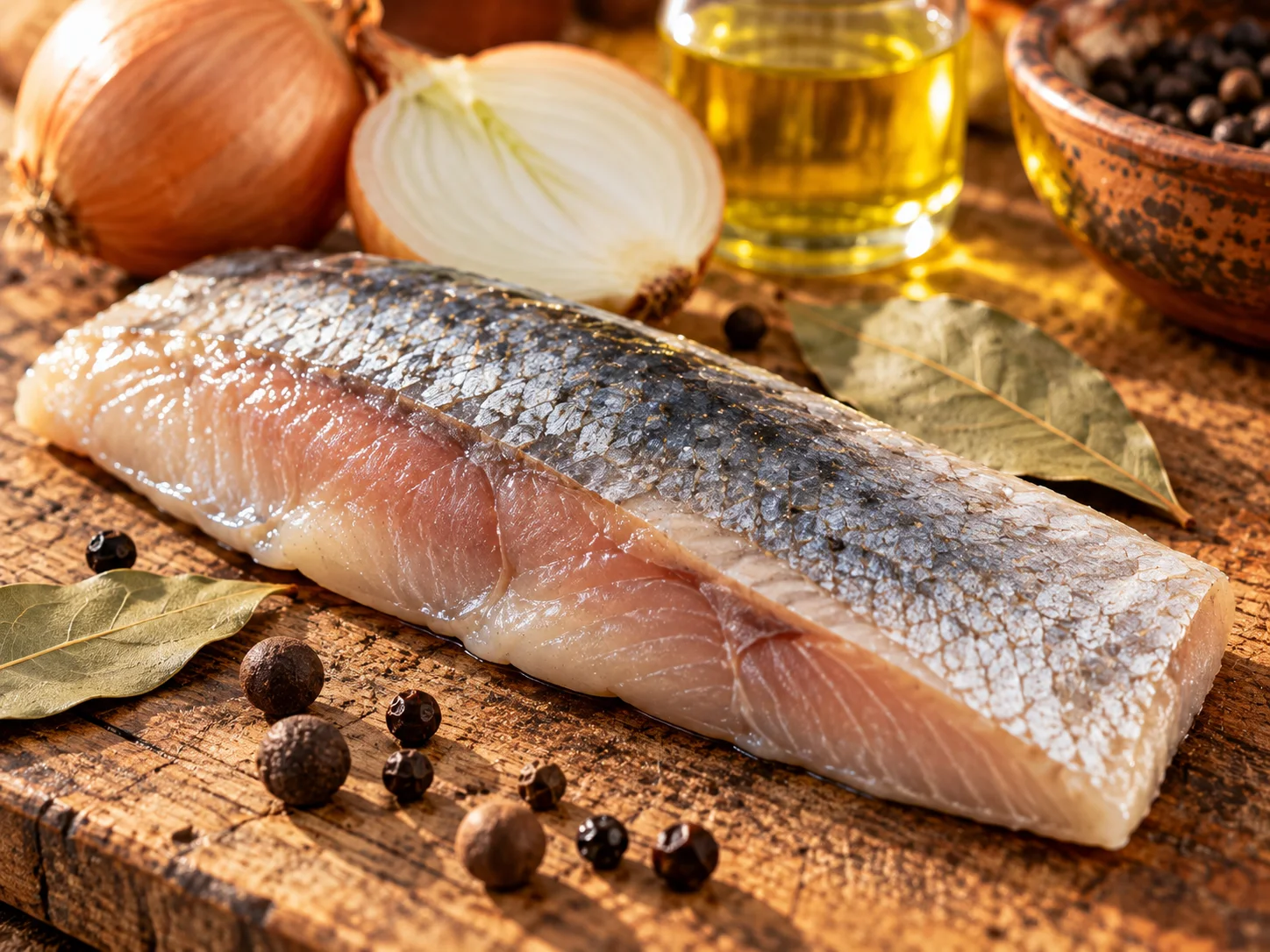
- Drain and cut. Pat the fillets dry with paper towels. Run a fingertip along each one and pull out any bones you find. Cut each fillet into 4 or 5 pieces.³
- Slice the onions. Peel the onions and cut them into thin rings.
- Layer the jar. In a clean glass jar, alternate layers of herring and onion, scattering the bay leaves, allspice berries, and peppercorns between the layers.³
- Add the oil. Pour the oil over the herring and onion until everything is submerged. Press the pieces down gently and tap the jar on the counter to release trapped air. Seal the jar.
- Marinate. Refrigerate for a couple of days.³ A third day rounds out the flavor further, as the onion softens and the fish takes on the bay and allspice.
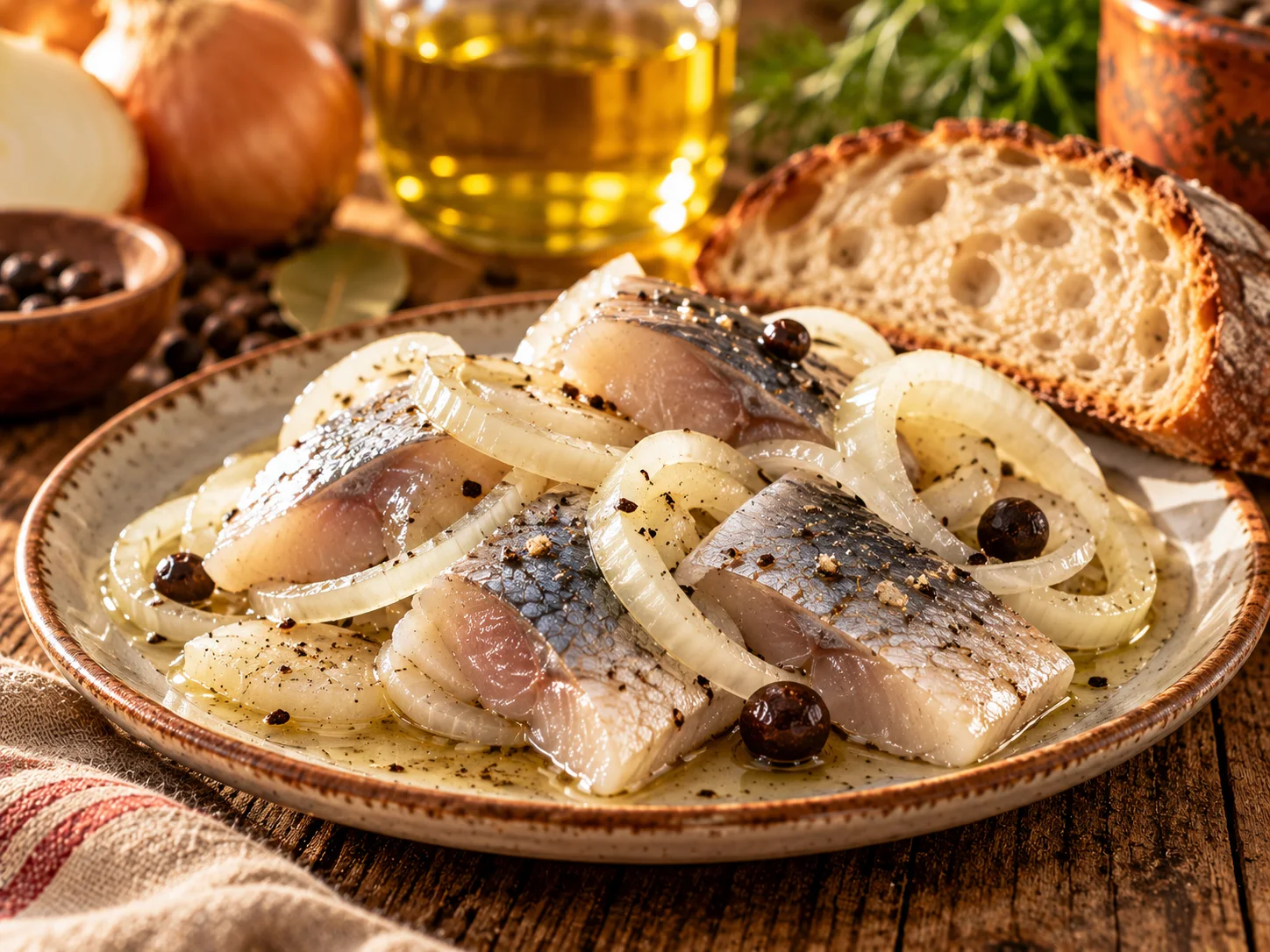
- Serve. Lift the herring and some of the onion out of the jar with a slotted spoon, arrange on a plate, and serve cold with sourdough bread or boiled potatoes.³ Leave the rest in the jar, still under the oil.
Kitchen Tips
The soak decides the dish. Taste a piece straight from the water before you cut anything, because nothing that happens later in the jar removes salt. A fillet that’s still sharp at that point will stay sharp after three days in oil. Salted fillets vary from one brand to the next, so go by taste and not by the clock.
Keep every piece under the oil. Fish left sticking out of the surface dries at the edges and loses the soft, silky texture the marinade is meant to give it. If the level drops after a day, top it up.
Oil is a large part of what you taste, so use a fresh bottle. Culture.pl’s recipe calls for linseed or rapeseed oil,³ and this one uses a mild rapeseed oil, which lets the herring, onion, and allspice come through.
Check the bones. Fillets sold as boneless can still carry a few fine ones, and a fingertip run along the flesh takes only a minute.
Make the jar three or four days before the supper. It’s ready when the rest of the table is still being prepared, whereas a jar made that same morning has a harsher onion, and the fish hasn’t settled into the oil.
Nutritional Information
Per Serving (1 of 6 Servings, about 83 g of Herring)
- Calories: approximately 210–350 kcal
- Protein: approximately 13.9–17.0 g
- Total fat: approximately 15.4–29.4 g
- Saturated fat: approximately 2.2–3.4 g
- Carbohydrates: approximately 3.5–4.3 g
- Sugars: approximately 1.6–1.9 g
- Fiber: approximately 0.6–0.8 g
- Sodium: approximately 69–799 mg
- EPA and DHA (omega-3 fatty acids from the fish): approximately 1.18–1.44 g
Values are estimates calculated ingredient by ingredient from USDA FoodData Central reference data and cross-checked against the Atwater energy formula, which agreed with the summed figures to within 1 percent.¹⁰ Bread, potatoes, and other accompaniments are not included.
The widest range comes from the oil. The figures assume that between a quarter and a half of the oil in the jar ends up on the plate, since the pieces are lifted out with a slotted spoon. At the low end the oil supplies about a third of a serving’s calories, and at the high end a little over half. The rest comes almost entirely from the fish, which was modeled with the USDA values for raw Atlantic herring after soaking.¹⁰
The sodium range is wide for a different reason: soaking decides it. The low end treats the herring as fully desalted, in line with USDA’s value for raw herring. The high end uses USDA’s value for pickled herring, 870 mg per 100 g, as the reference for a fish that is still noticeably brined.¹⁰ Real values depend on how long the fish was soaked. The American Heart Association recommends no more than 2,300 mg of sodium a day, with an optimal goal of no more than 1,500 mg for most adults,⁹ so a serving in this range falls between roughly 3 and 35 percent of the higher figure.
On the other side of the ledger, herring is an oily fish. Cleveland Clinic’s guide to the healthiest fish calls it loaded with omega-3s and rich in vitamin B12 and vitamin D.⁷ Harvard’s Nutrition Source cites an analysis of 20 studies covering hundreds of thousands of participants, which linked eating about one to two 3-ounce servings of fatty fish a week, herring among them, to a 36 percent lower risk of dying from heart disease.⁸ A serving of this dish holds about 83 g of fish, close to that 3-ounce (85 g) measure.
Storage and Reheating
Keep the herring in its oil in a tightly sealed glass jar in the refrigerator. The Polish site Rodzice.pl puts the shelf life of homemade herring in oil at about two weeks, while noting that published guidance varies, so two weeks is best treated as a cautious limit and not a guarantee. Once a jar has been opened, it advises eating the contents within two days.⁶
Herring in cream keeps far less time, only a few days.⁶ Freezing herring in oil is not recommended either, because the thawed fish turns mushy.⁶
There’s no reheating. Śledzie w oleju is eaten cold, straight from the refrigerator.
Traditional Śledzie w Oleju

Ingredients
Ingredients (Serves 6, as one dish among several)
- 500g (about 1.1 lb) salted herring fillets, about 5 fillets
- 250g (about 9 oz) onions, about 2 medium, cut into thin rings
- 250ml (about 1 cup) rapeseed (canola) oil, enough to cover the fish
- 4 bay leaves
- 6 allspice berries
- 6 whole black peppercorns
- Sourdough bread or boiled potatoes, to serve
Instructions
- Soak the herring. Put the fillets in a large bowl and cover them with cold water. Refrigerate for 12 to 24 hours, changing the water two or three times. Taste a small piece at the end: it should taste pleasantly salty, not sharp.⁵ If it is still too salty, soak for a few more hours in fresh water.
- Drain and cut. Pat the fillets dry with paper towels. Run a fingertip along each one and pull out any bones you find. Cut each fillet into 4 or 5 pieces.³
- Slice the onions. Peel the onions and cut them into thin rings.
- Layer the jar. In a clean glass jar, alternate layers of herring and onion, scattering the bay leaves, allspice berries, and peppercorns between the layers.³
- Add the oil. Pour the oil over the herring and onion until everything is submerged. Press the pieces down gently and tap the jar on the counter to release trapped air. Seal the jar.
- Marinate. Refrigerate for a couple of days.³ A third day rounds out the flavor further, as the onion softens and the fish takes on the bay and allspice.
- Serve. Lift the herring and some of the onion out of the jar with a slotted spoon, arrange on a plate, and serve cold with sourdough bread or boiled potatoes.³ Leave the rest in the jar, still under the oil.
Frequently Asked Questions
Can this be made with cream instead of oil?
Yes. Cream is the other classic dressing, usually paired with sour apples and chopped onions.¹ Some households add nuts, raisins, or plums.² A cream version keeps only a few days, so it is better made closer to serving.⁶
Which herring is best for this dish?
Culture.pl describes the classic as soused fillets, usually sold as matjas.¹ The Polonist explains that matjes is a young, immature herring, plumper, richer in fat, and milder than ordinary herring, and warns that fillets labeled “à la matjas” are just regular herring.⁵ Salted fillets need the full soak described above, and milder ones need less, so taste before you cut. Outside Poland, the same source suggests Dutch, Polish, Scandinavian, or German groceries, among others.⁵
Can the herring be soaked in milk instead of water?
Yes. The Polonist’s instructions allow either cold water or milk, left overnight in the refrigerator, until the fish no longer tastes overly salty.⁵ Polish cooks once also used buttermilk, beer, or even wine.² Whatever the liquid, taste a piece before cutting.
What is a śledzik?
Śledzik, “little herring,” is also the name of a party. One falls on Mardi Gras, and in some parts of Poland friends now hold informal gatherings called śledziki before Christmas, a custom Culture.pl describes as recently invented.³
What goes with herring in oil?
Culture.pl’s recipe serves it with sourdough bread or boiled potatoes,³ its twelve-dishes guide mentions a root-vegetable salad or potatoes,¹ and the Polonist adds dark rye bread, dill pickles, and boiled eggs.⁵
Further Reading & Sources
The recipe is a compilation based on the published recipes listed here; these links are provided for readers who want to explore further.
- Kasprzyk-Chevriaux, Magdalena. “The 12 Dishes of Polish Christmas.” Culture.pl (December 2013, updated December 2022).
- Kasprzyk-Chevriaux, Magdalena. “Polish Food 101 – Herring.” Culture.pl (12 January 2015).
- “Herring – Or ‘Śledź’: And a Recipe to Perfectly Create This Traditional Staple.” Culture.pl (6 December 2022, updated 20 December 2023).
- “Not Just Carp & Herring: Traditional Polish Recipes for Fish.” Culture.pl (1 December 2016, updated 13 December 2022).
- Polonist Test Kitchen. “Pickled Herring (in Vinegar).” The Polonist (7 September 2019, updated 18 July 2023).
- Olechniewicz, Katarzyna. “Ile mogą stać śledzie w śmietanie i w oleju? Sprawdzone sposoby przechowywania.” Rodzice.pl (23 December 2025; in Polish).
- Zumpano, Julia, RD, LD. “Best Catch: The Healthiest Fish To Eat.” Cleveland Clinic Health Essentials.
- “Fish: Friend or Foe?” The Nutrition Source, Harvard T.H. Chan School of Public Health.
- “How Much Sodium Should I Eat Per Day?” American Heart Association.
- U.S. Department of Agriculture. FoodData Central: “Fish, herring, Atlantic, raw” (FDC ID 175116); “Fish, herring, Atlantic, pickled” (FDC ID 175118); “Onions, raw” (FDC ID 170000); “Oil, canola” (FDC ID 172336).
Disclaimer
The information in this article is provided for educational and informational purposes only. Heritage Healthy Kitchen makes no representations or warranties regarding the accuracy or completeness of any content on this site. Nutritional values are estimates only and will vary depending on the specific ingredients, brands, and measurements used. This content is not intended as dietary, medical, or professional nutritional advice. Always consult a qualified healthcare provider regarding any dietary needs or health conditions. Heritage Healthy Kitchen is not responsible for any outcomes resulting from the use of recipes or information published on this site.
Cook by Occasion
This recipe is part of our Wigilia menu.
You Might Also Like
More heritage recipes from our kitchen


Leave a Reply